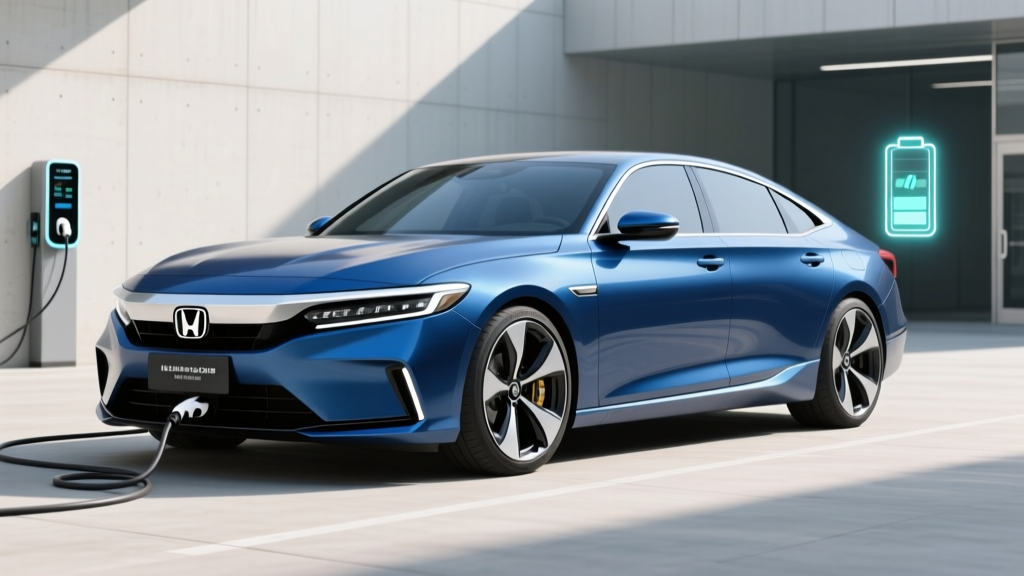
The Honda Accord has been a midsize sedan benchmark for decades, and searches around the 06 Honda Accord bolt pattern remain surprisingly common among owners maintaining, modifying, or cross-shopping older Accords against today's electrified alternatives. This guide covers the bolt pattern specifics for the 2006 Accord, how those specs carry into the current generation, and what Honda's 2026 electrified lineup actually looks like for sedan buyers weighing EV, hybrid, and gas options.
06 Honda Accord Bolt Pattern: The Exact Specs
The 2006 Honda Accord (7th generation, 2003–2007) uses a 5×114.3 mm bolt pattern (also expressed as 5×4.5 inches). This is one of the most common bolt patterns in the automotive world, shared with many Honda, Acura, Toyota, Nissan, and Hyundai models across multiple generations.
| Specification | 2006 Honda Accord |
|---|---|
| Bolt Pattern | 5×114.3 mm (5×4.5") |
| Center Bore | 64.1 mm |
| Thread Size | M12 × 1.5 |
| Wheel Fastener | Lug nuts (not bolts) |
| Typical OEM Wheel Size | 15"–17" depending on trim |
| Recommended Torque | 80 lb-ft (108 Nm) |
This bolt pattern has remained consistent on the Accord through subsequent generations, including the current 2026 model year. If you're swapping wheels from a 2006 Accord onto a newer Honda or cross-referencing fitment for winter tire sets, the 5×114.3 pattern and 64.1 mm center bore are your critical reference points. Hub-centric rings may be needed if mounting aftermarket wheels with a larger center bore.
Why Bolt Pattern Searches Matter for EV Shoppers
It might seem odd to connect a 2006 Accord bolt pattern query to electric vehicles, but there's a practical thread. Many current EV owners are upgrading from long-running ICE sedans like the Accord and want to know whether existing wheel/tire investments carry over. Additionally, EV-specific wheels — designed for lower rolling resistance and higher load ratings to handle battery weight — are becoming a significant aftermarket category.
The 2026 Honda Accord Hybrid, for instance, uses the same 5×114.3 bolt pattern but comes with wheels optimized for its electrified powertrain. Honda's e:HEV hybrid system pairs a 2.0L Atkinson-cycle engine with dual electric motors producing a combined 204 horsepower. The Accord Hybrid achieves an EPA-estimated 51 city / 44 highway / 48 combined MPG, making it one of the most efficient midsize sedans available without plugging in.
2026 Honda Accord Hybrid: Electrified Sedan Specs
Honda does not currently offer a fully electric Accord for the U.S. market as of the 2026 model year. The Accord lineup consists of a 1.5L turbocharged gas model and the hybrid variant described above. However, Honda has committed to its e:HEV hybrid technology across the Accord and CR-V lines, and the company's Honda 0 Series EV platform (announced for future models) may eventually underpin an electric Accord successor.
| Spec | 2026 Accord Hybrid (Sport Touring) | 2026 Accord Gas (LX) |
|---|---|---|
| Powertrain | 2.0L + dual electric motors (e:HEV) | 1.5L Turbo I-4 |
| Horsepower | 204 hp combined | 192 hp |
| 0–60 mph | ~6.5 seconds | ~7.2 seconds |
| EPA MPG (city/hwy/combined) | 51 / 44 / 48 | 29 / 37 / 32 |
| Drivetrain | FWD | FWD |
| Bolt Pattern | 5×114.3 mm | 5×114.3 mm |
| Base MSRP | ~$33,990 | ~$28,990 |
| Cargo Volume | 16.7 cu ft | 16.7 cu ft |
| Rear Legroom | 40.3 inches | 40.3 inches |
| Federal Tax Credit (§30D) | Not eligible (HEV, not PHEV/BEV) | Not eligible |
Source: fueleconomy.gov and Honda's official specifications.
The EV Sedan Alternatives: What Competes With the Accord?
If you're researching the Accord but considering a full battery-electric vehicle (BEV) instead, the 2026 market offers several sedans that directly challenge the Accord on space, comfort, and efficiency — with the added benefit of federal tax credit eligibility under IRS §30D rules.
| Model | EPA Range | Battery | 0–60 mph | Base MSRP | §30D Credit |
|---|---|---|---|---|---|
| 2026 Tesla Model 3 LR | 341 mi | 75 kWh (NMC) | 4.2 sec | $42,490 | Up to $7,500 (eligibility varies) |
| 2026 Hyundai Ioniq 6 SE LR | 361 mi | 77.4 kWh (NMC) | 5.1 sec | $39,950 | Up to $7,500 (eligibility varies) |
| 2026 BMW i4 eDrive40 | 307 mi | 83.9 kWh (NMC) | 5.5 sec | $57,900 | Not eligible (MSRP over $55k cap for sedans) |
| 2026 Honda Accord Hybrid | ~550 mi (gas range) | 1.3 kWh (HEV battery) | 6.5 sec | $28,990 | Not eligible |
Charging Speed Comparison: EV Sedans vs. Hybrid Refueling
One of the most significant ownership differences between a BEV and the Accord Hybrid is the "refueling" experience. The Accord Hybrid refuels in 3 minutes at any gas station. EVs require planning, but DC fast-charging technology has narrowed that gap substantially for road trips.
| Charging Method | Tesla Model 3 LR | Hyundai Ioniq 6 SE | Accord Hybrid |
|---|---|---|---|
| Max DC Fast Charge | 250 kW (peak) | 250 kW (peak) | N/A (gas only) |
| 10–80% DC Time | ~25 minutes | ~18 minutes | |
| Level 2 Home (240V) | 11.5 kW (~37 mi/hr) | 10.9 kW (~35 mi/hr) | N/A |
| Level 1 (120V) | ~1.4 kW (~4 mi/hr) | ~1.4 kW (~4 mi/hr) | N/A |
| "Full Tank" Time | Overnight (home L2) | Overnight (home L2) | ~3 minutes (gas) |
Charging curve reality: Both the Model 3 and Ioniq 6 peak at 250 kW only at low states of charge (typically 10–30% SoC). Above 50%, the charge rate tapers significantly — often dropping below 100 kW by 70% SoC and below 50 kW past 85%. This is why manufacturers quote 10–80% times rather than 0–100%. Charging past 80% on a DC fast charger is rarely time-efficient and is best reserved for overnight Level 2 sessions.
The Ioniq 6's faster 10–80% time (18 minutes vs. 25) is attributable to its 800V electrical architecture, which allows higher sustained charge rates across a wider portion of the battery's state of charge. The Model 3 uses a 400V architecture. For road-trippers who fast-charge frequently, this difference adds up — roughly 7 fewer minutes per stop on the Ioniq 6.
Federal Tax Credit: Who Qualifies in 2026?
The standard Honda Accord (gas or hybrid) does not qualify for the federal §30D EV tax credit because it is not a plug-in electric vehicle. The hybrid system is a conventional HEV — it recovers energy through regenerative braking but cannot be plugged in.
For BEV competitors like the Model 3 and Ioniq 6, the §30D credit offers up to $7,500, but eligibility depends on multiple factors that change periodically:
- MSRP Cap: Sedans must be priced at or below $55,000 (vans, SUVs, and trucks have a $80,000 cap)
- Buyer Income Cap: Modified AGI must not exceed $150,000 (single), $225,000 (head of household), or $300,000 (joint)
- Battery Sourcing: Critical minerals and battery components must meet escalating percentage thresholds from approved sources (U.S. or free-trade-agreement partners)
- Point-of-Sale Transfer: As of 2024+, eligible buyers can transfer the credit to the dealer at purchase, reducing the upfront price rather than waiting for a tax refund
- Final Assembly: Vehicle must undergo final assembly in North America
Practical example: A 2026 Tesla Model 3 Long Range at $42,490 MSRP, purchased by a joint-filing couple with $180,000 MAGI, may qualify for the full $7,500 — bringing the effective price to ~$34,990. However, battery-sourcing rules tighten annually, and specific trim/battery-pack eligibility can shift mid-year. Always verify current eligibility on IRS.gov before purchasing.
Who Should Buy What: Decision Framework
Choose the Honda Accord Hybrid if:
- You lack reliable home charging access (apartment, street parking, no garage)
- You drive 30,000+ miles/year and want minimal refueling cost without range planning
- You want proven long-term reliability with minimal drivetrain complexity
- Your budget is under $35,000 and you don't want to depend on tax-credit eligibility
Choose a BEV sedan (Model 3, Ioniq 6) if:
- You have Level 2 home charging (or can install it — budget $500–$2,000 for a 240V/48A circuit)
- Your daily commute is under 200 miles round-trip (covers >95% of U.S. commutes)
- You qualify for the §30D credit, making the effective price competitive with the Accord
- You value instant torque, one-pedal driving, and lower per-mile "fuel" costs (~$0.04–$0.06/mi on home electricity vs. ~$0.10–$0.14/mi for the Accord Hybrid at 48 MPG and $3.50/gal gas)
Pros and Cons at a Glance
2026 Honda Accord Hybrid — Pros
- 48 MPG combined — outstanding for a midsize sedan with no plug-in requirement
- Spacious cabin: 40.3" rear legroom, 16.7 cu ft trunk
- Proven e:HEV system with 8-year/100,000-mile hybrid component warranty
- Same 5×114.3 bolt pattern across generations — easy wheel/tire sourcing
- No range anxiety, no charging infrastructure dependence
2026 Honda Accord Hybrid — Cons
- Not eligible for any federal EV tax credit
- No all-wheel-drive option (competitors like the Model 3 offer AWD)
- CVT-like driving feel under hard acceleration (e:HEV uses an e-CVT)
- Infotainment lags behind Tesla and Hyundai in responsiveness and OTA updates
- Not a plug-in — cannot drive on electric-only power beyond ~1 mile at low speeds
Frequently Asked Questions
What is the bolt pattern on a 2006 Honda Accord?
The 2006 Honda Accord uses a 5×114.3 mm (5×4.5 inch) bolt pattern with a 64.1 mm center bore and M12×1.5 lug nuts. This pattern is shared across most Honda and Acura sedans from the 1990s through 2026, making wheel swaps and aftermarket options widely available.
Is there an all-electric Honda Accord for 2026?
No. Honda does not offer a fully electric Accord in the U.S. for the 2026 model year. The Accord is available as a 1.5L turbo gas model or a 2.0L e:HEV hybrid. Honda's future EV sedan plans are tied to the Honda 0 Series platform, but no electric Accord has been confirmed for production as of early 2026.
Does the Honda Accord Hybrid qualify for the federal EV tax credit?
No. The Accord Hybrid is a conventional hybrid (HEV), not a plug-in hybrid (PHEV) or battery-electric vehicle (BEV). The IRS §30D credit applies only to plug-in vehicles with a battery capacity of at least 7 kWh that can be recharged from an external power source. The Accord Hybrid's ~1.3 kWh battery is charged solely by the engine and regenerative braking.
Can I use 2006 Accord wheels on a 2026 Accord Hybrid?
The bolt pattern (5×114.3 mm) and center bore (64.1 mm) are the same. However, you must verify that older wheels clear the current-generation brake calipers and that the wheel width/offset are compatible with the 2026 Accord's suspension geometry. The 2026 Accord Hybrid Sport Touring rides on 19" wheels; older 15" or 16" wheels from the 2006 model may not clear larger modern brake components.
What's the best EV sedan alternative to the Honda Accord?
The 2026 Hyundai Ioniq 6 SE Long Range offers the closest match to the Accord's blend of interior space, efficiency, and value. With 361 miles of EPA range, a 10–80% DC fast-charge time of ~18 minutes, and potential §30D credit eligibility, its effective price can approach the Accord Hybrid's MSRP. The Tesla Model 3 Long Range is another strong alternative with Supercharger network access and 341 miles of range.
What is the warranty on the 2026 Honda Accord Hybrid battery?
Honda covers the Accord Hybrid's lithium-ion battery pack and hybrid system components for 8 years or 100,000 miles (whichever comes first). In states that follow California Air Resources Board (CARB) standards — including California, New York, Massachusetts, and others — the hybrid battery warranty extends to 10 years or 150,000 miles.
Always verify current tax-credit eligibility at IRS.gov, confirm EPA figures at fueleconomy.gov, and check NHTSA.gov for the latest safety ratings before purchasing. Specifications and incentive rules are subject to change.