The Quick Answer: How Can I Charge My Electric Car at Home?
You have two practical options for home EV charging:
- Level 1 (120V): Plug into any standard household outlet using the cord that came with your EV. Adds 3–5 miles of range per hour. No installation needed, but a full charge can take 40–50+ hours on a large battery.
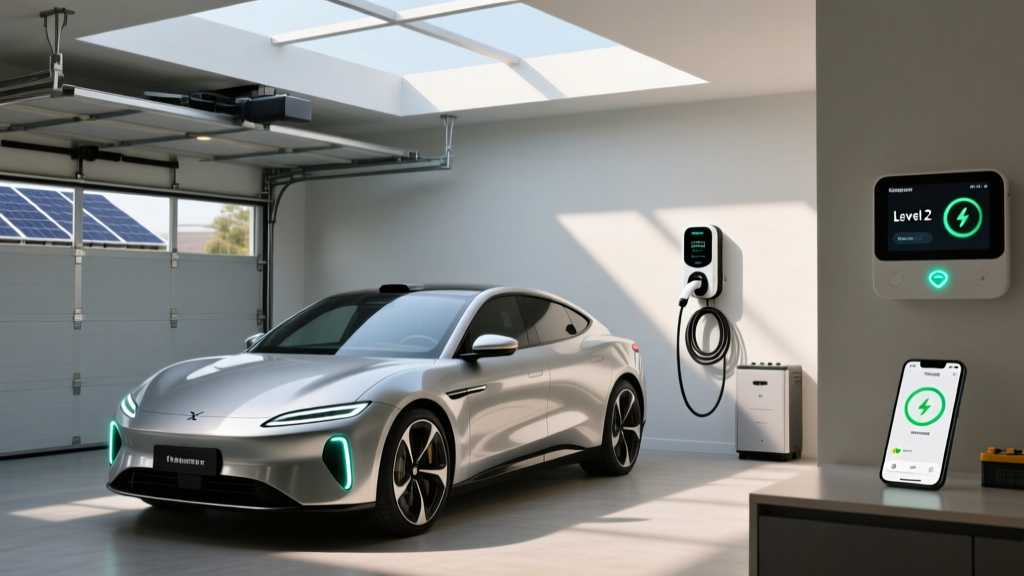
- Level 2 (240V): Install a dedicated 240-volt circuit (like a dryer outlet) with a wall-mounted or plug-in charger. Adds 25–44 miles of range per hour. A full overnight charge for most EVs. Equipment costs $200–$700; professional installation runs $500–$2,000+.
For daily driving under 50 miles, Level 1 may suffice. For anything beyond that — or if you want the flexibility to charge quickly after road trips or cold-weather commutes — Level 2 is the standard most EV owners choose.
Over 80% of EV charging happens at home, according to the U.S. Department of Energy. That single fact is what makes EV ownership fundamentally different from gas cars: instead of weekly trips to a fuel station, you start each morning with a full or near-full "tank." But getting that home setup right — and understanding the real costs — requires sorting through electrical specs, connector types, and installation variables that most dealerships won't explain.
Level 1 vs. Level 2: Charging Speeds and What They Mean in Practice
Before comparing costs, you need to understand what each level actually delivers. The critical distinction here is kW (kilowatts), which measures charging power — the rate at which energy flows into your battery — versus kWh (kilowatt-hours), which measures the total energy capacity of your battery. Think of kW as the width of the pipe and kWh as the size of the tank.
| Level | Voltage | Power (kW) | Miles of Range/Hour | Full Charge Time (80 kWh Battery) | Best For |
|---|---|---|---|---|---|
| Level 1 | 120V (standard outlet) | 1.0–1.4 kW | 3–5 miles | 55–80 hours | Low daily mileage, overnight top-ups, PHEVs |
| Level 2 | 240V (dryer-style circuit) | 3.3–19.2 kW | 12–44+ miles | 4–10 hours | Daily drivers, larger BEV batteries, cold climates |
A few real-world nuances matter here:
- Most Level 2 home chargers run at 7.2–11.5 kW. A 48-amp hardwired unit on a 60-amp circuit delivers 11.5 kW. A 32-amp plug-in unit (NEMA 14-50 outlet) delivers 7.7 kW. Both will fully charge a typical 75–85 kWh battery overnight.
- Your EV's onboard charger caps your Level 2 speed. Even if your home charger can push 19.2 kW, a Tesla Model Y accepts a max of 11.5 kW on AC, and a Hyundai Ioniq 5 accepts 10.9 kW. The vehicle, not the charger, sets the ceiling for Level 2.
- Plug-in hybrid (PHEV) owners often don't need Level 2. A Toyota RAV4 Prime has an 18.1 kWh battery and accepts only 3.3 kW on Level 2. Level 1 fully charges it in about 5.5 hours — plenty for overnight.
Home Charger Installation: Real Costs and Electrical Requirements
This is where most first-time EV buyers get surprised. The charger hardware itself is relatively inexpensive. The electrical work — running a new 240V circuit from your panel to your garage or driveway — is where costs vary wildly.
| Cost Component | Low End | Typical | High End | Notes |
|---|---|---|---|---|
| Level 2 charger hardware (EVSE) | $200 | $400 | $700 | Emporia, ChargePoint, Wallbox, Tesla Wall Connector |
| Electrician labor (240V circuit run) | $300 | $800 | $1,500 | Depends on distance from panel, wall/floor penetration |
| Electrical panel upgrade (if needed) | $1,500 | $2,500 | $4,000+ | Required if your panel is maxed out at 100A; upgrade to 200A |
| Permit and inspection | $50 | $150 | $400 | Varies by municipality; some jurisdictions waive for EV installs |
| Total (no panel upgrade) | $550 | $1,350 | $2,600 | |
| Total (with panel upgrade) | $2,050 | $3,850 | $6,600+ |
Key variables that drive cost:
- Distance from panel to charger location. A garage right next to your electrical panel may only need 15 feet of wire. A detached garage or driveway-side mount could need 80+ feet of conduit and trenching.
- Panel capacity. A Level 2 charger on a 60-amp circuit draws a continuous 48 amps. If your home has a 100-amp panel already near capacity, you'll need a service upgrade to 200 amps — the single biggest cost driver.
- Hardwired vs. plug-in (NEMA 14-50). Hardwired chargers avoid the need for a GFCI breaker (required by NEC 2020+ for 14-50 receptacles in garages), saving $100–$200 on the breaker alone. Hardwired also allows higher amperage (48A vs. 40A max on a 14-50).
- Smart charger features. WiFi-connected chargers (Emporia Level 2, ChargePoint Home Flex) offer scheduling, energy tracking, and utility integration — worth the $100–$200 premium over basic units if your utility offers time-of-use rates.
Always get a final specification from a licensed electrician before purchasing equipment. They'll perform a load calculation on your panel and confirm whether your existing service can handle the additional draw. Some utilities offer rebates of $250–$1,000 for Level 2 installations — check with your local provider before scheduling work.
Connector Types: NACS, CCS, and What You Actually Need
As of 2026, the North American EV charging landscape has consolidated significantly around the North American Charging Standard (NACS), originally developed by Tesla. Here's where things stand:
| Connector | Brands Using It (2026 Models) | Home Charger Availability |
|---|---|---|
| NACS (Tesla-style) | Tesla, Ford, GM, Rivian, Volvo, Polestar, Fisker, Mercedes (new models) | Tesla Wall Connector, Emporia, Lectron, and others now offer NACS |
| CCS1 | Hyundai, Kia, BMW, Volkswagen (remaining models), legacy EVs | ChargePoint, Emporia, JuiceBox, and most universal chargers |
| CHAdeMO | Nissan Leaf (discontinued; legacy owners only) | Limited; most new home chargers don't include CHAdeMO |
For home Level 2 charging, the connector matters less than you'd think. Most Level 2 home chargers come with a J1772 plug (the AC standard), and Tesla includes a J1772 adapter with every vehicle. If you buy a non-Tesla EV with NACS, adapters are available. If you're a two-EV household with mixed connectors, universal chargers with swap-able cables exist.
For DC fast charging on road trips, connector type is critical — but that's a public-charging concern, not a home one.
The Real Economics: Home Charging Cost vs. Gas and Public Charging
Home charging is where EVs deliver their strongest financial advantage. Here's a concrete comparison using national averages.
| Fueling Method | Cost per kWh/Gallon | Cost per 1,000 Miles | Annual Cost (12,000 mi) |
|---|---|---|---|
| Home Level 2 (national avg. electricity: $0.17/kWh) | $0.17/kWh | $51–$68 | $612–$816 |
| Public DC fast charging (avg. $0.35–$0.50/kWh) | $0.35–$0.50/kWh | $105–$170 | $1,260–$2,040 |
| Gas car (25 MPG combined, $3.30/gallon) | $3.30/gallon | $132 | $1,584 |
| Hybrid (50 MPG combined, $3.30/gallon) | $3.30/gallon | $66 | $792 |
Based on an average EV efficiency of 3–4 miles per kWh (the EPA rates the 2026 Tesla Model Y at 3.5 mi/kWh and the Hyundai Ioniq 6 at 4.1 mi/kWh, per fueleconomy.gov):
- Home charging saves $750–$950/year vs. a gas car at 25 MPG.
- Home charging is competitive with a 50-MPG hybrid — and beats it in states with cheaper electricity (Washington, Louisiana, Idaho average under $0.12/kWh).
- Public DC fast charging is more expensive than gas in many markets. This is why home access is the single biggest predictor of EV satisfaction.
If your utility offers time-of-use (TOU) rates, charging overnight at off-peak rates ($0.06–$0.10/kWh in many regions) can drop your annual fuel cost to $250–$400 — roughly one-quarter of what a gas car costs.
Myths About Home EV Charging, Corrected With Data
| Myth | Fact |
|---|---|
| "I need a 200-amp panel upgrade to charge at home." | Most homes with a 100A or 150A panel can add a Level 2 charger without upgrading — especially a 32-amp unit (7.7 kW) that draws only ~38 continuous amps. A licensed electrician's load calculation will confirm. |
| "Home charging will spike my electric bill." | Driving 12,000 miles/year in an average EV adds ~3,400 kWh to your annual usage. At $0.17/kWh, that's ~$578/year — or ~$48/month. Compare that to $132/month in gas at 25 MPG. |
| "Level 1 is too slow to be useful." | If you drive under 40 miles/day and park for 10+ hours overnight, Level 1 adds 30–50 miles of range while you sleep. That covers most daily commutes. It's also the default for PHEVs with smaller batteries. |
| "Charging to 100% every night destroys the battery." | For NMC batteries (most long-range EVs), daily charging to 80% is recommended to slow degradation. For LFP batteries (Tesla Model 3 RWD, some base trims), manufacturers recommend charging to 100% regularly. Set your charge limit in the vehicle's app and let it manage itself. |
| "I can't charge at home if I live in an apartment or park on the street." | This is a real limitation. Without home or workplace charging, EV ownership relies entirely on public infrastructure. If you lack reliable Level 2 access within 5 minutes of home, a PHEV or hybrid may be the more practical choice today. |
Real-World Ownership Considerations Most Guides Skip
Cold-weather charging. Lithium-ion batteries charge slower when cold. If you park in an unheated garage in Minnesota, your EV's battery management system will limit charge rate until the pack warms up. A Level 2 charger's battery preconditioning feature (available on Tesla, Ford, BMW, and others) mitigates this for DC fast charging, but at home it simply means the first hour or two of charging may be slower than the rated speed. Budget 15–20% more time in sub-freezing conditions.
Circuit sharing. A NEMA 14-50 outlet in your garage may share a circuit with your electric dryer. Running both simultaneously will trip the breaker. A dedicated circuit — installed by your electrician — is the correct solution, not an adapter or splitter.
Utility demand charges and TOU rates. Some utilities charge higher rates during peak hours (typically 4–9 PM weekdays). Program your charger or EV to begin charging at 10 PM or later. Smart chargers from Emporia, ChargePoint, and Wallbox integrate directly with utility TOU schedules.
Solar + EV charging. If you have rooftop solar, midday charging (when production peaks) can effectively make your driving free. Some smart chargers (Emporia, Myenergi Zappi) can dynamically match charge rate to excess solar production — a feature worth investigating if your system produces surplus.
Federal and state incentives for home charging. The IRS §30C Alternative Fuel Vehicle Refueling Property Credit covers up to 30% of home charger equipment and installation costs, capped at $1,000, for installations in eligible census tracts. Check irs.gov for current eligibility — the census-tract requirement catches many suburban homeowners off guard.
Decision Framework: Which Home Charging Setup Is Right for You?
Choose Level 1 (120V, no installation) if:
- You drive under 40 miles per day on most days
- You own a PHEV with a small battery (under 20 kWh)
- You park within reach of a standard outlet for 10+ hours nightly
- Your budget is tight and you want to defer installation costs
- You want to test EV ownership before committing to a Level 2 install
Choose Level 2 (240V, professional installation) if:
- You drive 50+ miles per day or have an unpredictable schedule
- You own a BEV with a large battery (75+ kWh) and need full overnight charging
- You live in a cold climate where range loss and slower charging are factors
- You want to precondition your battery for DC fast charging on road trips
- You plan to stay in your home 3+ years (installation cost amortizes quickly)
Consider a PHEV or hybrid instead if:
- You rent and cannot install a charger
- You park on the street with no outlet access
- Your workplace lacks EV charging and public infrastructure is sparse in your area
- You frequently drive 400+ miles in a day where DC fast-charging deserts exist
Frequently Asked Questions
Can I use an extension cord for Level 1 EV charging?
Manufacturers universally advise against it. The mobile charging cord included with your EV is designed for direct outlet connection. Extension cords introduce resistance, heat buildup, and voltage drop — fire risks at sustained 12-amp draws over 12+ hours. If you need more reach, have an electrician install a dedicated 120V outlet closer to your parking spot (typically $150–$350).
How long does a Level 2 home charger installation take?
The physical installation usually takes 2–6 hours for a straightforward garage setup where the electrical panel is nearby. Add time for permitting (1–4 weeks depending on your municipality) and scheduling the electrician. Total timeline from decision to first charge: 2–6 weeks in most cases.
Will a home EV charger increase my home insurance premium?
Most insurers don't specifically surcharge for a Level 2 charger, but you should notify your provider. A hardwired 240V installation is treated like any other permanent electrical fixture. Some insurers offer a small EV discount that offsets any adjustment.
What happens if my power goes out while charging?
Nothing damaging. Your EV and charger will simply stop charging and resume when power returns. Modern EVSEs (Electric Vehicle Supply Equipment) have built-in safety cut-offs. No data is lost, and your vehicle's battery management system handles the interruption gracefully.
Is it cheaper to charge at home or at a public DC fast charger?
Home charging is dramatically cheaper. At the national average of $0.17/kWh, home charging costs roughly $0.05 per mile. Public DC fast chargers average $0.35–$0.50/kWh ($0.10–$0.15/mile), with some networks exceeding $0.60/kWh in high-demand urban areas. Reserve DC fast charging for road trips.
Do I need a smart charger, or is a basic unit fine?
A basic Level 2 charger (no WiFi, no app) works perfectly for charging. A smart charger ($100–$200 more) adds scheduling for off-peak rates, energy monitoring, remote start/stop, and utility demand-response programs. If your utility offers TOU rates or rebates for smart chargers, the upgrade pays for itself within a year.