Quick Answer: Highest PSI Electric Power Washer for EV Owners
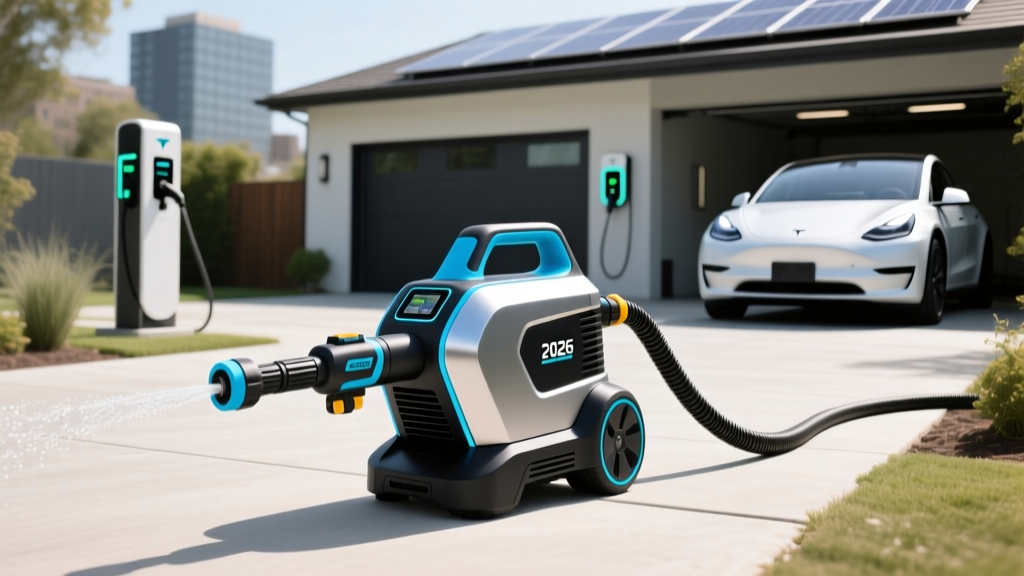
The highest PSI consumer electric power washer available in 2026 is the Greenworks 3200 PSI / 2.5 GPM cold-water model, delivering 8,000 cleaning units (PSI × GPM). For most EV owners washing cars at home on a standard 120V/15A circuit (1,800W max), the practical ceiling is 2,000–2,300 PSI at 1.2–1.5 GPM. Higher-PSI units (3,000+) require a 240V outlet — the same NEMA 14-50 receptacle many EV owners install for Level 2 charging.
EV owners are natural candidates for electric pressure washers. You already have a 240V circuit for Level 2 charging, you value zero tailpipe emissions (which extends to avoiding gas-powered washer fumes), and your EV's paint and sensors deserve careful, high-quality cleaning. But PSI alone is a misleading metric. A 3,200 PSI unit with 1.2 GPM cleans slower and less effectively than a 2,300 PSI unit at 2.3 GPM. This guide breaks down the real numbers, power requirements, and ownership costs so you can match a pressure washer to your home electrical setup — whether you're plugging into a standard outlet or leveraging your EV charger's dedicated 240V line.
PSI vs GPM vs Cleaning Units: The Numbers That Matter
Pressure (PSI) measures force. Flow rate (GPM) measures water volume. Cleaning Units (CU) = PSI × GPM, and CU is the single best predictor of real-world cleaning speed.
| Model | PSI | GPM | Cleaning Units | Voltage | Motor Watts | Price (MSRP) |
|---|---|---|---|---|---|---|
| Ryobi 1600 PSI 1.2 GPM | 1,600 | 1.2 | 1,920 | 120V | 1,440W | $129 |
| Sun Joe SPX3000 2030 PSI | 2,030 | 1.76 | 3,573 | 120V | 1,800W | $199 |
| Greenworks 2300 PSI 2.3 GPM | 2,300 | 2.3 | 5,290 | 120V | 1,800W | $279 |
| Craftsman 2800 PSI 2.0 GPM | 2,800 | 2.0 | 5,600 | 120V | 1,800W | $329 |
| Greenworks 3200 PSI 2.5 GPM | 3,200 | 2.5 | 8,000 | 240V | ~3,600W | $499 |
| Simpson 3400 PSI (gas baseline) | 3,400 | 2.5 | 8,500 | Gas | N/A | $399 |
The 120V ceiling is physical: a 15A/120V circuit delivers 1,800W maximum. Motor efficiency and pump losses mean roughly 1,400–1,500W reaches the pump, capping practical output around 2,300–2,800 PSI at moderate flow. To break past that, manufacturers move to 240V — which is where EV owners have a built-in advantage.
Your EV Charger Circuit: A Hidden Power-Washer Asset
If you installed a NEMA 14-50 outlet or hardwired a Level 2 EV charger (like a ChargePoint Home Flex or Tesla Wall Connector), you likely have a 240V/40A or 240V/50A circuit. A 240V pressure washer drawing 3,600W uses only 15A — well within that circuit's capacity.
Important caveat: You cannot run a Level 2 charger and a 240V pressure washer simultaneously on the same circuit. The National Electrical Code (NEC) requires continuous loads to stay at 80% of breaker capacity. A 50A breaker allows 40A continuous; a 32A EV charger plus a 15A pressure washer totals 47A — over the limit. Unplug the EV, plug in the washer. Wash first, charge after.
Home Electrical Capacity at a Glance
| Setup | Voltage | Breaker | Max Continuous Watts | Can Run 3200 PSI Washer? | Can Run EV Charger Simultaneously? |
|---|---|---|---|---|---|
| Standard outlet (NEMA 5-15) | 120V | 15A | 1,440W | No | N/A |
| Dedicated 120V (NEMA 5-20) | 120V | 20A | 1,920W | No | N/A |
| Level 2 EV circuit (NEMA 14-50) | 240V | 50A | 9,600W | Yes (EV unplugged) | No (over 80% rule) |
| Hardwired 240V/60A | 240V | 60A | 11,520W | Yes | Possible (depends on charger draw) |
If your panel is already at capacity from the EV charger installation (common in older homes with 100A service), adding a 240V pressure washer may require a licensed electrician to evaluate your panel. A panel upgrade from 100A to 200A typically costs $1,500–$3,000 — a factor worth considering before buying a high-PSI unit.
Electric vs Gas Pressure Washer: Cost and Ownership Breakdown
For EV owners, the electric-vs-gas decision mirrors the EV-vs-gas-car decision. Here's how the numbers compare over five years of typical homeowner use (roughly 50 hours/year).
| Category | Greenworks 3200 PSI Electric | Simpson 3400 PSI Gas |
|---|---|---|
| Purchase price | $499 | $399 |
| Energy/fuel (250 hrs total) | $22 (at $0.13/kWh, 3.6 kW) | $225 (gas + 2-stroke oil) |
| Maintenance (oil, spark plug, air filter) | $0 | $120 |
| Winterization / storage | Minimal | $40 (fuel stabilizer, fogging) |
| Noise (at operator) | ~75 dB | ~90 dB |
| Emissions at point of use | Zero | CO, NOx, unburned hydrocarbons |
| 5-Year Total | $521 | $784 |
The electric unit saves roughly $263 over five years, with the gap widening if your electricity comes from rooftop solar (marginal cost near zero) or if gas prices rise. The gas unit wins only on raw portability — no cord, no outlet dependency — which matters for large properties or remote jobs. For washing an EV in a driveway next to your Level 2 charger, the electric unit is the clear match.
Real-World Car Washing: What PSI and GPM You Actually Need
More PSI is not always better on a vehicle. Automotive paint, clear coat, and especially EV sensor suites (radar emblems, camera lenses, ultrasonic parking sensors) can be damaged by excessive pressure at close range.
- Rinse and loose dirt: 1,200–1,600 PSI at 40° nozzle, 12+ inches from surface
- Road grime and brake dust: 1,800–2,300 PSI with foam-cannon pre-soak
- Concrete driveway / deck stripping: 2,800–3,200 PSI with 0° or 15° nozzle
- EV-specific caution: Avoid directing high-pressure streams at door seals, charge-port gaskets, sensor housings, or the 12V battery vent. Tesla, Rivian, and Hyundai all specify low-pressure rinse for sensor areas in owner's manuals.
For a dedicated car-washing setup, the Greenworks 2300 PSI / 2.3 GPM at 120V hits the sweet spot: enough pressure for grime, enough flow for fast rinsing, and it works on any standard outdoor outlet without touching your EV charging circuit. Reserve the 3,200 PSI 240V unit for homeowners who also need to clean decks, fences, and concrete.
Common Misconceptions About Electric Pressure Washers
| Myth | Fact |
|---|---|
| "Electric washers are weak — you need gas for real work." | 240V electric units now reach 3,200 PSI / 2.5 GPM (8,000 CU), matching mid-range gas models. The gap only exists above 4,000 PSI. |
| "Higher PSI always means better cleaning." | GPM matters more for rinsing speed. A 2,000 PSI / 2.5 GPM unit (5,000 CU) outcleans a 3,000 PSI / 1.2 GPM unit (3,600 CU) on most surfaces. |
| "I'll blow up my EV charger circuit if I plug in a pressure washer." | A 240V/15A pressure washer draws 3,600W — less than half a typical Level 2 charger. The risk is simultaneous use exceeding 80% breaker capacity, not the washer itself. |
| "I can use an extension cord to reach my 240V outlet." | 240V extension cords rated for 15A+ are expensive ($60–$120 for 25 ft of 10-gauge) and introduce voltage drop. Plan your outlet location or hose length instead. |
| "My solar panels make pressure washing free." | A 3.6 kW washer running for 30 minutes uses 1.8 kWh. With net metering, that's essentially free. Without net metering (battery-only offset), timing matters — run it midday when panels produce. |
Decision Framework: Which Electric Pressure Washer Fits Your Setup?
If / Then Buyer Guide
- If you only have standard 120V outdoor outlets → Greenworks 2300 PSI / 2.3 GPM ($279). Best cleaning units on a 120V circuit.
- If you have a NEMA 14-50 from your EV charger installation → Greenworks 3200 PSI / 2.5 GPM ($499). Unplug EV, plug in washer, wash, then recharge.
- If you're adding a 240V outlet specifically for the washer → Factor in $300–$600 for electrician + permit. Only worthwhile if you also need high-PSI for concrete/deck work.
- If you wash your EV weekly and rarely clean hardscapes → 2,000–2,300 PSI is sufficient. Spend the savings on a quality foam cannon ($30–$50) and pH-neutral car shampoo.
- If you live in an apartment/condo with no dedicated outdoor outlet → Consider a cordless battery-powered unit (e.g., Ryobi 40V 1600 PSI, $249 with battery) or a self-service coin-operated bay. Do not run an extension cord from an indoor outlet — it's a fire and code violation.
- If you need 4,000+ PSI for paint stripping or heavy industrial use → Gas remains the only practical option in 2026. Electric consumer units top out at 3,200 PSI.
First-Time EV Buyer? Plan Your Garage Power Holistically
If you're buying your first EV and planning a Level 2 home charger installation, think about your total 240V power needs upfront. A licensed electrician can install a sub-panel or pull extra conduit during the initial visit, saving $500–$1,000 versus a second visit later.
Consider these 240V appliances you might add over the next decade: Level 2 EV charger (32–48A), electric pressure washer (15A), welder (20–30A), hot tub (40–50A), EV bi-directional charger/V2H system (40A). Sizing your panel and conduit for future expansion is far cheaper than upgrading later.
For the pressure washer specifically: if your charger installation already includes a 14-50 outlet in the garage or on the exterior wall, you have everything needed for the highest-PSI consumer electric unit on the market. No additional electrical work required — just schedule your car wash and charging sessions so they don't overlap.
Can I run a 3200 PSI electric pressure washer on a standard 120V outlet?
No. Units rated 3,000+ PSI require 240V power (typically a NEMA 6-15 or 14-50 plug). On 120V, consumer electric pressure washers top out around 2,300–2,800 PSI.
Will using a 240V pressure washer damage my EV charger circuit?
No, provided you don't run both simultaneously. A 3,600W pressure washer draws 15A at 240V — well within a 50A breaker's capacity when used alone. The NEC 80% continuous-load rule means a 50A breaker supports 40A continuous; a 32A EV charger plus 15A washer would total 47A and trip the breaker.
Is 3200 PSI safe for washing a Tesla, Rivian, or Hyundai Ioniq?
At 12+ inches distance with a 40° (white) nozzle tip, yes for body panels and wheels. Avoid directing the stream at charge-port seals, radar emblems (front badge on many EVs), camera housings, and door weatherstripping. Use 1,600 PSI or less for sensor areas.
How much does it cost to wash an EV at home vs. a commercial car wash?
A 30-minute home wash with a 3.6 kW electric pressure washer uses ~1.8 kWh ($0.23 at the U.S. average of $0.13/kWh) plus ~40 gallons of water. A commercial touchless wash costs $10–$18 per visit. Over 52 weekly washes, home washing saves $500–$900/year.
What's the best pressure washer if I don't have a 240V outlet?
The Greenworks 2300 PSI / 2.3 GPM ($279) delivers the highest cleaning units (5,290 CU) on a standard 120V/15A circuit. It handles car washing, patio furniture, and light concrete cleaning effectively.
Does the federal EV tax credit apply to pressure washers?
No. The IRS §30D clean vehicle credit applies only to qualifying new EVs and PHEVs (up to $7,500, subject to MSRP caps, buyer income limits, and battery-sourcing requirements). Home energy equipment credits (§25C) cover chargers and solar but not pressure washers.