Quick Answer: Highest GPM Electric Pressure Washers in 2026
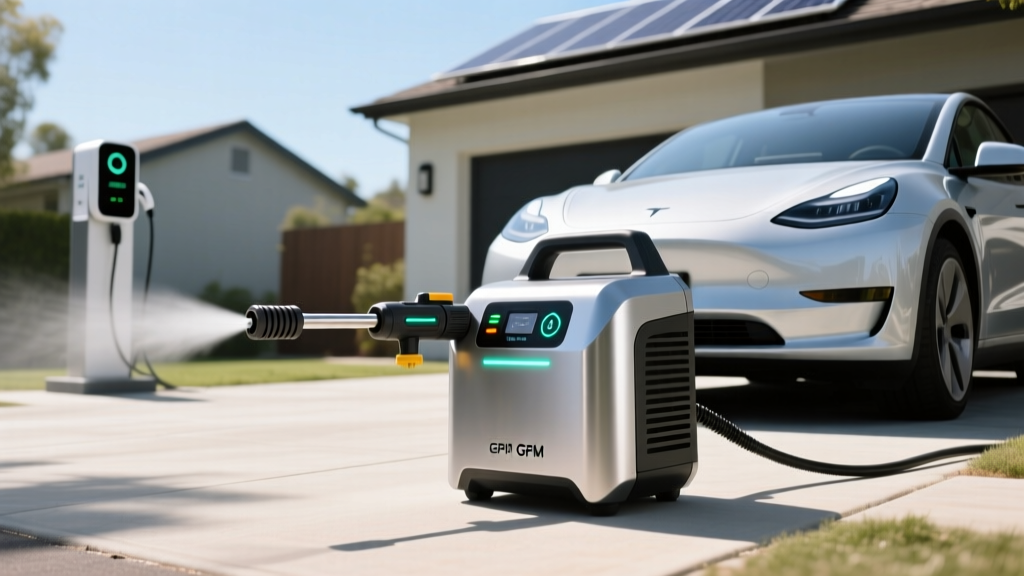
The highest GPM electric pressure washers available to consumers in 2026 top out at approximately 2.5 GPM (gallons per minute) at 2,300–3,100 PSI for standard 120V household units. Models wired for 240V — such as the Karcher K5 Premium (2.4 GPM / 2,000 PSI) and select commercial-grade units — push slightly higher flow rates by leveraging greater electrical input. For EV owners washing vehicles at home, a 2.0–2.5 GPM electric unit drawing 13–15 amps on a standard 120V/15A circuit provides ample cleaning power for road grime, brake dust, and bug splatter without the noise, fumes, or maintenance of a gas-powered washer.
If you've invested in an electric vehicle, pairing it with a gas-powered pressure washer feels contradictory — and practically, it's unnecessary. Electric pressure washers have closed the performance gap significantly, and for the vast majority of car-washing tasks, the highest GPM electric pressure washer you can plug into a standard outlet does the job. Here's exactly what to look for, what it costs, and how electric models stack up against gas alternatives.
Understanding GPM, PSI, and What Actually Cleans Your Car
Before comparing models, it's critical to understand the two numbers that define pressure washer performance:
- PSI (pounds per square inch): The force of the water stream. Higher PSI strips stubborn grime but can damage automotive paint if concentrated too closely. Most automotive paint experts recommend staying between 1,200–1,900 PSI at the nozzle for safe vehicle washing.
- GPM (gallons per minute): The volume of water delivered. GPM determines how quickly you rinse away loosened dirt and soap. Higher GPM means faster, more efficient cleaning — especially on large surfaces like an SUV or truck.
The cleaning power formula is essentially PSI × GPM = cleaning units (CU). A 2.0 GPM unit at 2,000 PSI delivers 4,000 CU, which is more than sufficient for vehicle washing. Professional car washes typically operate in the 3.0–4.0 GPM range, but those use commercial-grade electrical or gas systems.
For EV owners, the practical question is: what can a standard household circuit support? A typical 120V/15A outlet delivers roughly 1,800 watts of continuous power (1,440W at the 80% continuous-load rule). That electrical ceiling is what limits consumer electric pressure washers to the 2.0–2.5 GPM range.
Top Electric Pressure Washers by GPM: 2026 Specifications
| Model | Max GPM | Max PSI | Power Draw | Voltage | Approx. Price | Best For |
|---|---|---|---|---|---|---|
| Karcher K5 Premium Electric | 2.4 | 2,000 | ~1,800W | 120V | $330–$380 | Large SUVs, trucks |
| Sun Joe SPX4001 | 2.2 | 2,300 | ~1,650W | 120V | $220–$260 | Sedans, crossovers |
| Greenworks GPW2700 | 2.3 | 2,700 | ~1,750W | 120V | $250–$300 | All vehicle types |
| Ryobi RY142300 | 2.3 | 2,300 | ~1,700W | 120V | $280–$320 | Home + vehicle use |
| AR Blue Clean AR383 | 1.5 | 1,900 | ~1,400W | 120V | $150–$180 | Compact cars, budget |
Key takeaway: The Karcher K5 Premium and Greenworks GPW2700 lead the consumer 120V segment at 2.3–2.4 GPM. If you have access to a 240V outlet (like a dryer circuit or the same circuit used for your EV's Level 2 charger), some semi-commercial units can push to 3.0+ GPM — but this requires dedicated wiring and is beyond what most homeowners need for vehicle washing.
Electric vs. Gas Pressure Washers: Cost and Performance Comparison
Gas pressure washers still dominate the high-GPM space (3.0–4.0+ GPM), but for car washing, the gap is less meaningful than marketing suggests. Here's a data-driven comparison:
| Factor | Electric (2.3 GPM / 2,700 PSI) | Gas (2.5–3.0 GPM / 3,200 PSI) |
|---|---|---|
| Upfront Cost | $250–$380 | $300–$500 |
| Energy/Fuel Cost Per Wash (30 min) | ~$0.09 (0.875 kWh × $0.10/kWh avg) | ~$0.45–$0.65 (0.2–0.3 gal gasoline) |
| Annual Maintenance | $0–$15 (nozzle/hose replacement) | $40–$80 (oil, spark plug, air filter, winterization) |
| Noise Level | ~65–75 dB (conversation level) | ~85–95 dB (lawnmower level) |
| Weight | 25–40 lbs | 55–85 lbs |
| Cold-Weather Starting | Instant (push-button) | Pull-start; may require choke in cold |
| Emissions at Point of Use | Zero | CO₂, NOₓ, unburned hydrocarbons |
| Expected Lifespan | 5–10 years (brushless motor) | 5–8 years (small-engine maintenance dependent) |
Over five years of weekly car washes (260 washes), an electric pressure washer costs roughly $23 in electricity versus $117–$169 in gasoline for a comparable gas model. Add the maintenance differential (~$150–$350 for gas over five years), and the electric unit saves you $244–$496 in operating costs — while producing zero local emissions and significantly less noise.
Real-World Ownership Considerations for EV Owners
Electrical Circuit Capacity and Your EV Charger
This is where EV ownership intersects directly with pressure washer selection. If you've already installed a Level 2 EV charger (typically a 240V/40A or 240V/48A circuit), you need to understand your home's electrical panel capacity before adding any high-draw appliance.
A 120V electric pressure washer drawing 13–15 amps uses a standard household outlet on a dedicated 15A or 20A circuit. This is completely independent of your Level 2 charger circuit and poses no conflict. You can wash your EV while it charges on Level 2 without any electrical issue — they operate on separate circuits.
However, if you're considering a 240V pressure washer for higher GPM (3.0+), you'll need a dedicated circuit, and your electrical panel must have the spare capacity. A licensed electrician can assess whether your 200A panel has headroom. Most homes with a Level 2 charger already installed have had their panel evaluated, so adding a second 240V circuit is feasible but typically costs $300–$800 for the dedicated line.
Water Usage and Efficiency
A 2.3 GPM pressure washer used for a 20-minute active wash cycle consumes approximately 46 gallons of water. By comparison, a standard garden hose (5–8 GPM) running for the same duration uses 100–160 gallons. The pressure washer actually saves water despite its force, because the pressurized stream cleans more efficiently per gallon.
For context, a typical commercial touchless car wash uses 40–60 gallons per vehicle, and a tunnel wash uses 80–150 gallons. Your at-home electric pressure washer is competitive with or better than commercial options on water efficiency.
Climate and Storage
Electric pressure washers have one cold-weather vulnerability: internal water must be fully drained before freezing temperatures. Unlike gas models where you also worry about fuel stabilization, electric units simply need you to run them dry or use compressed air to blow out the pump. Store the unit above 32°F to prevent pump cracking.
If you live in a region with long winters and wash your EV less frequently (or rely on touchless drive-through washes in cold months), a smaller, more affordable 1.5–2.0 GPM unit may be a better investment than paying for maximum GPM you'll use for only six months of the year.
Common Misconceptions: Myths vs. Facts
| Myth | Fact |
|---|---|
| "Electric pressure washers don't have enough power to clean a car properly." | A 2.0–2.5 GPM unit at 1,900–2,700 PSI exceeds the recommended automotive cleaning range. Professional detailers regularly use 1,500–2,000 PSI for paint-safe washing. |
| "Higher PSI is always better for car washing." | Excessive PSI (above 2,500 concentrated at close range) can chip paint, strip clear coat edges, and force water into seals and electrical connectors — a particular concern for EVs with exposed charging ports. |
| "Running a pressure washer will trip my breaker if my EV is charging." | A 120V pressure washer and a 240V Level 2 charger operate on separate circuits. No conflict exists unless you're running both on the same 120V circuit (which would be unusual and inadvisable). |
| "You need a gas pressure washer for foam cannon attachments." | Foam cannons work with any pressure washer that delivers at least 1.4 GPM and 1,100+ PSI. Most electric models in the 2.0+ GPM range drive foam cannons effectively. |
| "Electric pressure washers have short lifespans." | Brushless-motor electric units from reputable brands (Karcher, Ryobi, Greenworks) carry 2–3 year warranties and commonly last 5–10 years with proper winterization. Induction motors outlast the universal motors found in budget gas units. |
Total Cost Breakdown: Electric Pressure Washer Ownership
| Cost Category | Electric (2.3 GPM) | Gas (2.5 GPM) |
|---|---|---|
| Purchase Price | $280 | $380 |
| Energy/Fuel (5 years, 260 washes) | $23 | $143 |
| Maintenance (oil, filters, plugs, winterization) | $30 | $275 |
| Accessories (foam cannon, surface cleaner) | $60 | $60 |
| Repairs / Replacement Parts | $25 | $85 |
| 5-Year Total | $418 | $943 |
The electric pressure washer costs less than half what a gas equivalent costs over five years of regular use. The savings widen further if gasoline prices rise or if you wash more than once per week.
Decision Framework: Which Electric Pressure Washer Should You Buy?
Choose Based on Your Situation
- Choose a 2.3–2.5 GPM unit (Karcher K5, Greenworks GPW2700) if you own a large EV (SUV or truck like the Rivian R1S, Ford F-150 Lightning, or Tesla Model X), wash weekly, and want the fastest rinse times on broad body panels.
- Choose a 2.0–2.2 GPM unit (Sun Joe SPX4001, Ryobi RY142300) if you own a sedan or compact crossover (Tesla Model 3, Hyundai Ioniq 6, BMW i4) and want a balance of cleaning power, portability, and value.
- Choose a 1.5–1.8 GPM budget unit (AR Blue Clean AR383) if you wash infrequently (monthly), have limited storage space, live in an apartment with outdoor access, or primarily need the washer for light rinse-and-soap tasks.
- Consider a 240V semi-commercial unit (3.0+ GPM) only if you have a dedicated 240V circuit, wash multiple vehicles weekly, or also need the washer for deck/patio/driveway cleaning — and understand the $300–$800 electrical installation cost.
EV-Specific Washing Tips
When washing your electric vehicle with any pressure washer:
- Keep the nozzle 12+ inches from the charging port and ensure the port door is fully closed. While EV charging ports are weather-sealed (IP67-rated in most cases), high-pressure water forced directly at seals is unnecessary risk.
- Avoid directing high-PSI streams at battery pack underbody panels. While battery enclosures are sealed and tested for water intrusion, there's no reason to concentrate pressure on gasket seams.
- Use a foam cannon pre-soak to loosen road film before pressure rinsing. This reduces the PSI needed and protects your EV's paint — especially important on matte or satin finishes offered on models like the Tesla Model S Plaid and Lucid Air.
- Pre-rinse wheel wells thoroughly. EVs are heavier than comparable gas vehicles (the GMC Hummer EV weighs over 9,000 lbs), which means more brake dust accumulation despite regenerative braking reducing pad wear.
Frequently Asked Questions
Can I use an electric pressure washer while my EV is plugged in and charging?
Yes. A 120V electric pressure washer runs on a standard household circuit, completely separate from your 240V Level 2 EV charging circuit. There is no electrical conflict. Just ensure you're not spraying water near your EVSE (charging equipment) or the outlet itself.
What's the minimum GPM I need to effectively wash a car?
At least 1.5 GPM is needed for effective rinsing. Below that, you'll spend excessive time rinsing soap and loosened dirt. For a full-size SUV or truck, 2.0+ GPM is strongly recommended for reasonable wash times (15–25 minutes for a full exterior wash).
Will a pressure washer damage my EV's sensors and cameras?
Modern EVs have numerous exterior sensors (cameras, ultrasonic sensors, radar units) for ADAS features like Autopilot, BlueCruise, or Toyota Safety Sense. These are weather-sealed, but you should avoid holding a high-PSI nozzle within 6 inches of any sensor housing. Use a wider spray pattern (25° or 40° nozzle tip) around sensor areas and keep distance at 12+ inches.
Is a 240V electric pressure washer worth the installation cost?
For most car-only use, no. The jump from 2.3 GPM (120V) to 3.0 GPM (240V) saves roughly 3–5 minutes per wash. At $300–$800 for circuit installation, the payback period in time savings alone is impractical. A 240V unit makes sense only if you're also cleaning large concrete areas, decks, or second-story siding.
How do I winterize an electric pressure washer?
Disconnect the water supply, run the unit until it sprays dry (15–30 seconds), disconnect hoses, and store in a location above freezing. Some owners use compressed air to blow residual water from the pump. Unlike gas models, you don't need fuel stabilizer or oil changes — just protect the water pump from freeze damage.
Does using a pressure washer affect my EV's range or battery?
No. Washing your EV has zero impact on the traction battery or range. The 12V auxiliary battery powers door locks and electronics while the car is off, and washing doesn't draw from either battery system. If your EV is actively charging during the wash, the charging process continues normally.