The Short Answer: Why 1970s Electric Cars Failed — and Why Today's Are Different
The electric car in the 1970s was a real, federally funded experiment — not a myth. Vehicles like the AMC Amitron, CitiCar, and various prototype conversions hit the road during the OPEC oil crisis, but nearly all suffered from the same fatal flaws: lead-acid batteries offering 30–60 miles of range, top speeds under 50 mph, charge times exceeding 8 hours, and prices rivaling full-size luxury sedans. Modern EVs in 2026 succeed where 1970s models failed because lithium-ion and LFP batteries deliver 250–400+ miles of EPA range, DC fast charging adds 200+ miles in ~20 minutes, and motor efficiency exceeds 90%. The 1970s proved the concept; modern chemistry made it practical.
What the 1970s Electric Car Actually Was
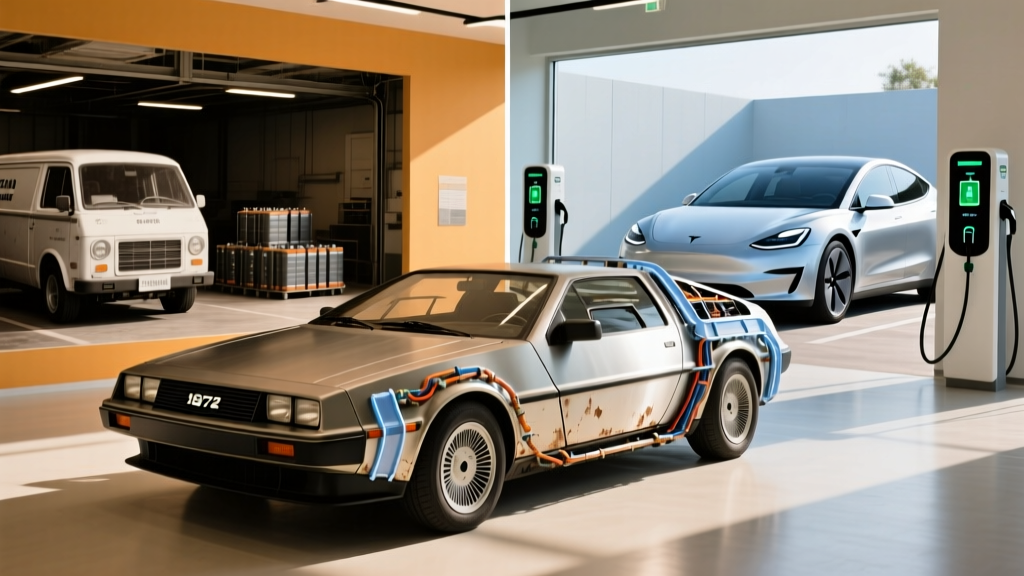
When the 1973 Arab oil embargo sent gasoline prices soaring and sparked nationwide fuel shortages, the U.S. government and automakers scrambled to explore alternatives. The electric car in the 1970s wasn't a single production model — it was a scattered wave of prototypes, conversions, and small-production vehicles, most powered by heavy, energy-poor lead-acid batteries.
Key 1970s EV Prototypes and Production Attempts
| Vehicle | Year | Battery Type | Range (est.) | Top Speed | Status |
|---|---|---|---|---|---|
| CitiCar (Vanguard-Sebring) | 1974–1977 | Lead-acid (8× 6V) | ~35–40 mi | ~38 mph | ~2,600 built |
| AMC Amitron (concept) | 1977 | Lithium (prototype) | ~150 mi (claimed) | 50 mph | Concept only |
| General Motors Electrovette | 1978 | Nickel-zinc / lead-acid | ~50 mi | ~53 mph | Prototype |
| Ford Comuta | 1970s | Lead-acid | ~35 mi | ~40 mph | Limited test fleet |
| Electric Fuel Propulsion Mars II | 1970s | Lead-acid (tri-motor) | ~50–60 mi | ~55 mph | Dozens built |
The Smithsonian Institution's history of electric vehicles notes that the CitiCar was the best-selling American electric car of its era — yet total production barely exceeded 2,600 units across all variants. For context, a single 2026 Tesla Model Y production week at Giga Texas can exceed that figure.
Why the 1970s Electric Car Couldn't Compete
The physics of lead-acid batteries doomed these vehicles. A typical lead-acid pack in a 1970s EV weighed 800–1,200 pounds and stored roughly 5–10 kWh of usable energy. Compare that to a 2026 Hyundai Ioniq 5's 84 kWh (usable) NMC pack weighing approximately 950 pounds — delivering 8–17× more energy at lower weight.
- Energy density: Lead-acid ~30–40 Wh/kg vs. modern NMC ~250–300 Wh/kg
- Cycle life: Lead-acid ~300–500 deep cycles vs. modern LFP ~3,000–5,000+ cycles
- Charge time: 1970s EVs: 8–12 hours on 120V. Modern EVs: 10–80% in 18–25 minutes on 150–350 kW DC fast chargers.
- Cost per kWh: Lead-acid was cheap per unit, but the sheer mass required for even modest range made total vehicle cost impractical.
1970s EV vs. 2026 EV: The Numbers That Explain Everything
The table below compares a representative 1970s electric car (the CitiCar) against a mainstream 2026 EV (the Chevrolet Equinox EV 2LT) to illustrate just how far the technology has advanced.
| Specification | CitiCar (1974) | 2026 Chevy Equinox EV 2LT | Improvement Factor |
|---|---|---|---|
| Battery Chemistry | Lead-acid | NMC lithium-ion | — |
| Usable Battery Capacity | ~7 kWh | 85 kWh | ~12× |
| EPA Range | ~35 mi | 319 mi | ~9× |
| Top Speed | 38 mph | ~115 mph (governed) | ~3× |
| 0–60 mph | N/A (couldn't reach 60) | ~7.9 sec | — |
| Full Charge Time | 8–12 hr (120V) | ~10–80% in 24 min (150 kW DC) | ~30× faster |
| MSRP (adjusted for inflation) | ~$16,000 (2026 $) | $43,900 | — |
| Heating / Climate Control | Minimal / none | Heat pump + full HVAC | — |
| Safety (crash testing) | None | IIHS Top Safety Pick eligible | — |
The inflation-adjusted price comparison is revealing: the CitiCar cost roughly the equivalent of $16,000 today for a vehicle with 35 miles of range and a top speed below highway minimums. The Equinox EV costs about 2.7× more but delivers 9× the range, highway-capable speed, modern safety, and full climate control. Source: fueleconomy.gov EV technology overview.
What Killed the 1970s Electric Car — and What Resurrected It
Three Factors That Doomed 1970s EVs
1. Battery chemistry hit a wall. Lead-acid batteries simply couldn't store enough energy per pound. Every additional mile of range required exponentially more weight, creating a vicious cycle. Nickel-cadmium and early nickel-zinc chemistries offered marginal improvements but introduced cost and toxicity problems.
2. The oil crisis subsided. When fuel prices stabilized in the early 1980s and new oil supplies came online, the political and economic urgency behind electric vehicles evaporated. The U.S. Department of Energy's EV research funding was slashed.
3. No charging infrastructure existed. The 1970s electric car was strictly a home-charge, short-trip vehicle. There was no public charging network, no standardized connector, and no concept of DC fast charging. The SAE J1772 standard wouldn't arrive until 2001; CCS and NACS were decades away.
What Changed Between 1990 and 2026
Several converging breakthroughs made modern EVs possible:
- Lithium-ion commercialization (1991): Sony's first consumer Li-ion cell offered 3× the energy density of nickel-cadmium at steadily declining costs.
- Tesla Roadster (2008): Proved that lithium-ion packs could deliver 200+ miles of range in a production vehicle.
- Battery cost collapse: From ~$1,100/kWh in 2010 to approximately $115–130/kWh by 2025–2026 (BloombergNEF data), making EVs price-competitive with gas cars.
- LFP chemistry maturation: Lithium iron phosphate batteries eliminated cobalt dependency, extended cycle life to 3,000–5,000+ cycles, and enabled sub-$30,000 EVs.
- Charging infrastructure: Over 200,000 public charging ports in the U.S. by 2026, with NACS becoming the dominant standard.
- Federal policy: The Inflation Reduction Act's §30D tax credit (up to $7,500, subject to MSRP caps, income limits, and battery-sourcing requirements per IRS.gov) accelerated adoption.
Real Costs: What a First-Time EV Buyer Should Know in 2026
If you've stumbled onto this article searching for "electric car 1970s" and are now curious about buying a modern EV, here's the practical ownership picture today.
5-Year Total Cost of Ownership: EV vs. Gas vs. Hybrid (Midsize Sedan/SUV Segment)
| Cost Category | 2026 EV (e.g., Tesla Model 3 RWD) | 2026 Gas (e.g., Honda Accord LX) | 2026 PHEV (e.g., Toyota Prius Prime) |
|---|---|---|---|
| MSRP (before incentives) | $38,990 | $28,990 | $33,445 |
| Federal Tax Credit (§30D) | Up to $7,500* | $0 | Up to $7,500* |
| Effective Purchase Price | ~$31,490 | $28,990 | ~$25,945 |
| Fuel / Energy (5 yr / 75,000 mi) | ~$3,750** | ~$8,250*** | ~$4,800 |
| Maintenance (5 yr) | ~$1,500 | ~$3,500 | ~$2,800 |
| Insurance (5 yr avg.) | ~$9,500 | ~$7,200 | ~$8,000 |
| Estimated 5-Year Total | ~$46,240 | ~$47,940 | ~$41,545 |
* §30D credit eligibility depends on MSRP caps ($55,000 sedans / $80,000 SUVs/trucks), buyer AGI limits ($150K single / $300K joint), and battery critical-mineral sourcing rules. Verify current-year rules at IRS.gov and consult a tax professional. ** Assumes ~$0.15/kWh home charging average. *** Assumes $3.30/gal, 30 MPG combined.
Home Charging: The Make-or-Break Factor
The single biggest ownership variable in 2026 remains home charging access. If you can install a Level 2 (240V) home charger, daily EV ownership is nearly frictionless — you wake up every morning with a "full tank." If you rely solely on public charging, costs rise and convenience drops significantly.
| Charging Level | Power (kW) | Miles Added per Hour | Typical Use Case |
|---|---|---|---|
| Level 1 (120V household) | 1.2–1.9 kW | 3–5 mi/hr | Overnight top-up, PHEV-friendly |
| Level 2 (240V home/public) | 7.2–11.5 kW | 25–44 mi/hr | Daily primary charging |
| DC Fast Charge (CCS/NACS) | 50–350 kW | 150–1,000+ mi/hr (peak) | Road trips, quick stops |
Level 2 home installation costs typically range from $800 to $2,500 for a standard setup (charger + electrician + permit), but can reach $4,000–$8,000 if your home needs an electrical panel upgrade from 100A to 200A service. Always get a quote from a licensed electrician before purchasing a charger.
Common Misconceptions About EVs — Rooted in 1970s Thinking
| Myth (1970s Legacy Thinking) | Fact (2026 Reality) |
|---|---|
| "EVs can't go far enough." | Median 2026 EV EPA range: 270–330 miles. Multiple models exceed 350+ miles. A 1970s CitiCar managed ~35 miles. |
| "Charging takes all night." | Level 2 home charging fully replenishes most EVs in 7–10 hours (overnight). DC fast charging reaches 10–80% in 18–25 minutes. |
| "Batteries won't last." | Modern NMC and LFP packs are warrantied for 8 years / 100,000 miles (federally mandated minimum). Real-world data shows ~10–15% degradation at 150,000 miles for quality packs. |
| "EVs are slow and underpowered." | Even mainstream EVs produce 200–400 HP with instant torque. A 2026 Tesla Model 3 Performance does 0–60 in 2.9 seconds. |
| "EVs are worse in winter." | Range drops 15–30% in freezing temps — real and worth planning for. But heat pumps, battery preconditioning, and AWD mitigate this significantly vs. 1970s EVs that had zero thermal management. |
| "The grid can't handle it." | Most EV charging happens overnight during off-peak hours. Smart charging and V2G (vehicle-to-grid) technology actually help stabilize grids. |
Decision Framework: Should You Buy an EV, Hybrid, or Stick with Gas?
Choose a battery-electric vehicle (BEV) if:
- You have home charging access (garage, driveway, or landlord-approved outlet)
- Your daily driving is under 200 miles round-trip
- You want minimal maintenance (no oil changes, fewer brake replacements due to regen braking)
- You qualify for the §30D federal tax credit or state incentives
- You take road trips 2–4× per year and can plan around DC fast-charging stops
Choose a plug-in hybrid (PHEV) if:
- You lack reliable home charging but want some electric-only driving
- Your commute is 25–45 miles (within PHEV electric-only range, e.g., Toyota RAV4 Prime: 42 mi EV)
- You frequently drive in rural areas or charging deserts where DC fast chargers are sparse
- You want one vehicle for daily electric commuting and long gas-powered road trips without route planning
Stick with a conventional hybrid (HEV) or gas car if:
- You live in an apartment with no charging access and no workplace charging
- Your budget is strictly under $25,000 and the used EV market doesn't fit your needs
- You regularly tow heavy loads (5,000+ lbs) in extreme cold, where EV range loss compounds
Real-World Ownership Considerations Most Guides Skip
Cold-Weather Range Loss Is Real — Plan For It
In sustained temperatures below 20°F, expect 20–30% range reduction in most EVs. A 2026 Hyundai Ioniq 5 with a 303-mile EPA rating may deliver ~215–245 real-world winter miles. Vehicles equipped with heat pumps (standard on most 2024+ models) lose less range than those using resistive heating. Preconditioning the battery while plugged in — warming it before you drive — recovers significant efficiency.
Charging Curves Aren't Linear
A charger rated at 250 kW doesn't deliver that rate for the entire session. Most EVs peak at their maximum charge rate between 10–40% State of Charge (SoC), then taper progressively. A typical session might look like: 10–40% at 200–250 kW, 40–60% at 120–150 kW, 60–80% at 60–90 kW. This is why manufacturers quote "10–80% charge time" — charging past 80% is dramatically slower and usually not worth the wait on road trips.
Insurance Costs Are Higher (Budget For It)
EV insurance premiums run 15–25% higher than comparable gas vehicles, driven by higher repair costs (specialized body shops, battery safety protocols) and higher MSRP. Shop quotes from multiple insurers before purchase — the spread can be $300–$800/year depending on model and driver profile.
Tax Credits Aren't Guaranteed
The §30D federal tax credit of up to $7,500 for new EVs (or up to $4,000 for used EVs under §25E) has strict eligibility requirements that change annually. Key 2026 rules include:
- MSRP caps: $55,000 for sedans; $80,000 for SUVs, trucks, and vans
- Buyer income caps: Modified AGI ≤ $150,000 (single) / $225,000 (head of household) / $300,000 (joint)
- Battery sourcing: Increasingly strict critical-mineral and battery-component requirements tied to U.S. free-trade partners
- Point-of-sale transfer: You can transfer the credit to the dealer at purchase for an immediate price reduction, rather than waiting to claim it on your tax return
Always verify eligibility on the specific VIN you're purchasing via the IRS tool and confirm with a tax professional.
Frequently Asked Questions
Were there any production electric cars in the 1970s?
Yes, but in very small numbers. The CitiCar (later rebranded as the ComutaCar) was the most commercially successful, with approximately 2,600 units built between 1974 and 1977. Various other prototypes and limited conversions existed from GM, Ford, and AMC, but none reached mass production. They used lead-acid batteries with ranges of 30–60 miles and top speeds below 55 mph.
Why did electric cars disappear after the 1970s?
Three factors converged: the oil crisis eased (removing the economic urgency), lead-acid battery technology hit fundamental energy-density limits, and no charging infrastructure existed beyond a standard household outlet. It wasn't until lithium-ion chemistry matured and battery costs dropped below ~$150/kWh that EVs became commercially viable again around 2010–2015.
How does a 2026 EV compare to a gas car on total cost?
Over 5 years and 75,000 miles, a mainstream EV like the Tesla Model 3 RWD often breaks even with or slightly beats a comparable gas sedan (e.g., Honda Accord) on total cost of ownership, primarily due to lower fuel and maintenance costs offsetting a higher purchase price. The §30D tax credit (if eligible) tips the math further in the EV's favor. However, insurance costs are typically 15–25% higher for EVs, and depreciation varies by model.
What should a first-time EV buyer prioritize?
In order: (1) Confirm you have home or workplace Level 2 charging access — this is the single biggest predictor of EV satisfaction. (2) Match EPA range to your longest regular trip, then subtract 20–30% for real-world highway/cold-weather driving. (3) Verify §30D tax credit eligibility for your specific VIN and income. (4) Get insurance quotes before signing. (5) Understand that DC fast charging peaks early and tapers — plan road-trip stops around 10–80% charges, not 0–100%.
Is the electric car 1970s history relevant to today's buyers?
Yes, as a cautionary framework. The 1970s proved that without adequate battery energy density, charging infrastructure, and supportive policy, EVs can't succeed at scale. Today's buyers should watch for the modern equivalents: ensuring charging access exists in their area, understanding real (not advertised) range, and confirming that incentive programs remain in place. The technology is now mature — the ownership ecosystem around it is what determines success.