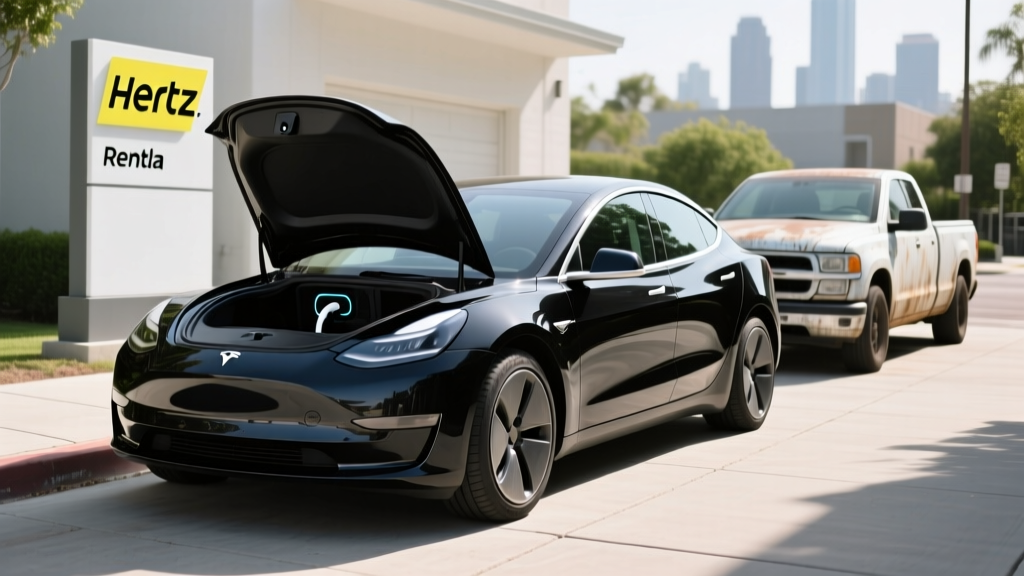
If you've searched for a hertz tesla car rental, you've probably wondered whether it makes more sense to rent one for a trip or simply buy your own. Hertz reshaped the rental-EV landscape when it began offering Tesla Model 3 and Model Y vehicles at major airports, but the economics have shifted considerably since those early headlines. Rental rates have fluctuated, Hertz has recalibrated its EV fleet strategy, and Tesla's own pricing and federal tax credit eligibility have evolved through 2026.
This guide breaks down what you actually get behind the wheel — real-world range, charging logistics, and total trip cost — alongside the full ownership picture: MSRP, §30D tax credit eligibility, and five-year cost of ownership. Whether you're a curious traveler or a potential buyer using a rental as a test drive, these numbers will frame your decision.
Which Teslas Does Hertz Actually Rent in 2026?
Hertz's Tesla fleet in 2026 is dominated by two models: the Tesla Model 3 Rear-Wheel Drive and the Tesla Model Y Long Range AWD. You may occasionally find a Model Y Performance at select locations, but the RWD Model 3 and dual-motor Model Y are the workhorses. Here's what each delivers on paper and on the road.
| Spec | Model 3 RWD | Model Y Long Range AWD |
|---|---|---|
| EPA Range | 363 miles | 320 miles |
| Battery Capacity | ~60 kWh (LFP) | ~75 kWh (NMC) |
| Max DC Fast Charge | 170 kW | 250 kW |
| 10–80% DCFC Time | ~25 min | ~27 min |
| Level 2 Home Charge | 11.5 kW (~44 mi/hr) | 11.5 kW (~40 mi/hr) |
| 0–60 mph | 5.8 sec | 4.8 sec |
| Horsepower | 283 hp | 384 hp |
| Drivetrain | RWD (single motor) | AWD (dual motor) |
| MPGe (combined) | 132 MPGe | 117 MPGe |
| Efficiency | 25 kWh/100 mi | 28 kWh/100 mi |
| Cargo Volume | 23 cu ft (trunk + frunk) | 76 cu ft (rear seats folded) |
| Base MSRP (2026) | $38,990 | $44,990 |
| Battery Warranty | 8 yr / 100,000 mi | 8 yr / 120,000 mi |
Sources: EPA / fueleconomy.gov, Tesla.com specifications.
Real-World Range: What the EPA Sticker Doesn't Tell You
Model 3 RWD: EPA 363 mi. Expect ~300–320 mi on mixed highway driving at 70 mph; ~240–270 mi in sub-30°F cold weather.
Model Y LR AWD: EPA 320 mi. Expect ~270–290 mi highway; ~210–240 mi in freezing temperatures.
The Model 3 RWD's LFP (lithium iron phosphate) battery offers an advantage here: LFP chemistry tolerates repeated 100% charging without accelerated degradation, so Hertz can send you out with a full battery without concern. NMC batteries (in the Model Y Long Range) prefer an 80% daily charge ceiling, though Tesla's software manages this automatically in rental configurations.
On a real road trip at sustained 75 mph speeds with climate control running, plan for roughly 80–85% of the EPA sticker. Cold weather compounds this — battery resistance increases and cabin heating draws significant energy. If you're renting in January in Chicago, budget for 200–220 usable miles from a Model 3 before needing a charge.
Charging on a Rental Trip: The Logistics Most Guides Skip
Renting a Tesla means learning fast-charging etiquette on the fly. Here's the breakdown renters need:
| Charging Level | Power | Miles Added / Hour |
|---|---|---|
| Level 1 (120V outlet) | ~1.4 kW | ~4–5 mi/hr |
| Level 2 (240V, home/hotel) | 7.2–11.5 kW | ~30–44 mi/hr |
| DC Fast (Tesla Supercharger V3) | Up to 250 kW | ~200+ mi in 15 min (peak) |
The charge curve matters. Peak kW is not sustained kW. A Model Y Long Range peaks at 250 kW around 10–20% state of charge, then tapers progressively. By 60%, you're seeing ~120 kW; above 80%, speeds drop to ~50 kW or less. The 10–80% time of ~27 minutes is realistic at a V3 Supercharger, but only if you arrive at a low state of charge and the battery is preconditioned (Tesla does this automatically when you navigate to a Supercharger).
For renters: Tesla Superchargers are billed per kWh (typically $0.25–$0.40/kWh depending on location and time). A Model 3 charge from 10–80% adds about 42 kWh, costing roughly $11–$17. Hertz's rental agreement typically passes Supercharger fees to the renter through the Tesla account linked to the vehicle.
The Cost Comparison: Hertz Tesla Rental vs Ownership
Here's the question most searchers actually want answered. Let's run the numbers for a typical scenario.
Rental Costs (2026 Typical Rates)
Hertz Tesla rental rates vary significantly by location, season, and demand. As of early 2026:
- Daily rate: $65–$130/day (Model 3 RWD), $85–$160/day (Model Y LR)
- Weekly rate: $350–$650/week (Model 3), $450–$800/week (Model Y)
- Charging cost: Renter pays all Supercharger and destination charging fees
- Mileage: Most Hertz Tesla rentals include unlimited mileage, but confirm at booking
- Insurance: Your personal auto policy or credit card coverage typically applies; Hertz offers supplemental coverage (~$25–$45/day)
Buying: MSRP and Federal Tax Credit
| Model | Base MSRP | §30D Credit | Effective Price |
|---|---|---|---|
| Model 3 RWD | $38,990 | Up to $7,500* | ~$31,490* |
| Model Y LR AWD | $44,990 | Up to $7,500* | ~$37,490* |
*Eligibility depends on buyer income caps ($150K single / $300K joint AGI), vehicle MSRP caps ($55K sedans / $80K SUVs), and battery critical-mineral sourcing requirements per IRS §30D rules. Point-of-sale transfer available at participating dealers. Consult a tax professional.
Both models fall under their respective MSRP caps, and Tesla's North American battery sourcing has improved eligibility — but specific trims and build dates matter. Always verify eligibility on the IRS qualified vehicles list before purchasing.
Tech, Interior, and Daily Livability
Both the Model 3 and Model Y share Tesla's minimalist interior architecture: a 15.4-inch center touchscreen handles virtually all vehicle controls, navigation, and media. There is no instrument cluster — speed and navigation appear in the upper-left corner of the main screen.
Driver assistance: All rental Teslas come with Tesla's Basic Autopilot (lane centering and adaptive cruise control). This is an SAE Level 2 system — you must keep your hands on the wheel and eyes on the road at all times. Full Self-Driving (Supervised) capability is generally not enabled on Hertz vehicles, and even if it were, FSD remains a Level 2 driver-assist feature, not autonomous driving.
Notable tech features:
- Over-the-air software updates (the car improves over time)
- Tesla mobile app for remote climate control, charging status, and location
- Sentry Mode dashcam recording (useful for rental incident documentation)
- Heat pump for efficient cabin heating (significant cold-weather range advantage)
- HEPA air filtration (Model Y)
Drawbacks renters notice:
- No physical buttons for climate, wipers, or glovebox — everything requires the touchscreen
- Turn signal stalk removed on refreshed Model 3 — signals are on the steering wheel
- Firm ride quality on rough pavement (especially Model 3 with 18/19-inch wheels)
- Limited rear-seat headroom in Model 3 compared to Model Y
Who Should Rent vs Who Should Buy
- You're taking a one-off road trip and want to try an EV without commitment
- You don't have reliable home charging access and aren't ready to install a Level 2 charger
- You need a Tesla for 1–14 days per year, not daily commuting
- You want to compare Tesla against other EVs you're considering purchasing
- You drive 15,000+ miles per year and can charge at home
- You qualify for the full §30D credit (income, sourcing, and MSRP requirements met)
- You'll keep the car 4+ years to amortize the higher upfront cost and insurance premiums
- You value the Supercharger network for regular long-distance travel
For context: at $100/day, a week-long Hertz Tesla rental costs $700. That same $700 covers roughly two months of home electricity for a daily commuter driving 30 miles round-trip in a Model 3 (at $0.14/kWh national average).
Pros and Cons of Hertz Tesla Rentals
- Access to Tesla Supercharger network — the most reliable DC fast-charging network in the US
- Low running cost per mile when charging at Superchargers vs gasoline (~$0.04–0.06/mi vs $0.12–0.16/mi)
- Strong acceleration and one-pedal driving reduce fatigue on long trips
- Over-the-air updates mean features may improve during your rental
- Sentry Mode provides security and incident documentation
- Daily rental rates remain higher than comparable gas-powered sedans/SUVs at most locations
- Charging logistics add time and planning to road trips (20–30 min stops every 200–250 mi)
- No FSD capability on most Hertz Teslas — Basic Autopilot only
- Renters unfamiliar with EVs may mismanage charging and face range stress
- Insurance and damage liability can be complex with EV-specific repair costs
Frequently Asked Questions
What is the real-world range of a Hertz Tesla rental?
The Model 3 RWD delivers approximately 300–320 miles of real-world highway range (EPA sticker: 363 mi). The Model Y LR AWD achieves roughly 270–290 miles highway (EPA: 320 mi). Cold weather reduces these figures by 15–30% depending on temperature and cabin heating use.
How fast does a Hertz Tesla charge on a road trip?
At a Tesla V3 Supercharger (250 kW capable), the Model Y Long Range charges from 10–80% in approximately 27 minutes. The Model 3 RWD (170 kW peak) takes about 25 minutes. Plan for 20–30 minute stops every 200–250 miles of driving.
How much does it cost to charge a Hertz Tesla rental?
Supercharger rates vary by location but average $0.25–$0.40/kWh. A full 10–80% charge on a Model 3 costs roughly $11–$17. The renter is responsible for all charging costs, billed through the Tesla account associated with the vehicle.
Does the Tesla Model 3 or Model Y qualify for the federal EV tax credit?
Both the Model 3 RWD and Model Y Long Range AWD are potentially eligible for up to $7,500 under IRS §30D, subject to buyer income limits ($150K single / $300K joint AGI), MSRP caps (both models qualify), and battery critical-mineral and component sourcing requirements. Eligibility can vary by build date — verify on the IRS qualified vehicles list before purchasing. This applies to purchases, not rentals.
Is it worth buying a Tesla instead of renting from Hertz?
If you drive more than 12,000 miles annually and can charge at home, purchasing is significantly more economical. A Model 3 RWD at ~$31,500 after the federal credit costs less per month than renting a Tesla for just 8–10 days. However, renting remains ideal for occasional trips, EV test-driving, or if you lack home charging infrastructure.
Can I take a Hertz Tesla on a cross-country road trip?
Yes. Tesla's Supercharger network covers all major US highway corridors, and most Hertz rentals include unlimited mileage. Plan 20–30 minute charging stops every 3–4 hours of driving. Use the in-car navigation for automatic route planning with Supercharger waypoints.