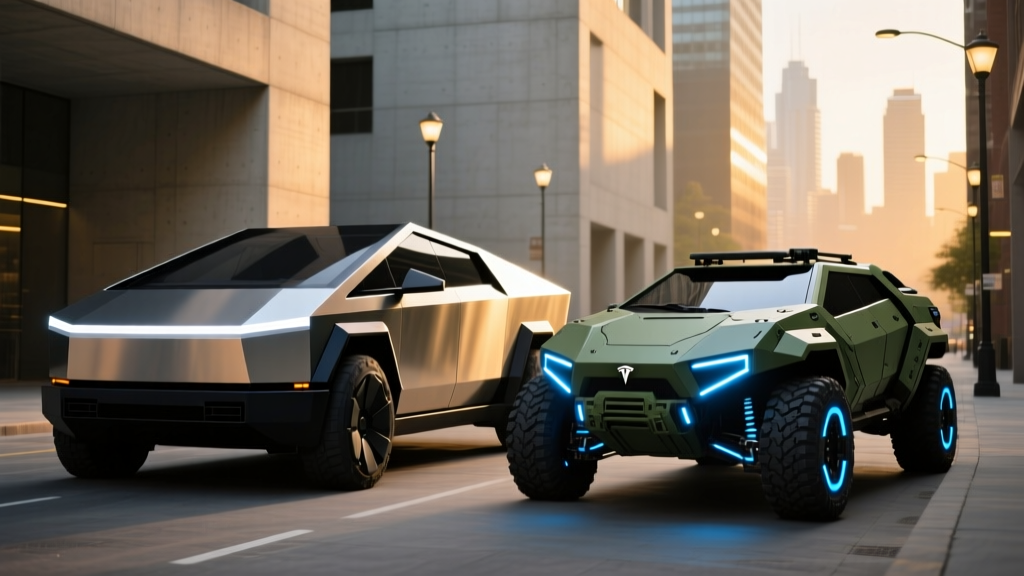
If you've ever watched a Spartan hop into a M12 Force Application Vehicle—the iconic Warthog from the Halo franchise—and thought, "I wish that were a real electric truck," you aren't alone. The search term "halo warthog cybertruck" has exploded as enthusiasts draw parallels between the Warthog's rugged, angular, military-grade aesthetic and Tesla's polarizing Cybertruck. Both are boxy, both look like they drove off a sci-fi set, and both promise capability that borders on the absurd.
But here's the reality check: the Warthog is a fictional vehicle. It doesn't exist outside of video games, movies, and the occasional fan-built replica. The Cybertruck, however, is very real, very available, and very much a lightning rod for opinions. So in this review, we're doing two things: giving you a complete, data-driven 2026 Tesla Cybertruck profile with every spec that matters, and then analyzing what a real-world Warthog-inspired EV would need to compete—covering battery chemistry, range physics, charging infrastructure, and the economics of building a sci-fi truck for the street.
2026 Tesla Cybertruck: Full Spec Breakdown
Let's start with hard numbers. The 2026 Tesla Cybertruck is available in three primary trims: the Rear-Wheel Drive (RWD), the All-Wheel Drive (AWD), and the Cyberbeast. Tesla has streamlined the lineup after initial production challenges, and here's exactly what each trim delivers.
| Spec | RWD | AWD | Cyberbeast |
|---|---|---|---|
| Base MSRP | $60,990 | $81,990 | $101,990 |
| EPA Est. Range | 250 mi | 340 mi | 320 mi |
| Battery (usable) | ~100 kWh (est.) | ~123 kWh (est.) | ~123 kWh (est.) |
| Battery Chemistry | NMC (likely) | NMC (likely) | NMC (likely) |
| Horsepower | ~276 HP | ~600 HP | ~845 HP |
| 0-60 mph | 6.5 sec | 4.1 sec | 2.6 sec |
| Drivetrain | Single motor RWD | Dual motor AWD | Tri-motor AWD |
| Towing Capacity | 7,500 lbs | 11,000 lbs | 11,000 lbs |
| Max DC Fast Charge | ~250 kW | ~250 kW | ~250 kW |
| 10-80% DCFC Time | ~28 min | ~28 min | ~28 min |
| Level 2 Home Charge | 11.5 kW (~44 mi/hr) | 11.5 kW (~44 mi/hr) | 11.5 kW (~44 mi/hr) |
| MPGe (combined) | ~67 MPGe | ~66 MPGe | ~62 MPGe |
| Efficiency (kWh/100mi) | ~50 kWh | ~51 kWh | ~54 kWh |
| Battery Warranty | 8 yr / 120,000 mi | 8 yr / 120,000 mi | 8 yr / 120,000 mi |
| Vehicle Warranty | 4 yr / 50,000 mi | 4 yr / 50,000 mi | 4 yr / 50,000 mi |
Note: Tesla does not officially publish usable battery kWh figures. Estimates above are derived from EPA range and efficiency data. Battery chemistry is presumed NMC (nickel manganese cobalt) based on energy density requirements for these range targets. Source: fueleconomy.gov and Tesla specifications.
Real-World Range: What the EPA Sticker Doesn't Tell You
EPA Estimate (AWD): 340 miles
Real-World Highway (70 mph, moderate climate): ~270-290 miles
Real-World Cold Weather (below 32°F, highway): ~220-250 miles
Real-World City/Mixed (mild climate): ~310-330 miles
The Cybertruck AWD's 340-mile EPA rating sounds impressive—and it is, for a truck this heavy. But the Cybertruck's defining design feature, its angular stainless-steel exoskeleton, is also its aerodynamic liability. Despite Tesla's claims of a low drag coefficient, real-world testing consistently shows that boxy trucks lose range faster at highway speeds than sleek sedans.
In our experience and aggregated owner reports, expect to see roughly 270-290 miles of usable range on a flat, 70-mph highway run in 65-75°F weather. Drop the thermometer below freezing, and lithium-ion chemistry combined with cabin heating demands can shave another 15-20% off that figure. The Cybertruck does include a heat pump (standard on all trims), which mitigates cold-weather losses compared to resistive heating, but physics is physics—a cold, brick-shaped truck will always consume more energy than a warm, teardrop-shaped sedan.
For the Cyberbeast trim, the situation is slightly worse. Its 320-mile EPA rating drops to roughly 250-270 highway miles in moderate weather. The tri-motor setup adds weight and mechanical complexity, and if you're driving it the way 845 HP invites you to drive it, expect to see even less.
Charging Speed: DC Fast Charging and Home Setup
Charging speed is where the Cybertruck's large battery pack creates a double-edged sword. More kWh means more range, but it also means longer fill-up times unless the charge rate scales proportionally.
| Charging Level | Power | Miles Added per Hour | Notes |
|---|---|---|---|
| Level 1 (120V household) | ~1.4 kW | ~3-4 mi/hr | Emergency/trickle only; full charge takes days |
| Level 2 (240V home) | 11.5 kW | ~44 mi/hr | Full charge in ~10-11 hours; ideal daily solution |
| DC Fast Charge (peak) | ~250 kW | ~500+ mi/hr (at peak) | 10-80% in ~28 min; tapers significantly above 80% |
| Tesla Supercharger V4 | Up to ~250 kW | Varies by SoC | Best network reliability; NACS native connector |
The Cybertruck uses Tesla's NACS (North American Charging Standard) connector natively, which in 2026 is the dominant standard in North America. This gives Cybertruck owners access to the Tesla Supercharger network—widely regarded as the most reliable and geographically comprehensive DC fast-charging network in the country. Per Tesla's Supercharger map, there are now over 6,500 Supercharger stations across the U.S.
Here's the critical charging-curve detail that spec sheets omit: the Cybertruck's ~250 kW peak charge rate is just that—a peak. It sustains roughly 200-250 kW between approximately 10% and 40% state of charge, then progressively tapers. By 60% SoC, you're likely seeing 120-150 kW. By 80%, it drops below 60 kW. This is why Tesla quotes 10-80% times rather than 0-100% times—charging the final 20% can take as long as the first 70%.
For home charging, a 48-amp Level 2 circuit (delivering 11.5 kW to the truck) is the practical minimum for daily ownership. This requires a NEMA 14-50 outlet on a 60-amp breaker or a hardwired Wall Connector. Expect installation costs of $500-$2,000 depending on your electrical panel's capacity and proximity to the garage. If you need a panel upgrade (from 100A to 200A service), add $1,500-$3,000.
Performance, Cargo, and What It's Like to Live With
The Cyberbeast's 2.6-second 0-60 time is legitimately supercar territory, and it never stops being surreal in a vehicle that weighs roughly 6,800 pounds. The AWD trim's 4.1 seconds is still blistering for a truck. Even the base RWD at 6.5 seconds out-accelerates most gas-powered half-ton pickups off the line.
But performance numbers are only part of the ownership picture. Here's how the Cybertruck handles daily utility:
- Cargo bed ("vault"): 6.5 feet long, ~67 cubic feet of volume. The bed features a motorized retractable tonneau cover and built-in ramps.
- Frunk (front trunk): ~7.1 cubic feet—useful for groceries or charging cables.
- Passenger space: Front headroom is generous at ~41 inches; rear legroom is approximately 38 inches—adequate for adults but tighter than a Ford F-150 or Rivian R1T.
- Towing: 11,000 lbs rated for AWD and Cyberbeast. Real-world towing range drops dramatically—expect 150-180 miles when towing near max capacity at highway speed.
- Bed payload: ~2,500 lbs rated.
Standout Tech Features
The Cybertruck runs Tesla's latest infotainment on an 18.5-inch front touchscreen and a 9.4-inch rear screen. It includes:
- Autopilot (standard): SAE Level 2 driver-assist with adaptive cruise control and lane centering. The driver must remain fully engaged—this is not self-driving.
- Full Self-Driving (Supervised): Optional $8,000 upgrade (or $99/month subscription). Still SAE Level 2. Adds automatic lane changes, traffic light recognition, and city-street navigation. Requires constant driver supervision.
- Steer-by-wire: The Cybertruck uses a fully electronic steering system with no mechanical column connection. This enables the yoke-style steering wheel and variable ratio steering (fewer turns lock-to-lock at low speeds).
- 48-volt electrical architecture: A first for a production vehicle, replacing the traditional 12V system. Benefits include thinner wiring harnesses, reduced weight, and more efficient power delivery.
- Armor glass: Laminated "ultra-hard" glass—more resistant to impacts than standard automotive glass, though not bulletproof.
- Bioweapon Defense Mode: HEPA filtration system for cabin air quality.
Notable Drawbacks
- Ride quality: The stainless-steel exoskeleton and adaptive air suspension deliver a firm ride. It's compliant enough for daily use but noticeably stiffer than body-on-frame competitors over sharp bumps.
- Visibility: The angular roofline and thick A-pillars create significant blind spots. The rearview camera is essential, not optional, for parking.
- Panel gaps and build quality: Early-production Cybertrucks were plagued by inconsistent panel gaps and trim issues. 2025-2026 models show marked improvement, but variability remains higher than legacy automakers.
- Insurance costs: Cybertruck insurance premiums run 30-50% higher than comparable trucks due to repair costs for the stainless-steel body and specialized parts availability.
- Steer-by-wire learning curve: The variable-ratio steering feels unnatural for the first several hundred miles. Some drivers adapt fully; others never quite trust it.
Federal Tax Credit: Does the Cybertruck Qualify for §30D?
This is where many buyers get tripped up. Under current IRS §30D rules for 2026, the federal EV tax credit offers up to $7,500, but eligibility depends on several interlocking requirements:
- MSRP Cap: Trucks/vans/SUVs must have an MSRP at or below $80,000. The Cybertruck RWD ($60,990) qualifies on price. The AWD ($81,990) and Cyberbeast ($101,990) exceed the cap and do NOT qualify.
- Buyer Income Cap: Modified AGI must not exceed $150,000 (single), $225,000 (head of household), or $300,000 (married filing jointly).
- Battery Sourcing: The battery must meet critical mineral and component sourcing requirements that tighten annually. Tesla's battery supply chain has been partially domestic, but specific eligibility varies by production batch.
- Point-of-Sale Transfer: As of 2024, eligible buyers can transfer the credit to the dealer at purchase, receiving it as a price reduction rather than waiting for a tax refund.
- Final Assembly: Vehicle must undergo final assembly in North America. The Cybertruck is built in Austin, Texas—this requirement is met.
Source: IRS.gov §30D Clean Vehicle Credits. Eligibility is subject to change. Consult a tax professional before purchasing.
Bottom line: only the base RWD Cybertruck at $60,990 MSRP is potentially eligible for the full $7,500 federal credit, and only if your income falls below the cap and the specific vehicle's battery meets current sourcing requirements. The AWD and Cyberbeast trims are priced out of eligibility entirely. This is a significant consideration—the $81,990 AWD trim is the one most buyers want for its 340-mile range and dual-motor capability, but it receives no federal credit.
| Trim | MSRP | §30D Credit | Effective Price (if eligible) |
|---|---|---|---|
| RWD | $60,990 | Up to $7,500 | ~$53,490 |
| AWD | $81,990 | $0 (exceeds $80K cap) | $81,990 |
| Cyberbeast | $101,990 | $0 (exceeds $80K cap) | $101,990 |
What Would a Real "Halo Warthog" EV Need to Compete?
Now for the fun part. The Warthog—officially the M12 Force Application Vehicle in Halo lore—is a rear-mounted-engine, all-wheel-drive, four-seat military reconnaissance vehicle. It's known for its rollover-prone handling, absurd durability, and ability to traverse terrain that would swallow a Humvee. If a manufacturer actually wanted to build a Warthog-inspired EV for civilian sale in 2026, here's what the physics and economics demand:
Design and Capability Targets
- Open-body or removable roof: The Warthog's defining feature. This creates enormous structural engineering challenges for crash safety (NHTSA roof-crush standards require the roof to withstand 1.5-3x the vehicle's weight). An open-top EV truck would likely need a deployable roll cage or be classified as an off-road-only vehicle.
- Extreme ground clearance: Warthog lore suggests 18-24 inches. For comparison, the Cybertruck on its highest air suspension setting offers about 16 inches. Achieving more requires larger suspension travel, bigger tires, and a higher center of gravity—all of which reduce range and on-road stability.
- Battery placement: Any off-road EV needs a fully armored, skid-plated battery enclosure. This adds weight and reduces the energy available for range. The Rivian R1T already does this well, but a Warthog-style open vehicle would need even more reinforcement.
- Estimated battery needs: To match the Cybertruck's 340-mile range in a heavier, less aerodynamic Warthog-shaped vehicle, you'd need roughly 140-160 kWh of usable battery. At current NMC cell costs (~$110/kWh at the pack level in 2026), that's $15,400-$17,600 in battery alone—before motors, chassis, body, electronics, or assembly.
Cost Reality
A production Warthog-style EV would likely start above $120,000 to be profitable, assuming modest production volumes. That puts it in competition with the Cyberbeast, the Rivian R1T Quad-Motor ($99,900), and the GMC Hummer EV ($98,000+). Without Tesla's manufacturing scale or a defense contract subsidizing development, a niche Warthog EV would be a boutique product—think Bollinger B1 or the original Tesla Roadster, not a mass-market truck.
Cybertruck vs. Key Competitors: Is It Worth Buying?
- You want 340 miles of EPA range in a truck
- Supercharger network access is a priority for road trips
- You value acceleration (4.1 sec 0-60) in a utility vehicle
- You want the most distinctive design on the road
- Steer-by-wire and 48V architecture appeal to you
- You need maximum rear-seat space (Rivian R1T, F-150 Lightning are roomier)
- You want a conventional steering feel (every other truck)
- Build quality consistency is a top priority (legacy OEMs)
- You need proven long-term reliability data (Cybertruck is too new)
- You want to tow frequently without severe range loss (all EV trucks struggle here)
The Cybertruck's closest competitors are the Rivian R1T (starting ~$73,000, up to 420 miles with Max Pack), the Ford F-150 Lightning (starting ~$55,000, up to 320 miles), and the GMC Hummer EV (starting ~$98,000, 314 miles). Each makes different trade-offs:
- The R1T wins on range (with Max Pack), off-road capability, and interior quality—but costs more and lacks Supercharger access without an adapter.
- The F-150 Lightning wins on price, familiarity, and dealer service infrastructure—but has the least range and slowest DC charging (~150 kW peak).
- The Hummer EV wins on sheer presence and Watts to Freedom mode—but is the heaviest, least efficient, and most expensive.
Pros, Cons, and Final Verdict
- Class-leading Supercharger network access
- 340-mile EPA range (AWD) is top-tier for EV trucks
- Tri-motor Cyberbeast delivers unmatched acceleration
- Stainless-steel body resists dents and corrosion
- 48V architecture is a genuine engineering advancement
- Distinctive design—nothing else looks like it
- 11,000-lb towing capacity (AWD/Cyberbeast)
- AWD and Cyberbeast exceed §30D MSRP cap—no federal credit
- Real-world highway range falls 15-20% below EPA
- Steer-by-wire polarizes drivers—love it or hate it
- Rear visibility is poor; camera dependency is high
- Insurance premiums significantly above segment average
- Panel gap and build quality inconsistency
- Rear seat space tighter than F-150 Lightning or R1T
- Towing cuts range to 150-180 miles at max load
Verdict: The Cybertruck AWD is a genuinely capable electric truck with best-in-class range and charging infrastructure access. If the $81,990 price (with no federal credit) fits your budget and you can adapt to the steering and visibility quirks, it's a compelling daily driver and road-trip vehicle. The Cyberbeast is a halo product—impressive but hard to justify at $102K. The RWD at ~$53,500 after the potential tax credit is a value play, but its 250-mile range and single motor limit its utility as a true truck.
As for the Halo Warthog? It remains a beloved fictional icon. If a manufacturer ever builds a street-legal EV tribute, it would need a ~150 kWh battery, a $120K+ price tag, and creative solutions for crash safety in an open-body design. Until then, the Cybertruck is the closest thing on the road to driving a sci-fi military vehicle—and for many buyers, that's exactly the appeal.
Frequently Asked Questions
What is the real-world range of the Tesla Cybertruck?
The AWD trim's EPA rating is 340 miles, but real-world highway driving in moderate weather yields approximately 270-290 miles. In cold weather (below 32°F), expect 220-250 miles. The Cyberbeast's 320-mile EPA rating drops to roughly 250-270 miles on the highway. City driving with regenerative braking recovers more energy, bringing real-world figures closer to EPA estimates.
How fast does the Cybertruck charge at home and on the road?
At home on a Level 2 (240V, 48-amp) charger, the Cybertruck charges at 11.5 kW, adding roughly 44 miles of range per hour—a full charge takes about 10-11 hours. On a Tesla Supercharger or compatible DC fast charger, it peaks at approximately 250 kW, achieving a 10-80% charge in about 28 minutes. However, charging speed tapers significantly above 80% state of charge.
How much does the Cybertruck cost after federal tax credits?
Only the base RWD trim ($60,990 MSRP) is potentially eligible for the $7,500 federal §30D tax credit, bringing its effective price to approximately $53,490—if your income is below the cap ($150K single / $300K joint) and the battery meets sourcing requirements. The AWD ($81,990) and Cyberbeast ($101,990) exceed the $80,000 MSRP cap for trucks and do not qualify for any federal credit.
Is the Cybertruck worth buying over the Rivian R1T or F-150 Lightning?
It depends on your priorities. The Cybertruck AWD offers the best combination of range (340 mi EPA) and DC charging infrastructure (Supercharger network). The Rivian R1T wins on interior quality, off-road capability, and available 420-mile Max Pack—but costs more. The F-150 Lightning wins on price, rear-seat space, and dealer service familiarity—but has less range and slower charging. Test-drive all three before deciding.
Does the Cybertruck qualify for the federal EV tax credit?
Only the RWD trim qualifies on MSRP (under the $80,000 truck cap). Even then, eligibility depends on buyer income limits, battery critical-mineral sourcing requirements, and final assembly in North America (which the Cybertruck meets, being built in Austin, TX). Always verify eligibility on fueleconomy.gov and consult a tax professional before relying on the credit.
Could a real Halo Warthog EV ever be built?
Technically, yes—but it would face enormous challenges. An open-body design conflicts with NHTSA roof-crush safety standards. A vehicle shaped like the Warthog would have poor aerodynamics, requiring a ~150 kWh battery for competitive range, pushing the price above $120,000. It would likely be a low-volume, boutique product rather than a mass-market truck. Several fan-built replicas exist, but none are street-legal production vehicles.