The Quick Verdict: Is the 2026 Tesla Model Y Still the Default EV?
The Tesla Model Y remains the world's best-selling electric vehicle for good reason: it offers a compelling mix of range, charging speed, cargo utility, and access to the largest fast-charging network in North America. But the competition has closed the gap. The Hyundai Ioniq 5, Ford Mustang Mach-E, and Chevrolet Equinox EV all challenge the Model Y on specific metrics — and some undercut it on price after federal incentives.
For 2026, Tesla refreshed the Model Y (internally dubbed "Juniper") with a redesigned interior, updated suspension tuning, a rear touchscreen for passengers, and ambient lighting. The powertrain lineup now includes a Long Range RWD, Long Range AWD, and Performance AWD variant. If you're researching what enthusiasts call "hacking Tesla" — meaning optimizing ownership, maximizing range, and extracting the most value from the ecosystem — this review gives you the exact numbers and decision framework you need.
Range, Efficiency, and the Real-World Reality
The EPA publishes official range estimates, but every experienced EV owner knows the sticker number is a starting point, not a guarantee. Here's what the 2026 Model Y lineup delivers:
| Spec | Long Range RWD | Long Range AWD | Performance AWD |
|---|---|---|---|
| EPA Range | 320 miles | 308 miles | 277 miles |
| Battery (usable) | ~78 kWh (NMC) | ~78 kWh (NMC) | ~78 kWh (NMC) |
| MPGe (combined) | 123 MPGe | 118 MPGe | 111 MPGe |
| Efficiency (kWh/100 mi) | 27 kWh | 28 kWh | 30 kWh |
| 0–60 mph | 5.8 sec | 4.8 sec | 3.5 sec |
| Horsepower | 346 hp | 384 hp | 456 hp |
| Drivetrain | RWD (single motor) | AWD (dual motor) | AWD (dual motor) |
| Base MSRP | $44,990 | $47,990 | $52,490 |
The EPA 320-mile figure for the Long Range RWD assumes a mix of city and highway driving at moderate temperatures. In practice:
- Highway (70–75 mph, summer): Expect ~270–290 miles before needing a charge stop.
- City / suburban mixed driving: 300–315 miles is achievable thanks to regenerative braking.
- Cold weather (below 32°F): Range drops 15–25%. Plan for ~220–260 miles on the Long Range AWD in winter conditions. Preconditioning the battery while plugged in recovers some of this loss.
- Towing: Rated at 3,500 lbs, but towing cuts range roughly in half — expect ~150 miles.
Source: EPA fueleconomy.gov
Charging Speed: DC Fast, Level 2, and the Supercharger Advantage
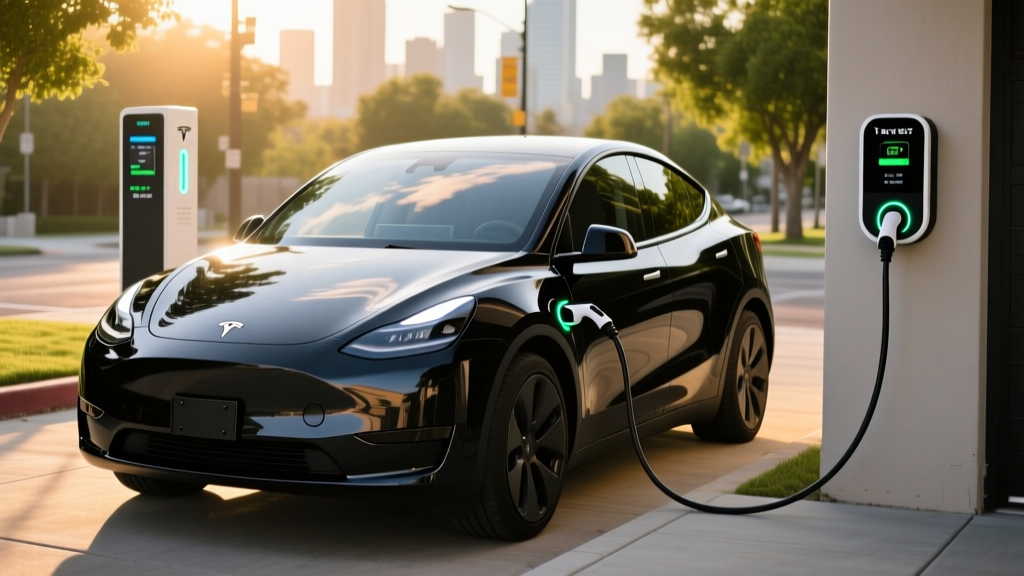
Charging speed is where Tesla still holds a structural advantage. The Supercharger network — now open to other brands via the NACS connector — remains the most reliable DC fast-charging ecosystem in the U.S. Here's what the 2026 Model Y can accept:
| Charging Level | Power / Rate | Estimated Speed |
|---|---|---|
| DC Fast Charge (V3/V4 Supercharger) | Peak 250 kW | 10–80% in ~25 minutes |
| DC Fast Charge (CCS adapter, 350 kW station) | Peak 250 kW (vehicle-limited) | 10–80% in ~25–28 minutes |
| Level 2 (Tesla Wall Connector, 48A / 11.5 kW) | 11.5 kW | ~44 miles per hour of charging |
| Level 2 (standard 240V / 32A outlet) | 7.7 kW | ~30 miles per hour |
| Level 1 (120V household) | ~1.4 kW | ~4–5 miles per hour |
Charging-curve reality: The 250 kW peak only sustains from roughly 10% to 45% State of Charge (SoC). Above 60%, the rate tapers to ~100 kW, and above 85% it drops further to ~40 kW. This is why Tesla (and most EV makers) quote 10–80% times — the last 20% takes nearly as long as the first 70%.
Owner hack: Always precondition the battery before arriving at a Supercharger. Navigate to the charger in the Tesla app or in-car nav, and the car will warm or cool the battery to optimal temperature, shaving 3–5 minutes off your charge session — especially critical in winter.
Pricing, Tax Credits, and Total Cost of Ownership
Sticker price is only part of the equation. The federal EV tax credit under IRS §30D can reduce your effective cost by up to $7,500, but eligibility depends on several factors that change periodically:
| Trim | MSRP | Est. Destination | Max §30D Credit | Effective Price (if eligible) |
|---|---|---|---|---|
| Long Range RWD | $44,990 | $1,390 | $7,500 | ~$38,880 |
| Long Range AWD | $47,990 | $1,390 | $7,500 | ~$41,880 |
| Performance AWD | $52,490 | $1,390 | $7,500 | ~$46,380 |
Tax credit eligibility is NOT automatic. Under current §30D rules, you must meet ALL of the following:
- MSRP cap: SUVs must be at or below $80,000 (all Model Y trims qualify).
- Buyer income cap: Modified AGI ≤ $150,000 (single), $225,000 (head of household), $300,000 (joint).
- Battery sourcing: A percentage of critical minerals and battery components must be sourced from the U.S. or FTA partners. Tesla's U.S.-built battery cells (from the Nevada and Texas gigafactories) generally meet current thresholds, but the specific dollar amount ($3,750 for minerals + $3,750 for components) can shift as sourcing rules tighten annually.
- Point-of-sale transfer: As of 2024+, you can transfer the credit to the dealer at purchase, reducing your out-of-pocket cost immediately rather than waiting for tax filing.
Always verify current-year requirements at IRS.gov or consult a tax professional before purchase.
Interior, Cargo, and Daily Livability
The Juniper refresh brought meaningful interior upgrades: ventilated front seats, a rear 8-inch touchscreen, improved sound insulation, and ambient lighting that finally matches what Hyundai and BMW have been offering for years. The minimalist cabin remains polarizing — there are still no physical buttons for climate or mirrors — but the build quality gap between Tesla and legacy automakers has narrowed.
Cargo capacity:
- Behind second row: 30.2 cu ft
- Second row folded: 72.1 cu ft
- Front trunk (frunk): 4.1 cu ft — fits a laptop bag or charging cables, not a full suitcase
Passenger space:
- Front legroom: 41.8 inches
- Rear legroom: 41.6 inches — generous for a compact crossover, enough for adults on long trips
- Seating: 5 standard; a 7-seat option (third row) was available in prior model years but has been discontinued for the Juniper generation
Notable drawback: The glass roof provides an airy feel but offers no retractable shade. In hot climates, cabin temperatures can spike, and Tesla's cabin overheat protection feature draws from the battery. Many owners purchase aftermarket shades (~$40–$80) as a practical fix.
Driver-Assist Tech: Autopilot and FSD Supervised
Tesla's Autopilot (standard) and Full Self-Driving Supervised ($8,000 option or $99/month) are Level 2 driver-assist systems. The driver must remain fully engaged, hands on or near the wheel, and eyes on the road at all times. These are NOT self-driving systems. Tesla's FSD branding has drawn regulatory scrutiny from NHTSA over exactly this distinction.
What Autopilot (standard) includes: Traffic-aware cruise control, lane-centering assist, automatic emergency braking, blind-spot monitoring, and lane-departure warning.
What FSD Supervised adds: Navigate on Autopilot (highway on/off-ramps and lane changes), autosteer on city streets, traffic light and stop sign recognition, and smart summon (car navigates parking lots to you). In 2026 testing, FSD handles most suburban and highway scenarios competently but still struggles with construction zones, unprotected left turns in heavy traffic, and poorly marked rural roads.
Owner hack: If you don't need city-street autosteer, the standard Autopilot handles highway driving excellently and is included at no extra cost. The $8,000 FSD premium is difficult to justify for most buyers unless you commute daily in complex urban environments and value the convenience — not the safety — benefit.
Warranty, Battery Longevity, and What to Expect
Tesla's warranty structure is competitive but not class-leading:
- Basic vehicle: 4 years / 50,000 miles
- Battery and drive unit: 8 years / 120,000 miles (Long Range AWD & Performance) or 8 years / 100,000 miles (RWD)
- Capacity retention guarantee: Tesla warrants the battery will retain at least 70% of original capacity during the warranty period
Battery chemistry: The 2026 Model Y Long Range and Performance trims use NMC (nickel manganese cobalt) chemistry, which offers higher energy density than LFP but benefits from charging to 80% for daily use to minimize degradation. Tesla recommends setting the charge limit to 100% only before long road trips.
Real-world degradation data: Tesla's own impact reports and third-party fleet data (from sources like Recurrent Auto) show NMC packs typically lose ~5–8% capacity over the first 100,000 miles, then degradation slows significantly. Many Model Y vehicles from 2020–2022 still report 90%+ State of Health (SoH) at 80,000 miles.
Replacement cost: Out-of-warranty battery replacement runs approximately $12,000–$16,000 including labor. This is a worst-case scenario — the vast majority of Model Y batteries outlast the vehicle's useful life.
Pros and Cons at a Glance
Pros
- Best-in-class Supercharger network access (19,000+ stalls in North America)
- Strong real-world efficiency — 27 kWh/100 mi is excellent for an AWD crossover
- Over-the-air updates add features post-purchase (new UI, safety features, entertainment)
- Low maintenance costs — no oil changes, minimal brake wear from regen
- Class-leading cargo volume (72.1 cu ft folded) beats Ioniq 5 and Mach-E
- Strong resale value relative to most EVs
Cons
- Touchscreen-only controls for climate, mirrors, and glovebox frustrate some drivers
- No physical instrument cluster — all info on the center screen
- FSD Supervised costs $8,000 and remains Level 2 (not autonomous)
- Ride quality improved with Juniper but still firmer than Ioniq 5 or Equinox EV
- Insurance premiums run 15–30% higher than comparable gas crossovers
- Glass roof lacks a retractable shade
Who Should Buy the 2026 Tesla Model Y?
Choose the Model Y if:
- You road-trip regularly and want the most reliable, widespread DC fast-charging network
- You value OTA software updates and a tech-forward ownership experience
- You need maximum cargo space in a compact electric crossover
- You want strong resale value and brand recognition
Consider a competitor if:
- You want a more traditional interior with physical buttons → Hyundai Ioniq 5 or Ford Mach-E
- You need a lower entry price with federal credit → Chevrolet Equinox EV (from ~$33,000 after credit)
- You prioritize ride comfort over sportiness → Hyundai Ioniq 5
- You want 800V ultra-fast charging architecture → Hyundai Ioniq 5 / Kia EV6 (10–80% in ~18 min on 350 kW chargers)
Frequently Asked Questions
What is the real-world range of the 2026 Tesla Model Y?
The EPA rates the Long Range RWD at 320 miles and the Long Range AWD at 308 miles. In real-world highway driving at 70–75 mph, expect 270–290 miles. In cold weather (below freezing), plan for a 15–25% reduction — roughly 220–260 miles for the AWD variant.
How fast does the Model Y charge on DC fast chargers and at home?
On a V3 or V4 Supercharger, the Model Y peaks at 250 kW and charges from 10–80% in approximately 25 minutes. At home on a Level 2 Tesla Wall Connector (11.5 kW), you'll add about 44 miles of range per hour — enough to fully recharge overnight from any daily driving.
Does the 2026 Tesla Model Y qualify for the federal EV tax credit?
Yes, all Model Y trims fall under the $80,000 SUV MSRP cap. However, buyer eligibility depends on income limits ($150K single / $300K joint), and the full $7,500 credit depends on battery-component and critical-minerals sourcing thresholds that adjust annually. Verify current rules at IRS.gov and consider the point-of-sale transfer option to reduce your upfront cost.
Is the Tesla Model Y worth buying versus the Hyundai Ioniq 5 or Ford Mach-E?
The Model Y wins on charging-network reliability, cargo space, and software. The Ioniq 5 wins on 800V charging speed (faster 10–80% on compatible chargers), ride comfort, and interior design. The Mach-E offers a more engaging driving experience and traditional controls. If Supercharger access matters most to you, the Model Y still leads. If you want the best ride quality or a lower price, test-drive the Ioniq 5.
What are the biggest ownership hacks for the Model Y?
Set daily charge limit to 80% to preserve NMC battery health. Always precondition before Supercharging. Use the Tesla app's scheduled departure feature to warm the cabin and battery on winter mornings while plugged in — this preserves range significantly. Buy an aftermarket glass roof shade for summer. And if you don't need city-street autosteer, skip the $8,000 FSD package — standard Autopilot handles highways well.
How long will the Model Y battery last?
Tesla warranties the battery for 8 years / 100,000–120,000 miles (depending on trim) with a 70% capacity retention guarantee. Fleet data suggests NMC packs lose ~5–8% in the first 100,000 miles, then degradation plateaus. With proper charging habits (80% daily limit, avoiding prolonged 100% SoC), most Model Y batteries should outlast 200,000 miles with usable capacity.