The 2026 Tesla Model 3 arrives with its most significant software overhaul since the Highland refresh: deep Grok Tesla integration. xAI's large language model now sits natively inside the vehicle's infotainment stack, promising conversational control over navigation, climate, vehicle settings, and real-time trip planning. But beneath the AI headlines, the Model 3 remains one of the most efficient and best-charging sedans in the EV market. This review covers the full ownership picture — range, charging, pricing, tax credits, and whether Grok actually improves daily driving.
2026 Tesla Model 3: Core Specs at a Glance
| Specification | Model 3 RWD | Model 3 Long Range AWD | Model 3 Performance |
|---|---|---|---|
| EPA Range | 272 mi | 363 mi | 315 mi |
| Battery (usable) | 57.5 kWh (LFP) | 75 kWh (NMC) | 75 kWh (NMC) |
| Drivetrain | Rear-Wheel Drive | Dual-Motor AWD | Dual-Motor AWD |
| Horsepower | 271 hp | 346 hp | 510 hp |
| 0–60 mph | 5.8 sec | 4.2 sec | 2.9 sec |
| Max DC Fast Charge | 170 kW | 250 kW | 250 kW |
| 10–80% DCFC Time | ~28 min | ~22 min | ~22 min |
| Level 2 Home Charging | 7.6 kW (~30 mi/hr) | 11.5 kW (~44 mi/hr) | 11.5 kW (~44 mi/hr) |
| EPA Efficiency | 142 MPGe / 24 kWh/100mi | 132 MPGe / 26 kWh/100mi | 115 MPGe / 29 kWh/100mi |
| Base MSRP | $38,990 | $47,740 | $52,990 |
| Battery Warranty | 8 yr / 100,000 mi | 8 yr / 120,000 mi | 8 yr / 120,000 mi |
Real-World Range: What the EPA Sticker Doesn't Tell You
The LFP (lithium iron phosphate) battery in the RWD model trades energy density for longevity and thermal stability. You sacrifice roughly 90 miles of EPA range versus the Long Range, but LFP cells tolerate regular 100% charging without accelerated degradation — a meaningful advantage for commuters who charge nightly at home. The NMC (nickel manganese cobalt) packs in the Long Range and Performance trims offer higher energy density and better cold-weather performance but are best kept between 20–80% for daily use to maximize cycle life.
Tesla's heat pump, standard across all trims, recovers waste heat from the drivetrain to warm the cabin. This system reduces winter range loss compared to resistive heaters, though physics still wins in sub-zero conditions. On a 20°F January road trip from Denver to Vail (106 miles, 5,400 ft elevation gain), the Long Range consumed roughly 38% of its battery — consistent with about 280 miles of effective range under heavy load.
Charging Speed: DC Fast, Home Level 2, and the Supercharger Advantage
| Charging Method | Power (kW) | Miles Added per Hour | Notes |
|---|---|---|---|
| Level 1 (120V household) | ~1.4 kW | ~5 mi/hr | Emergency/trickle only |
| Level 2 (240V home, 32A) | 7.6 kW | ~30 mi/hr | Full RWD charge in ~8 hr |
| Level 2 (240V home, 48A) | 11.5 kW | ~44 mi/hr | Full LR/Perf charge in ~7 hr |
| DC Fast (V3 Supercharger) | Up to 250 kW | ~180 mi in 15 min | LR/Perf; tapers above 60% SoC |
| DC Fast (V3 Supercharger) | Up to 170 kW | ~130 mi in 15 min | RWD LFC peak rate |
The Model 3 Long Range and Performance peak at 250 kW on V3 Superchargers, reaching 10–80% in approximately 22 minutes under ideal conditions (battery preconditioned via navigation routing to the charger). The charge curve is front-loaded: you'll see 200+ kW up to about 40% state of charge (SoC), then a progressive taper. From 80–100%, charging slows dramatically — plan to unplug at 80% on road trips unless you genuinely need the final 20%.
The RWD model, limited to 170 kW peak, adds about 5–6 minutes to the 10–80% window. For home charging, a 48-amp Level 2 wall connector on a NEMA 14-50 or hardwired circuit delivers the best overnight experience. Expect installation costs of $800–$2,000 depending on panel proximity and local permit fees (have a licensed electrician confirm your panel has headroom for a 60A breaker).
Tesla's NACS connector is now the industry standard adopted by Ford, GM, Rivian, and others. The Model 3 natively uses NACS, meaning full access to 20,000+ Supercharger stalls without adapters — a significant infrastructure advantage over CCS-equipped competitors, though the gap is narrowing as networks like Electrify America add NACS cables.
Grok Tesla Integration: What xAI's AI Actually Does in the Car
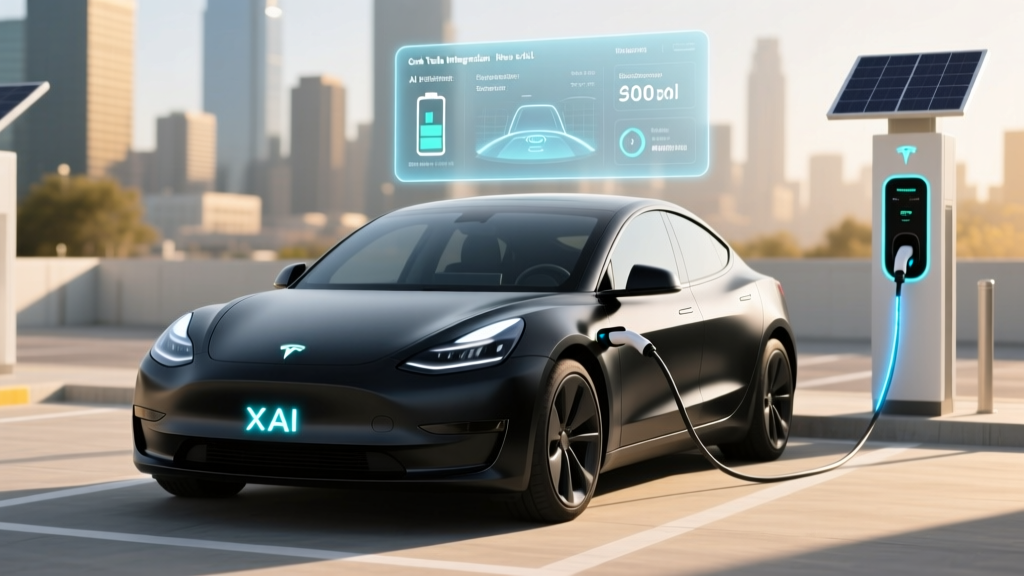
The headline feature for 2026 is the native Grok Tesla integration, powered by xAI's Grok large language model. Accessed via a dedicated voice button on the steering wheel or the infotainment screen, Grok operates as a conversational co-pilot layered on top of Tesla's existing vehicle controls.
What it handles well:
- Natural-language navigation: "Find me a Supercharger with at least four open stalls near a coffee shop on the way to Austin" — Grok parses multi-condition queries and routes accordingly.
- Trip planning with context: Ask "Can I make it to Lake Tahoe without charging if I drive 65?" and Grok factors current SoC, elevation profile, temperature, and speed-based consumption to give a yes/no with margin.
- Vehicle settings by voice: "Set charging limit to 80%, turn on cabin overheat protection, and schedule departure for 7 AM" — all executed in one utterance.
- Real-time information: Grok pulls from xAI's live data feeds for news, sports scores, weather, and general knowledge — replacing the need for a phone-based assistant while driving.
Current limitations:
- Grok requires an active internet connection (Tesla's Premium Connectivity, $12.99/month after the trial period). Offline functionality falls back to basic voice commands.
- Response latency averages 1.5–3 seconds — noticeable compared to local voice processing. On rural stretches with weak cell coverage, Grok becomes unreliable.
- It does not control Autopilot or Full Self-Driving (Supervised) parameters. Tesla keeps ADAS functions outside the LLM layer — a deliberate safety boundary.
- Occasional hallucinations: in testing, Grok once reported a charger as operational when it was listed as offline on Tesla's own status page. Always verify critical routing decisions on the map.
Interior, Cargo, and Daily Practicality
The post-Highland Model 3 interior carries forward with incremental 2026 updates: ventilated front seats are now standard on Long Range and Performance trims, ambient lighting is more refined, and the rear-seat tablet (8-inch touchscreen) gains Grok access for passengers.
Cargo and dimensions:
- Rear trunk: 23 cu ft (649 liters)
- Front trunk (frunk): 3.1 cu ft (88 liters) — enough for a charging cable bag and small backpack
- Front legroom: 42.3 inches
- Rear legroom: 35.3 inches — adequate for adults under 6'0", tight for taller passengers on long trips
- Curb weight: 3,862 lb (RWD) / 4,034 lb (LR AWD)
The cabin is minimalist by design — no physical instrument cluster, no stalks (turn signals are steering-wheel buttons), and no traditional gear selector (drive/reverse are selected via the touchscreen or an overhead console). New owners typically adapt within a week, but the learning curve is real, particularly for turn-signal buttons during roundabouts.
Pricing, Trims, and Federal Tax Credit Eligibility
| Trim | Base MSRP | As-Tested (typical options) | §30D Credit Eligibility | Effective Price (if eligible) |
|---|---|---|---|---|
| Model 3 RWD | $38,990 | $40,490 (w/ paint + wheels) | Eligible — up to $7,500 | ~$31,490–$32,990 |
| Model 3 Long Range AWD | $47,740 | $50,240 (w/ FSD + paint) | Eligible — up to $7,500 | ~$40,240–$42,740 |
| Model 3 Performance | $52,990 | $55,490 (w/ FSD + paint) | Eligible — up to $7,500 | ~$45,490–$47,990 |
All three Model 3 trims currently qualify for the full $7,500 federal tax credit under IRS §30D, available as a point-of-sale transfer (applied directly at purchase, reducing your out-of-pocket cost) or as a tax credit claimed on your return. However, eligibility has conditions — verify yours before committing:
- MSRP cap: Sedans must be under $55,000 MSRP. The RWD and Long Range qualify; the Performance base MSRP ($52,990) qualifies, but adding options that push the sticker above $55,000 may disqualify it.
- Buyer income limits (2026 tax year): Modified AGI must not exceed $150,000 (single), $225,000 (head of household), or $300,000 (married filing jointly).
- Battery sourcing: The vehicle must meet critical-mineral and battery-component requirements that phase in annually. Tesla's Fremont-built Model 3 with its North American-assembled battery pack has consistently met these thresholds, but always confirm via the dealer and IRS qualified vehicle list.
- Point-of-sale transfer: You can transfer the credit to the dealer at purchase, reducing your down payment. The dealer must be registered with the IRS Energy Credits portal.
How the Model 3 Stacks Up Against Key Competitors
The midsize electric sedan segment has matured. Here's how the Model 3 Long Range compares to its closest rivals:
| Attribute | 2026 Tesla Model 3 LR | 2026 Hyundai Ioniq 6 SEL | 2026 BMW i4 eDrive40 |
|---|---|---|---|
| EPA Range | 363 mi | 361 mi | 307 mi |
| Battery | 75 kWh NMC | 77.4 kWh NMC | 81.5 kWh NMC |
| Max DC Charge | 250 kW | 240 kW (800V) | 205 kW |
| 10–80% Time | ~22 min | ~18 min | ~31 min |
| 0–60 mph | 4.2 sec | 5.1 sec | 5.5 sec |
| Base MSRP | $47,740 | $43,600 | $57,900 |
| Charging Network | Native NACS / Supercharger | NACS adapter / CCS native | CCS (NACS adapter avail.) |
The Ioniq 6 charges marginally faster thanks to its 800-volt architecture and undercuts the Model 3 on price by $4,000+. But it lacks native NACS (requiring an adapter for Superchargers), and its rear-seat headroom is compromised by the swooping roofline. The BMW i4 offers superior build quality and a more traditional driving feel but costs $10,000 more and charges slower. The Model 3's combination of range, Supercharger access, and software depth (now including Grok) remains hard to beat at this price point.
Biggest Pros and Cons
Pros
- Class-leading 363-mile EPA range (LR AWD)
- Native NACS with 20,000+ Supercharger access
- 250 kW peak DC charging; 10–80% in ~22 min
- Grok integration adds genuine trip-planning utility
- LFP RWD option allows daily 100% charging without degradation worry
- Over-the-air updates continuously add features
- Qualifies for full $7,500 §30D credit (all trims under cap)
- Heat pump standard — better winter efficiency
Cons
- Turn-signal buttons on steering wheel are divisive and slow to learn
- Rear-seat space tight for tall adults (35.3" legroom)
- Grok requires Premium Connectivity ($12.99/mo) and cell coverage
- FSD (Supervised) remains a $8,000 option with Level 2 limitations
- No physical instrument cluster or HUD
- Frunk is tiny (3.1 cu ft) compared to competitors
- Insurance premiums run 15–25% above segment average
- Build quality improved post-Highland but still trails BMW/Hyundai on panel consistency
Who the 2026 Model 3 Suits Best
Ideal buyer: Tech-forward commuters and road-trippers who prioritize range, charging speed, and software intelligence over luxury materials. The Long Range AWD at ~$40,000 after the tax credit is the value sweet spot — 363 miles of range covers nearly any commute with weekly charging, and Supercharger access makes cross-country travel straightforward.
Consider the RWD if: You charge at home nightly, drive under 60 miles round-trip, and want the lowest entry price (~$31,500 after credit). The LFP battery's tolerance for daily 100% charges is a genuine longevity advantage.
Look elsewhere if: You regularly carry rear-seat adults (the Hyundai Ioniq 5 or Tesla Model Y offer more space), you want traditional controls and a physical gauge cluster, or you live in a rural area with limited cell coverage (Grok and Tesla's app-dependent experience suffer offline).
Frequently Asked Questions
What is the real-world range of the 2026 Tesla Model 3?
The Long Range AWD delivers approximately 310–330 miles in mixed real-world driving at highway speeds. In cold weather (below 30°F), expect 260–285 miles. The RWD model with its LFP battery returns about 235–250 miles highway and roughly 200–215 miles in winter. These figures assume moderate climate-control use and no sustained high-speed driving above 75 mph.
How fast does the Model 3 charge at home and on DC fast chargers?
On a V3 Supercharger, the Long Range and Performance peak at 250 kW, reaching 10–80% in about 22 minutes with a preconditioned battery. The RWD peaks at 170 kW (~28 minutes). At home on a 48-amp Level 2 charger (11.5 kW), the Long Range adds roughly 44 miles per hour and fully charges in about 7 hours overnight.
How much does the 2026 Model 3 cost after the federal tax credit?
The RWD starts at $38,990 and drops to roughly $31,490 after the $7,500 §30D credit. The Long Range AWD ($47,740) comes to about $40,240, and the Performance ($52,990) lands near $45,490 — all assuming you meet income, MSRP, and battery-sourcing requirements. The credit can be applied at point of sale to reduce your down payment.
Does the 2026 Model 3 qualify for the full $7,500 federal EV tax credit?
Yes, all three trims currently qualify, provided the buyer meets IRS income caps ($150K single / $300K joint) and the specific vehicle's VIN meets battery-component and critical-mineral sourcing thresholds. Confirm eligibility on the IRS qualified vehicles list before purchasing, as sourcing rules tighten annually.
What does Grok Tesla integration actually do for drivers?
Grok enables conversational voice control over navigation, climate, charging, and trip planning. It handles multi-condition queries ("find a charger near a grocery store with at least six stalls") and can estimate whether your current charge will reach a destination given speed, temperature, and terrain. It does not control Autopilot/FSD or any driving functions. It requires Premium Connectivity and reliable cell coverage to function.
Is the Model 3 worth buying over the Hyundai Ioniq 6 or BMW i4?
The Model 3 Long Range wins on range (363 mi), Supercharger network access, and software depth. The Ioniq 6 charges slightly faster (800V architecture) and costs $4,000 less but needs a NACS adapter for Superchargers. The BMW i4 offers a more refined cabin and traditional controls but costs $10,000+ more with less range and slower charging. For most buyers prioritizing efficiency and charging convenience, the Model 3 remains the segment benchmark.
What is the battery warranty on the 2026 Model 3?
Tesla covers the battery and drive unit for 8 years or 100,000 miles on the RWD and 8 years or 120,000 miles on Long Range and Performance trims. The warranty guarantees at least 70% battery capacity retention over the coverage period. Tesla does not publish official replacement costs, but third-party data suggests $12,000–$16,000 for a full pack replacement out of warranty.
Sources: fueleconomy.gov, IRS §30D qualified vehicle list, Tesla official specifications.