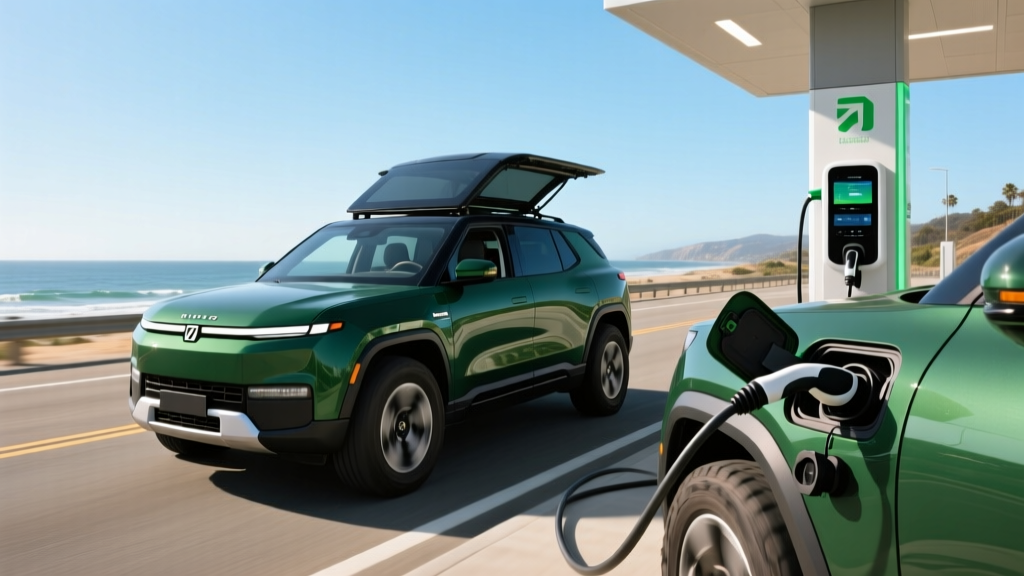
The Rivian R1S enters the 2026 model year as one of the few full-size, three-row electric SUVs built for genuine off-road capability and family hauling. With up to 410 miles of EPA-estimated range on the Max Pack and a tri-motor option producing over 1,000 horsepower, the R1S occupies a unique niche: adventure-ready utility without the compromises of early-generation EVs. But at a base price hovering near $80,000, buyers need to know whether the real-world efficiency, charging speed, and ownership costs justify the premium. This Rivian SUV review breaks down the numbers that matter.
Range, Efficiency, and the Real-World Reality Check
Rivian offers the 2026 R1S with three battery configurations. The Standard Pack uses a 92.5 kWh (usable) lithium-ion NMC (nickel manganese cobalt) battery, the Large Pack steps up to 109.4 kWh usable, and the Max Pack pushes to approximately 149 kWh usable. All packs use 2170-format cylindrical cells with active liquid thermal management.
| Battery Pack | Usable Capacity | EPA Range (Dual-Motor) | MPGe (Combined) | kWh/100 mi |
|---|---|---|---|---|
| Standard (92.5 kWh) | 92.5 kWh NMC | 270 mi | 73 MPGe | 46 |
| Large (109.4 kWh) | 109.4 kWh NMC | 340 mi | 73 MPGe | 46 |
| Max (149 kWh) | ~149 kWh NMC | 410 mi | 72 MPGe | 47 |
Efficiency of 46–47 kWh/100 miles is competitive for a 7,000-pound vehicle but trails lighter crossovers like the Hyundai Ioniq 5 (30 kWh/100 mi). If most of your driving is suburban at 30–50 mph, you'll beat the EPA figure; sustained highway speeds and mountain grades push consumption higher.
Charging Speed: DC Fast Charging and Home Level 2
The R1S charges via a NACS (North American Charging Standard) port, giving it native access to the Tesla Supercharger network — currently the most reliable DC fast-charging infrastructure in the U.S. Peak DC fast-charge rates vary by pack size:
| Metric | Standard Pack | Large Pack | Max Pack |
|---|---|---|---|
| Peak DC Fast Charge | 200 kW | 220 kW | 220 kW |
| 10–80% DC Time | ~21 min | ~21 min | ~34 min |
| Level 2 (Home) Rate | 11.5 kW (~27 mi/hr) | 11.5 kW (~27 mi/hr) | 11.5 kW (~27 mi/hr) |
| Level 1 (120V) | ~1.4 kW (~3 mi/hr) | ~1.4 kW (~3 mi/hr) | ~1.4 kW (~3 mi/hr) |
A 220 kW peak charge rate means the Large Pack can add roughly 140 miles in 15 minutes at a capable V3 Supercharger or Electrify America 350 kW station. However, the charge curve tapers significantly above 80% — expect the final 20% to take nearly as long as the first 60%. For road trips, plan stops around the 10–80% window to minimize time at the charger.
At home on a 48-amp Level 2 circuit (the most common residential installation), the onboard 11.5 kW charger replenishes about 27 miles per hour. A full overnight charge from 20% to 80% takes roughly 6 hours on the Large Pack — easily manageable with a standard nighttime routine. Rivian's Wall Connector is a solid option, but any J1772/NACS-compatible Level 2 EVSE rated for 48 amps will work.
Performance and Drivetrain: From Dual-Motor to Tri-Motor
The 2026 R1S offers three drivetrain configurations, each with distinct performance profiles:
| Drivetrain | Horsepower | Torque (lb-ft) | 0–60 mph | Drivetrain Type |
|---|---|---|---|---|
| Dual-Motor AWD | 533 hp | 610 | 4.5 sec | AWD |
| Performance Dual-Motor | 665 hp | 829 | 3.5 sec | AWD |
| Tri-Motor AWD | 1,025 hp | 1,100+ | 2.9 sec | AWD |
The dual-motor setup provides genuine all-wheel drive with independent torque vectoring front and rear — no mechanical linkage. Rivian's quad-motor system was discontinued after 2024, replaced by the tri-motor configuration that adds a rear-axle twin-motor unit for extraordinary thrust. The tri-motor R1S hits 60 mph in under 3 seconds, making it one of the quickest SUVs on the road, period.
Beyond straight-line speed, the R1S uses an adaptive air suspension with 6.5 inches of travel, adjustable ride height (from 6.2 to 14.9 inches of ground clearance), and a dedicated off-road mode. Approach, departure, and breakover angles rival purpose-built off-roaders. Towing capacity reaches 7,700 pounds when properly equipped — enough for a mid-size travel trailer or boat.
Interior Space, Cargo, and Technology
As a three-row SUV, the R1S accommodates up to seven passengers (2-3-2 seating) or six with optional second-row captain's chairs. Interior dimensions are generous:
- Front legroom: 41.3 inches
- Second-row legroom: 38.5 inches
- Third-row legroom: 30.2 inches (best for children or short trips)
- Cargo behind 3rd row: 20.5 cu ft
- Cargo behind 2nd row: 57.5 cu ft
- Cargo behind 1st row (max): 104.7 cu ft
- Front trunk (frunk): 11.0 cu ft
The 11-cubic-foot frunk is weather-sealed and drainable — useful for muddy gear, groceries, or a cooler. Combined with the rear cargo area, total storage capacity exceeds what most competitors offer.
The infotainment system runs on a 15.6-inch center touchscreen with a dedicated 12.3-inch driver display. Rivian's software supports over-the-air updates, built-in navigation with charging-aware route planning, and a Gear Guard security camera system. Wireless Apple CarPlay and Android Auto are standard. The premium audio system (available on higher trims) includes 18 speakers with Dolby Atmos support.
Driver assistance falls under Rivian's Driver+ suite, which includes adaptive cruise control, lane centering, and automatic lane changes on divided highways. This is an SAE Level 2 system — the driver must remain attentive with hands on the wheel at all times. It is not autonomous driving.
Pricing, Trims, and Federal Tax Credit Eligibility
The 2026 R1S is offered in two primary trim levels: Adventure and Ascend (the latter replacing the previously named "Explore" and "Adventure" tiers). Pricing breaks down as follows:
| Configuration | Adventure Trim | Ascend Trim |
|---|---|---|
| Dual-Motor / Standard Pack | $79,900 | $84,900 |
| Dual-Motor / Large Pack | $85,900 | $90,900 |
| Performance Dual-Motor / Large | $91,900 | $96,900 |
| Tri-Motor / Max Pack | $99,900 | $104,900 |
Destination charges add $1,800. Popular options like the Forest Green paint, camp kitchen accessory, or 22-inch wheels can push an as-tested Ascend Tri-Motor above $110,000.
- MSRP cap: SUVs must be priced at or below $80,000. Only the base Dual-Motor / Standard Pack Adventure trim ($79,900) meets this threshold. All other configurations exceed the cap and are ineligible.
- Buyer income cap: Modified AGI must not exceed $300,000 (joint), $225,000 (head of household), or $150,000 (single).
- Battery sourcing: Critical minerals and battery components must meet escalating domestic-content percentages. Rivian's supply chain has been evolving; confirm current-year compliance at fueleconomy.gov before purchasing.
Warranty and Long-Term Ownership Costs
Rivian backs the R1S with the following coverage:
- Basic vehicle warranty: 5 years / 60,000 miles
- Battery and drive unit warranty: 8 years / 175,000 miles (retains ≥70% capacity)
- Corrosion warranty: 12 years / unlimited miles
- Roadside assistance: 5 years / 60,000 miles
The 8-year/175,000-mile battery warranty is competitive, and the 70% capacity retention threshold aligns with industry norms from Tesla, Ford, and Hyundai. NMC chemistry in the R1S has shown moderate degradation in early owner reports — roughly 5–8% loss over the first 50,000 miles — though long-term data for the 2026 pack revision is still accumulating. Rivian's over-the-air battery management updates have improved thermal conditioning and charge-curve optimization since launch.
Insurance costs for the R1S run 15–25% higher than comparable gas-powered SUVs, driven by repair complexity and parts pricing. Expect annual premiums in the $2,400–$3,200 range depending on your profile and state. Depreciation has improved as Rivian's brand recognition grows, but the R1S still loses roughly 45–50% of value over five years — typical for luxury EVs but steeper than a Toyota Highlander Hybrid.
Pros, Cons, and the Verdict
Pros
- Class-leading real-world range on Max Pack (330+ highway miles)
- Genuine off-road capability with air suspension and 14.9" ground clearance
- 7,700-lb towing capacity exceeds most electric SUVs
- NACS port = native Supercharger access
- Massive frunk + 104.7 cu ft max cargo space
- Tri-motor performance (0–60 in 2.9 sec) is supercar-level
Cons
- Only base trim qualifies for $7,500 federal tax credit (MSRP cap)
- Third row is tight for adults on long trips
- Insurance premiums run $500–$800/yr higher than gas alternatives
- 220 kW peak charge rate trails 350 kW competitors (Hyundai Ioniq 5, Porsche Macan EV)
- Service center network still expanding — rural owners may face longer wait times
Who the R1S suits best: Active families who need three rows, tow a trailer, and want to explore unpaved roads without range anxiety. The Max Pack dual-motor is the sweet spot for road-trippers who regularly drive 300+ miles between charges. Budget-conscious buyers should look at the base dual-motor Standard Pack to capture the federal tax credit — though 270 miles of EPA range means more frequent charging stops on long hauls.
Who should look elsewhere: Urban commuters who never leave the city (a smaller, cheaper EV like the Tesla Model Y or Hyundai Ioniq 5 makes more financial sense). Buyers who prioritize the lowest possible cost-per-mile should consider a plug-in hybrid like the Toyota Grand Highlander Hybrid if home charging isn't available.
How the R1S Stacks Up Against Key Competitors
| Metric | Rivian R1S (Large Pack) | Tesla Model X (Long Range) | Kia EV9 (GT-Line AWD) |
|---|---|---|---|
| EPA Range | 340 mi | 348 mi | 270 mi |
| Starting MSRP | $85,900 | $81,630 | $60,900 |
| 0–60 mph | 4.5 sec | 3.8 sec | 5.0 sec |
| Peak DC Charge | 220 kW | 250 kW | 236 kW |
| Towing Capacity | 7,700 lb | 5,000 lb | 5,000 lb |
| Ground Clearance | 14.9 in (max) | 8.2 in | 7.8 in |
| Federal Credit Eligible | Base trim only | Yes (Long Range) | Yes (select trims) |
The Model X is quicker and has a slightly longer range at a lower price, but its towing and off-road capability don't match the Rivian. The Kia EV9 is the value pick — $25,000 less than the R1S — but sacrifices range, power, and ground clearance. For pure adventure utility, the R1S remains the segment leader.
Frequently Asked Questions
What is the real-world range of the 2026 Rivian R1S?
Expect 280–300 highway miles on the Large Pack dual-motor in moderate temperatures, and roughly 330–350 miles on the Max Pack. Cold weather (below freezing) reduces these figures by 15–25%. City driving with regenerative braking can exceed EPA estimates.
How fast does the R1S charge at home and on the road?
On a 48-amp Level 2 home charger, the R1S adds about 27 miles per hour (11.5 kW). On a DC fast charger, the Large Pack peaks at 220 kW and charges from 10–80% in approximately 21 minutes, adding up to 140 miles in 15 minutes at a capable station.
Does the Rivian R1S qualify for the $7,500 federal EV tax credit?
Only the base Dual-Motor Standard Pack Adventure trim ($79,900 MSRP) qualifies under the §30D SUV price cap of $80,000. You must also meet income limits ($300K joint / $150K single) and the vehicle must meet current-year battery sourcing requirements. Check fueleconomy.gov and consult a tax professional before relying on the credit.
Is the Rivian R1S worth buying over a Tesla Model X or Kia EV9?
If you need serious towing capacity (7,700 lb), off-road clearance, and a massive frunk, the R1S has no true rival. The Model X is quicker and slightly cheaper but can't match the Rivian's utility. The EV9 is the budget pick but has 70 fewer miles of range and limited off-road ability. Choose the R1S if adventure capability is a priority; choose the EV9 if value matters most.
How long will the R1S battery last?
Rivian warranties the battery for 8 years or 175,000 miles against capacity loss below 70%. Early owner data suggests 5–8% degradation over the first 50,000 miles with NMC chemistry. With proper care (avoiding frequent 100% charges, using preconditioning for DC fast charging), the battery should retain usable capacity well beyond 150,000 miles.
Can the Rivian R1S use Tesla Superchargers?
Yes. The 2026 R1S comes equipped with a native NACS charge port, providing direct access to the Tesla Supercharger network without an adapter. This gives R1S owners access to the largest and most reliable DC fast-charging network in North America.