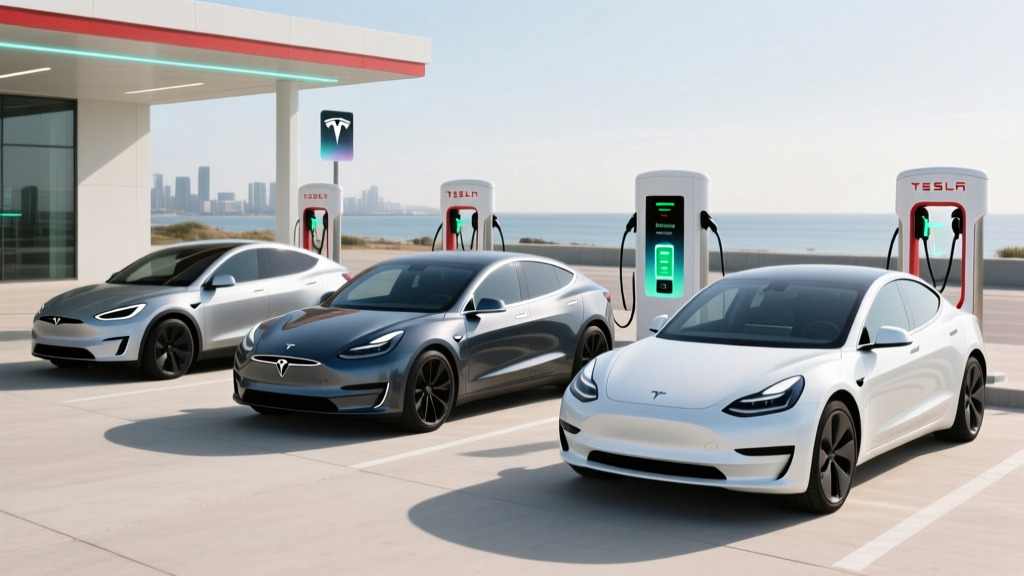
The 2026 Tesla Lineup at a Glance
If you've searched "grok tesla" hoping for a clear, no-hype breakdown of what Tesla actually sells in 2026, you're in the right place. Tesla's four-vehicle consumer lineup — Model 3, Model Y, Model S, and Model X — covers sedans, crossovers, and performance flagships, but the spec sheets, real-world efficiency, and tax-credit eligibility differ dramatically between trims. Below, we parse every number that matters to a buyer: EPA range, battery chemistry, DC fast-charge curves, Level 2 home charging, 0-60 performance, cargo volume, and exactly which models qualify for the IRS §30D federal tax credit in 2026.
| Spec | Model 3 RWD | Model 3 Long Range AWD | Model Y Long Range AWD | Model S LR | Model X LR |
|---|---|---|---|---|---|
| EPA Range | 272 mi | 363 mi | 320 mi | 402 mi | 348 mi |
| Battery (usable, est.) | 57.5 kWh (LFP) | 75 kWh (NMC) | 75 kWh (NMC) | 95 kWh (NMC) | 95 kWh (NMC) |
| Peak DC Charge | 170 kW | 250 kW | 250 kW | 250 kW | 250 kW |
| 10-80% DCFC | ~25 min | ~22 min | ~22 min | ~27 min | ~28 min |
| Level 2 Rate | 7.6 kW (30 mi/hr) | 11.5 kW (44 mi/hr) | 11.5 kW (44 mi/hr) | 11.5 kW (41 mi/hr) | 11.5 kW (36 mi/hr) |
| 0-60 mph | 5.8 sec | 4.2 sec | 4.8 sec | 3.1 sec | 3.8 sec |
| Drivetrain | RWD | Dual-Motor AWD | Dual-Motor AWD | Dual-Motor AWD | Dual-Motor AWD |
| MPGe (combined) | 132 MPGe | 125 MPGe | 117 MPGe | 120 MPGe | 105 MPGe |
| Base MSRP | $38,990 | $47,740 | $48,990 | $79,990 | $84,990 |
Sources: fueleconomy.gov, Tesla.com order pages. Figures reflect 2026 model year estimates and may shift with mid-year battery updates.
Real-World Range vs. EPA Sticker
EPA range is measured on a controlled dynamometer cycle and rarely matches what you'll see on a 75°F highway road trip at 70 mph, let alone a 20°F winter commute. Here's how Tesla's 2026 lineup translates in real ownership.
Model 3 Long Range AWD — 363 mi EPA
Expect: ~290-310 mi highway at 70 mph in mild weather; ~240-260 mi in sub-30°F winter driving with cabin heat. City/regen-heavy driving can approach or exceed the EPA sticker thanks to Tesla's aggressive regenerative braking.
Model Y Long Range AWD — 320 mi EPA
Expect: ~260-280 mi highway; ~210-230 mi cold-weather. The Y's taller, less aerodynamic profile costs it roughly 10-15% highway efficiency vs. the Model 3 on the same platform.
Model S Long Range — 402 mi EPA
Expect: ~330-350 mi highway; ~280-300 mi in freezing temps. The larger 95 kWh pack gives a buffer that partially offsets cold-weather losses, but highway speeds still cut range meaningfully.
Model 3 RWD (LFP) — 272 mi EPA
Expect: ~220-240 mi highway. LFP chemistry handles cold slightly worse than NMC at the cell level, but Tesla's thermal management and heat pump mitigate much of the gap. The trade-off: LFP tolerates routine 100% charging, so your daily usable range is effectively higher.
Charging Speed: DC Fast, Home Level 2, and the Curve Reality
Tesla's Supercharger network remains the most reliable public DC fast-charging ecosystem in the U.S., with V3 stalls delivering up to 250 kW and V4 stalls rolling out at similar peak rates with improved cable management. But peak kW is not sustained kW — understanding the charge curve is critical for trip planning.
| Model | DCFC Peak kW | Sustained Avg (10-80%) | 10-80% Time | Level 2 Home (kW / mi per hr) | Level 1 (120V) |
|---|---|---|---|---|---|
| Model 3 RWD (LFP) | 170 kW | ~110 kW | ~25 min | 7.6 kW / 30 mi/hr | ~3-4 mi/hr |
| Model 3 LR AWD | 250 kW | ~165 kW | ~22 min | 11.5 kW / 44 mi/hr | ~4-5 mi/hr |
| Model Y LR AWD | 250 kW | ~160 kW | ~22 min | 11.5 kW / 44 mi/hr | ~4-5 mi/hr |
| Model S LR | 250 kW | ~150 kW | ~27 min | 11.5 kW / 41 mi/hr | ~4-5 mi/hr |
| Model X LR | 250 kW | ~145 kW | ~28 min | 11.5 kW / 36 mi/hr | ~3-4 mi/hr |
Charge-curve reality check: Tesla's peak 250 kW is typically sustained only between roughly 10-30% State of Charge. Above 50%, the rate tapers to ~150 kW; above 80%, it drops sharply to ~40-60 kW to protect the battery. This is why Tesla (and every other automaker) quotes 10-80% times — the final 20% can add another 20-30 minutes. For road trips, the optimal strategy is short, frequent stops between 10-80% rather than topping off to 100%.
Preconditioning matters. Navigate to a Supercharger via the Tesla nav system, and the car will pre-warm the battery to ~35°C before arrival, enabling peak charge rates even in cold weather. Arriving at a Supercharger without preconditioning (e.g., using a third-party app or driving to a stall not set as a nav destination) can cut peak charge rates by 30-50% in cold conditions.
Home charging setup: Tesla's Wall Connector on a 60-amp circuit delivers up to 11.5 kW (48 amps continuous). For the Model 3 RWD with its smaller onboard charger, expect 7.6 kW (32 amps) maximum. Most overnight charges from 20-80% take 4-6 hours at Level 2 — more than sufficient for daily use. Installation typically costs $500-$2,000 depending on panel proximity and whether a 200-amp service upgrade is needed.
Pricing, Trims, and Federal Tax Credit Eligibility
Tesla's pricing has shifted repeatedly over the past two years. As of the 2026 model year, here's where the lineup stands — and critically, which models qualify for the §30D federal tax credit.
| Model / Trim | Base MSRP | As-Tested (typical) | §30D Credit Eligible? | Effective Price (after credit) |
|---|---|---|---|---|
| Model 3 RWD | $38,990 | $40,490 (w/ paint) | Yes — up to $7,500* | ~$31,490 - $32,990 |
| Model 3 LR AWD | $47,740 | $49,240 | Yes — up to $7,500* | ~$40,240 - $41,740 |
| Model 3 Performance | $54,990 | $56,490 | Yes — up to $7,500* | ~$47,490 - $48,990 |
| Model Y LR AWD | $48,990 | $50,490 | Yes — up to $7,500* | ~$41,490 - $42,990 |
| Model Y Performance | $53,490 | $54,990 | Yes — up to $7,500* | ~$45,990 - $47,490 |
| Model S LR | $79,990 | $84,990 | No — exceeds $55k sedan cap | $79,990+ |
| Model X LR | $84,990 | $89,990 | No — sourcing requirements* | $84,990+ |
*Critical §30D caveats (per IRS guidelines):
- Income caps: Modified AGI must not exceed $150,000 (single), $225,000 (head of household), or $300,000 (joint).
- MSRP caps: Sedans (Model 3) capped at $55,000; SUVs/trucks/vans (Model Y, Model X) capped at $80,000.
- Battery sourcing: The $7,500 credit splits into $3,750 for critical-minerals sourcing and $3,750 for battery-component manufacturing. Depending on the specific build month and supply chain, some Tesla trims may qualify for only $3,750 or the full $7,500. Always verify the VIN-specific eligibility on the IRS qualified-vehicles list before purchase.
- Point-of-sale transfer: As of 2024+, you can transfer the credit to the dealer at purchase, reducing your out-of-pocket cost immediately rather than waiting for tax filing.
Consult a tax professional for your specific situation — eligibility depends on your income, the vehicle's build date, and current sourcing determinations.
Performance and Efficiency Breakdown
Tesla's performance credentials remain a core selling point, but efficiency (kWh per 100 miles) is equally important for ownership cost.
| Model | Horsepower | 0-60 mph | Top Speed | kWh/100mi | MPGe (combined) |
|---|---|---|---|---|---|
| Model 3 RWD | 271 hp | 5.8 sec | 125 mph | 25 | 132 |
| Model 3 LR AWD | 346 hp | 4.2 sec | 125 mph | 26 | 125 |
| Model 3 Performance | 510 hp | 2.9 sec | 163 mph | 28 | 115 |
| Model Y LR AWD | 384 hp | 4.8 sec | 135 mph | 28 | 117 |
| Model Y Performance | 510 hp | 3.5 sec | 155 mph | 30 | 111 |
| Model S LR | 670 hp | 3.1 sec | 155 mph | 28 | 120 |
| Model X LR | 670 hp | 3.8 sec | 155 mph | 32 | 105 |
The Model 3 RWD at 25 kWh/100mi is one of the most efficient EVs sold in the U.S. — translating to roughly $0.04-$0.05 per mile on the national average electricity rate (~$0.16/kWh). Compare that to a 30-MPG gas car at $3.30/gallon ($0.11/mile), and the per-mile fuel cost advantage is roughly 2:1 before accounting for home vs. public charging price differences.
Interior, Cargo, and Tech
Tesla's minimalist interiors polarize, but the cargo and tech specs are concrete.
| Model | Front Legroom | Rear Legroom | Cargo (rear seats up) | Cargo (seats folded) | Frunk |
|---|---|---|---|---|---|
| Model 3 | 42.7 in | 35.3 in | 23 cu ft | ~60 cu ft | 3.1 cu ft |
| Model Y | 41.8 in | 37.0 in | 30 cu ft | ~72 cu ft | 4.1 cu ft |
| Model S | 42.7 in | 35.4 in | 28 cu ft | ~65 cu ft | 5.3 cu ft |
| Model X | 41.2 in | 36.6 in | 42 cu ft (5-seat) | ~88 cu ft | 6.6 cu ft |
Standout tech: All 2026 Teslas ship with a 15.4-inch center touchscreen (Model 3/Y) or 17-inch (Model S/X), over-the-air updates, Tesla's app ecosystem, Sentry Mode dashcam recording, and the option for FSD (Supervised) at $8,000 or $99/month. Note: FSD is an SAE Level 2 driver-assist system — you must remain engaged with hands on the wheel and eyes on the road at all times. It is not autonomous driving.
Notable drawbacks: No Apple CarPlay or Android Auto. No physical buttons for climate or mirror adjustment (all screen-based). Model 3 rear visibility is limited; Model Y's ride quality on 20-inch wheels can be firm. Panel-gap consistency has improved but still varies by Fremont vs. Austin build origin.
Autopilot, FSD, and Safety
SAE Automation Level: Level 2
Tesla's Autopilot (standard) and FSD Supervised (optional) are SAE Level 2 driver-assistance systems. They combine adaptive cruise control and lane-centering but require continuous driver supervision. The driver is legally and practically responsible for the vehicle at all times. Only Waymo-style robotaxis operating in geofenced areas without a driver present qualify as Level 4.
All 2026 Teslas include standard automatic emergency braking, blind-spot monitoring, lane-departure warning, and Tesla's camera-based vision system (no radar or ultrasonic sensors in current production). NHTSA has awarded the Model 3 and Model Y 5-star overall safety ratings; IIHS has named the Model 3 a Top Safety Pick+ in recent test cycles.
⚠️ FSD (Supervised) Limitations
- Does NOT make the vehicle self-driving — you must monitor the road continuously
- Performance degrades in heavy rain, construction zones, and faded lane markings
- Tesla issues periodic safety recalls via OTA for Autopilot/FSD behavior; keep software updated
- $8,000 purchase or $99/month subscription — evaluate whether your commute justifies the cost
Battery Warranty and Longevity
| Model | Battery Warranty | Capacity Retention Guarantee | Drive Unit Warranty |
|---|---|---|---|
| Model 3 RWD (LFP) | 8 yr / 100,000 mi | ≥70% retention | 8 yr / 100,000 mi |
| Model 3 LR / Performance | 8 yr / 120,000 mi | ≥70% retention | 8 yr / 120,000 mi |
| Model Y LR / Performance | 8 yr / 120,000 mi | ≥70% retention | 8 yr / 120,000 mi |
| Model S / Model X | 8 yr / 150,000 mi | ≥70% retention | 8 yr / 150,000 mi |
Tesla's LFP packs (Model 3 RWD) typically exhibit slower calendar degradation than NMC but are more sensitive to extreme cold. NMC packs (all other trims) offer higher energy density and better cold performance. Real-world fleet data suggests Tesla packs retain 85-90% capacity at 100,000 miles under normal charging habits — well above the 70% warranty threshold. Out-of-warranty pack replacement runs $12,000-$18,000 depending on the model.
Who Should Buy Which Tesla?
Choose Model 3 RWD if:
- You want the lowest entry price (~$31,500 after credit)
- Your daily commute is under 100 miles round-trip
- You have home Level 2 charging and rarely road-trip over 250 miles
- You prefer LFP's tolerance for daily 100% charging
Choose Model 3 Long Range AWD if:
- You need 300+ real-world miles for road trips
- You live in a cold-weather state and want NMC + AWD
- You want 250 kW peak DC charging for faster stops
Choose Model Y Long Range AWD if:
- You need crossover cargo space (30 cu ft) and higher seating
- You have a family and need easy rear car-seat access
- You want the best balance of range, space, and price after credit
Choose Model S or Model X if:
- Budget is not a primary constraint ($80k-$90k+)
- You want 400+ mi EPA range (Model S) or 6-7 seat capacity (Model X)
- You value air suspension, premium audio, and flagship performance
Pros, Cons, and Competitive Position
Pros
- Supercharger network — still the most reliable, widely available DC fast-charging ecosystem
- Class-leading efficiency (Model 3 at 25 kWh/100mi)
- Strong §30D credit eligibility on Model 3 and Model Y (up to $7,500)
- OTA updates continuously add features post-purchase
- Best-in-class DC fast-charge speeds (250 kW peak, V3/V4 Superchargers)
- Extensive real-world fleet data proving long-term battery durability
Cons
- No Apple CarPlay / Android Auto — all navigation and media through Tesla's UI
- Service center wait times can stretch weeks in high-volume metro areas
- Model S/X excluded from §30D credit due to MSRP caps or sourcing issues
- FSD (Supervised) costs $8,000 extra and remains Level 2 — not autonomous
- Minimalist interior frustrates buyers who prefer physical controls
- Insurance premiums 15-30% higher than comparable ICE vehicles in most states
Vs. key competitors: The Hyundai Ioniq 5 and Kia EV6 offer 800V charging (350 kW peak on compatible chargers) and CarPlay, but rely on third-party networks (Electrify America, Ionity) that have lower uptime than Superchargers. The BMW i4 and Ford Mustang Mach-E compete on build quality and dealer service, respectively. For buyers prioritizing charging convenience and software integration above all, Tesla retains a structural advantage. For those who value interior refinement, physical buttons, or CarPlay, competitors deserve a serious test drive.
Frequently Asked Questions
What is the real-world range of a Tesla in 2026?
The Model 3 Long Range delivers roughly 290-310 highway miles in mild weather and 240-260 in winter. The Model Y LR averages 260-280 highway. The Model S LR can reach 330-350 highway. All figures drop 15-25% in sub-freezing temperatures due to cabin heating and increased battery resistance.
How fast does a Tesla charge at home and on the road?
At a V3/V4 Supercharger, most Teslas peak at 250 kW and charge 10-80% in 22-28 minutes. At home on a 60-amp Wall Connector, expect 11.5 kW (44 mi/hr of range added) for Long Range models, or 7.6 kW for the Model 3 RWD. A full overnight charge takes 5-8 hours depending on pack size.
How much does a Tesla cost after the federal tax credit?
The Model 3 RWD starts at ~$31,490 after the full $7,500 §30D credit. The Model 3 LR drops to ~$40,240. The Model Y LR lands around ~$41,490. These figures assume you meet income caps ($150k single / $300k joint), the vehicle meets battery-sourcing requirements, and you transfer the credit at point of sale. Model S and Model X do not qualify.
Does the Tesla Model Y qualify for the $7,500 federal tax credit?
The Model Y qualifies for up to $7,500 under §30D, subject to buyer income limits, the $80,000 SUV MSRP cap, and battery-component/critical-mineral sourcing requirements that vary by build date. Check the IRS qualified-vehicles list for your specific VIN before purchasing.
Is Tesla's FSD worth the $8,000 cost?
FSD (Supervised) is a Level 2 driver-assist system — it does not drive autonomously. It excels on highways and in stop-and-go traffic but requires constant driver attention. For daily highway commuters, the $99/month subscription is a low-risk way to test it. For city-only drivers, the standard Autopilot included with every Tesla is typically sufficient.
How long do Tesla batteries last?
Tesla warranties its packs for 8 years / 100,000-150,000 miles (depending on model) with a minimum 70% capacity retention guarantee. Fleet data shows most packs retain 85-90% at 100,000 miles. LFP packs (Model 3 RWD) degrade slightly slower but are more cold-sensitive. Out-of-warranty replacement costs $12,000-$18,000.
Should I buy a Tesla or a competitor like the Hyundai Ioniq 5?
Choose Tesla if Supercharger access, software integration, and proven efficiency are your top priorities. Choose the Ioniq 5 or EV6 if you want 800V ultra-fast charging (on compatible chargers), Apple CarPlay, a more traditional interior, and competitive pricing. Test-drive both — the decision often comes down to charging ecosystem preference and interior ergonomics.