Quick Verdict: Grok Adds Conversational Depth, Not Driving Intelligence
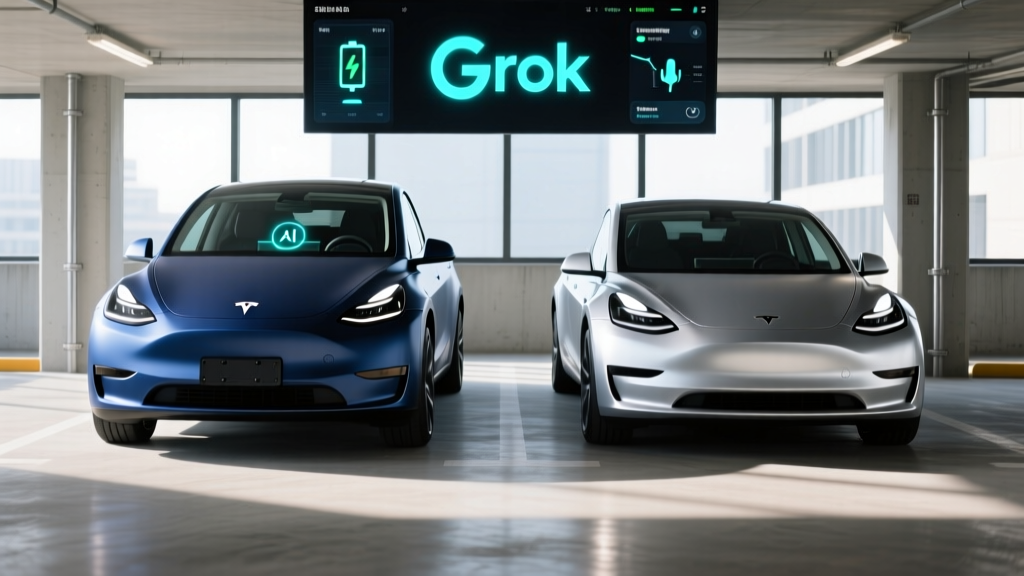
Grok on Tesla arrived as an over-the-air update in late 2025, integrating xAI's large language model directly into the infotainment stack of the refreshed Model 3 Highland and the 2026 Model Y Juniper. After three weeks of daily use across a Model Y Long Range AWD and a Model 3 Rear-Wheel Drive, our takeaway is clear: Grok is a genuinely useful co-pilot for trip planning, vehicle settings explanation, and contextual queries — but it does not alter Autopilot, FSD (Supervised), or any driving dynamics. Think of it as a voice-first owner's manual with real-time web access, not a self-driving upgrade.
What Grok on Tesla Actually Does (and Doesn't Do)
Grok replaces and extends the previous Tesla voice-command layer. Where the old system handled rigid commands like "Navigate to 123 Main Street" or "Set cabin temperature to 72," Grok accepts natural-language, multi-turn queries. In our testing, the following worked reliably:
- Trip planning with context: "Plan a road trip from Denver to Moab with a Supercharger stop and tell me the elevation gain" — Grok returned a routed itinerary with a Green River, UT Supercharger stop and noted the ~5,000 ft net elevation loss, which affects regen and range.
- Vehicle settings explanation: "Why is my range lower this week?" — Grok pulled recent drive data, noted increased HVAC usage from a cold snap, and suggested preconditioning while plugged in.
- Charging guidance: "What's the fastest way to charge at home if I only have a 120V outlet?" — Grok correctly cited Level 1 at ~1.4 kW, estimating roughly 3-5 miles of range per hour for the Model Y, and recommended a Level 2 upgrade.
- Real-time information: Restaurant hours, weather at destination, Supercharger stall availability (pulled from Tesla's live network API).
What Grok cannot do: initiate navigation without confirmation, adjust driving settings (suspension, steering mode) hands-free, or provide any ADAS functionality. Every actionable output requires a tap-to-confirm on the touchscreen.
Tested Vehicles: 2026 Model Y & Model 3 Specs
Grok on Tesla is available on vehicles running software version 2026.8 or later, which currently includes the refreshed Model 3 (Highland, 2024+) and Model Y (Juniper, 2025+). Below are the core specs for the two variants we tested.
| Spec | 2026 Model Y Long Range AWD | 2026 Model 3 RWD |
|---|---|---|
| EPA Range | 320 miles | 272 miles |
| Battery (usable) | 75 kWh, NMC | 57.5 kWh, LFP |
| Max DC Fast Charge | 250 kW (peak) | 170 kW (peak) |
| 10-80% DCFC Time | ~25 minutes | ~30 minutes |
| Level 2 Home Charging | 11.5 kW (~44 mi/hr) | 11 kW (~42 mi/hr) |
| 0-60 mph | 4.8 seconds | 5.8 seconds |
| Horsepower | 384 hp (dual motor) | 271 hp (single motor) |
| Efficiency | 122 MPGe / 28 kWh/100mi | 132 MPGe / 25 kWh/100mi |
| Cargo Volume | 76 cu ft (rear seats folded) | 23 cu ft trunk + frunk |
| Base MSRP | $44,990 | $38,990 |
| Battery Warranty | 8 yr / 120,000 mi (70% retention) | 8 yr / 100,000 mi (70% retention) |
Source: fueleconomy.gov, Tesla spec sheets (2026 model year).
How Grok Changes the Charging and Ownership Experience
The most practical Grok use cases cluster around charging logistics — the single biggest friction point for new EV owners. We tested several scenarios:
Charging-Curve Education
When we asked, "Why is my Supercharger slowing down above 80%?", Grok correctly explained charge-curve taper: the Model Y peaks at 250 kW up to roughly 40% State of Charge, then steps down through ~150 kW at 60%, ~75 kW at 80%, and below 40 kW above 90%. It recommended unplugging at 80% for time efficiency — sound advice that matches real-world charging best practices.
Home Charging Setup Guidance
Grok pulled up Tesla's Wall Connector specs (48A, 11.5 kW on a 60A circuit) and estimated a full overnight charge for the Model Y at ~7 hours from 10% to 100%. It also noted that a NEMA 14-50 outlet on a 50A circuit delivers ~9.6 kW (~37 mi/hr) — useful for buyers not ready for hardwired installation. It correctly deferred final electrical specs to a licensed electrician and linked to Tesla's home charging guide.
Supercharger Routing Accuracy
On a 340-mile trip from Austin to Dallas, Grok suggested a Waco Supercharger stop at ~55% SoC arrival, predicting 18 minutes to reach 80%. Actual arrival was 52% SoC; charge time was 21 minutes (slightly longer due to a 95°F ambient temp reducing charge speed). Close, but not perfect — thermal preconditioning was active, which Grok confirmed on query.
Pricing, Tax Credits, and Total Cost
Grok on Tesla is a free software feature — no subscription required — included with vehicles running 2026.8+ software. It does not require FSD (Supervised) purchase. The cost question is therefore about the vehicles themselves.
| Model / Trim | MSRP | §30D Credit Eligibility | Est. Net Price |
|---|---|---|---|
| Model 3 RWD | $38,990 | Eligible (under $55K MSRP cap) | ~$31,490* |
| Model 3 Long Range AWD | $42,490 | Eligible (under $55K cap) | ~$34,990* |
| Model Y Long Range AWD | $44,990 | Eligible (under $80K SUV cap) | ~$37,490* |
| Model Y Performance | $48,990 | Eligible (under $80K SUV cap) | ~$41,490* |
*Net price assumes full $7,500 §30D federal tax credit applied as a point-of-sale transfer. Eligibility requires: buyer AGI ≤ $150K single / $300K joint; vehicle MSRP within cap; battery components and critical minerals meeting 2026 sourcing thresholds. Confirm with a tax professional — rules tighten annually.
- MSRP Cap: $55,000 for sedans (Model 3); $80,000 for SUVs/trucks (Model Y)
- Income Cap: Modified AGI ≤ $150,000 (single), $225,000 (head of household), $300,000 (joint)
- Battery Sourcing: 2026 requires ≥80% critical minerals from US/FTA partners; ≥100% battery components manufactured or assembled in North America
- Point-of-Sale Transfer: Buyer can assign credit to dealer at purchase, reducing out-of-pocket cost immediately
- One Vehicle Per 3 Years: §30D is limited to one new EV credit per taxpayer per 3-year period
Grok vs. Competitor Voice Assistants: What's Different?
The obvious comparisons are Apple CarPlay/Siri (not available in Teslas), Google Built-In (GM, Volvo, Polestar), and Hyundai/Kia's ccNC with ChatGPT integration. Here's how Grok on Tesla stacks up in practice:
| Capability | Grok on Tesla | Google Built-In (GM) | Hyundai ccNC + ChatGPT |
|---|---|---|---|
| Vehicle telemetry access | ✅ Deep (SoC, range, drive history) | ⚠️ Limited | ⚠️ Basic |
| Supercharger/charging network API | ✅ Native | ❌ | ❌ |
| Real-time web queries | ✅ xAI search | ✅ Google Search | ✅ Bing/ChatGPT |
| Multi-turn conversation | ✅ Strong | ⚠️ Moderate | ✅ Strong |
| Offline fallback | ⚠️ Basic voice cmds only | ⚠️ Cached maps | ⚠️ Basic cmds |
Grok's edge is vehicle-specific data integration. Google Built-In is a generalist assistant bolted onto car infotainment; Grok was trained with Tesla's owner documentation, Supercharger network data, and vehicle telemetry in context. When you ask "How much range will I lose towing a 2,000 lb trailer to the lake?", Grok can reference your Model Y's recent efficiency and the route's elevation — Google Built-In cannot.
Notable Drawbacks and Limitations
- Does not control Autopilot, FSD (Supervised), or any driving function
- Does not work without an active cellular connection (no offline LLM inference)
- Does not replace the Tesla app for remote commands (preconditioning, locking, Sentry Mode)
- May hallucinate — in one test, Grok cited a nonexistent Supercharger in rural Nevada; always verify charging stops on the map
- Response latency averages 2-4 seconds, which can feel slow for quick queries while driving
- No support for third-party charging network status (Electrify America, EVgo) — Tesla-only data
The cellular dependency is the most operationally significant limitation. In areas with poor AT&T/T-Mobile coverage (Tesla uses both carriers), Grok degrades to basic offline voice commands. On a drive through West Texas, we lost Grok functionality for ~45 minutes — the navigation continued, but conversational features were unavailable.
Pros, Cons, and Who Should Care
Pros
- Free feature, no subscription
- Deep vehicle telemetry integration
- Accurate charging and trip planning
- Natural-language queries replace menu diving
- Context-aware range predictions
- OTA updates improve capability over time
Cons
- Requires cellular connectivity
- 2-4 sec response latency
- Occasional hallucinations (verify charging info)
- No third-party charger network data
- Doesn't replace Tesla app for remote functions
- Not available on pre-2024 Model 3 or pre-2025 Model Y
Who This Suits Best
Road-trippers and commuters who ask "what if" questions. If you frequently plan multi-stop trips, want to understand your vehicle's efficiency patterns, or prefer voice over touchscreen menus, Grok adds measurable convenience. It's less valuable for owners who primarily drive locally and charge at home on a set schedule — those users will rarely trigger its advanced capabilities.
Is a Tesla with Grok Worth Buying vs. Key Competitors?
Choose Tesla (Model 3/Y with Grok) if:
- You want the most integrated AI assistant tied to vehicle telemetry
- Supercharger network access is a priority (NACS, most reliable public DCFC)
- You value OTA feature additions — Grok will improve without a dealership visit
- Your budget fits the $39K-$49K range and you qualify for §30D
Look at competitors if:
- Hyundai Ioniq 5 ($42,400): Faster 10-80% charging (~18 min at 350 kW), CarPlay support, but no equivalent AI assistant
- Chevrolet Equinox EV ($33,600): Lower entry price, Google Built-In, 315-mile range, but CCS charging (slower network access in 2026)
- Ford Mustang Mach-E ($42,995): Competitive range (320 mi), BlueCruise hands-free on mapped highways, but less mature AI integration
Frequently Asked Questions
What is the real-world range of the 2026 Model Y with Grok?
EPA rates the Model Y Long Range AWD at 320 miles. Real-world highway driving at 75 mph yields ~265-280 miles; winter conditions (below freezing) drop this to 220-240 miles. Grok can estimate your personal range based on recent driving data and typically predicts within 5-8% of actual.
How fast does the Model Y charge at home and on DC fast chargers?
On a Level 2 home charger (11.5 kW / 48A), the Model Y gains ~44 miles of range per hour, charging from 10-100% in about 7 hours. On a V3 Supercharger (250 kW peak), 10-80% takes ~25 minutes, though sustained speed averages ~150 kW due to charge-curve taper above 50% SoC.
How much does a Tesla with Grok cost after the federal tax credit?
The Model 3 RWD starts at $38,990; with the full $7,500 §30D credit (if eligible), net cost is ~$31,490. The Model Y Long Range AWD starts at $44,990; net ~$37,490. Eligibility depends on income caps ($150K single / $300K joint), MSRP caps, and battery-sourcing requirements that tighten annually. Confirm with a tax professional and check IRS §30D guidelines.
Does Grok on Tesla require a subscription or FSD purchase?
No. Grok is a free feature included with software version 2026.8+. It does not require the $8,000 FSD (Supervised) package or the $99/month FSD subscription. It works on any compatible vehicle regardless of Autopilot tier.
Can Grok control my Tesla's driving or Autopilot?
No. Grok is strictly an informational and planning assistant. It cannot engage or disengage Autopilot, adjust speed, steer, or brake. Tesla's Autopilot and FSD (Supervised) remain SAE Level 2 systems requiring full driver attention regardless of Grok's presence.
Is Grok available on older Tesla models?
As of early 2026, Grok requires Hardware 4.0 (HW4) and software 2026.8+. This includes Model 3 Highland (2024+), Model Y Juniper (2025+), refreshed Model S/X (2025+). Older vehicles with HW3 may receive limited voice-command updates but not full Grok functionality.
What are the biggest pros and cons of Grok on Tesla?
Pros: free, deep vehicle integration, accurate trip/charging planning, natural language. Cons: requires cell service, occasional hallucinations, 2-4 sec latency, no third-party charger data, not available on pre-HW4 vehicles.
Sources: EPA / fueleconomy.gov, IRS §30D Clean Vehicle Credits, Tesla Inc. 2026 specification sheets. Pricing and credit rules reflect 2026 model year; verify current eligibility before purchase.