What Is Grok for Tesla? The 2026 Reality Check
If you've searched "Grok for Tesla" lately, you're likely trying to figure out whether xAI's large language model can actually run inside a Tesla vehicle, control its systems, or enhance the driving experience in 2026. The short answer: Grok is not a native Tesla infotainment or vehicle-control system. It is xAI's conversational AI, accessible via the X (formerly Twitter) platform and standalone apps — not a factory-installed feature in any Tesla Model 3, Model Y, Model S, or Model X.
However, the intersection of Grok and Tesla ownership is real and growing. Tesla's 2026 infotainment system supports third-party app integration, browser-based access, and voice-command layering that lets tech-savvy owners pull Grok responses into their daily EV workflow. Meanwhile, Tesla's own AI stack — powering Autopilot and Full Self-Driving (Supervised) — remains entirely separate from xAI's Grok model, despite Elon Musk's involvement with both companies.
This guide untangles what Grok actually does for Tesla owners in 2026, then delivers the hard EV data every Tesla buyer needs: real-world range, charging speeds, battery chemistry, pricing, and federal tax credit eligibility.
Grok vs. Tesla's Built-In AI: What Controls What
Tesla vehicles run a proprietary AI stack for driving, navigation, and vehicle management. Here's where Grok fits — and where it doesn't:
| Feature | Tesla Native AI | Grok (xAI) |
|---|---|---|
| Autopilot / FSD (Supervised) | ✅ Full control (SAE Level 2) | ❌ No vehicle integration |
| Voice Commands (navigation, media) | ✅ Built-in | ❌ Not integrated |
| Trip planning & route optimization | ✅ Native nav with Supercharger routing | ⚠️ Text-based advice only (no live vehicle data) |
| General knowledge Q&A | ❌ Limited | ✅ Via browser or phone |
| Charging station lookup | ✅ Native + third-party apps | ⚠️ General info, no real-time availability |
| Vehicle diagnostics | ✅ Service mode, Tesla app | ❌ No OBD or telematics access |
2026 Tesla Lineup: Range, Battery, and Charging Specs
Whether you're a Grok power-user or simply evaluating Tesla as your next EV, the vehicle specs are what matter at purchase time. Here's the 2026 lineup with EPA data sourced from fueleconomy.gov and Tesla's official specifications.
| Spec | Model 3 Long Range AWD | Model Y Long Range AWD | Model S Long Range | Model X Long Range |
|---|---|---|---|---|
| EPA Range | 363 mi | 320 mi | 402 mi | 348 mi |
| Battery (usable) | ~79 kWh (NMC) | ~79 kWh (NMC) | ~100 kWh (NMC) | ~100 kWh (NMC) |
| Max DC Fast Charge | 250 kW | 250 kW | 250 kW | 250 kW |
| 10–80% DCFC Time | ~25 min | ~27 min | ~35 min | ~36 min |
| Level 2 Home Rate | 11.5 kW (~44 mi/hr) | 11.5 kW (~44 mi/hr) | 11.5 kW (~34 mi/hr) | 11.5 kW (~34 mi/hr) |
| 0–60 mph | 4.2 sec | 4.8 sec | 3.1 sec | 3.8 sec |
| Horsepower | ~346 hp | ~384 hp | ~670 hp | ~670 hp |
| Drivetrain | Dual-Motor AWD | Dual-Motor AWD | Dual-Motor AWD | Dual-Motor AWD |
| Efficiency | 132 MPGe / 25 kWh/100mi | 122 MPGe / 27 kWh/100mi | 120 MPGe / 28 kWh/100mi | 108 MPGe / 31 kWh/100mi |
| Cargo (rear seats up) | 23 cu ft | 30 cu ft | 28 cu ft | 88 cu ft (seats folded) |
| Rear Legroom | 35.3 in | 40.5 in | 35.4 in | 37.1 in |
| Base MSRP | $47,740 | $48,240 | $79,990 | $84,990 |
EPA estimates assume a mix of city and highway driving at moderate temperatures. In real-world use:
- Highway (70–80 mph, steady): Expect ~85–90% of EPA range. A Model 3 LR rated at 363 mi delivers roughly 305–325 mi at sustained highway speed.
- Cold weather (below 32°F): Range drops 15–30% depending on cabin heating use and battery preconditioning. A Model Y LR may deliver 225–270 mi in freezing conditions without preconditioning.
- Preconditioning matters: Tesla's navigation system automatically warms the battery when a Supercharger is set as your destination, improving charge speed and partially mitigating cold-weather losses.
Charging Deep Dive: Supercharger Network and Home Setup
One of Tesla's strongest ownership advantages in 2026 remains the Supercharger network — now exceeding 60,000 connectors globally and increasingly open to non-Tesla EVs via NACS adapters. Here's what charging actually looks like:
| Charging Level | Power | Miles Added per Hour | Use Case |
|---|---|---|---|
| Level 1 (120V outlet) | ~1.4 kW | ~4–5 mi/hr | Emergency / overnight trickle |
| Level 2 (240V home) | 11.5 kW | ~34–44 mi/hr | Daily home charging (8-hr overnight = full battery) |
| DC Fast (V3 Supercharger) | 250 kW peak | ~200 mi in 15 min | Road trips, rapid top-ups |
| DC Fast (V4 Supercharger) | Up to 350 kW (cable-dependent) | Similar for current Teslas (vehicle-limited to 250 kW) | Future vehicles with higher acceptance |
Charging curve reality: Tesla's 250 kW peak rate applies only between roughly 10–30% State of Charge. Above 50%, the rate tapers significantly. By 80%, you're pulling ~70–90 kW. This is why the 10–80% metric matters more than peak kW — and why Tesla's quoted 25–27 minute times are honest but assume a V3 or V4 Supercharger at optimal battery temperature.
Home charging cost: Installing a Tesla Wall Connector on a dedicated 60A circuit typically costs $1,200–$2,800 total (unit + electrician + permit), depending on panel proximity and whether your home needs a 200A service upgrade. At the US average electricity rate of ~$0.16/kWh, a full Model 3 charge costs roughly $12.64 — about 5–6 cents per mile driven.
2026 Pricing and Federal Tax Credit Eligibility
Tesla pricing has shifted multiple times. Below are early-2026 MSRPs before any incentives. The IRS §30D federal tax credit remains available but comes with strict eligibility gates.
| Model / Trim | Base MSRP | Est. After §30D Credit | Credit Eligible? |
|---|---|---|---|
| Model 3 RWD | $38,990 | ~$31,490 | ✅ Yes (under $55K MSRP cap) |
| Model 3 Long Range AWD | $47,740 | ~$40,240 | ✅ Yes (under $55K cap) |
| Model 3 Performance | $52,990 | ~$45,490 | ✅ Yes (under $55K cap) |
| Model Y Long Range AWD | $48,240 | ~$40,740 | ✅ Yes (under $80K SUV cap) |
| Model Y Performance | $51,490 | ~$43,990 | ✅ Yes (under $80K SUV cap) |
| Model S Long Range | $79,990 | $79,990 | ❌ No (exceeds $55K sedan cap) |
| Model X Long Range | $84,990 | $84,990 | ❌ No (exceeds $80K SUV cap) |
- MSRP caps: $55,000 for sedans (Model 3); $80,000 for SUVs/trucks/vans (Model Y). Model S and X exceed these limits.
- Buyer income caps: AGI must not exceed $150K (single), $225K (head of household), or $300K (joint filers).
- Battery sourcing: A percentage of critical minerals and battery components must be sourced from the US or FTA-partner countries. Tesla's US-built LFP and NMC packs have largely met these thresholds in 2025–2026, but always verify on the IRS eligible-vehicle list before purchasing.
- Point-of-sale transfer: Since 2024, buyers can transfer the credit to the dealer at purchase, reducing the sale price directly rather than waiting for a tax refund.
Consult a tax professional and the official IRS §30D guidance before relying on credit eligibility. Rules are subject to change.
Software, Tech, and Where Grok Fits In
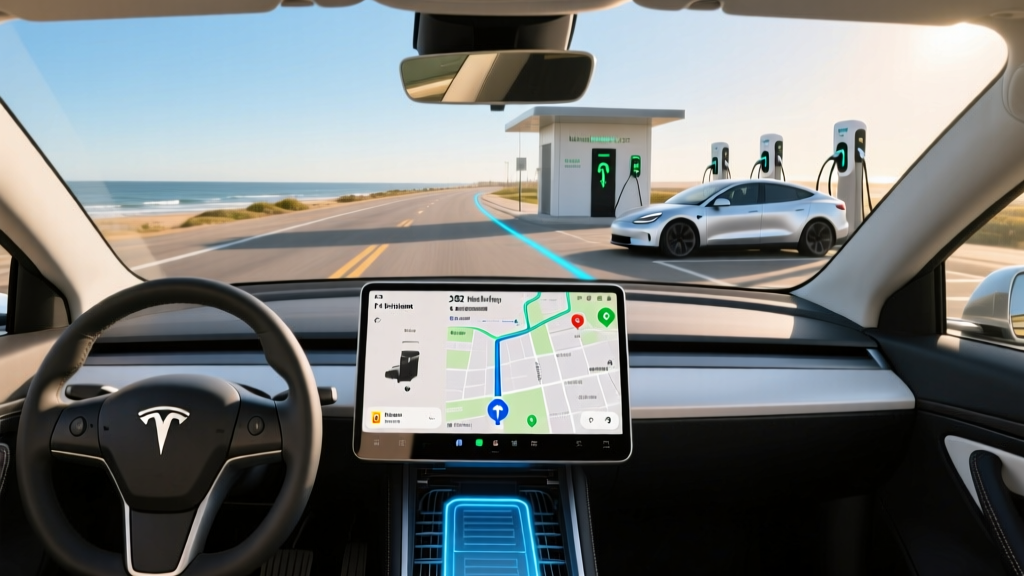
Tesla's 2026 software stack (v13.x) includes a full Chromium-based browser, Spotify/Apple Music integration, Netflix/YouTube for parked viewing, and a robust voice-command system. While Grok is not pre-installed, owners can:
- Access Grok via the in-car browser: Navigate to grok.com while parked (Tesla restricts most browser interaction while driving for safety).
- Use Grok on a paired phone: Query charging routes, compare EV specs, or research destinations, then enter results into Tesla's navigation manually or via voice.
- Leverage Grok for ownership research: Ask Grok to explain kWh/100mi calculations, compare insurance costs, or summarize new §30D rule changes — tasks Tesla's native voice assistant doesn't handle well.
Tesla's own AI strengths remain driving-focused: the vision-based FSD (Supervised) neural network, adaptive cruise with stop-and-go, automatic lane changes on highways, and Smart Summon in parking lots. These systems are trained on billions of miles of Tesla fleet data — an entirely different AI domain than Grok's conversational language model.
Battery Chemistry, Degradation, and Warranty
Tesla uses two primary battery chemistries in 2026:
- NMC (Nickel Manganese Cobalt): Found in Long Range and Performance trims. Higher energy density, enabling 320–402 mi EPA ranges. Tesla recommends charging to 80% daily and 100% only for trips.
- LFP (Lithium Iron Phosphate): Found in the Model 3 RWD. Slightly lower energy density (~363 mi in the LR variant uses NMC; the RWD LFP variant rates at ~272 mi). LFP can and should be charged to 100% regularly for cell balancing. It also offers longer cycle life and reduced fire risk, at the cost of ~20–30 fewer miles of range.
Warranty coverage: All 2026 Tesla vehicles include an 8-year/100,000-mile battery and drive unit warranty (Model S/X: 8 years/150,000 miles). Tesla warrants that the battery will retain at least 70% of its original capacity during the warranty period. Real-world data from Tesla's 2025 Impact Report shows average degradation of ~12% at 200,000 miles across the fleet — well within warranty thresholds for most owners.
Pros, Cons, and the Verdict
- Best-in-class Supercharger network (60,000+ global connectors)
- Class-leading efficiency (Model 3: 25 kWh/100mi)
- Over-the-air updates continuously add features
- Strong resale value relative to most EV brands
- FSD (Supervised) among the most capable Level 2 systems available
- Model 3 and Y qualify for up to $7,500 in federal tax credits
- No native Grok or third-party AI assistant integration
- No Apple CarPlay or Android Auto
- Panel gaps and build quality still inconsistent vs. legacy luxury brands
- FSD requires a $8,000 one-time purchase or $99/mo subscription
- Model S and X no longer qualify for federal tax credit
- Insurance costs 15–30% higher than comparable ICE vehicles in many states
Who Should Buy a Tesla in 2026?
- Choose Model 3 RWD if: You want the lowest entry price (~$31,490 after credit), commute under 60 miles daily, and can charge at home. LFP battery is ideal for daily 100% charging.
- Choose Model 3 Long Range if: You take regular road trips (363 mi EPA range), need AWD for snow/rain, and want the best efficiency in the sedan segment.
- Choose Model Y Long Range if: You need family cargo space (30 cu ft rear + frunk), prefer a higher seating position, and want SUV tax-credit eligibility up to $80K MSRP.
- Choose Model S/X if: Budget is secondary to performance (670 hp, 3.1-sec 0–60), you want air suspension, and you accept no federal tax credit.
- Look elsewhere (Hyundai Ioniq 5, Chevy Equinox EV) if: You need Apple CarPlay, prefer a traditional dealer service network, or want a sub-$35K EV with credit eligibility.
Frequently Asked Questions
Can I install Grok directly on my Tesla's touchscreen?
No. Grok is xAI's conversational AI and is not available as a native Tesla app. You can access it via Tesla's built-in web browser while parked, or use it on your phone alongside your Tesla. Tesla's vehicle AI (Autopilot, FSD, voice commands) is entirely separate from Grok.
What is the real-world range of a 2026 Tesla Model Y?
The EPA rates the Model Y Long Range AWD at 320 miles. In real-world highway driving at 70–80 mph, expect roughly 270–290 miles. In freezing temperatures without preconditioning, that can drop to 225–260 miles. Preconditioning via navigation routing to a Supercharger helps recover some of this loss.
How fast does a Tesla charge at home vs. a Supercharger?
At home on a Level 2 Tesla Wall Connector (11.5 kW, 48A), a Model 3 gains about 44 miles of range per hour — a full charge in roughly 8 hours. At a V3 Supercharger (250 kW DC), you can add ~200 miles in 15 minutes, with a 10–80% charge taking about 25 minutes under ideal conditions.
Does the Tesla Model Y qualify for the $7,500 federal tax credit in 2026?
Yes, the Model Y qualifies under the §30D credit rules, provided the buyer's AGI is under $150K (single) or $300K (joint), and the vehicle meets battery-sourcing requirements — which Tesla's US-built packs have largely satisfied. The credit can be transferred at point of sale to reduce the purchase price directly. Always verify current eligibility on IRS.gov.
Is Tesla's FSD actually self-driving?
No. Full Self-Driving (Supervised) is an SAE Level 2 driver-assistance system. It can handle highway lane changes, navigate on-ramps to off-ramps, and manage some city streets — but the driver must remain fully attentive and ready to take over instantly. It is not a Level 4 autonomous system like Waymo.
How long will a Tesla battery last?
Tesla warranties its batteries for 8 years/100,000 miles (150,000 for Model S/X) with at least 70% capacity retention. Fleet data shows average degradation of ~12% at 200,000 miles. Many Teslas exceed 300,000 miles on the original pack. Battery replacement, if needed outside warranty, costs approximately $12,000–$20,000 depending on the model.
Is a Tesla worth buying over competitors in 2026?
For road-trip-heavy drivers and those who value charging-network reliability, Tesla's Supercharger advantage remains significant. The Model 3 and Y offer top-tier efficiency and strong tax-credit pricing. However, competitors like the Hyundai Ioniq 5 (faster 800V charging), Chevrolet Equinox EV (lower starting price), and BMW i4 (CarPlay + luxury fit-finish) are compelling alternatives depending on your priorities.