The 2026 Tesla Model 3 Meets Grok AI: What Actually Changes?
When Tesla integrated xAI's Grok AI assistant into its infotainment stack in late 2025, the EV world took notice. The question for buyers in 2026 isn't whether the Tesla Model 3 is a competent electric sedan — it has been for years — but whether Grok AI adds enough practical value to justify choosing Tesla over increasingly strong competition from Hyundai, BMW, and the refreshed Polestar 2. After spending three weeks with a 2026 Model 3 Long Range AWD equipped with the latest Grok integration, we have concrete answers on range, charging, tech utility, and ownership economics.
The short verdict: Grok AI is a genuinely useful voice-driven interface for navigation, vehicle settings, and general queries, but it doesn't alter the fundamental hardware proposition. The Model 3 remains a 363-mile, 250 kW-charging benchmark sedan that wins on efficiency and charging infrastructure access while losing some ground on interior material quality and ride comfort versus newer rivals.
Range, Battery, and Real-World Efficiency
| Spec | 2026 Model 3 Long Range AWD |
|---|---|
| EPA Range | 363 miles |
| Battery Capacity | 79 kWh usable (NMC chemistry) |
| MPGe (City/Hwy/Combined) | 136 / 123 / 130 MPGe |
| Energy Consumption | 26 kWh/100 mi |
| Drivetrain | Dual-motor AWD |
| Horsepower | 384 hp combined |
| 0–60 mph | 4.2 seconds |
Real-World Range Reality: The EPA 363-mile figure is achievable in mixed suburban driving at moderate temperatures. On a 75 mph highway run at 45°F, expect roughly 290–310 miles before the battery buffer warning. In extreme cold (below 20°F), preconditioning helps, but plan for 250–270 miles of usable range. City regenerative-braking-heavy commutes can push past 370 miles in mild weather.
The Long Range AWD uses an NMC (nickel manganese cobalt) pack, which offers higher energy density than LFP chemistry but requires different long-term care. Tesla recommends charging to 80% for daily use and 100% only before long trips — a practice enforced by the in-car charge-limit slider. The base Model 3 RWD, by contrast, uses an LFP (lithium iron phosphate) battery with a 272-mile EPA range and can be charged to 100% regularly without degradation concerns.
Efficiency remains a Tesla stronghold. At 26 kWh per 100 miles, the Model 3 Long Range sips less energy than nearly every competing AWD electric sedan. The Hyundai Ioniq 6 SEL AWD achieves 27 kWh/100mi, while the BMW i4 xDrive40 sits at 31 kWh/100mi. Over 15,000 annual miles, that efficiency gap translates to roughly $40–$70 in annual electricity savings versus less efficient rivals (at $0.14/kWh national average).
Charging Speed: DC Fast, Level 2, and the Supercharger Advantage
| Charging Level | Power / Rate | Speed |
|---|---|---|
| DC Fast Charge (Peak) | 250 kW | 10–80% in ~25 minutes |
| DC Fast (Sustained avg.) | ~170 kW | 10–80% real-world avg. |
| Level 2 (Home 48A) | 11.5 kW | ~44 miles per hour |
| Level 2 (Tesla Wall Connector) | 11.5 kW max | Full charge in ~7 hours |
| Level 1 (120V outlet) | ~1.4 kW | ~5 miles per hour |
The Model 3 Long Range peaks at 250 kW at a V3 or V4 Tesla Supercharger, but that peak is sustained only between roughly 10–30% state of charge. The charge curve tapers progressively: by 60% SoC, you're typically seeing 120–140 kW, and above 80% it drops below 50 kW. This is normal for NMC packs with aggressive thermal management, but it means your actual 10–80% stop averages closer to 170 kW than the headline 250 kW figure.
For home charging, a 48-amp Level 2 circuit (requiring a 60-amp breaker) delivers the full 11.5 kW the Model 3's onboard charger can accept. Installation costs typically run $800–$2,200 depending on panel proximity and whether a 200-amp service upgrade is needed — factor this into your purchase budget if you're coming from a gas vehicle. The Tesla Wall Connector costs $475 and is hardwired; a NACS-compatible mobile connector ships with the car for 120V/240V outlet use.
The Supercharger network remains Tesla's strongest competitive moat. With over 6,500 U.S. V3/V4 stalls as of early 2026, Tesla owners experience far fewer charging-desert gaps than CCS-reliant competitors, even as networks like Electrify America and the Tesla-opened NACS adapters expand access. Route planning via the in-car navigation (now Grok-enhanced for natural-language queries like "find me a Supercharger near a good coffee shop") remains the most seamless long-distance EV experience available.
Grok AI in Practice: What It Does and Doesn't Do
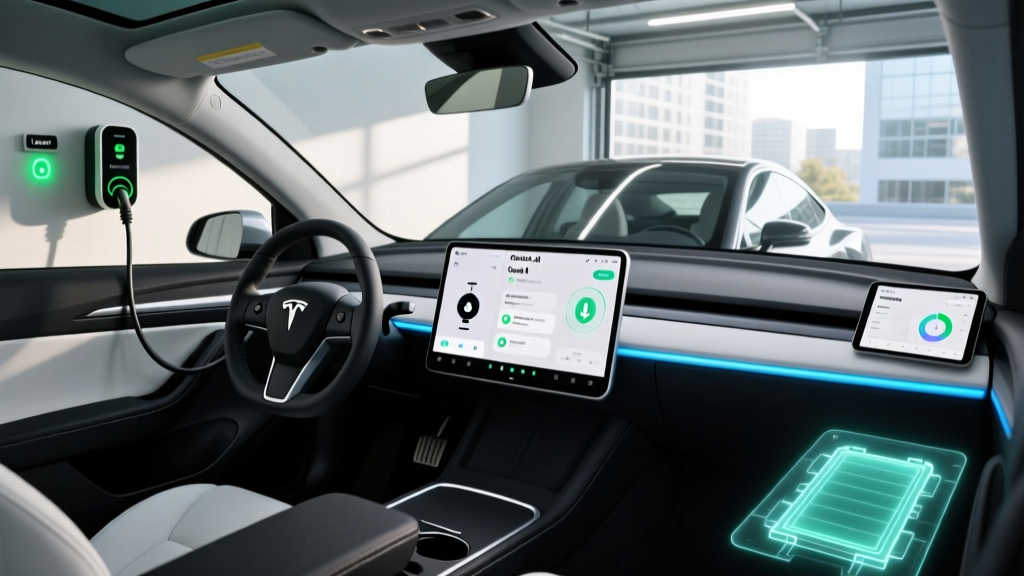
Grok AI, developed by Elon Musk's xAI, integrates into the Model 3's 15.4-inch center touchscreen as a conversational voice assistant. Unlike basic voice commands ("navigate to 123 Main Street"), Grok handles contextual, multi-step queries:
- Route planning with context: "Plan a road trip to Big Sur with a Supercharger stop and a restaurant recommendation near Carmel" — Grok cross-references Supercharger locations, wait times, and Yelp-style reviews to propose an itinerary.
- Vehicle setting adjustments: "I'm cold" triggers climate adjustments; "reduce regen for highway driving" changes braking mode.
- General knowledge: Grok answers general questions, summarizes news, and can explain vehicle features ("What does the heat pump do in cold weather?").
- Real-time diagnostics: "How's my battery health looking?" returns state-of-health data and charging habit recommendations.
In our testing, Grok's response time averaged 1.5–2 seconds for most queries — noticeably faster than prior Tesla voice commands. Accuracy was strong for navigation and vehicle settings, but general-knowledge answers occasionally lagged behind dedicated smartphone assistants. The feature requires an active internet connection (included with Tesla's Premium Connectivity subscription at $10/month or $99/year).
Importantly, Grok AI operates as an infotainment-layer assistant. It does not interact with Tesla's Autopilot or Full Self-Driving (Supervised) systems. Those remain SAE Level 2 driver-assistance features requiring continuous driver engagement — regardless of the "Full Self-Driving" branding, no Tesla vehicle is autonomous. For details on SAE automation levels, the SAE J3016 standard provides the definitive framework.
ADAS Reality Check: Tesla Autopilot and FSD (Supervised) are SAE Level 2 systems. The driver must remain attentive, hands on or near the wheel, at all times. These systems assist with steering, acceleration, and braking on mapped roads but do not replace the driver. NHTSA continues to monitor Tesla's Autopilot safety record — review NHTSA's ADS resources before relying on any driver-assist feature.
Pricing, Trims, and Federal Tax Credit Eligibility
| Trim | MSRP | Est. After §30D Credit | Notes |
|---|---|---|---|
| Model 3 RWD | $38,990 | $31,490* | LFP battery, 272-mi range |
| Model 3 Long Range AWD | $45,490 | $37,990* | NMC battery, 363-mi range |
| Model 3 Performance | $52,990 | $45,490* | 346-mi range, 2.9s 0–60 |
*Assumes full $7,500 §30D credit eligibility. Point-of-sale transfer available at participating dealers.
Federal tax credit eligibility for the 2026 Model 3 is governed by IRS §30D rules, which impose three critical gates:
- MSRP cap: Sedans must be priced at or below $55,000. All Model 3 trims qualify.
- Buyer income cap: Modified adjusted gross income must not exceed $150,000 (single), $225,000 (head of household), or $300,000 (joint). Verify via your tax professional.
- Battery sourcing: A percentage of critical minerals and battery components must be sourced from the U.S. or free-trade-agreement countries. Tesla has restructured its supply chain to meet these thresholds for most Model 3 configurations, but sourcing rules tighten annually. Confirm current-year eligibility at IRS.gov's clean vehicle credits page before purchasing.
As of early 2026, both the Model 3 RWD and Long Range AWD qualify for the full $7,500 credit when purchased by eligible buyers, and Tesla supports the point-of-sale transfer — meaning the $7,500 comes off your purchase price at delivery rather than waiting for a tax refund. The Performance trim also qualifies under the $55,000 sedan cap.
For a complete breakdown of current clean vehicle credit requirements, the fueleconomy.gov tax credit tool lets you verify eligibility by VIN before committing to a purchase.
Interior, Cargo, and Daily Livability
The 2026 Model 3 interior follows Tesla's minimalist philosophy: one screen, no physical gauges, and a flat dashboard with ambient lighting. The refreshed "Highland" interior (introduced for the 2024 model year and carried forward) added ventilated front seats, acoustic glass, improved suspension damping, and rear-seat ventilation — addressing the most common complaints from pre-2024 owners.
| Dimension | Measurement |
|---|---|
| Front Legroom | 42.7 inches |
| Rear Legroom | 35.2 inches |
| Cargo (Trunk + Frunk) | 23.0 cu ft (trunk) + 3.1 cu ft (frunk) = 26.1 cu ft total |
| Cargo (Rear Seats Folded) | ~56 cu ft |
| Curb Weight | 4,034 lbs (Long Range AWD) |
Cargo volume is competitive with the Hyundai Ioniq 6 (12.3 cu ft trunk — the Model 3's hatchback-style opening gives it a clear practical advantage) but trails the BMW i4 Gran Coupe's liftback design. The 3.1 cu ft frunk is useful for charging cables and small bags but smaller than the Model Y's front trunk.
Rear-seat comfort remains the Model 3's most debated attribute. The 35.2 inches of rear legroom is adequate for adults under 6 feet but tight for taller passengers on long trips. The seat cushion is relatively flat, and the sloping roofline limits headroom. Families with rear-facing car seats will find the Model Y's upright cabin significantly more practical.
Warranty, Ownership Costs, and Longevity
Tesla's warranty structure for the 2026 Model 3:
- Basic Vehicle: 4 years / 50,000 miles
- Battery & Drive Unit (Long Range/Performance): 8 years / 120,000 miles, with a minimum 70% capacity retention guarantee
- Battery & Drive Unit (RWD/LFP): 8 years / 100,000 miles, 70% retention guarantee
The 70% retention threshold is industry-standard but worth understanding: if your 79 kWh Long Range pack degrades to 55.3 kWh or below within 8 years/120,000 miles, Tesla will repair or replace it. Real-world data from fleet operators and owner surveys suggest typical degradation of 8–12% over the first 100,000 miles for NMC packs — well within the warranty floor.
Insurance costs remain a consideration. The Model 3 Long Range AWD averages $2,200–$2,800 annually for full coverage depending on state, age, and driving record — roughly 15–25% higher than a comparably priced gas sedan. Tesla's own insurance product, available in most states, uses real-time driving data to price premiums and can be competitive for safe drivers. Always compare quotes from at least three providers.
Five-year total cost of ownership, factoring in the $7,500 credit, electricity at $0.14/kWh, insurance, and estimated maintenance, typically runs $3,000–$5,000 less than a comparably equipped BMW 330i or Audi A4, primarily due to fuel and maintenance savings. Depreciation remains more volatile for EVs — the Model 3 has stabilized but still loses roughly 45–50% of its value over five years, per Kelley Blue Book estimates.
Pros, Cons, and Who Should Buy
Pros
- 363-mile EPA range leads the AWD electric sedan segment
- 250 kW DC fast charging with Supercharger network access
- Class-leading efficiency (26 kWh/100mi)
- Grok AI adds genuine voice-driven utility for navigation and settings
- Full $7,500 federal tax credit eligibility (with income/sourcing caveats)
- Over-the-air updates continuously add features
- Hatchback-style trunk opening for practical cargo loading
Cons
- Rear-seat space is tight for adults on long trips
- Minimalist interior won't suit buyers who prefer physical controls
- Ride quality improved but still firm over rough pavement
- Insurance premiums 15–25% above gas sedan averages
- No Apple CarPlay or Android Auto — Tesla's ecosystem only
- Grok AI requires Premium Connectivity subscription ($99/yr)
- FSD (Supervised) costs $8,000 extra and remains Level 2 only
Choose the Model 3 if: You prioritize range and charging speed, have reliable home charging access, commute solo or with one passenger, and want the most seamless long-distance EV road-trip experience via Superchargers. Grok AI adds value if you frequently use voice commands and want contextual trip planning.
Look elsewhere if: You regularly carry rear-seat passengers (consider the Model Y or Hyundai Ioniq 5), prefer physical climate and volume controls (BMW i4), or want Apple CarPlay integration (most non-Tesla EVs). If your budget is under $35,000 after credits, the base RWD trim sacrifices 91 miles of range for a $6,500 savings.
Frequently Asked Questions
What is the real-world range of the 2026 Tesla Model 3?
The EPA rates the Long Range AWD at 363 miles. In real-world highway driving at 75 mph, expect 290–310 miles. In cold weather below 20°F, plan for 250–270 miles. City driving with regenerative braking can exceed the EPA estimate in mild temperatures. The base RWD model is EPA-rated at 272 miles.
How fast does the Model 3 charge at home and on the road?
On a DC fast charger, the Model 3 Long Range peaks at 250 kW, reaching 10–80% in approximately 25 minutes (averaging ~170 kW due to charge-curve taper). At home on a 48-amp Level 2 circuit, it charges at 11.5 kW, adding roughly 44 miles of range per hour — a full charge takes about 7 hours. A standard 120V outlet adds only ~5 miles per hour.
How much does the Model 3 cost after the federal tax credit?
The 2026 Model 3 RWD starts at $38,990 and drops to approximately $31,490 with the full $7,500 §30D credit. The Long Range AWD starts at $45,490 (~$37,990 after credit). Eligibility requires meeting IRS income caps ($150K single / $300K joint), the $55,000 sedan MSRP cap, and battery-sourcing requirements. Confirm eligibility at IRS.gov before purchasing.
Is the Tesla Model 3 worth buying over the Hyundai Ioniq 6 or BMW i4?
The Model 3 wins on range (363 vs. 316 miles for the Ioniq 6 AWD), charging infrastructure (Supercharger access), and efficiency. The Ioniq 6 offers a more conventional interior with physical controls and competitive 800V charging architecture. The BMW i4 delivers superior ride quality and Apple CarPlay but trails on range and costs more. For road-trip-heavy owners, the Model 3's Supercharger network remains the decisive advantage.
Does Grok AI replace the need for a smartphone in the car?
Not entirely. Grok handles navigation queries, vehicle settings, and general information well, but it doesn't replace smartphone apps for music streaming libraries, messaging, or phone calls beyond basic Bluetooth. Tesla still lacks Apple CarPlay and Android Auto, which remains a dealbreaker for some buyers who prefer their phone's native interface.
What is the battery warranty on the 2026 Model 3?
The Long Range and Performance models carry an 8-year/120,000-mile battery and drive unit warranty with a guaranteed minimum 70% capacity retention. The base RWD (LFP) carries 8 years/100,000 miles with the same 70% floor. If the battery degrades below the threshold within the warranty period, Tesla covers repair or replacement.