Can You Actually Buy a Green Cybertruck?
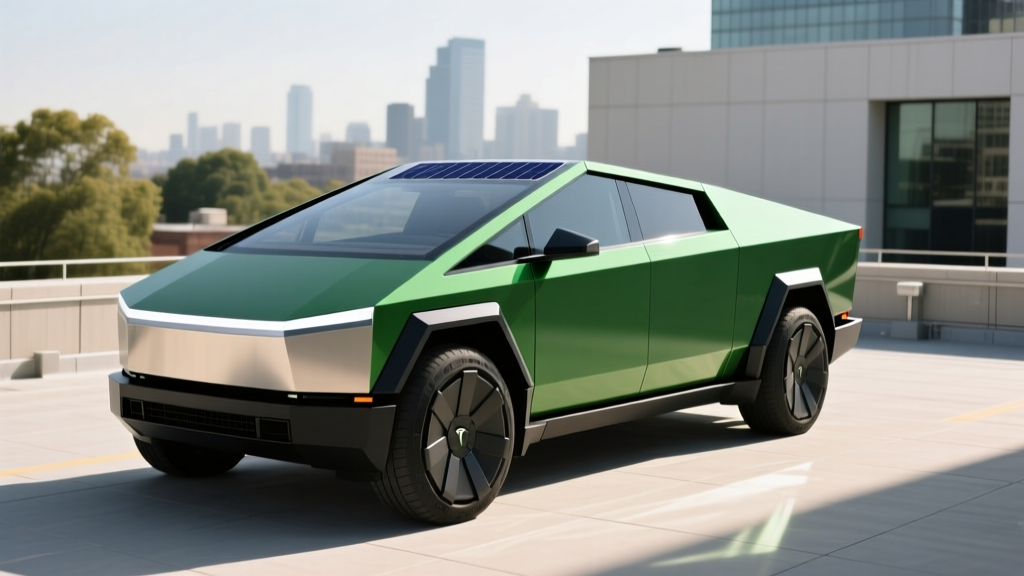
If you've been searching for a green Cybertruck, here's the unvarnished truth: Tesla does not offer green as a factory paint option for the Cybertruck in 2025 or 2026. The stainless steel exoskeleton ships in its raw brushed finish, or buyers can opt for Tesla's limited factory color palette — currently Satin Black, Satin White, and Satin Gray — all applied as a PPF-style wrap over the stainless panels at an additional cost.
That hasn't stopped thousands of owners from going green. Matte olive, British Racing Green, metallic emerald, and tactical forest green wraps have become some of the most popular aftermarket modifications in the Cybertruck community. In this review, we'll cover everything you need to know about making a Cybertruck green — plus deliver a full spec breakdown on range, charging, performance, pricing, and federal tax credit eligibility so you can decide if the Cybertruck itself is the right electric truck for you.
Tesla Cybertruck Full Spec Table
| Specification | AWD (Dual Motor) | Cyberbeast (Tri-Motor) |
|---|---|---|
| EPA Range | 340 miles | 320 miles |
| Battery Capacity (usable) | ~123 kWh (NMC) | ~123 kWh (NMC) |
| Drivetrain | Dual Motor AWD | Tri-Motor AWD |
| Horsepower | 600 hp | 845 hp |
| 0–60 mph | 4.1 seconds | 2.6 seconds |
| Top Speed | 130 mph | 130 mph |
| Max DC Fast Charge | 250 kW (peak) | 250 kW (peak) |
| 10–80% DC Charge Time | ~28 minutes | ~28 minutes |
| Level 2 Home Charge Rate | 11.5 kW (~34 mi/hr) | 11.5 kW (~34 mi/hr) |
| MPGe (combined) | 70 MPGe | 68 MPGe |
| kWh per 100 mi | 48 kWh | 50 kWh |
| Towing Capacity | 11,000 lbs | 11,000 lbs |
| Payload Capacity | 2,500 lbs | 2,500 lbs |
| Cargo Volume (bed) | ~34 cu ft (vault closed) | ~34 cu ft (vault closed) |
| Front Trunk (Frunk) | ~7 cu ft | ~7 cu ft |
| Base MSRP | $79,990 | $99,990 |
| Battery Warranty | 8 yr / 120,000 mi | 8 yr / 120,000 mi |
| Vehicle Warranty | 4 yr / 50,000 mi | 4 yr / 50,000 mi |
Sources: Tesla Cybertruck Design Page, fueleconomy.gov
How to Get a Green Cybertruck: Factory Colors vs. Aftermarket Wraps
Tesla's Factory Color Options (2025–2026)
The Cybertruck's cold-rolled stainless steel body doesn't accept traditional automotive paint the way aluminum or steel-stamped panels do. Tesla's factory-applied color options use a paint protection film (PPF) wrap over the raw stainless surface:
- Satin Black — $6,500 additional
- Satin White — $6,500 additional
- Satin Gray — $6,500 additional
- Stainless Steel (raw) — No charge
No green. No blue. No red. Tesla has kept the palette intentionally minimal, likely to streamline production on a vehicle that was already notoriously difficult to manufacture at scale.
The Aftermarket Wrap Route to Green
This is how virtually every green Cybertruck you've seen on Instagram or YouTube was born. Professional vinyl wrap shops across the US now have extensive Cybertruck experience, and the angular geometry actually makes wrapping more straightforward than on curved-body vehicles — flat panels, hard creases, fewer compound curves.
What to budget:
- Full-body color change wrap (3M, Avery Dennison, or XPEL film): $3,500–$6,000 installed
- Premium finishes (color-shift, chrome, textured): $5,500–$9,000+
- Cybertruck-specific PPF with color tint (protective + colored): $7,000–$10,000
Popular green choices among Cybertruck owners:
- Matte Olive Drab / Military Green — the most common "green Cybertruck" look, plays into the truck's utilitarian aesthetic
- British Racing Green (gloss or satin) — a classic, upscale green that contrasts strikingly with the angular design
- Emerald Metallic — bold, head-turning, photographs extremely well
- Forest / Hunter Green (matte) — outdoorsy, tactical look popular with overlanding builds
Pro tip: If you plan to wrap a green Cybertruck, buying the base stainless steel (no factory color upcharge) and applying the wrap yourself saves $6,500 versus getting a Tesla factory color and then wrapping over it. The raw stainless surface is actually an excellent substrate for vinyl adhesion when properly prepped with isopropyl alcohol and a mild adhesion promoter.
Range, Efficiency, and Real-World Expectations
EPA Estimated Range: 340 miles (AWD) / 320 miles (Cyberbeast)
Real-World Expectations:
• Highway cruising (70–75 mph, mild weather): ~270–300 miles
• City/mixed driving (regenerative braking active): ~290–320 miles
• Cold weather (below 32°F, cabin heat on): ~220–260 miles
• Towing (loaded trailer, 6,000+ lbs): ~150–180 miles
The Cybertruck's brick-like aerodynamic profile (Cd ~0.34 estimated) hits efficiency hard at highway speeds. City driving with regen braking recovers more energy than in most trucks.
The Cybertruck's efficiency — roughly 48–50 kWh per 100 miles — is among the worst of any current EV on the market. For context, a Tesla Model Y uses about 28 kWh/100mi, and even the Ford F-150 Lightning manages around 42–47 kWh/100mi. The Cybertruck's mass (nearly 7,000 lbs curb weight), aggressive frontal area, and stainless steel body all work against it.
That said, 340 miles of EPA range is genuinely useful for road trips. You can comfortably plan 200–240 mile legs between Supercharger stops with a reasonable buffer, which covers the vast majority of US interstate corridors.
Battery: 123 kWh NMC Pack
Tesla uses an NMC (nickel-manganese-cobalt) lithium-ion battery pack in the Cybertruck with approximately 123 kWh of usable capacity. This is a large pack by any measure — comparable to the GMC Hummer EV's available packs and significantly larger than the F-150 Lightning's extended-range 131 kWh pack.
NMC chemistry was chosen over LFP (lithium iron phosphate) for the Cybertruck because of its higher energy density — critical in a vehicle that already pushes weight limits and needs every mile of range it can get. The trade-off is that NMC degrades slightly faster than LFP over thousands of cycles and prefers not to sit at 100% SoC for extended periods. Tesla recommends daily charging to 80–90% and only charging to 100% when you need the full range for a trip.
Charging Speed: DC Fast Charging and Home Level 2
| Charging Level | Power (kW) | Miles Added per Hour | Typical Use Case |
|---|---|---|---|
| Level 1 (120V household) | ~1.4 kW | ~3–4 mi/hr | Emergency/overnight trickle |
| Level 2 (240V home, 48A) | 11.5 kW | ~34 mi/hr | Daily home charging |
| DC Fast (250 kW peak, V3 Supercharger) | 250 kW (peak) | ~200 mi in 15 min | Road trips |
| DC Fast (average sustained, 10–80%) | ~150 kW (avg) | — | 10–80% in ~28 min |
DC Fast Charging Reality
The Cybertruck peaks at 250 kW on Tesla V3 Superchargers using the NACS connector (native to the vehicle — no adapter needed). However, as with all EVs, peak rate is not sustained rate. The charging curve tapers significantly above 60% SoC, and the 10–80% session takes approximately 28 minutes.
On a 2026 road trip, that means a typical Supercharger stop adds about 200 miles of range in 15 minutes if you arrive at 10–15% SoC. Plan to charge to 80% and go — the time spent charging from 80% to 100% at a Supercharger is painfully slow (often 25+ additional minutes for the last 20%) and not worth the wait unless you absolutely need every mile.
CCS adapter note: The Cybertruck ships with the NACS port. If you need to use CCS-network chargers (Electrify America, EVgo CCS stalls), Tesla sells a NACS-to-CCS adapter (~$250) that enables charging at up to ~150 kW on compatible CCS stations.
Home Level 2 Charging
At home, the Cybertruck accepts up to 11.5 kW on Level 2 (48 amps on a 60-amp circuit). This adds roughly 34 miles of range per hour, meaning a full charge from 10% to 90% takes approximately 9–10 hours — perfectly suited for overnight charging.
For a 123 kWh battery, home charging is non-negotiable for practical daily ownership. Relying solely on DC fast charging would cost significantly more per mile and add unnecessary wear to the battery through repeated high-current sessions.
Estimated home charging cost: At the US average residential rate of ~$0.16/kWh, fully recharging the Cybertruck from 10% to 90% (~100 kWh) costs roughly $16 — yielding about $0.047/mile in electricity. Compare that to a gas truck getting 18 mpg at $3.50/gallon: $0.194/mile. The per-mile fuel savings are substantial.
Performance and Driving Dynamics
The Cybertruck delivers supercar-level acceleration in a truck body, and there's no way around the fact that it's absurdly quick:
- AWD (Dual Motor): 600 hp, 0–60 mph in 4.1 seconds
- Cyberbeast (Tri-Motor): 845 hp, 0–60 mph in 2.6 seconds
The Cyberbeast's 2.6-second 0–60 time puts it in the territory of a Porsche 911 Turbo S. In a 7,000-pound stainless steel truck. The torque-vectoring tri-motor setup (one front, two rear) delivers instant, brutal acceleration with no turbo lag or shift interruption.
Ride and Handling
The Cybertruck uses a 48-volt steer-by-wire system — there is no mechanical connection between the steering wheel and the front wheels. This allows a variable steering ratio that requires less than one full turn lock-to-lock at any speed. The learning curve is real: most drivers report needing 2–3 days before the steering feels natural.
The adaptive air suspension provides up to 12 inches of ground clearance in Extract mode (for off-road obstacles) and can lower the truck for highway efficiency. Ride quality is firm — this is a heavy vehicle on stiff springs, and you will feel expansion joints and potholes more than in an F-150 Lightning or Rivian R1T.
Towing
Rated at 11,000 lbs maximum towing capacity, the Cybertruck matches heavy-duty gas trucks on paper. However, real-world towing range drops dramatically — expect roughly 150–180 miles of range when pulling a 6,000+ lb trailer at highway speeds. For frequent heavy towing, a diesel remains more practical for long hauls, though the Cybertruck's instant torque makes it excellent for boat launches and short towing runs.
Pricing, Trims, and Federal Tax Credit Eligibility
| Trim | Base MSRP | Federal §30D Credit | Estimated Net Price |
|---|---|---|---|
| AWD (Dual Motor) | $79,990 | $0 (MSRP cap exceeded) | $79,990 |
| Cyberbeast (Tri-Motor) | $99,990 | $0 (MSRP cap exceeded) | $99,990 |
| RWD (announced, 2026+) | ~$60,990 (est.) | Potentially eligible* | ~$53,490 (est.)* |
*The RWD single-motor Cybertruck has been announced by Tesla for a future production date but is not currently available for purchase. Pricing and tax credit eligibility are preliminary estimates.
Federal Tax Credit: Why the AWD and Cyberbeast Don't Qualify
Under current IRS §30D rules, the federal clean vehicle credit has an MSRP cap of $80,000 for trucks, vans, and SUVs. The Cybertruck AWD at $79,990 sits tantalizingly close — and some early buyers in 2024 did manage to claim the credit before Tesla's destination fee pushed the effective price above the cap.
As of 2025–2026, with destination and delivery fees included, the AWD model's total MSRP typically exceeds the $80,000 threshold. The Cyberbeast at $99,990 is well above the cap. Additionally, buyers must meet adjusted gross income limits ($150,000 single / $300,000 married filing jointly / $225,000 head of household) and the vehicle must meet critical mineral and battery component sourcing requirements that continue to tighten through 2026.
Bottom line: Do not count on the $7,500 federal tax credit for a currently available Cybertruck. Consult a tax professional and verify current IRS guidance before making a purchase decision based on credit eligibility.
State and Local Incentives
Some states offer their own EV rebates that have different MSRP caps or no caps at all. California's CVRP, Colorado's innovative motor vehicle credit, and various utility company rebates may apply. Check your state's energy office and local utility for current programs — these vary significantly by jurisdiction and change frequently.
Cargo, Interior Space, and Daily Practicality
The Cybertruck is a full-size crew cab pickup with a 6-foot bed (called the "vault" by Tesla) and seating for five adults.
- Bed volume: ~34 cu ft (vault lid closed) / ~67 cu ft (vault lid open to tailgate)
- Frunk: ~7 cu ft — lockable front trunk, useful for charging cables and groceries
- Front legroom: ~41.5 inches
- Rear legroom: ~38.5 inches (adequate for adults, but tighter than an F-150 SuperCrew)
- Rear headroom: Limited by the sloping roofline — tall passengers will notice
The motorized vault cover (tonneau) is standard and integrates with the vehicle's locking system. When closed, the bed is secure and weather-resistant. The tailgate deploys as a ramp for loading ATVs or motorcycles.
Interior and Technology
The Cybertruck's interior is minimalist even by Tesla standards:
- 18.5-inch center touchscreen with all vehicle controls, navigation, and media
- 9.4-inch rear touchscreen for rear passengers (HVAC, media, climate controls)
- Yoke or round steering wheel (buyer's choice at order time)
- No physical buttons or stalks — turn signals are on the steering wheel, wipers and lights are touchscreen-controlled
- 15-speaker premium audio with active noise cancellation
- HEPA air filtration (Bioweapon Defense Mode)
The lack of turn signal stalks and physical controls is the most polarizing aspect of the interior. Most owners adapt within a week, but it requires deliberate re-learning of muscle memory, especially for roundabout navigation and lane changes.
Driver Assistance: Autopilot and FSD (Supervised)
The Cybertruck comes standard with Tesla's Basic Autopilot (lane centering + adaptive cruise). Full Self-Driving (Supervised) is available as an $8,000 add-on or $99/month subscription.
Both Autopilot and FSD (Supervised) are SAE Level 2 driver-assistance systems. They require continuous driver supervision — hands near the wheel, eyes on the road, ready to take over at any moment. They are not self-driving. Tesla's camera-only "Tesla Vision" system handles lane changes, stop signs, and some city street navigation, but the driver remains legally and practically responsible for the vehicle at all times. Only Level 4 services like Waymo operate without a human driver.
Pros and Cons: The Honest Assessment
✅ Pros
- Brutal acceleration — Cyberbeast is legitimately supercar-fast
- 340-mile EPA range is genuinely road-trip capable
- 250 kW Supercharger access with native NACS
- Stainless steel body resists dents, scratches, and corrosion
- 11,000-lb towing capacity matches conventional trucks
- Frunk + secure vault provide versatile cargo options
- Tesla Supercharger network reliability
- Over-the-air updates continually add features
❌ Cons
- Poor efficiency (48–50 kWh/100mi) — worst in class for EVs
- No factory green color — wrap adds $3,500–$9,000
- Does not qualify for $7,500 federal tax credit (MSRP cap)
- Highway range drops significantly due to aerodynamics
- Steer-by-wire learning curve is real and not for everyone
- No physical controls — turn signals on wheel frustrate some drivers
- Rear headroom compromised by roofline
- Stainless steel panels show fingerprints and smudges constantly
- Panel gap and build quality inconsistencies reported
- High insurance premiums (average 25–40% above comparable trucks)
Who Should Buy the Cybertruck (and Who Shouldn't)
Choose the Cybertruck if:
- You want a statement vehicle that turns heads at every stoplight
- You value Tesla's Supercharger network for road-trip convenience
- You want supercar acceleration in a truck body
- You're planning to wrap the truck anyway (save the $6,500 factory color fee)
- Your daily commute is under 200 miles round-trip with home charging
Consider alternatives if:
- You need maximum efficiency — the Rivian R1T and F-150 Lightning are more efficient per mile
- You want the $7,500 federal tax credit — look at the F-150 Lightning XLT or Rivian R1S/R1T (eligibility varies)
- You tow heavy loads long-distance — range while towing is poor, and diesel remains more practical
- You prefer traditional controls and a proven, conventional truck layout
- You need a third row or more than 5 seats — Cybertruck is strictly a 5-passenger vehicle
Cybertruck vs. Key Competitors
| Spec | Cybertruck AWD | Ford F-150 Lightning (Ext. Range) | Rivian R1T (Dual Motor Max) |
|---|---|---|---|
| EPA Range | 340 mi | 320 mi | 410 mi |
| Base MSRP | $79,990 | $59,995 | $89,900 |
| 0–60 mph | 4.1 sec | 3.8 sec | 4.5 sec |
| Max DC Charge | 250 kW | 150 kW | 220 kW |
| Towing | 11,000 lbs | 10,000 lbs | 11,000 lbs |
| Federal §30D Credit | Unlikely (MSRP cap) | Eligible (select trims) | Eligible (select configs) |
| Efficiency | 48 kWh/100mi | ~44 kWh/100mi | ~40 kWh/100mi |
The F-150 Lightning wins on value and tax credit eligibility. The Rivian R1T wins on range, efficiency, and off-road capability. The Cybertruck wins on raw acceleration, charging speed, and — let's be honest — the polarizing factor that makes it unlike anything else on the road.
Frequently Asked Questions
Does Tesla make a green Cybertruck from the factory?
No. Tesla's factory Cybertruck colors are limited to Satin Black, Satin White, Satin Gray, and raw stainless steel. A green Cybertruck requires an aftermarket vinyl wrap, which typically costs $3,500–$6,000 for a full-body color change.
Will wrapping my Cybertruck void the warranty?
A professionally installed vinyl wrap generally does not void the vehicle's warranty. However, if a wrap causes damage during installation or removal (adhesive residue on trim, damage to sensors), those specific repairs may not be covered. Tesla Service Centers have confirmed that wraps over the stainless panels are acceptable. Keep documentation from your wrap installer.
What is the real-world range of the Cybertruck?
The EPA rates the AWD at 340 miles and the Cyberbeast at 320 miles. In real-world highway driving at 70–75 mph, expect 270–300 miles. In cold weather below freezing, expect 220–260 miles. When towing a loaded trailer, range drops to approximately 150–180 miles.
How fast does the Cybertruck charge at home?
On a Level 2 home charger (240V, 48A), the Cybertruck charges at up to 11.5 kW, adding about 34 miles of range per hour. A typical overnight charge from 20% to 80% takes about 6–7 hours.
Does the Cybertruck qualify for the federal EV tax credit?
The currently available AWD ($79,990) and Cyberbeast ($99,990) trims likely do not qualify for the full $7,500 §30D federal tax credit due to the $80,000 MSRP cap for trucks. The announced RWD model (not yet in production) may qualify. Always verify current IRS rules and consult a tax professional before relying on credit eligibility.
Is the Cybertruck worth it compared to the F-150 Lightning or Rivian R1T?
It depends on your priorities. The Lightning offers better value and tax credit access. The R1T delivers more range and a more refined off-road experience. The Cybertruck delivers the fastest acceleration, the most reliable charging network access (Superchargers), and the most distinctive design — if you're willing to accept the efficiency penalty, the higher price, and the learning curve of its unconventional controls.
How much does it cost to wrap a Cybertruck green?
A full-body green vinyl wrap on a Cybertruck costs between $3,500 and $6,000 at a professional wrap shop using quality film (3M, Avery, XPEL). Premium finishes like color-shift or chrome green can push costs to $7,000–$9,000. The angular panels are actually easier to wrap than curved vehicles, which can slightly reduce labor costs.