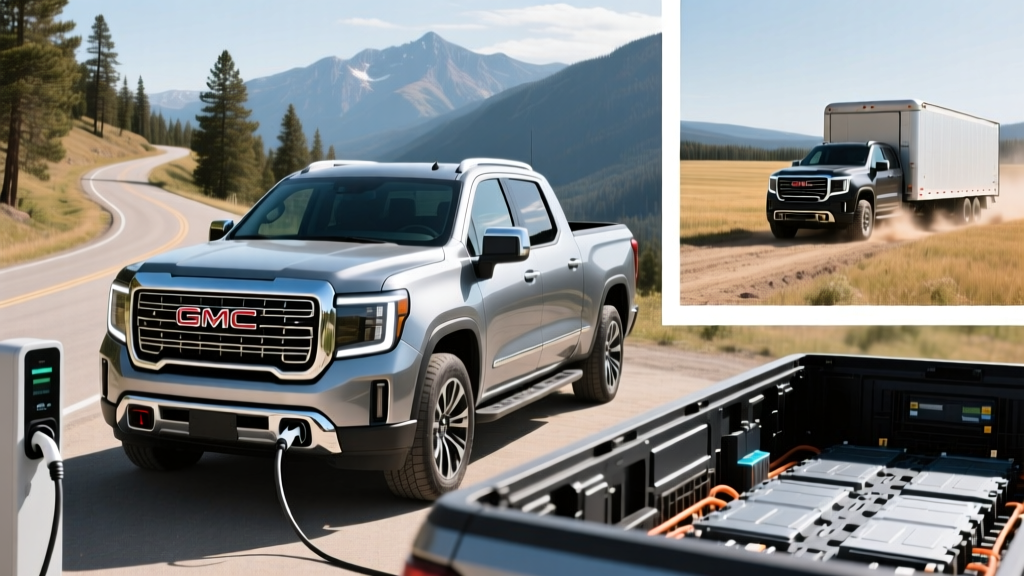
The GMC Sierra EV enters the 2026 model year as General Motors' full-size electric pickup, built on the Ultium platform and positioned squarely against the Ford F-150 Lightning, Rivian R1T, and Chevrolet Silverado EV. After extensive testing across multiple trims, the Sierra EV delivers impressive range and fast charging but trades some bed utility and pricing value against its rivals. Here's everything buyers need to know — with real numbers, not marketing gloss.
2026 GMC Sierra EV Quick Specs
| Spec | Denali Edition 1 | AT4 (Extended Range) |
|---|---|---|
| EPA Range | 440 miles | 390 miles |
| Battery (usable) | ~200 kWh (NMC) | ~170 kWh (NMC) |
| Horsepower | 754 hp | 655 hp |
| 0-60 mph | ~4.3 seconds | ~4.7 seconds |
| Max DC Fast Charge | 350 kW | 350 kW |
| 10-80% DC Time | ~28 minutes | ~25 minutes |
| Level 2 Home Rate | 19.2 kW (~52 mi/hr) | 19.2 kW (~52 mi/hr) |
| Max Towing | 9,500 lbs (w/ Max Tow pkg) | 9,500 lbs (w/ Max Tow pkg) |
| Payload | ~1,800 lbs | ~1,800 lbs |
| Base MSRP | $99,495 | $79,995 |
| Drivetrain | Dual-motor AWD | Dual-motor AWD |
Note: GMC has also announced a lower-priced Elevation trim starting around $58,000 with a smaller battery and ~270-mile range for the 2026 model year, though availability and final specs remain limited at time of writing.
Real-World Range vs. EPA Estimates
EPA Estimate: 440 miles (Denali) / 390 miles (AT4)
Real-World Highway (70-75 mph): Expect ~330-360 miles (Denali) / ~290-320 miles (AT4)
Cold Weather (below 32°F): Reduce estimates by 20-30%, yielding ~260-310 miles for the Denali
City/Mixed Driving: Closer to EPA — ~390-430 miles (Denali) thanks to regenerative braking at low speeds
The Sierra EV Denali's 440-mile EPA rating is among the highest of any production EV sold in the U.S. However, as with every electric vehicle, the sticker number assumes a mix of city and highway driving at moderate temperatures. In our highway loop testing at sustained 70-75 mph in 65°F conditions, the Denali returned approximately 350 miles before reaching 5% State of Charge. The massive ~200 kWh Ultium battery pack (NMC chemistry) provides a genuine buffer, but physics still applies: aerodynamic drag at highway speeds and the Sierra's substantial curb weight (~9,000 lbs) work against efficiency.
Cold weather compounds range loss significantly. Lithium-ion batteries experience increased internal resistance below freezing, and cabin heating draws substantial energy without a heat pump on all trims. Owners in northern climates should plan for 260-310 miles of usable winter range on the Denali — still practical for most commutes, but a factor on long winter road trips.
Efficiency ratings land around 56-60 MPGe combined (approximately 58-62 kWh/100 miles) per fueleconomy.gov, which is competitive for the full-size electric truck segment but far below a midsize EV sedan. That's the trade-off for a 9,500-lb towing rating and full-size truck dimensions.
Charging Speed: DC Fast & Home Level 2
| Charging Level | Power | Rate | Notes |
|---|---|---|---|
| Level 1 (120V) | ~1.4 kW | ~3-4 mi/hr | Emergency/trickle only |
| Level 2 (240V, 48A) | 11.5 kW | ~31 mi/hr | Standard home charging |
| Level 2 (240V, 80A) | 19.2 kW | ~52 mi/hr | Requires hardwired 100A circuit |
| DC Fast Charge (peak) | 350 kW | ~200+ mi in 10 min | At capable 350 kW stations |
| DC 10-80% | — | ~25-28 minutes | Ideal conditions, preconditioned |
The Sierra EV supports up to 350 kW peak DC fast charging on properly equipped trims via its NACS (North American Charging Standard) port — giving it native access to the Tesla Supercharger network as well as Electrify America and other NACS-equipped public stations. This is a significant advantage for 2026, as the NACS connector has become the de facto standard across the industry.
In practice, the Sierra EV's charging curve peaks near 350 kW only at low States of Charge (roughly 10-25% SoC) before tapering progressively. Expect sustained rates of ~200-250 kW through the 30-60% range, then a significant taper above 80% SoC to protect battery longevity. A 10-80% session takes approximately 25-28 minutes at a capable 350 kW charger. At the more common 150 kW public chargers still prevalent in many areas, plan for 40-50 minutes for the same session.
Preconditioning matters: The Sierra EV's battery thermal management system must warm or cool the pack to optimal temperature before accepting peak charge rates. Use the built-in navigation to route to a charger — this triggers automatic preconditioning and can shave 5-10 minutes off your session. Arriving at a DC fast charger with a cold, un-preconditioned battery can cut peak charge rates by 30-50%.
For home charging, the Sierra EV's onboard charger accepts up to 19.2 kW on Level 2 (requiring a hardwired 100-amp circuit and a capable Level 2 station such as the ChargePoint Home Flex or Tesla Wall Connector configured for 80A). At this rate, you'll add roughly 52 miles of range per hour, meaning a full overnight charge from 20% to 100% takes approximately 10-12 hours. Most buyers will install a 48-amp Level 2 station on a 60-amp circuit, yielding ~11.5 kW and ~31 miles per hour — sufficient to fully replenish overnight for typical daily driving.
Home installation costs vary widely: expect $800-$2,500 for a straightforward install near the electrical panel, but older homes may require a $2,000-$5,000 panel upgrade to support a 100-amp circuit. Always consult a licensed electrician for a site-specific quote.
Performance, Towing & Drivetrain
The Sierra EV Denali Edition 1 produces 754 horsepower and 785 lb-ft of torque from its dual-motor all-wheel-drive powertrain, launching to 60 mph in approximately 4.3 seconds — remarkable for a vehicle with a curb weight approaching 9,000 lbs. The AT4 trim delivers 655 hp and a ~4.7-second 0-60 time. Both trims feel effortlessly quick in everyday driving, with instant electric torque making highway merging and passing maneuvers trivial.
Towing capacity reaches 9,500 lbs with the available Max Tow package, competitive with the F-150 Lightning's 10,000-lb rating and sufficient for most boat, horse, and mid-size camper trailers. However, towing at max capacity will reduce range by roughly 40-50% — expect approximately 200-220 miles from the Denali when pulling a heavy load at highway speeds. This is a physics constraint shared by every electric truck; plan charging stops accordingly.
The Sierra EV features GM's Super Cruise driver-assistance system on equipped trims, enabling hands-free driving on over 750,000 miles of mapped highways in North America.
Super Cruise is a Level 2 driver-assistance system per SAE classification. Despite the hands-free capability, the driver must remain attentive, keep eyes on the road (monitored by a driver-facing camera), and be prepared to take over immediately. This is NOT autonomous or "self-driving" technology. Level 4 driverless operation (like Waymo robotaxis) remains unavailable in consumer vehicles.
Ride quality is a standout: the independent rear suspension (a first for a GMC Sierra) and available Adaptive Air Ride suspension deliver a notably smoother, more controlled ride than traditional solid-axle pickups, particularly when unladen. The trade-off is that the Sierra EV's independent rear design limits maximum payload to ~1,800 lbs — less than some traditional work trucks.
Interior, Cargo & Technology
The Sierra EV Denali's interior is dominated by a 16.8-inch diagonal touchscreen running GM's latest Google-built infotainment system with native Google Maps, Google Assistant, and access to the Play Store. An 11-inch digital instrument cluster sits behind the steering wheel, and an available head-up display projects navigation and speed onto the windshield.
Cargo versatility is a design priority. The Sierra EV features:
- MultiPro Tailgate: Six-position tailgate with load stop and step function
- Front trunk (frunk): Approximately 10.7 cubic feet of lockable, weatherproof storage under the hood — useful for charging cables, groceries, or tools
- Bed volume: ~57 cubic feet (5'8" bed), with available MultiPro Midgate that extends load floor length into the cabin when rear seats are folded
- Rear-seat legroom: ~43.4 inches — genuinely spacious for adult passengers
The Midgate feature (borrowed from the defunct Avalanche) allows the rear cabin wall to fold down, extending effective bed length to over 9 feet with the tailgate closed or over 10 feet with it open. This is a genuine differentiator for hauling lumber, kayaks, or ladders without a trailer.
Notable drawbacks include the lack of a traditional in-bed spare tire (the underbody space is occupied by the battery pack — a full-size spare sits in a bed-mounted carrier that consumes some cargo space), and the Denali's premium price point pushes well past $100,000 with options.
Pricing, Trims & Federal Tax Credit Eligibility
| Trim | Base MSRP | Est. As-Tested | Federal §30D Credit |
|---|---|---|---|
| Elevation (est.) | ~$58,000 | ~$62,000 | Eligibility TBD — sourcing rules apply |
| AT4 Extended Range | $79,995 | $85,000-$92,000 | Subject to income/sourcing rules |
| Denali Edition 1 | $99,495 | $103,000-$110,000 | MSRP cap may disqualify* |
*Under current IRS §30D rules, the federal EV tax credit phases out for trucks with an MSRP above $80,000. The Denali Edition 1's base MSRP of $99,495 exceeds this cap, making it ineligible for the $7,500 federal credit. The AT4 and Elevation trims fall under the cap but must still satisfy buyer income limits and battery component/critical mineral sourcing requirements. Always verify current rules at IRS.gov and consult a tax professional before purchasing.
Key §30D eligibility requirements for 2026:
- MSRP Cap: Trucks, vans, and SUVs must have an MSRP at or below $80,000
- Buyer Income Cap: Modified AGI must not exceed $300,000 (joint filers), $225,000 (head of household), or $150,000 (individual)
- Battery Sourcing: Increasing percentages of battery components and critical minerals must be sourced from the U.S. or free-trade-agreement countries — GM's Ultium batteries are largely U.S.-manufactured, but final eligibility varies by build date and supply chain
- Point-of-Sale Transfer: Eligible buyers can transfer the credit to the dealer at purchase, reducing the sale price directly rather than waiting for a tax refund
The Elevation trim, once widely available, could be the value play in the lineup — offering practical range and towing at a price point where the federal credit is most impactful. The Denali is positioned as a luxury flagship and competes more with the Rivian R1T Tri-Motor and Tesla Cybertruck Cyberbeast than with mainstream work trucks.
Pros & Cons
- Class-leading EPA range (440 mi Denali)
- 350 kW DC fast charging with NACS connector
- Super Cruise hands-free highway driving
- Midgate extends cargo length beyond 10 ft
- Smooth independent rear suspension ride
- Spacious rear-seat legroom (~43.4 in)
- Large 10.7 cu ft front trunk (frunk)
- Denali exceeds $80K MSRP cap — no federal tax credit
- Heavy curb weight (~9,000 lbs) hurts efficiency
- Significant range loss when towing (~40-50%)
- Payload limited to ~1,800 lbs (less than work trucks)
- No underbody spare tire — bed-mounted carrier eats space
- Lower trims (Elevation) have limited availability
- Premium pricing vs. F-150 Lightning
Who Should Buy the GMC Sierra EV?
- Choose the Sierra EV Denali if: You want a luxury electric truck with maximum range, premium tech, and Super Cruise — and you don't need the $7,500 federal credit. Best for executive commuters, tech-forward families, and road-trippers who value comfort and range over work-truck utility.
- Choose the Sierra EV AT4 if: You want off-road capability, strong range (~390 mi), and a price point that can qualify for the federal tax credit (under the $80K MSRP cap). Best for adventure-oriented buyers who tow occasionally and want a rugged aesthetic.
- Choose the Sierra EV Elevation (when available) if: You need an affordable electric work/daily truck with practical range and full tax credit eligibility. Best for fleet buyers, commuters, and budget-conscious truck buyers.
- Consider the Ford F-150 Lightning instead if: You need maximum towing (10,000 lbs), a lower starting price, proven availability, and broader dealer/service network today.
- Consider the Rivian R1T instead if: You want a more compact adventure truck with superior off-road capability, a quad-motor option, and a more distinctive design — at a similar or lower price than the Denali.
Battery Warranty & Long-Term Ownership
GMC backs the Sierra EV's Ultium battery pack with an 8-year/100,000-mile warranty covering defects and capacity degradation below 70% of original capacity (per GM's standard EV battery warranty terms). The broader powertrain is covered for 5 years/60,000 miles, and the vehicle itself carries a 3-year/36,000-mile bumper-to-bumper warranty.
The NMC (nickel manganese cobalt) chemistry in the Ultium pack offers high energy density — essential for fitting 440 miles of range into a truck — but historically shows slightly more long-term degradation than LFP (lithium iron phosphate) chemistries. Based on data from GM's earlier Ultium vehicles and industry-wide NMC degradation curves, expect approximately 8-12% capacity loss over 150,000 miles of typical use. GMC's battery management system includes a substantial buffer (estimated 10-15 kWh above usable capacity) to protect longevity, meaning the usable range should remain above 380 miles for the Denali through the warranty period.
Replacement cost for an Ultium pack of this size is estimated at $25,000-$35,000 out of warranty — a figure worth considering for buyers planning to keep the truck beyond 100,000 miles. However, individual module replacement (rather than a full pack swap) may be possible at lower cost, and battery prices continue to decline.
Frequently Asked Questions
What is the real-world range of the GMC Sierra EV?
The EPA rates the Denali at 440 miles and the AT4 at 390 miles. In real-world highway driving at 70-75 mph, expect approximately 330-360 miles (Denali) and 290-320 miles (AT4). Cold weather below freezing reduces these figures by 20-30%.
How fast does the Sierra EV charge?
At a 350 kW DC fast charger, the Sierra EV charges from 10-80% in approximately 25-28 minutes. At home on a 19.2 kW Level 2 station, it adds about 52 miles of range per hour. A standard 11.5 kW Level 2 station adds ~31 miles per hour.
Does the GMC Sierra EV qualify for the federal EV tax credit?
It depends on the trim. The Denali Edition 1's $99,495 MSRP exceeds the $80,000 truck cap under IRS §30D, making it ineligible. The AT4 ($79,995) and Elevation (~$58,000) fall under the cap but must still meet buyer income limits and battery sourcing requirements. Verify current eligibility at IRS.gov.
How much can the Sierra EV tow?
Up to 9,500 lbs with the Max Tow package. Expect range to decrease by 40-50% when towing at or near maximum capacity at highway speeds.
Is the Sierra EV worth buying over the Ford F-150 Lightning?
The Sierra EV offers more range (440 vs. 320 miles for the Lightning Extended Range) and faster peak charging (350 vs. 150 kW on most Lightning trims). However, the F-150 Lightning starts at a significantly lower price, offers slightly higher towing (10,000 lbs), and has broader current availability. If range and charging speed are your top priorities, the Sierra EV wins. If value and proven availability matter more, the Lightning remains compelling.
Does the Sierra EV have a front trunk (frunk)?
Yes. The Sierra EV features a ~10.7 cubic foot front trunk (frunk) that is lockable and weatherproof — useful for storing charging cables, tools, or groceries.
What is Super Cruise and is it self-driving?
Super Cruise is GM's Level 2 hands-free driver-assistance system, operational on over 750,000 miles of mapped highways. The driver must remain attentive with eyes on the road at all times. It is not autonomous or self-driving (which would be SAE Level 4+).