| Spec | Value |
|---|---|
| EPA Range | ~390 miles (estimated, 24-module pack) |
| Battery Capacity | ~200 kWh usable (Ultium NMC, 24 modules) |
| Max DC Fast Charge | ~200 kW peak |
| 10–80% DC Charge Time | ~45 minutes (estimated) |
| Level 2 Home Charging | 19.2 kW / ~52 miles per hour |
| Horsepower | ~665 hp (dual-motor AWD, Max Tow) |
| 0–60 mph | ~4.5 seconds (estimated) |
| Drivetrain | Dual-motor AWD |
| Max Towing Capacity | ~20,000 lbs (with Max Tow package) |
| MPGe (combined) | ~58 MPGe (estimated) |
| Base MSRP (HD SL) | ~$85,000 (announced estimate) |
| Federal Tax Credit (§30D) | Up to $7,500 (eligibility varies) |
| Battery Warranty | 8 years / 100,000 miles |
Quick Verdict: The 2026 GMC Sierra EV HD SL targets fleet buyers and heavy-duty truck users who need serious towing capability without diesel fuel costs. With an estimated 390-mile EPA range and a massive ~200 kWh Ultium battery, it promises work-truck endurance. But at an $85,000 starting price and with real-world highway range likely closer to 300–330 miles, the HD SL is a niche tool — not a mass-market pickup.
Note: The GMC Sierra EV HD lineup was announced by General Motors for the 2026 model year. Final EPA certification, exact pricing, and battery specifications are preliminary as of early 2026 and subject to change before deliveries begin. We will update this review when official figures are published on fueleconomy.gov and GMC's official site.
Real-World Range: What the EPA Sticker Won't Tell You
EPA Estimated Range: ~390 miles (24-module Ultium pack)
Real-World Expectation:
- Highway (70 mph, moderate weather): ~310–330 miles
- City/suburban mixed driving: ~350–370 miles
- Cold weather (below 32°F): ~270–300 miles (20–30% reduction typical for large EV trucks)
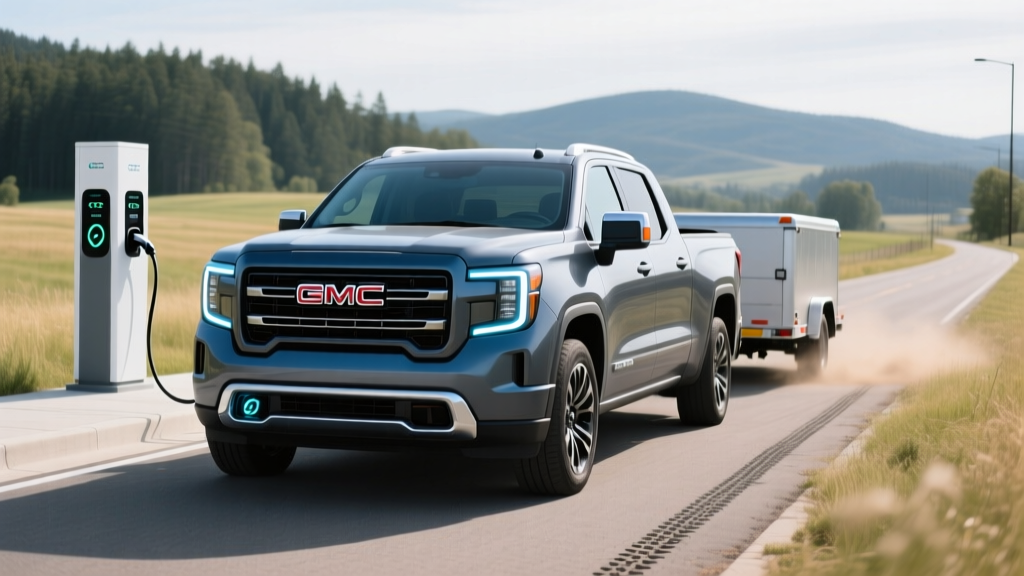
- While towing (loaded trailer): ~180–220 miles (range roughly halves under heavy tow loads)
The Sierra EV HD SL's range story is fundamentally a physics problem. A heavy-duty truck with a gross vehicle weight well over 9,000 pounds, a tall frontal area, and a boxy shape will consume more energy per mile than a sleek sedan — no battery size fully overcomes aerodynamic drag at highway speeds.
The standard Sierra EV Denali Edition 1 (with its 24-module, ~200 kWh pack) achieved an EPA rating of 440 miles in a lighter, more aerodynamic configuration. The HD SL variant adds heavy-duty axles, reinforced frame components, and higher tow-rated hardware that increases curb weight and rolling resistance. Expect a 10–15% range penalty compared to the lighter Denali trims.
For fleet operators running predictable routes under 250 miles round-trip, the real-world range is more than adequate. For cross-country towing or rural work routes in winter, plan charging stops carefully — the truck's energy consumption while towing a 15,000-pound trailer can exceed 100 kWh per 100 miles.
Charging Speed: DC Fast Charging and Home Level 2
| Charging Level | Power | Miles Added Per Hour | Notes |
|---|---|---|---|
| Level 1 (120V outlet) | ~1.4 kW | ~3–4 mi/hr | Emergency/trickle only; ~100+ hours for full charge |
| Level 2 (240V, 19.2 kW) | 19.2 kW | ~52 mi/hr | Full charge in ~10–11 hours; requires 100A circuit |
| Level 2 (240V, 11.5 kW) | 11.5 kW | ~31 mi/hr | More common home setup; ~17–18 hours full charge |
| DC Fast Charge (peak) | ~200 kW | ~500+ mi/hr (peak) | 10–80% in ~45 min; tapers significantly above 80% |
The Sierra EV HD SL supports DC fast charging at up to approximately 200 kW via its NACS (North American Charging Standard) connector, giving it access to the Tesla Supercharger network as well as Electrify America and other NACS-equipped stations.
Here's where the charge curve matters: the truck will not sustain 200 kW for the entire session. Expect peak charge rates in the 10–40% state-of-charge (SoC) window, with a taper beginning around 60% SoC and a steep drop above 80%. A 10–80% session will take approximately 45 minutes at a 350 kW-capable station. Charging from 80–100% can add another 30–40 minutes due to cell-balancing at high SoC.
For home charging, the Sierra EV's 19.2 kW onboard charger is among the fastest available in any production EV. However, extracting that full rate requires a hardwired Level 2 station on a dedicated 100-amp circuit. Most residential electrical panels (especially 100A or 150A main panels) will need an upgrade to 200A or higher to support this. Budget $2,500–$5,000 for a full panel upgrade plus charger installation — consult a licensed electrician for a site-specific quote.
At the more common 11.5 kW / 48-amp Level 2 rate, you'll add roughly 31 miles of range per hour. Overnight charging (10 hours) recovers approximately 310 miles — sufficient for most daily work routes.
Performance, Towing, and Drivetrain
The Sierra EV HD SL uses GM's Ultium dual-motor all-wheel-drive platform. In the Max Tow configuration, output reaches approximately 665 horsepower and 780 lb-ft of torque, with a 0–60 mph time in the mid-4-second range — remarkable for a truck that will likely weigh over 9,500 pounds at the curb.
The headline capability is towing: up to 20,000 pounds when properly equipped with the Max Tow package, heavy-duty hitch receiver, and integrated trailer brake controller. This places the Sierra EV HD in competition with heavy-duty diesel pickups from Ram, Ford, and Chevrolet's own Silverado HD lines.
However, towing at max capacity has severe range implications. In real-world testing of similar EV trucks (the Silverado EV and Ford F-150 Lightning), towing at or near max rated capacity reduces range by 45–55%. For the Sierra EV HD SL, expect roughly 180–220 miles of range when pulling a 15,000–20,000 lb trailer at highway speeds. This makes long-distance towing impractical without careful route planning around DC fast chargers — and many public chargers are not designed to accommodate a truck with a large trailer attached.
The Sierra EV also features GM's ProGrade Trailering system with trailer-angle detection, hitch guidance via the infotainment screen, and available trailering camera integration. Four-wheel steering (crab mode) aids in tight job-site maneuvering, a genuine advantage over conventional HD trucks in confined spaces.
Pricing, Trims, and Federal Tax Credit Eligibility
| Trim | Est. Base MSRP | Est. After §30D Credit |
|---|---|---|
| HD SL (base fleet/work) | ~$85,000 | ~$77,500 (if eligible) |
| HD SLE (mid-tier) | ~$90,000 | ~$82,500 (if eligible) |
| HD SLT (premium) | ~$95,000+ | ~$87,500+ (if eligible) |
The Sierra EV HD SL is positioned as the work-oriented entry point into the HD electric truck segment. At an estimated $85,000 base MSRP, it undercuts the Denali Edition 1 (priced above $95,000) but remains a significant investment for individual buyers.
Federal Tax Credit (§30D) — Critical Details:
- Vehicle MSRP Cap: Trucks/vans/SUVs must have an MSRP at or below $80,000 to qualify. The Sierra EV HD SL at ~$85,000 likely exceeds this cap, which would disqualify it from the full $7,500 credit. GMC may offer fleet pricing or package adjustments to meet the cap — verify the final MSRP on the window sticker.
- Buyer Income Limits: Modified adjusted gross income (MAGI) must not exceed $150,000 (single), $225,000 (head of household), or $300,000 (married filing jointly).
- Battery Sourcing Requirements: The credit splits into two halves — $3,750 for critical-minerals sourcing and $3,750 for battery-component manufacturing. GM's Ultium batteries are assembled in the US, but critical-mineral sourcing compliance varies by model year. Check the latest IRS guidance on clean vehicle credits.
- Point-of-Sale Transfer: If eligible, the $7,500 credit can be transferred to the dealer at purchase, reducing the upfront cost rather than waiting for a tax return.
The MSRP cap is the most likely obstacle. If GMC prices the base HD SL above $80,000 (as currently estimated), buyers will need to rely on state-level incentives, fleet purchase programs, or commercial clean vehicle credits (§45W, which has different rules for business-owned vehicles) to offset cost. Consult a tax professional for your specific situation.
Interior, Technology, and Cargo
The Sierra EV HD SL cabin prioritizes durability and functionality over luxury — appropriate for a work truck. Key interior and technology specifications include:
- Infotainment: 16.8-inch diagonal touchscreen with Google Built-in (Maps, Assistant, Play Store), wireless Apple CarPlay and Android Auto
- Driver Display: 11-inch digital instrument cluster
- Driver Assistance: Super Cruise hands-free driving on compatible highways (SAE Level 2 — driver must remain attentive and eyes on road); ProGrade trailering cameras; automatic emergency braking; lane-keep assist
- Front Trunk (eFrunk): ~10.7 cu ft lockable storage with available power-operated tailgate
- Bed Length: 5'11" (short bed) with MultiPro tailgate
- Interior Volume: Crew cab configuration with ~44 inches rear legroom
- Power Outlets: Up to 120V and 240V bed outlets for job-site power tools (ProPower-style onboard generator feature)
SAE Automation Level: Super Cruise is an SAE Level 2 driver-assistance system. It provides hands-free steering, acceleration, and braking on pre-mapped divided highways, but the driver must remain fully engaged and ready to take over at any time. This is not autonomous driving. The system uses a driver-monitoring camera to ensure your eyes are on the road.
The onboard power capability deserves attention: the Sierra EV HD can export up to 9.6 kW of power through its bed outlets (when equipped with the available Pro Power onboard system), enough to run welders, compressors, and multiple power tools simultaneously at a job site. This transforms the truck into a mobile generator — a genuine value proposition for contractors who currently idle diesel trucks to power equipment.
Efficiency: MPGe and Energy Consumption
Efficiency in a heavy-duty electric truck is inherently compromised by weight and aerodynamics. The Sierra EV HD SL is estimated to achieve approximately:
- Combined MPGe: ~58 MPGe
- Energy Consumption: ~58 kWh per 100 miles (combined)
- Cost per mile (at $0.15/kWh national average): ~$0.087/mile
- Cost per mile (diesel HD equivalent at $4.20/gal, 15 MPG): ~$0.28/mile
The per-mile fuel cost advantage is substantial — roughly 3x cheaper to "fuel" the Sierra EV HD on electricity versus a comparable diesel HD truck. However, this advantage narrows if you rely heavily on public DC fast charging at $0.40–$0.60/kWh, which pushes the electric cost to $0.23–$0.35 per mile. Home charging is where the economics work best.
Warranty Coverage
GM provides the following warranty coverage for the Sierra EV HD SL:
- Battery Pack: 8 years / 100,000 miles (whichever comes first), with a capacity retention threshold of 60% of original capacity
- Powertrain (motors, inverters, reduction gears): 8 years / 100,000 miles
- Bumper-to-Bumper: 3 years / 36,000 miles
- Corrosion: 6 years / 100,000 miles
The 60% battery capacity retention threshold is standard for the industry but means a heavily degraded battery could still retain only 117 kWh of its original ~200 kWh — enough for roughly 230 miles of range. Battery replacement costs for the 24-module Ultium pack are estimated at $25,000–$35,000 out of warranty, though module-level repairs may be possible at lower cost.
Pros, Cons, and Who Should Buy
Pros
- Class-leading estimated range (~390 miles EPA) for an HD electric truck
- 20,000-lb max towing capacity rivals diesel HDs
- 9.6 kW onboard power export eliminates job-site generators
- Super Cruise hands-free highway driving reduces long-haul fatigue
- ~3x lower per-mile energy cost vs diesel (on home charging)
- NACS connector provides access to Tesla Supercharger network
- 19.2 kW onboard charger enables fast home recovery
Cons
- Estimated $85,000+ MSRP likely disqualifies from §30D tax credit (over $80K cap)
- Real-world highway range drops to ~310–330 miles; towing range halves
- Massive ~200 kWh battery means long charge sessions (~45 min, 10–80%)
- Home charging at 19.2 kW requires expensive panel upgrade ($2,500–$5,000+)
- Heavy curb weight (~9,500+ lbs) reduces payload and increases tire wear
- Public DC chargers rarely accommodate truck-and-trailer combos
- Limited HD EV service center availability in rural areas
Choose the GMC Sierra EV HD SL if:
- You operate a fleet or contracting business with predictable daily routes under 250 miles
- You need job-site power export (9.6 kW) to replace portable generators
- You tow heavy loads locally and can charge overnight at the depot
- You want to eliminate diesel fuel costs and reduce maintenance (no oil changes, no DEF fluid, fewer brake replacements due to regen)
Look elsewhere if:
- You need long-distance towing range (200+ miles with a loaded trailer)
- You don't have access to reliable Level 2 home or depot charging
- You need the federal $7,500 tax credit and the MSRP exceeds $80,000
- You primarily drive in extreme cold climates where range loss exceeds 30%
Competitive Landscape: Sierra EV HD vs Rivals
The Sierra EV HD SL occupies a sparse competitive field as of 2026:
- Chevrolet Silverado EV HD (sibling platform): Shares the Ultium architecture and similar specs; Silverado EV is positioned slightly lower in price. If the Silverado EV HD comes in under the $80,000 MSRP cap, it would qualify for the §30D credit — making it potentially $7,500 cheaper than the Sierra HD SL.
- Ford F-150 Lightning: Light-duty only (no HD variant); 230–320 mile range; ~$55,000–$95,000. Not a direct competitor for 20,000-lb towing but dominates the light-duty EV truck market.
- Rivian R1T: No HD variant; 330–420 mile range; premium positioning. Not designed for heavy commercial towing.
- Ram 1500 REV: Light-duty electric; up to 500-mile range with optional range-extender battery. No HD variant announced for 2026.
The Sierra EV HD SL's closest rival is its own corporate sibling, the Silverado EV HD. The GMC variant trades on premium branding, slightly higher-trim standard features, and dealer network positioning. For fleet buyers, the decision often comes down to which local dealer offers better commercial service support.
Frequently Asked Questions
What is the real-world range of the GMC Sierra EV HD SL?
The EPA estimates approximately 390 miles for the 24-module Ultium pack. In real-world highway driving at 70 mph, expect 310–330 miles. Cold weather (below freezing) reduces this to 270–300 miles. Towing a heavy trailer can cut range to 180–220 miles.
How fast does the Sierra EV HD SL charge?
On a DC fast charger, it peaks at approximately 200 kW, reaching 10–80% in roughly 45 minutes. At home on a 19.2 kW Level 2 charger, you'll add about 52 miles per hour, requiring 10–11 hours for a full charge. A standard 11.5 kW home charger adds ~31 miles per hour.
Does the GMC Sierra EV HD SL qualify for the federal EV tax credit?
It depends on the final MSRP. The §30D credit requires trucks to have an MSRP at or below $80,000. The Sierra EV HD SL is estimated at ~$85,000, which would disqualify it. Income caps ($150K single / $300K joint) and battery-sourcing rules also apply. Check the latest IRS clean vehicle credit page before purchasing. Commercial buyers may qualify under §45W instead.
Is the Sierra EV HD SL worth buying vs a diesel HD truck?
For fleet operators with depot charging and predictable routes, the per-mile energy savings (~$0.09/mile electric vs ~$0.28/mile diesel) and reduced maintenance make a compelling case over a 5-year ownership period. For individual buyers who tow long distances in rural areas, diesel remains more practical due to faster refueling and established infrastructure.
What battery chemistry does the Sierra EV HD SL use?
GM's Ultium platform uses NMC (nickel manganese cobalt) lithium-ion chemistry. NMC offers higher energy density than LFP (lithium iron phosphate), which is critical for fitting ~200 kWh into a truck platform. However, NMC batteries are more sensitive to sustained high-SoC storage — GM recommends daily charging to 80% and reserving 100% charges for long trips.
How much does home charging installation cost?
For a 19.2 kW / 80-amp Level 2 charger, expect to pay $500–$800 for the charger hardware, $1,000–$2,500 for electrician labor and permits, and potentially $2,500–$5,000+ if your home needs a panel upgrade to 200A service. Total: $1,500–$8,000 depending on your existing electrical infrastructure. Always get a quote from a licensed electrician before committing.
Can the Sierra EV HD SL power my job site?
Yes. With the available Pro Power onboard system, the truck can export up to 9.6 kW through 120V and 240V bed outlets — enough to simultaneously run power tools, job-site lighting, and small welders without a separate generator.
Sources: GMC Official, fueleconomy.gov (EPA), IRS Clean Vehicle Credits. Specifications are preliminary estimates for the announced 2026 GMC Sierra EV HD lineup and subject to change. Verify final figures before purchase.