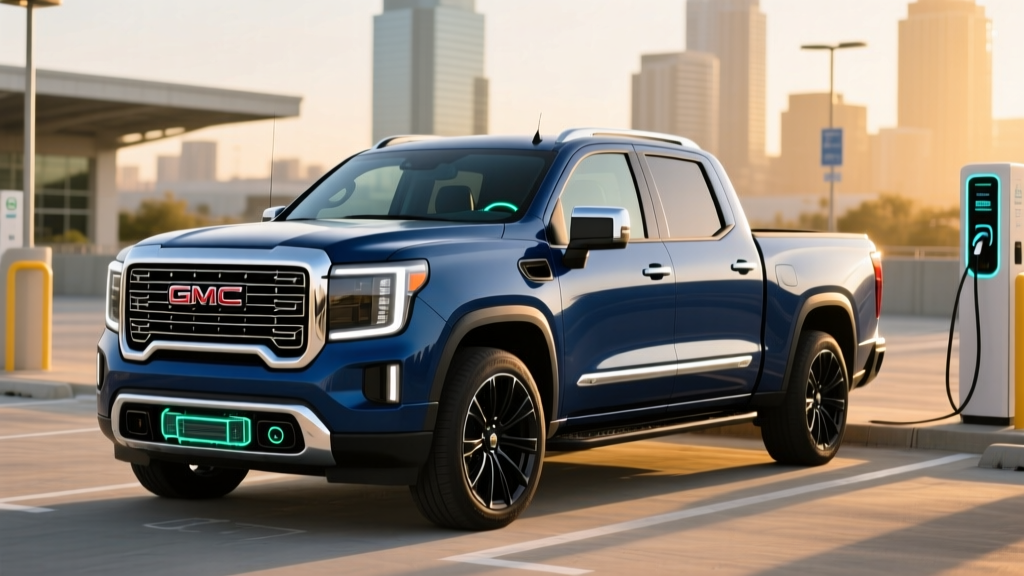
Bottom line on the Denali electric truck: The 2026 GMC Sierra EV Denali Edition 1 delivers an EPA-estimated 440 miles of range from a ~200 kWh Ultium battery, peaks at 350 kW DC fast charging (10–80% in roughly 28 minutes), and produces 754 horsepower. At a $99,495 MSRP before destination, it qualifies as a luxury electric pickup — and because it exceeds the federal §30D MSRP cap for trucks ($80,000), it does not qualify for the $7,500 new EV tax credit. If you need a premium, long-range electric truck for towing and daily driving and can charge at home, the Sierra EV Denali is the segment's range leader. If you're budget-focused or rely on public charging in rural areas, consider the Chevy Silverado EV or a plug-in hybrid alternative.
Range, Battery, and Real-World Expectations
The 2026 GMC Sierra EV Denali rides on GM's BT1 electric truck platform with a dual-motor all-wheel-drive layout and a massive nickel-manganese-cobalt (NMC) Ultium battery pack with approximately 200 kWh of usable capacity. The EPA rates it at 440 miles of combined range — the highest of any production electric pickup as of the 2026 model year.
EPA vs. Real-World Range: The 440-mile EPA figure assumes a mix of city and highway driving at moderate temperatures. Expect the following in actual use:
- Highway-only (70–75 mph): ~350–380 miles — aerodynamic drag hits tall pickups hard
- Cold weather (below 32°F): ~310–350 miles — battery chemistry and cabin heating reduce efficiency 20–30%
- Towing (5,000+ lb trailer): ~200–250 miles — towing can cut range nearly in half
- Mixed daily driving (suburban, mild weather): ~400–430 miles — closest to EPA sticker
Source: fueleconomy.gov
| Spec | Value |
|---|---|
| EPA Range | 440 miles |
| Battery (usable) | ~200 kWh, NMC (Ultium) |
| Motor Layout | Dual-motor AWD |
| Horsepower | 754 hp |
| Torque | 785 lb-ft |
| 0–60 mph | ~4.3 seconds |
| Max Tow Capacity | 10,000 lbs (est.) |
| Max Payload | ~1,800 lbs |
| DC Fast Charge Peak | 350 kW |
| 10–80% DC Time | ~28 minutes |
| Level 2 Charge Rate | 19.2 kW (80A) |
| Base MSRP | $99,495 (+$1,995 dest.) |
| Battery/Powertrain Warranty | 8 years / 100,000 miles |
Charging Speed and Infrastructure Reality
The Sierra EV Denali supports up to 350 kW on a compatible DC fast charger using its native CCS connector (with NACS adapter availability expanding through GM's Supercharger access agreement). At peak rate, GM claims a 10–80% charge in approximately 28 minutes. However, peak rate is not sustained rate — the charge curve tapers significantly above 80% SoC to protect battery health.
| Level | Power | Miles Added per Hour | Typical Use Case |
|---|---|---|---|
| Level 1 (120V) | ~1.4 kW | ~3–4 mi/hr | Emergency/trickle only |
| Level 2 (240V, 80A) | 19.2 kW | ~52 mi/hr | Home overnight, full charge in ~10.5 hrs |
| DC Fast (350 kW peak) | Up to 350 kW | ~900+ mi/hr (peak) | Road trips; 10–80% in ~28 min |
| DC Fast (150 kW station) | Up to 150 kW | ~400 mi/hr (peak) | Common public charger; 10–80% in ~55 min |
Home charging reality: To get the full 19.2 kW Level 2 rate, you'll need a dedicated 100-amp circuit and a hardwired EVSE rated for 80 amps. Most homes have 200-amp panels, so a panel upgrade to 300–400 amps may be necessary — adding $2,000–$5,000 to installation costs. A standard 48-amp Level 2 charger on a 60-amp circuit delivers about 11.5 kW, adding roughly 31 miles of range per hour — still enough to fully recharge overnight for most daily use.
For public charging, GM EV owners now have access to Tesla Supercharger stations via the included NACS adapter. This dramatically expands the available DC fast-charging network, though most V3 Superchargers peak at 250 kW — below the Sierra EV's 350 kW ceiling. Expect 10–80% in roughly 35–40 minutes on a 250 kW Supercharger.
Cost Breakdown: Purchase, Fuel, Maintenance, and Insurance
The Sierra EV Denali is a six-figure truck once options and destination are factored in. Here's what ownership actually costs over five years compared to a similarly priced gas truck, the GMC Sierra 1500 Denali (6.2L V8, ~$72,000 MSRP).
| Cost Category | Sierra EV Denali | Sierra 1500 Denali (6.2L V8) |
|---|---|---|
| MSRP (base + dest.) | $101,490 | $73,990 |
| Federal Tax Credit (§30D) | $0 (exceeds $80K MSRP cap) | $0 |
| Estimated Insurance (5 yr) | $14,500 | $11,200 |
| Energy/Fuel (5 yr, 75K mi) | $4,800 (home charging avg.) | $14,200 (17 MPG, $3.20/gal) |
| Maintenance (5 yr) | $2,100 | $5,800 |
| Estimated Depreciation | $42,000 | $30,000 |
| 5-Year Total | ~$164,890 | ~$135,190 |
| Cost per Mile | $0.64/mi (energy only) | $0.19/mi (fuel only) |
Key takeaways from the numbers: the Sierra EV Denali saves roughly $9,400 in fuel and $3,700 in maintenance over five years, but the $27,500 higher purchase price (and steeper projected depreciation on a six-figure EV) means the total cost of ownership remains higher than the gas Denali. The EV breaks even on operating costs around year 8–9 for a driver covering 15,000 miles annually.
Insurance note: EV insurance premiums run 15–25% higher than equivalent gas vehicles due to repair complexity and battery replacement costs. Shop quotes from EV-friendly insurers before purchase.
Tax Credit Eligibility and Incentive Landscape
The most common question from luxury EV buyers: does the Sierra EV Denali qualify for the federal §30D tax credit? No. Under current IRS rules, new electric trucks must have an MSRP at or below $80,000 to qualify. The Denali Edition 1 at $99,495 exceeds this cap.
Federal §30D New EV Tax Credit Requirements (2026):
- Vehicle MSRP cap: $80,000 for trucks/SUVs, $55,000 for sedans — Sierra EV Denali exceeds
- Buyer income cap: $300K joint / $225K head of household / $150K single — verify your AGI
- Battery critical minerals and component sourcing requirements — must meet annual thresholds
- Point-of-sale transfer available for eligible vehicles — but only if MSRP qualifies
- Final assembly in North America required
Alternative savings paths: Some states offer their own EV rebates that don't carry the same MSRP caps — California's CVRP program, for example, has varying income-based rebates. Check your state's energy office. Additionally, if you purchase a used Sierra EV in the future, the §25E used clean vehicle credit (up to $4,000 or 30% of sale price, whichever is lower) has an MSRP cap of $25,000 — unlikely to apply to a recent-model Denali for several years.
EV vs. Gas Truck: Honest Trade-offs
| Factor | Sierra EV Denali | Sierra 1500 Denali (6.2L V8) |
|---|---|---|
| Range | 440 mi (EPA) | ~520 mi (24 gal tank, 22 hwy) |
| Refuel/Recharge Time | 28 min (10–80% DC fast) | 5 min (gas station) |
| Energy Cost per Mile | ~$0.06/mi (home) | ~$0.19/mi (gas) |
| Towing Range Impact | Severe (~50% loss) | Moderate (~25% loss) |
| Cold-Weather Impact | 20–30% range loss | Minimal (5–10%) |
| Instant Torque | 785 lb-ft at 0 RPM | 460 lb-ft at 4,100 RPM |
| Maintenance Needs | Minimal (no oil, plugs, trans fluid) | Regular (oil, filters, trans, brakes) |
| Off-Road/Remote Use | Limited by charging access | Refuel anywhere |
| V2L / Power Pro | Up to 9.6 kW export | Not available |
The towing reality: If you tow frequently, the EV's range advantage shrinks dramatically. Pulling a 7,000-pound camper at highway speed can reduce the Sierra EV's range to 200–250 miles. For long-distance towing trips through areas with sparse DC fast-charging infrastructure, the gas Denali remains the more practical choice. For daily commuting and weekend towing within 150 miles of home, the EV's torque advantage and lower operating cost make it compelling.
V2L advantage: The Sierra EV supports up to 9.6 kW of vehicle-to-load power export through available Pro Power-style outlets, enough to run power tools at a job site, power a camper, or serve as emergency home backup during outages. The gas Denali offers no equivalent feature.
Common Misconceptions About the Denali Electric Truck
| Myth | Fact |
|---|---|
| "Electric trucks can't tow" | The Sierra EV Denali is rated to tow up to 10,000 lbs. The torque is exceptional — the issue is range loss while towing, not capability. |
| "The battery will need replacing in 5 years" | GM's Ultium battery is warranted for 8 years/100,000 miles against degradation below 60% capacity. Industry data shows NMC packs retaining 85–90% capacity at 100K miles under normal use. |
| "I'll save $7,500 on taxes" | The Sierra EV Denali exceeds the §30D MSRP cap for trucks ($80,000). No federal new-vehicle tax credit applies. Check state incentives separately. |
| "Charging takes too long" | At a 350 kW charger, 10–80% takes ~28 minutes. Most owners charge at home overnight and rarely use DC fast charging except on road trips. |
| "I can charge on any standard outlet quickly" | Level 1 (120V) adds only ~3–4 miles per hour. A full charge from near-empty would take over 50 hours. Level 2 home installation is practically mandatory for a 200 kWh battery. |
Decision Framework: Should You Buy the Sierra EV Denali?
Buy the GMC Sierra EV Denali if:
- You can install a Level 2 charger at home (ideally 80A/19.2 kW for this large battery)
- Your daily commute is under 100 miles round-trip, with occasional longer road trips
- You value instant torque, quiet operation, and V2L capability
- You're in a region with reliable DC fast-charging infrastructure (Tesla Superchargers, Electrify America)
- The $100K+ price point fits your budget without relying on tax credits
- You live in a mild-to-moderate climate, or accept cold-weather range reduction
Consider an alternative if:
- You tow heavy trailers over long distances regularly — the gas Sierra Denali or a diesel remains more practical
- You live in an apartment or lack home-charging access — a 200 kWh battery on public charging alone is expensive and time-consuming
- You need the federal tax credit — look at the Chevy Silverado EV Work Truck or LT trims (below $80K MSRP)
- You frequently drive in extreme cold (below 0°F) in rural areas with sparse charging
- Budget is a priority — the Silverado EV LT or Rivian R1S offer strong value at lower price points
First-Time EV Buyer Checklist
If the Sierra EV Denali is your first electric vehicle, here's what to prepare before delivery day:
- Electrical panel assessment: Have a licensed electrician evaluate your home panel. A 200 kWh battery benefits enormously from 80A Level 2 charging. Budget $1,500–$5,000 for installation, more if a panel upgrade is needed.
- Choose your EVSE: The GM-approved ChargePoint Home Flex or Emporia Vue are solid 80A-capable options ($500–$800 for hardware).
- Download charging apps: PlugShare, A Better Routeplanner (ABRP), and the myGMC app for route planning and charger status.
- Understand preconditioning: The Sierra EV can warm its battery before you arrive at a DC fast charger, enabling faster charging. Navigate to a charger via the built-in navigation to trigger this automatically.
- Adjust driving habits: Use regen braking modes (including one-pedal driving) to recapture energy in stop-and-go traffic. Highway efficiency drops sharply above 70 mph.
- Plan for road trips: Map DC fast-charger stops using ABRP before long drives. The Sierra EV's CCS/NACS compatibility opens both Electrify America and Tesla Supercharger networks.
Frequently Asked Questions
What is the real-world highway range of the GMC Sierra EV Denali?
The EPA rates it at 440 miles combined. On sustained highway driving at 70–75 mph in moderate weather, expect roughly 350–380 miles. In cold weather (below freezing), that drops to approximately 310–350 miles. Aerodynamics are the biggest efficiency penalty for full-size electric pickups at speed.
How long does it take to charge the Sierra EV Denali at home?
On a hardwired 80-amp Level 2 charger (19.2 kW), a full charge from 10% to 100% takes approximately 10.5 hours. On a 48-amp charger (11.5 kW), it takes closer to 17–18 hours. Most owners charge between 20–80% daily, which takes 6–7 hours at 19.2 kW — easily achievable overnight.
Does the Sierra EV Denali qualify for the $7,500 federal tax credit?
No. Under IRS §30D rules, trucks must have an MSRP at or below $80,000 to qualify for the new clean vehicle credit. The Denali Edition 1 at $99,495 exceeds this cap. Always verify current rules at irs.gov and consult a tax professional for your specific situation.
Can the Sierra EV Denali power my home during an outage?
GMC offers V2L (vehicle-to-load) capability with up to 9.6 kW of power export, enough to run most household essentials (refrigerator, lights, HVAC fan, outlets). Full V2H (vehicle-to-home) bidirectional charging requires a compatible home energy management system and specific bidirectional charger — availability and equipment vary. Consult a licensed electrician for setup.
How does the Sierra EV Denali compare to the Ford F-150 Lightning and Rivian R1T?
The Sierra EV leads on range (440 mi vs. F-150 Lightning Extended Range at ~320 mi and Rivian R1T Max Pack at ~410 mi). The Rivian R1T is more off-road focused with quad-motor options, while the F-150 Lightning offers a lower starting price. The Sierra EV's 350 kW peak charging rate also outpaces the Lightning's ~150 kW ceiling. Price-wise, the Rivian R1T and Lightning Platinum are competitive with the Denali.
What battery warranty does GMC provide?
GM covers the Ultium battery pack for 8 years or 100,000 miles (whichever comes first) against defects and excessive capacity loss — typically defined as falling below 60% of original capacity. The powertrain (motors, power electronics) carries the same 8-year/100,000-mile coverage.