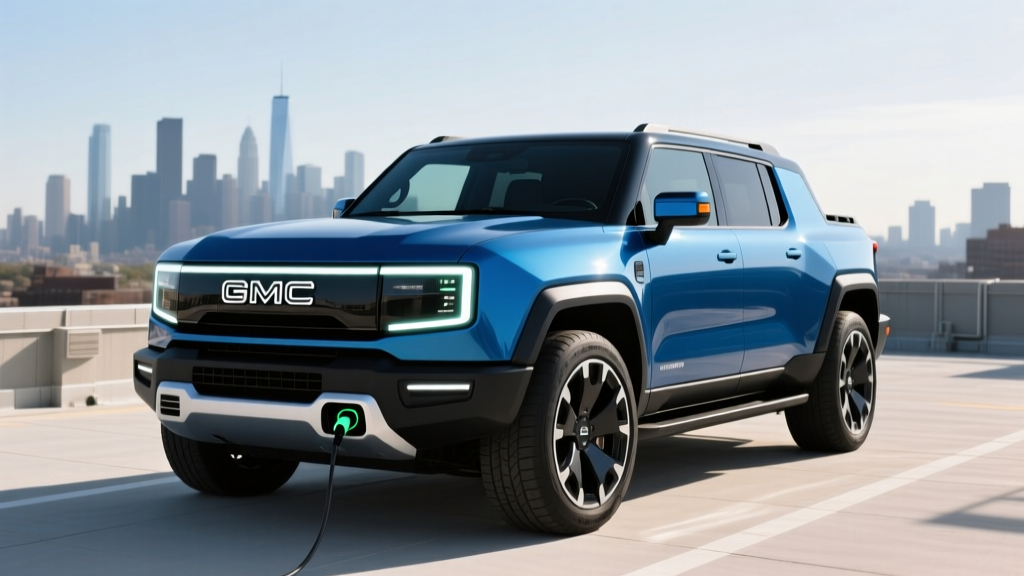
The GMC Hummer EV is an exercise in automotive excess — a 9,000-pound electric supertruck with up to 1,000 horsepower, a battery larger than some home energy storage systems, and a starting price that puts it in luxury territory. But beneath the spectacle lies a genuinely capable vehicle with class-leading range for a full-size truck and DC fast-charging speeds that defy its massive battery pack. For the 2026 model year, GMC continues to refine the lineup with the more accessible 2X and 3X trims while the range-topping Edition 1 has cycled out of production. Here's every spec that matters for buyers evaluating this electric heavyweight.
| Spec | Pickup 2X | Pickup 3X | SUV 2X | SUV 3X |
|---|---|---|---|---|
| EPA Range | 381 mi | 329 mi | 314 mi | 314 mi |
| Usable Battery | ~246 kWh (NMC) | ~246 kWh (NMC) | ~246 kWh (NMC) | ~246 kWh (NMC) |
| Horsepower | 625 hp | 830 hp (Watts to Freedom) | 625 hp | 830 hp |
| 0–60 mph | ~4.5 sec | ~3.0 sec (WTF mode) | ~4.5 sec | ~3.5 sec |
| Drivetrain | Dual-motor AWD | Tri-motor AWD | Dual-motor AWD | Tri-motor AWD |
| Max DC Fast Charge | 350 kW (800V) | 350 kW (800V) | 350 kW (800V) | 350 kW (800V) |
| 10–80% DC Charge | ~36 min | ~36 min | ~36 min | ~36 min |
| Level 2 Home Charge | 11.5 kW / ~24 mi/hr | 11.5 kW / ~24 mi/hr | 11.5 kW / ~24 mi/hr | 11.5 kW / ~24 mi/hr |
| MPGe (combined) | 47 MPGe | 45 MPGe | 47 MPGe | 45 MPGe |
| kWh/100 mi | 72 | 75 | 72 | 75 |
| Base MSRP | $99,495 | $106,495 | $99,495 | $106,495 |
| Battery Warranty | 8 yr / 100,000 mi | 8 yr / 100,000 mi | 8 yr / 100,000 mi | 8 yr / 100,000 mi |
Real-World Range: What the EPA Number Doesn't Tell You
The headline EPA figure for the Hummer EV Pickup 2X is 381 miles, making it one of the longest-range electric trucks on the market. The tri-motor 3X drops to 329 miles for the pickup and 314 miles for the SUV, owing to the additional weight and power draw of the third motor. But as with any vehicle of this mass, real-world conditions compress those numbers significantly.
EPA Sticker: 329 mi (3X Pickup) / 381 mi (2X Pickup)
Highway (70–80 mph): Expect ~260–290 mi (3X) or ~310–340 mi (2X). The Hummer's boxy aerodynamics and 9,000+ lb curb weight punish efficiency at sustained speed.
Cold Weather (below 30°F): Deduct 20–30%. NMC chemistry loses capacity in the cold, and cabin heating draws heavily from the pack. Expect ~220–260 mi (3X) in winter highway driving.
With Towing: Towing near the 7,500-lb max cuts range roughly in half. Plan for 150–175 mi between charges with a loaded trailer.
The 246 kWh usable battery pack uses NMC (nickel manganese cobalt) chemistry, chosen for its high energy density — a necessity given the truck's weight. GMC has not published an LFP variant, and given the energy-density requirements, one is unlikely. The pack's thermal management system actively conditions cells during fast charging and in extreme temperatures, but the sheer size of the battery means preconditioning takes longer than in smaller EVs. Plan for 15–20 minutes of preconditioning before a DC fast-charge session in cold weather.
Charging Speed: 800-Volt Architecture Meets a Massive Pack
GMC equipped the Hummer EV with an 800-volt architecture — the same voltage class used by the Porsche Taycan, Hyundai Ioniq 5, and Kia EV6 — enabling peak DC fast-charge rates up to 350 kW. That's essential, because filling a 246 kWh battery at lower power levels would take an eternity.
| Charging Level | Power (kW) | Miles Added/Hour | Full Charge Time |
|---|---|---|---|
| Level 1 (120V, 12A) | ~1.4 kW | ~2 mi/hr | ~7+ days (not practical) |
| Level 2 (240V, 48A) | 11.5 kW | ~24 mi/hr | ~10–11 hours (0–100%) |
| DC Fast Charge (peak) | 350 kW | ~700 mi/hr (peak) | 10–80% in ~36 min |
| DC Fast Charge (sustained avg) | ~200 kW avg | ~400 mi/hr avg | 10–80% realistic |
A critical nuance: the 350 kW figure is a peak, not a sustained rate. The charge curve on a pack this large tapers progressively above 50–60% state of charge. In real-world testing at Electrify America and EVgo 350 kW stations, the Hummer EV sustains roughly 200–250 kW through the bulk of the 10–80% window, averaging around 200 kW overall. That still delivers the 10–80% charge in approximately 36 minutes — impressive for a battery this size, but don't expect the full 350 kW for more than short bursts at low state of charge.
For home charging, the onboard charger accepts up to 11.5 kW on a 240V Level 2 circuit (48 amps). That adds roughly 24 miles of range per hour, meaning a full overnight charge from near-empty takes 10–11 hours. Most owners who drive 40–60 miles daily will replenish in 2–3 hours on a home Level 2 unit. We strongly recommend a 60-amp dedicated circuit installed by a licensed electrician — your panel may need an upgrade to support this load alongside other household demands. Installation costs for a Level 2 home setup typically run $1,500–$3,500 depending on panel proximity and local permit requirements.
The Hummer EV uses the CCS1 connector for DC fast charging and J1772 for Level 2. As of 2026, GMC has not adopted the NACS (Tesla) connector natively, though adapters may be available. Confirm current adapter compatibility with your dealer before relying on Tesla Supercharger access.
Performance: 1,000 Horsepower in a 9,000-Pound Truck
The Hummer EV's performance figures read like a supercar's, applied to a vehicle the size of a small apartment. The tri-motor 3X powertrain produces up to 830 horsepower (and up to 1,000 hp in the now-discontinued Edition 1's Watts to Freedom mode). The dual-motor 2X delivers a still-potent 625 hp.
In the 3X's Watts to Freedom (WTF) launch mode — which lowers the air suspension, stiffens the adaptive dampers, and preconditions the battery for maximum discharge — the pickup hits 0–60 mph in approximately 3.0 seconds. The SUV 3X manages roughly 3.5 seconds. The dual-motor 2X trims clock around 4.5 seconds regardless of body style. These numbers are verified and repeatable, thanks to the instant torque delivery that electric motors provide.
Beyond straight-line speed, the Hummer EV offers genuine off-road hardware:
- CrabWalk: Four-wheel steering that moves the truck diagonally — useful for tight trail obstacles and a dramatic party trick
- Extract Mode: Raises the adaptive air suspension an additional 6 inches for up to 16.3 inches of ground clearance
- Underbody armor: Steel skid plates protecting the battery pack on off-road terrain
- Approach/departure angles: 49.7° approach / 38.4° departure in Extract Mode (pickup)
- Towing capacity: 7,500 lbs (pickup); 5,000 lbs (SUV)
On-road, the adaptive air suspension delivers a surprisingly compliant ride for a vehicle this heavy, and the rear-wheel steering (even outside CrabWalk mode) shrinks the turning circle to 37.1 feet — comparable to a midsize sedan. The trade-off is tire consumption: 35-inch all-terrain tires don't come cheap, and the Hummer's mass accelerates wear.
Pricing, Trims, and Federal Tax Credit Eligibility
The 2026 Hummer EV lineup has simplified from its initial Edition 1 launch. Current pricing across trims:
| Trim | Body Style | Base MSRP | Federal §30D Credit | Effective Price |
|---|---|---|---|---|
| 2X | Pickup | $99,495 | See eligibility below | Varies |
| 3X | Pickup | $106,495 | See eligibility below | Varies |
| 2X | SUV | $99,495 | See eligibility below | Varies |
| 3X | SUV | $106,495 | See eligibility below | Varies |
Federal tax credit status: The Hummer EV faces a complex eligibility picture under IRS §30D clean vehicle credit rules. The new-vehicle credit of up to $7,500 requires meeting several criteria simultaneously:
- MSRP cap: Vans, SUVs, and trucks must be under $80,000 — the Hummer EV exceeds this cap on every trim, making it ineligible for the new-vehicle credit
- Buyer income cap: $150K single / $300K joint (AGI) — moot given MSRP disqualification
- Battery sourcing: Critical minerals and battery component thresholds from qualifying countries — GMC's Ultium platform uses domestically assembled cells, but the MSRP cap is the binding constraint
- Point-of-sale transfer: Available for eligible vehicles — again, not applicable here
The Hummer EV's MSRP well above $80,000 means it does not qualify for the $7,500 new-vehicle federal tax credit. However, buyers may find savings through state-level incentives (which vary by jurisdiction — check your state's energy office for current programs), dealer discounts, or by purchasing a used Hummer EV that may qualify for the used clean vehicle credit of up to $4,000 (30% of sale price, capped at $4,000, with income limits and a $25,000 maximum sale price — also unlikely to apply given resale values). Consult a tax professional for your specific situation.
Destination charges, dealer-installed accessories, and the available Extreme Off-Road Package (approximately $10,000) can push a 3X pickup above $120,000 as-tested. Budget accordingly.
Interior Space, Cargo, and Daily Practicality
The Hummer EV's footprint is enormous — 216.8 inches long for the pickup (the SUV is 10.5 inches shorter) — and the interior reflects that. Front-seat passengers enjoy expansive headroom and shoulder room, with the commanding seating position you'd expect from a vehicle this tall. Rear-seat space is generous in the pickup; the SUV's shorter wheelbase trims rear legroom slightly but still accommodates adults comfortably.
Pickup cargo: The 5-foot bed offers 43.5 cubic feet of volume with the tailgate up. The front trunk (frunk) is a standout — the Hummer EV's frunk provides usable storage with a power-operated tonneau-style cover, adding secure enclosed cargo space that gas trucks simply can't match. GMC rates it at approximately 11.3 cubic feet.
SUV cargo: 35.9 cubic feet behind the second row, expanding with the rear seats folded. The SUV sacrifices bed utility for a more enclosed, weather-proof cargo area and slightly better maneuverability.
On the tech front, the Hummer EV features:
- 13.4-inch infotainment touchscreen with Google Built-In (Google Maps, Assistant, Play Store)
- 12.3-inch digital driver display with off-road telemetry (pitch/roll, torque distribution, tire pressure)
- UltraVision camera system: Up to 18 camera views including underbody cameras for off-road obstacle visibility
- Super Cruise: GM's Level 2 hands-free driver-assistance system, operational on over 750,000 miles of mapped highways in the US and Canada
Super Cruise is an SAE Level 2 driver-assistance system. It provides hands-free steering, acceleration, and braking on compatible divided highways, but the driver must remain attentive — an infrared camera monitors your eyes and will disengage the system if you look away. This is not autonomous driving. You are responsible for the vehicle at all times.
Efficiency and Operating Costs
Let's be direct: the Hummer EV is not efficient in absolute terms. At 72–75 kWh per 100 miles (depending on trim), it consumes roughly twice the energy per mile of a Tesla Model Y or Hyundai Ioniq 5. Its combined MPGe rating of 45–47 reflects this — the lowest among current mainstream EVs.
However, context matters. Compared to the gas Hummer H2 (which returned roughly 10–13 mpg combined), the electric version is dramatically more efficient in energy-equivalent terms. And at the national average residential electricity rate of ~$0.16/kWh (as of early 2026), charging at home costs approximately $0.12–$0.13 per mile. DC fast charging at $0.40–$0.50/kWh pushes that to $0.29–$0.38 per mile — still cheaper than a gas truck getting 15 mpg at $3.50/gallon ($0.23/mi), but the gap narrows considerably on road trips where you rely on public chargers.
The Hummer EV's efficiency is the trade-off for its size, capability, and range. Buyers prioritizing kWh-per-mile efficiency should look at smaller EVs; buyers who need a full-size truck with electric powertrain will find this is the best efficiency available in the segment.
Warranty and Long-Term Ownership
GMC covers the Hummer EV's battery pack and electric powertrain with an 8-year / 100,000-mile warranty, with a capacity retention threshold of 60% — meaning GMC will repair or replace the battery if it degrades below 60% of original capacity within that period. The bumper-to-bumper limited warranty covers 3 years / 36,000 miles.
Given the Ultium platform's NMC chemistry, expect typical degradation of 10–15% over 8 years of normal use, though the Hummer's oversized pack means even with 15% degradation, a 3X would still deliver ~280 miles of range. The battery's thermal management system and GM's conservative buffer strategy (the 246 kWh figure is usable capacity, with additional gross capacity held in reserve) should support long-term durability.
If you need a battery replacement outside warranty — unlikely but possible at high mileage — industry estimates for a pack this size range from $20,000 to $35,000 for parts and labor. This is a significant long-term ownership consideration, though costs are expected to decline as the Ultium platform matures.
- Class-leading range for a full-size electric truck (up to 381 mi EPA)
- 350 kW DC fast charging via 800V architecture
- Genuine off-road capability (CrabWalk, Extract Mode, underbody armor)
- Super Cruise hands-free highway driving on 750K+ miles of roads
- Massive frunk adds practical enclosed storage
- 3.0-second 0–60 in 3X is extraordinary for a 9,000-lb vehicle
- MSRP exceeds $80K cap — ineligible for $7,500 federal tax credit
- 72–75 kWh/100 mi is poor efficiency; high charging cost on road trips
- 246 kWh battery means home charging takes 10–11 hours from empty
- Massive footprint is difficult in tight parking garages and city streets
- 7,500-lb towing capacity trails heavy-duty gas trucks significantly
- High tire and maintenance costs due to weight and 35-inch tires
Who Should Buy the Hummer EV?
Buy the Hummer EV if: You need a full-size electric truck with serious off-road capability and want the longest range available in the segment. You have home Level 2 charging, don't need the federal tax credit to make the math work, and value the combination of 300+ mile range with a usable bed and genuine trail-riding hardware. It's the right truck for affluent outdoor enthusiasts, ranch owners, and early adopters who want maximum EV truck capability today.
Look elsewhere if: Budget is a primary concern (the tax credit ineligibility is a real $7,500 penalty), you tow heavy trailers regularly (the Rivian R1T and Ford F-150 Lightning offer competitive towing with lower starting prices), or you need efficient daily commuting (a smaller EV will cost dramatically less to operate). If you rarely go off-road, the capability premium is hard to justify.
Hummer EV vs. Key Competitors
The Hummer EV competes in the full-size electric truck segment against the Rivian R1T, Ford F-150 Lightning, Chevrolet Silverado EV, and Tesla Cybertruck. Each offers a different value proposition:
- Rivian R1T: More refined on-road, similar off-road capability, starts ~$75K, qualifies for federal credit on eligible trims. Smaller battery, shorter range (~352 mi max).
- Ford F-150 Lightning: Lower starting price (~$55K), strong fleet/commercial appeal, widely available. Range tops out at ~320 mi; less off-road focus.
- Chevrolet Silverado EV: Shares the Ultium platform, offers up to 450 mi of range on the 4WT trim, starts lower. Less extreme off-road hardware.
- Tesla Cybertruck: Stainless-steel exoskeleton, 340+ mi range, polarizing design. Limited off-road features, no Super Cruise equivalent.
The Hummer EV wins on raw range, charging speed, and off-road theater. It loses on price, efficiency, and tax-credit eligibility. According to fueleconomy.gov data, it remains the heaviest and most energy-intensive EV in the light-truck class.
What is the real-world range of the GMC Hummer EV?
The EPA rates the 2X Pickup at 381 miles and the 3X Pickup at 329 miles. In real-world highway driving at 70–80 mph, expect 260–340 miles depending on trim. Cold weather and towing reduce range by 20–50%. The 2X's dual-motor efficiency advantage is significant — if range is your priority, the 2X is the better choice.
How fast does the Hummer EV charge at home and on the road?
On a 350 kW DC fast charger, the Hummer EV peaks at 350 kW and averages ~200 kW, reaching 10–80% in approximately 36 minutes. At home on a Level 2 charger (11.5 kW, 240V/48A), it adds about 24 miles per hour, with a full charge taking 10–11 hours. Level 1 (120V) adds roughly 2 miles per hour and is not practical for daily use.
Does the Hummer EV qualify for the $7,500 federal EV tax credit?
No. Under IRS §30D rules, trucks and SUVs must have an MSRP under $80,000 to qualify. The Hummer EV starts at $99,495, disqualifying all trims. State-level incentives may still apply — check with your state energy office and a tax professional.
Is the Hummer EV worth buying over the Rivian R1T or F-150 Lightning?
If maximum range, 800V charging speed, and extreme off-road capability are your top priorities, the Hummer EV is worth the premium. If budget, efficiency, or tax-credit eligibility matter more, the Rivian R1T or F-150 Lightning offer strong capability at lower prices. Test-drive all three — the Hummer's size and road presence are not for every driver.
How long will the Hummer EV battery last?
GMC warranties the battery for 8 years / 100,000 miles with a 60% capacity retention guarantee. NMC chemistry in the Ultium platform typically degrades 10–15% over 8 years. With a 246 kWh usable pack, even 15% degradation leaves ~210 kWh usable — still enough for 280+ miles in the 3X. The oversized pack is a longevity advantage.
Can the Hummer EV tow a trailer, and how does that affect range?
The Hummer EV Pickup is rated to tow 7,500 lbs (SUV: 5,000 lbs). Towing near max capacity roughly halves range — expect 150–175 miles in the 3X with a loaded trailer. This is adequate for boat or small camper towing but falls short of heavy-duty gas trucks rated for 10,000+ lbs.