The 2026 GMC Hummer EV: Excess With Purpose
If any vehicle defines the phrase "more is more," it's the GMC Hummer EV. For 2026, GM's electric supertruck continues to push the boundaries of what a battery-electric vehicle can be — a 9,000-pound, three-motor, crab-walking, 1,000+ horsepower pickup that also happens to be surprisingly efficient when you account for its mass. But beneath the spectacle lies a serious question for prospective buyers: does the Hummer EV deliver as a daily-drivable electric truck, or is it a rolling party trick?
After analyzing EPA data, real-world owner reports, and current pricing, this review breaks down every number that matters — from actual highway range to DC fast-charging curves to the tax-credit reality for a six-figure EV.
Range, Battery, and Efficiency: The Real Numbers
The 2026 GMC Hummer EV Pickup rides on GM's Ultium platform with a massive lithium-ion battery pack using NCMA (nickel-cobalt-manganese-aluminum) chemistry — a variant of NMC optimized for energy density and longevity. The usable battery capacity is approximately 212.7 kWh, one of the largest packs ever fitted to a production vehicle. The Hummer EV SUV variant carries a slightly smaller pack at roughly 170 kWh usable.
| Spec | Pickup (3X) | SUV (3X) | Pickup (2X) |
|---|---|---|---|
| EPA Range | 381 mi | 314 mi | 314 mi |
| Battery (usable) | ~212.7 kWh (NCMA) | ~170 kWh (NCMA) | ~170 kWh (NCMA) |
| MPGe (combined) | 47 MPGe | 44 MPGe | 45 MPGe |
| kWh / 100 mi | ~72 kWh | ~76 kWh | ~74 kWh |
| Drivetrain | Tri-motor AWD | Tri-motor AWD | Dual-motor AWD |
The EPA estimates 381 miles for the 3X Pickup, but real-world results depend heavily on driving style and conditions. At sustained highway speeds (75+ mph), expect 280–310 miles due to the Hummer's brick-like aerodynamics. In cold weather (below 32°F), range can drop 20–30%, putting winter highway range closer to 240–270 miles for the 3X Pickup. City and mixed driving with regenerative braking recovers more energy and gets you closer to the EPA sticker. Source: fueleconomy.gov.
Efficiency is the Hummer EV's least impressive metric — at roughly 72 kWh per 100 miles, it consumes nearly twice the energy per mile of a Tesla Model Y. But context matters: this is a vehicle with a GVWR exceeding 10,000 pounds. Per pound of vehicle moved, the Hummer EV is reasonably efficient; per mile, it will cost more to charge than lighter EVs.
Charging Speed: DC Fast, Level 2, and the 800-Volt Advantage
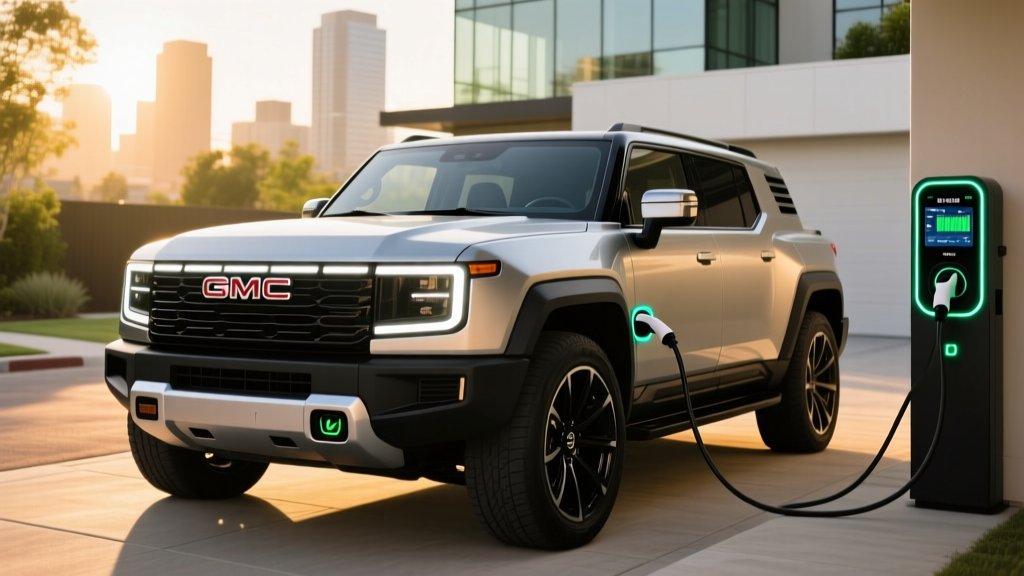
The Hummer EV's 800-volt architecture enables some of the fastest DC charging in production. The 3X models support a peak charge rate of 350 kW on compatible chargers, though sustained rates taper significantly past 60% State of Charge.
| Charging Level | Power | Speed / Time | Notes |
|---|---|---|---|
| Level 1 (120V) | ~1.4 kW | ~3 mi/hr | Emergency / trickle only |
| Level 2 (240V, 48A) | 11.5 kW | ~16 mi/hr | Full charge in ~13–18 hours |
| Level 2 (240V, 80A) | 19.2 kW | ~27 mi/hr | Requires compatible wall connector + 100A circuit |
| DC Fast (peak) | 350 kW (3X) | 10–80% in ~34 min | Requires 350 kW CCS/NACS station |
| DC Fast (150 kW station) | ~150 kW | 10–80% in ~55 min | More common public charger speed |
The charge curve is critical context: the Hummer EV peaks near 350 kW only between roughly 10–30% SoC, then steps down through the 200s, and drops below 100 kW past 70%. On a road trip, plan for 35–40 minute stops at 350 kW chargers to go from 15% to 80%. At the far more common 150 kW Electrify America or EVgo stations, budget about an hour.
For home charging, the 19.2 kW onboard charger is a standout — if your electrical panel supports an 80-amp dedicated circuit (100-amp breaker), you can add roughly 27 miles of range per hour. Most owners will install a 48-amp Level 2 charger on a 60-amp circuit for 11.5 kW, which adds about 16 miles per hour. A full overnight charge (10 hours) at 11.5 kW restores roughly 160 miles — enough for most daily driving, but not a full pack replenishment.
Note: GM has adopted the NACS (Tesla) connector for newer models. The 2026 Hummer EV ships with a CCS1 port but includes a NACS adapter for Tesla Supercharger access. Verify adapter inclusion with your dealer.
Performance: 1,000+ Horsepower and Sub-3-Second Sprints
The tri-motor 3X powertrain produces up to 1,000 horsepower and 12,000 lb-ft of wheel torque (GM's measurement at the wheels, not the motor output shaft — a distinction worth noting). In Watts to Freedom launch mode, the 3X Pickup hits 0–60 mph in approximately 3.0 seconds. The dual-motor 2X trims produce around 625 hp and reach 60 mph in roughly 5.0 seconds.
Beyond straight-line speed, the Hummer EV's four-wheel steering enables CrabWalk (diagonal movement at low speeds) and a remarkably tight turning circle of 37.1 feet — comparable to a midsize sedan. The available adaptive air suspension provides up to 15.9 inches of ground clearance in Extract Mode for off-road use, and the underbody armor protects the battery pack during rock crawling.
| Trim | Horsepower | 0–60 mph | Towing Capacity | Drivetrain |
|---|---|---|---|---|
| 2X Pickup | 625 hp | ~5.0 sec | 7,500 lb | Dual-motor AWD |
| 3X Pickup | 1,000 hp | ~3.0 sec | 7,500 lb | Tri-motor AWD |
| 3X SUV | 830 hp | ~3.5 sec | 7,500 lb | Tri-motor AWD |
Towing capacity maxes out at 7,500 pounds — adequate for most boat and camper trailers but less than the Ford F-150 Lightning's 10,000-pound max or the Rivian R1T's 11,000-pound rating. Expect range to drop 40–50% when towing near maximum capacity at highway speeds.
Pricing, Trims, and Federal Tax Credit Eligibility
The 2026 GMC Hummer EV is not an affordable truck, and the federal tax credit situation requires careful attention to IRS rules.
| Trim | Body Style | Base MSRP | As-Tested (typical) |
|---|---|---|---|
| 2X | Pickup | $99,995 | $105,000–$110,000 |
| 3X | Pickup | $122,995 | $130,000–$145,000 |
| 2X | SUV | $99,995 | $105,000–$112,000 |
| 3X | SUV | $112,995 | $120,000–$135,000 |
The Hummer EV Pickup exceeds the IRS MSRP cap of $80,000 for trucks, meaning the Pickup does NOT qualify for the $7,500 federal tax credit under current §30D rules. The Hummer EV SUV, classified as an SUV by the IRS, has a higher MSRP cap of $80,000 — and base trims also exceed this threshold. Additionally, buyer income caps apply ($150K single / $300K joint AGI), and battery critical-mineral sourcing requirements must be met. Always verify current-year eligibility at irs.gov or consult a tax professional before assuming credit qualification.
In short: at current pricing, the Hummer EV is unlikely to qualify for the federal purchase credit for most buyers. The point-of-sale transfer option (available for qualifying vehicles) also won't apply here. Budget accordingly and factor in state-level incentives, which vary by jurisdiction — check your state's energy office or DMV for local rebate programs.
Interior, Cargo, and Daily-Use Practicality
The Hummer EV's cabin is spacious, tech-forward, and built around a 13.4-inch infotainment touchscreen running GM's Ultifi software platform with Google built-in (Maps, Assistant, Play Store). A 12.3-inch digital instrument cluster and an available head-up display round out the driver interface.
| Dimension | Pickup | SUV |
|---|---|---|
| Front Legroom | 45.6 in | 45.6 in |
| Rear Legroom | 40.9 in | 38.9 in |
| Cargo (behind rear seats) | Bed: 5 ft (11.9 cu ft) | 35.9 cu ft |
| Max Cargo | Bed + frunk: ~15 cu ft frunk | 81.8 cu ft (seats folded) |
| Frunk (eTrunk) | ~15 cu ft | ~11.5 cu ft |
| Seating | 5 passengers | 5 passengers |
The pickup's 5-foot bed is shorter than a standard full-size truck bed, which limits utility for construction materials or large cargo. The eTrunk (front trunk) is genuinely useful — large enough for groceries, charging cables, or a weekend bag. The SUV's 81.8 cubic feet of max cargo space with seats folded is competitive with large SUVs.
Standout tech features include Super Cruise (GM's hands-on-wheel Level 2 driver-assist system) with automatic lane changes on compatible highways, UltraVision camera system with up to 18 camera views for off-road and trailer visibility, and the available Infinity roof with removable panels for open-air driving.
Super Cruise is an SAE Level 2 driver-assistance system. Despite its "hands-free" branding on mapped highways, the driver must remain attentive, and an infrared camera monitors eye gaze. It is not autonomous driving. You are legally and operationally responsible for the vehicle at all times.
Warranty, Battery Longevity, and Ownership Costs
GMC backs the Hummer EV with a comprehensive warranty package:
- Bumper-to-Bumper: 3 years / 36,000 miles
- Powertrain: 5 years / 60,000 miles
- Battery & Electric Components: 8 years / 100,000 miles (with a capacity retention threshold of 70% — if the pack degrades below 70% of original capacity within the warranty period, GM will repair or replace it)
The 8-year/100,000-mile battery warranty is standard for the industry and federally mandated for EVs. Given the massive NCMA pack and GM's active thermal management system (liquid cooling/heating), degradation should be moderate — most Ultium-based vehicles are projected to retain 85–90% capacity after 100,000 miles based on early fleet data. However, long-term data on a 212 kWh pack is still limited.
Insurance premiums are a real ownership factor: expect annual premiums in the $3,500–$5,000+ range depending on your profile, driven by the vehicle's repair costs, high MSRP, and performance category. Get quotes before purchasing.
Pros, Cons, and Who Should Buy the Hummer EV
Pros
- Class-leading 381-mile EPA range (3X Pickup)
- 800V architecture with 350 kW peak DC charging
- 1,000 hp / 3.0-sec 0–60 in a 9,000-lb truck
- CrabWalk and 4-wheel steering for tight maneuvers
- Super Cruise hands-free highway driving (Level 2)
- Massive eTrunk and versatile cargo options
- 19.2 kW onboard Level 2 charger (fastest in class)
Cons
- Efficiency is poor: ~72 kWh/100 mi means high charging costs
- Does NOT qualify for the $7,500 federal tax credit at current MSRP
- Base price near or above $100,000 for all trims
- Short 5-foot bed limits traditional truck utility
- Real-world highway range drops to 280–310 mi
- Insurance premiums significantly above average
- Too large for many urban garages and tight parking structures
- Tech-enthusiast truck buyers who want maximum performance and features and aren't budget-constrained
- Off-road adventurers who benefit from Extract Mode, underbody armor, and CrabWalk
- Home chargers with 200A+ panels who can leverage the 19.2 kW onboard charger for overnight replenishment
- NOT ideal for: budget-conscious buyers, urban apartment dwellers without home charging, or those prioritizing efficiency and low operating costs
Hummer EV vs. Key Competitors
| Spec | GMC Hummer EV 3X | Rivian R1T Tri-Motor | Ford F-150 Lightning Platinum | Tesla Cybertruck Cyberbeast |
|---|---|---|---|---|
| EPA Range | 381 mi | ~350 mi | 300 mi | 320 mi |
| Battery (usable) | ~212.7 kWh | ~141 kWh | ~131 kWh | ~123 kWh |
| 0–60 mph | ~3.0 sec | ~2.9 sec | ~4.0 sec | ~2.6 sec |
| Peak DC Charge | 350 kW | 220 kW | 150 kW | 250 kW |
| Towing | 7,500 lb | 11,000 lb | 10,000 lb | 11,000 lb |
| Base MSRP | $122,995 | $105,900 | $96,874 | $99,990 |
| Fed. Tax Credit | No (MSRP cap) | Partial/No | Partial/No | No (MSRP cap) |
The Hummer EV wins on range and charging speed but loses on towing capacity and price. The Rivian R1T offers better off-road capability with a more practical bed and lower price. The F-150 Lightning remains the value and utility leader. The Cybertruck undercuts on price and acceleration but has a smaller battery and less proven reliability. If maximum range and the fastest charging are your top priorities in an electric truck, the Hummer EV 3X Pickup is genuinely unrivaled.
Frequently Asked Questions
What is the real-world range of the GMC Hummer EV?
The EPA rates the 3X Pickup at 381 miles and the 3X SUV / 2X Pickup at 314 miles. In real-world highway driving at 75 mph, expect 280–310 miles for the 3X Pickup and 240–270 miles for the SUV/2X. In freezing temperatures, subtract another 20–30%. City driving with regenerative braking gets you closer to the EPA numbers.
How fast does the Hummer EV charge at home and on the road?
On a 350 kW DC fast charger, the 3X charges from 10–80% in approximately 34 minutes. At a 150 kW public charger, plan for about 55 minutes. At home on a 240V/80A Level 2 circuit (19.2 kW), you add about 27 miles of range per hour. A standard 48A Level 2 charger adds about 16 miles per hour.
Does the 2026 Hummer EV qualify for the federal EV tax credit?
Almost certainly not. Under IRS §30D rules, trucks must have an MSRP below $80,000 and SUVs below $80,000 to qualify. The Hummer EV's base pricing starts at $99,995, exceeding both caps. Even if future pricing adjusts, buyer income limits ($150K single / $300K joint) and battery-sourcing requirements apply. Verify at irs.gov.
Is the Hummer EV worth buying over the Rivian R1T or F-150 Lightning?
It depends on your priorities. Choose the Hummer EV if you want maximum range (381 mi), the fastest DC charging (350 kW), and the most dramatic performance experience. Choose the R1T if towing capacity (11,000 lb) and off-road versatility matter more. Choose the F-150 Lightning if budget, bed length, and proven fleet support are your priorities. The Hummer EV is a premium experience at a premium price.
How much does it cost to charge the Hummer EV?
At the national average electricity rate of ~$0.17/kWh, fully charging the 212.7 kWh pack costs roughly $36 at home. At DC fast chargers averaging $0.40–$0.50/kWh, a 10–80% session costs approximately $45–$60. Per mile, expect about $0.12 at home and $0.30–$0.35 on public DC chargers — significantly more than a Model Y but less than a gas truck getting 15 mpg at $3.50/gallon (~$0.23/mi).
Can the Hummer EV tow a camper or boat?
Yes, with a 7,500-pound max towing capacity, it handles most travel trailers, boat trailers, and car haulers. However, towing near max capacity at highway speeds will reduce range by 40–50%, bringing effective range down to 150–190 miles for the 3X Pickup. Plan charging stops accordingly on long tow trips.