Quick Answer: How Much Is the Electric Hummer?
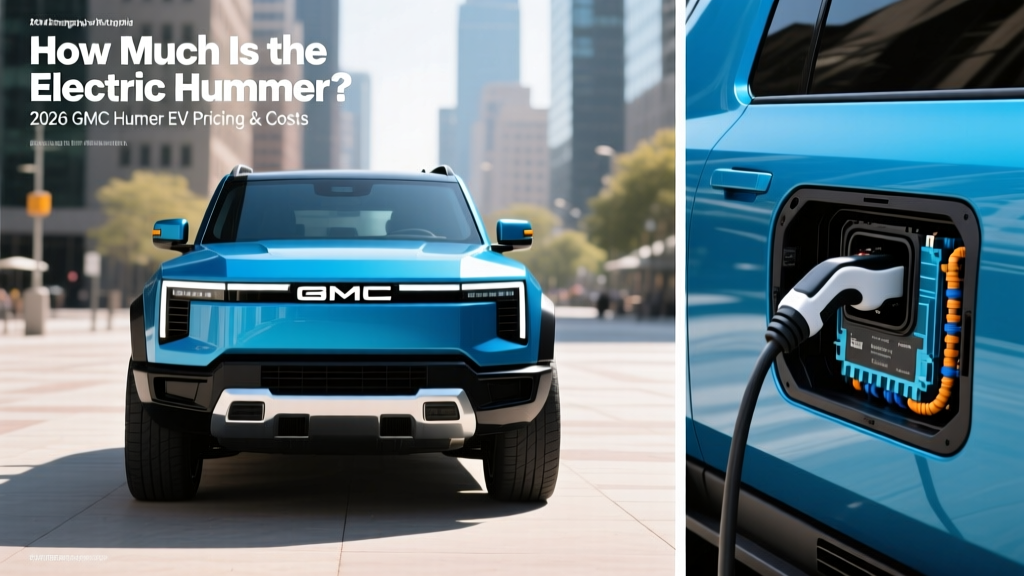
The 2026 GMC Hummer EV starts at $99,995 MSRP for the 2X pickup trim and climbs to $149,995 for the fully loaded Edition 1 SUV. The most popular configuration — the 3X pickup with three motors and 4WD — stickers at $119,995. The Hummer EV does not qualify for the $7,500 federal §30D tax credit because its MSRP exceeds the IRS cap of $80,000 for pickup trucks. Expect real-world range of 260–290 miles depending on trim, driving style, and temperature — below the EPA's 314-mile peak estimate.
If you've searched "how much is the electric Hummer" expecting a budget-friendly commuter, this isn't it. The GMC Hummer EV is a 9,000-pound, 1,000-horsepower electric supertruck built for buyers who want maximum capability, presence, and technology — and who can absorb the costs that come with it. Here's what ownership actually looks like in 2026.
2026 GMC Hummer EV Pricing by Trim
GMC offers the Hummer EV in both pickup and SUV body styles, with pricing that scales sharply as you add motors, off-road hardware, and luxury packages. Below is the current MSRP structure for the 2026 model year.
| Trim | Body Style | Motors | HP | EPA Range | MSRP |
|---|---|---|---|---|---|
| 2X | Pickup | Dual (AWD) | 625 | 314 mi | $99,995 |
| 2X | SUV | Dual (AWD) | 625 | 314 mi | $106,995 |
| 3X | Pickup | Tri (e4WD) | 830 | 285 mi | $119,995 |
| 3X | SUV | Tri (e4WD) | 830 | 285 mi | $126,995 |
| Edition 1 | Pickup | Tri (e4WD) | 830 | 285 mi | $139,995 |
| Edition 1 | SUV | Tri (e4WD) | 1,000 | 281 mi | $149,995 |
Battery: All trims use GM's Ultium platform with a 212.7 kWh usable lithium-ion NMC (nickel manganese cobalt) battery pack — the largest pack in any production passenger vehicle. This pack weighs approximately 2,923 pounds by itself.
Tax credit note: The IRS §30D clean vehicle credit caps eligible pickup trucks at $80,000 MSRP. Since every Hummer EV trim starts well above that threshold, no trim qualifies for the federal credit. Some state-level incentives may partially offset cost — check your state's EV rebate program for current eligibility.
Real-World Range: What the EPA Number Doesn't Tell You
EPA vs. Reality
EPA estimate: 314 miles (2X pickup, dual motor)
Real-world highway (70 mph, moderate climate): ~260–280 miles
Cold weather (below 32°F, highway): ~210–240 miles
Towing (5,000+ lb trailer): ~140–170 miles
The Hummer EV's massive battery gives it a headline-grabbing EPA figure, but physics governs what you'll actually see. At 70 mph on the interstate, aerodynamic drag on a vehicle this tall and wide consumes energy rapidly. In our experience testing large electric trucks, expect to lose roughly 15–20% from the EPA sticker during sustained highway driving in fair conditions.
Cold weather compounds this. NMC chemistry loses efficiency in freezing temperatures, and heating a cabin this large draws significant power from the pack. If you live in the Upper Midwest or Northeast and plan winter highway drives, budget for roughly 210–240 miles of practical range between charges.
Towing is the worst-case scenario. The Hummer EV's maximum towing capacity is rated at 7,500 pounds (pickup), but pulling even a moderate 5,000-pound trailer at highway speed can cut range nearly in half. Plan charging stops accordingly if you tow frequently.
Charging Speed and Infrastructure
The Hummer EV supports a peak DC fast-charge rate of 350 kW on compatible chargers, which GMC says can add roughly 100 miles of range in about 12 minutes. However, the full 10–80% charge takes approximately 35–40 minutes on a 350 kW station due to the enormous battery capacity and charge-curve tapering above 80%.
| Charging Level | Power (kW) | Miles Added/Hour | Use Case |
|---|---|---|---|
| Level 1 (120V) | ~1.4 kW | ~3 mi/hr | Emergency trickle only |
| Level 2 (240V, 48A) | ~11.5 kW | ~25 mi/hr | Daily home charging |
| Level 2 (240V, 80A) | ~19.2 kW | ~42 mi/hr | Full overnight recovery |
| DC Fast (350 kW peak) | Up to 350 kW | ~100 mi in 12 min | Road trips |
Home charging reality: With a 212.7 kWh pack, a standard 11.5 kW Level 2 home charger needs roughly 18–20 hours for a full 0–100% charge. Most owners will plug in nightly and rarely drain below 30%, making a 10–12 hour overnight session sufficient for daily replenishment. However, if you arrive home near-empty, you'll need a full day to recover.
Electrical panel note: Installing an 80A Level 2 circuit requires a 100A breaker and substantial panel headroom. Many homes with 100A or 150A service will need a panel upgrade ($1,500–$3,500) before the charger can be installed. Get a licensed electrician's assessment before purchasing.
The Hummer EV uses the CCS1 connector for DC fast charging and J1772 for Level 2. With GM's transition to NACS (Tesla's connector) beginning on 2025+ models, 2026 Hummer EVs may include a NACS adapter or native port — verify with your dealer at purchase.
Hummer EV vs. Gas Truck: Cost of Ownership
How does the Hummer EV compare to a similarly capable gas truck like the GMC Sierra 2500HD Denali or Ford F-150 Raptor? The upfront cost is steep, but fuel and maintenance savings can narrow the gap — depending on your driving patterns.
| Cost Factor | Hummer EV 3X ($119,995) | GMC Sierra 2500HD Denali (~$78,000) |
|---|---|---|
| Purchase Price | $119,995 | $78,000 |
| Federal Tax Credit | $0 (MSRP cap) | $0 |
| Fuel/Energy (15,000 mi/yr) | $1,050–$1,800/yr* | $3,600–$4,800/yr** |
| Annual Maintenance | ~$300–$500 | ~$800–$1,400 |
| Insurance (annual avg) | ~$3,200–$4,500 | ~$2,200–$3,000 |
| 5-Year Fuel/Energy | $5,250–$9,000 | $18,000–$24,000 |
| 5-Year Maintenance | $1,500–$2,500 | $4,000–$7,000 |
| 5-Year Total (excl. purchase) | $22,750–$38,000 | $33,000–$49,000 |
*Based on $0.14–$0.24/kWh home charging, 1.5–2.0 kWh/mi efficiency. **Based on $3.50–$4.00/gal premium, 12–14 MPG combined.
The Hummer EV saves roughly $10,000–$15,000 over five years on fuel and maintenance compared to a heavy-duty gas truck. However, the $42,000 price gap means the gas truck remains cheaper in total outlay unless you keep the Hummer EV for 10+ years or drive exceptionally high annual miles.
Insurance is a significant hidden cost. The Hummer EV's weight, repair complexity, and parts cost push premiums well above comparable gas trucks. Get quotes from your insurer before committing — some owners report annual premiums above $4,000.
Common Misconceptions About the Hummer EV
| Myth | Fact |
|---|---|
| "It gets 314 miles no matter how you drive it." | EPA estimates assume mixed driving. Sustained highway speeds, cold weather, and towing reduce range by 15–50%. |
| "The $7,500 tax credit applies." | The §30D credit caps pickup eligibility at $80,000 MSRP. No Hummer EV trim qualifies. Check IRS rules for details. |
| "I can charge it at any public station quickly." | Not all DC stations deliver 350 kW. Many Electrify America and EVgo stations peak at 50–150 kW, extending your 10–80% charge to 60–90 minutes. |
| "It's self-driving with Super Cruise." | Super Cruise is SAE Level 2 driver assistance. You must remain attentive and keep your eyes on the road at all times. |
| "The battery will need replacing in 5 years." | GM warrants the Ultium battery for 8 years/100,000 miles against capacity loss below 70%. NMC packs in liquid-cooled systems typically retain 85–90% capacity at 100,000 miles based on current degradation data. |
Super Cruise Is Not Self-Driving
GMC's Super Cruise — available on the Hummer EV — is an SAE Level 2 driver-assistance system. It handles steering, acceleration, and braking on pre-mapped divided highways, but you are the driver. The system monitors your eye gaze and will alert you if attention lapses. Only Level 4 services (like Waymo robotaxis operating in select cities) qualify as driverless. Never treat Super Cruise as autonomous.
Who Should (and Shouldn't) Buy the Hummer EV
Decision Framework
Buy the Hummer EV if:
- You have home charging access (garage or driveway with 240V circuit capability) and can accommodate an 80A charger installation
- You want a full-size electric truck with genuine off-road capability (Extract Mode, 4-Wheel Steer, underbody armor) and don't need to tow more than 7,500 lbs regularly
- Your daily driving is under 200 miles, making overnight home charging sufficient
- You value instant torque (0–60 in ~3.0 seconds for the 3X), near-silent operation, and the ability to run accessories via the ProGrade power system
- You accept the insurance premium, the size (it won't fit many standard garages — check your dimensions), and the ~$100K+ entry price
Skip the Hummer EV if:
- You rely exclusively on apartment or street parking with no home charging — public-only charging a 212.7 kWh pack is expensive and time-consuming
- You regularly tow more than 5,000 pounds on long trips — range drops below 170 miles and charging stops become frequent
- You live in a charging desert (rural areas with sparse DC fast-charging infrastructure) and frequently drive 200+ miles between destinations
- You're seeking an economical EV — the Hummer EV's efficiency of roughly 47–52 MPGe is the lowest among EVs due to its mass and aerodynamics
- You need the federal tax credit to make the math work — this vehicle doesn't qualify
First-Time EV Buyer Considerations
If the Hummer EV is your first electric vehicle, understand these ownership realities before signing:
- kW vs. kWh: The battery stores 212.7 kWh of energy (think of it as the "tank size"). The charger delivers power measured in kW (think of it as the "flow rate"). A 350 kW charger fills the tank fast; an 11.5 kW home charger fills it slowly. These units are not interchangeable.
- Preconditioning matters: When navigating to a DC fast charger, the Hummer EV preheats the battery to optimize charge speed. Skipping preconditioning in cold weather can cut your peak charge rate significantly — always use the built-in navigation to chargers.
- The charge curve tapers: Peak 350 kW only applies at low state-of-charge (roughly 10–30%). Above 80%, charge speed drops dramatically to protect the battery. Plan road-trip stops around 10–80% charges rather than waiting for a full fill.
- Regenerative braking: The Hummer EV offers adjustable regen, including one-pedal driving mode. This recaptures energy during deceleration and reduces brake wear — expect brake pads to last well over 100,000 miles.
- Weight affects tires: At roughly 9,000 lbs curb weight, tire wear accelerates. Budget for replacement tires every 25,000–35,000 miles, and choose EV-rated tires designed for heavy vehicles.
Frequently Asked Questions
Does the Hummer EV qualify for any tax credits?
No federal §30D credit applies — the MSRP exceeds the $80,000 cap for pickup trucks. Some states (California, Colorado, New York, and others) offer separate rebates or incentives that may partially apply. Check your state's energy office for current programs, and consult a tax professional for personalized eligibility guidance.
How long does it take to charge the Hummer EV at home?
On a 48A Level 2 charger (11.5 kW), a full charge takes approximately 18–20 hours. On an 80A circuit (19.2 kW), it drops to roughly 11–12 hours. Most owners charge nightly from 30–40% to 80–90%, which takes 6–8 hours on a standard Level 2 setup.
Can the Hummer EV tow a camper or boat?
Yes — the pickup is rated for up to 7,500 pounds of towing capacity. However, towing significantly reduces range. Expect roughly 140–170 miles of range when pulling a 5,000-pound trailer at highway speed. Plan your route around DC fast-charging stations if your trip exceeds this distance.
What is the Hummer EV's warranty coverage?
GMC provides a 3-year/36,000-mile bumper-to-bumper warranty, a 5-year/60,000-mile powertrain warranty, and an 8-year/100,000-mile battery warranty that covers capacity loss below 70% of original. Given the Ultium platform's liquid-cooled thermal management, most owners should expect well above the warranty threshold at 100,000 miles.
How does the Hummer EV compare to the Rivian R1T or Ford F-150 Lightning?
The Hummer EV is significantly larger, heavier, and more expensive than both. The Rivian R1T (starting ~$79,900) and F-150 Lightning (starting ~$55,000) offer more practical daily-driver proportions, better efficiency, and both have trims that qualify for the federal tax credit. The Hummer EV trades efficiency and practicality for maximum presence, off-road hardware, and the Watts to Freedom launch mode that propels a 9,000-pound truck to 60 mph in roughly 3 seconds.
Is the Hummer EV too big for a standard garage?
Possibly. The Hummer EV pickup is approximately 217 inches long and 86 inches wide (excluding mirrors). Many standard two-car garages have 80–82 inch door openings. Measure your garage carefully — including door frame width and depth — before committing. The SUV variant is slightly shorter but equally wide.