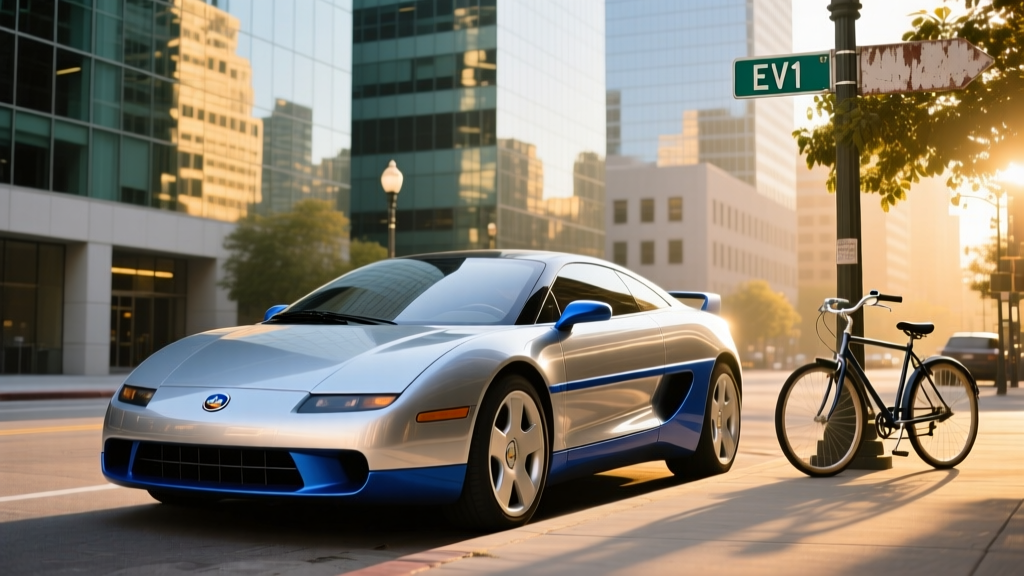
The GM EV1, launched under the Saturn brand in 1996, was the first mass-produced electric vehicle from a major American automaker — and it was deliberately recalled and destroyed by General Motors. Only about 1,117 units were built, none were ever sold outright (lease-only), and GM crushed most of them by 2003. The EV1's lead-acid battery gave it roughly 70 miles of range; the later nickel-metal hydride (NiMH) version reached about 100 miles. It remains a cautionary tale and a foundational lesson for anyone researching electric vehicles today.
Quick Answer: The GM EV1 Saturn
The GM EV1 was a two-seat electric coupe leased through Saturn dealerships from 1996–1999. It was never sold. GM recalled all units by 2003 and destroyed most of them. Range was 70–100 miles depending on battery chemistry. It cannot be purchased today — one surviving unit sits in the Smithsonian.
Why the EV1 Matters for Today's EV Buyers
If you've landed here searching for "ev1 saturn" while researching electric vehicles, you're touching one of the most important origin stories in EV history. The EV1's fate shaped the modern EV landscape in ways that directly affect the cars you can buy right now — from battery chemistry debates to charging infrastructure to manufacturer commitment.
The EV1 proved that consumer demand for electric vehicles existed, that the technology was viable for daily commuting, and that automaker commitment — not technology — was the bottleneck. Understanding why GM killed the EV1 helps you evaluate today's EV market with sharper eyes: which manufacturers are genuinely committed, which are hedging, and what ownership risks remain.
EV1 Saturn Specs: What GM Actually Built
The EV1 was engineered from the ground up as an electric vehicle — not a converted gas car. Its specs were impressive for 1996 but are thoroughly eclipsed by any modern EV.
| Specification | Gen 1 (1996–1997) | Gen 2 (1999) |
|---|---|---|
| Battery Chemistry | Lead-Acid (Delphi) | NiMH (Ovonic) |
| Battery Capacity | ~16.5 kWh | ~26.4 kWh |
| EPA Range | ~70 miles | ~100 miles |
| Motor Output | 102 kW (137 hp) | 102 kW (137 hp) |
| 0–60 mph | ~8.0 seconds | ~8.0 seconds |
| Top Speed | 80 mph (governed) | 80 mph (governed) |
| Charging | Magne Charge (inductive paddle) | Magne Charge (inductive paddle) |
| Charge Time (full) | ~5.5–8 hours (Level 2 equivalent) | ~5.5–8 hours |
| Curb Weight | ~3,090 lbs | ~3,270 lbs |
| Seats | 2 | 2 |
| Units Produced | 660 | ~457 |
| Price | Lease only (~$399–$549/mo) | Lease only (~$399–$549/mo) |
For context, a 2026 Chevrolet Equinox EV offers 319 miles of EPA range, a 85 kWh battery, DC fast charging up to 150 kW (10–80% in about 24 minutes), and a starting MSRP around $33,600 before any federal tax credits. The technological gap is enormous — but the EV1 proved the concept when most engineers said it couldn't be done.
Why GM Recalled and Crushed the EV1
This is the question that brings most people to this topic. The short answer: a combination of low profitability, questionable long-term battery support obligations, oil industry pressure, and a corporate decision that electric vehicles weren't yet worth the investment.
GM's stated reasons included:
- Insufficient demand: GM claimed only a niche market existed, despite waitlists and lessee petitions to keep the cars.
- Battery support liability: Maintaining and replacing lead-acid and NiMH batteries for a small fleet was expensive and unsustainable.
- Regulatory shifts: California's Zero Emission Vehicle (ZEV) mandate was weakened after oil and auto industry lobbying, removing the regulatory forcing function.
- Cost: Each EV1 reportedly cost GM over $80,000 to produce, far exceeding the ~$34,000 equivalent lease value recovered.
Lessee protests, including the famous "funeral" for the EV1 depicted in the documentary Who Killed the Electric Car? (2006), failed to reverse GM's decision. Most EV1s were crushed at a facility in Burbank, California. A handful were donated to museums and universities with disabled powertrains.
EV1 vs. a Modern EV: What 30 Years of Progress Looks Like
The most useful exercise for today's buyer is comparing what the EV1 offered against what you can get now. This comparison shows exactly how far battery energy density, charging speed, and pricing have come — and where concerns have shifted.
| Attribute | GM EV1 Gen 2 (1999) | 2026 Chevy Equinox EV 2LT |
|---|---|---|
| EPA Range | ~100 miles | 319 miles |
| Battery Chemistry | NiMH | NMC (Ultium platform) |
| Battery Capacity | ~26.4 kWh | 85 kWh (usable) |
| DC Fast Charging | None (inductive AC only) | Up to 150 kW (10–80% in ~24 min) |
| Level 2 Charging | ~6.6 kW (Magne Charge) | 11.5 kW |
| 0–60 mph | ~8.0 sec | ~7.9 sec |
| Seats / Cargo | 2 / minimal | 5 / 26.4 cu ft (rear seats up) |
| Starting Price | Lease only (not sold) | ~$33,600 MSRP |
| Federal Tax Credit | N/A (pre-§30D era) | Up to $7,500 (eligibility varies) |
| ADAS | None | Super Cruise available (SAE Level 2) |
| Real-World Winter Range | ~50–60 miles | ~250–270 miles (estimated) |
The range gap is the most dramatic difference. Where the EV1's lessees experienced genuine range limitation — especially in cold weather, where lead-acid and NiMH batteries lost 30–40% capacity — modern NMC and LFP chemistries with active thermal management have largely solved this problem. A 2026 EV losing 15–25% range in freezing temperatures is still delivering 240+ usable miles.
Charging infrastructure is the other transformation. The EV1 relied on GM's proprietary Magne Charge inductive paddle system, available only at a handful of installed stations in California and Arizona. Today's NACS (North American Charging Standard) and CCS networks — including Tesla Superchargers, Electrify America, and EVgo — offer tens of thousands of DC fast-charging stations nationwide.
Lessons from the EV1 for Today's First-Time EV Buyer
The EV1's story contains practical warnings and reassurances for anyone buying their first electric vehicle in 2026:
Lesson 1: Manufacturer Commitment Matters
GM abandoned EV1 lessees. Today, check a manufacturer's long-term EV roadmap before buying. Companies like Tesla, Hyundai/Kia, and Ford have made multi-billion-dollar, multi-year commitments to electrification. Look for warranty terms — most 2026 EV batteries carry an 8-year/100,000-mile warranty (per fueleconomy.gov data), and some brands offer 10-year coverage.
Lesson 2: Lease vs. Buy Has Real Implications
The EV1 was lease-only, which meant GM could reclaim and destroy every unit. Today, leasing an EV can be smart (lower upfront cost, access to latest tech, no battery degradation risk), but you forfeit the §30D federal tax credit as the lessee in most cases — though the leasing company may pass savings through as a capitalized cost reduction. Buying lets you claim the credit directly (or transfer it to the dealer at point of sale under current IRS rules), but you absorb depreciation.
Lesson 3: Battery Chemistry Is Not a Minor Detail
The EV1's switch from lead-acid to NiMH nearly doubled its range. Today's LFP (lithium iron phosphate) vs. NMC (nickel manganese cobalt) choice has similar impact. LFP batteries are heavier and slightly less energy-dense but offer longer cycle life, lower cost, and can be charged to 100% daily without degradation concerns. NMC delivers more range per kilogram but benefits from an 80% daily charge ceiling for longevity.
Lesson 4: Infrastructure Can't Be an Afterthought
The EV1 failed partly because charging infrastructure was nearly nonexistent. Before buying any EV in 2026, verify your home charging situation (Level 2 installation typically costs $500–$2,000 including equipment and electrician labor) and map the public DC fast-charging networks along your common routes.
EV1 Myths vs. Facts
| Myth | Fact |
|---|---|
| "Nobody wanted the EV1." | Waitlists existed; lessees petitioned GM to let them keep their cars. Demand was real but limited to California/Arizona markets. |
| "The EV1 was a failure of technology." | It was a failure of corporate strategy. The technology worked for daily commuting within its range envelope. |
| "Oil companies killed the EV1 alone." | Oil industry lobbying weakened California's ZEV mandate, but GM's own cost analysis and board decisions were the primary cause. |
| "You can still buy an EV1." | You cannot. GM reclaimed all units. One survives at the Smithsonian with a disabled drivetrain. |
| "The EV1 could have evolved into a modern EV." | Unlikely in its form — it was a two-seat, low-production vehicle. But it proved the engineering feasibility that Tesla and others later scaled. |
Real Costs: What an EV1 Would Cost vs. What You'll Pay Today
While you can't buy an EV1, understanding its cost structure illuminates how modern EV economics have shifted dramatically in the buyer's favor.
| Cost Factor | GM EV1 (1999 Lease) | 2026 EV (Buy, ~$38,000 MSRP avg) |
|---|---|---|
| Monthly Payment | $399–$549/mo lease | ~$550–$700/mo (finance, 72 mo, 6%) |
| Fuel / Electricity | ~$0.08/kWh (1999 CA rates) ≈ $2.10/full charge | ~$0.16/kWh (2026 avg) ≈ $13.60/full charge (home) |
| Cost Per Mile (energy) | ~$0.021/mi | ~$0.042/mi (home charging) |
| Maintenance | Minimal (covered under lease) | ~$0.03–$0.05/mi (no oil, fewer moving parts) |
| Insurance | Included in lease | ~$1,400–$2,200/year (varies by model/state) |
| Tax Credit | None | Up to $7,500 (§30D, eligibility varies) |
| Home Charger Install | GM installed Magne Charge stations | $500–$2,000 (Level 2, 240V) |
| Resale / End of Term | Car returned; GM destroyed it | Buyer retains equity; EV depreciation ~40–55% over 5 years |
Energy costs per mile have roughly doubled from 1999 to 2026 (electricity rates have risen), but a modern EV still costs roughly 50–60% less per mile to "fuel" than a comparable 28 MPG gas car at $3.40/gallon (~$0.12/mi). Maintenance savings remain substantial: no oil changes, no transmission fluid, fewer brake replacements due to regenerative braking.
Decision Framework: What the EV1 Teaches You to Ask Before Buying an EV
If-Then EV Buying Framework
IF you're worried about manufacturer commitment → THEN prioritize brands with publicly stated multi-year EV investment plans (Hyundai's $16B+ US EV commitment, Ford's Model e division, Tesla's singular focus). Check battery warranty terms: 8 years/100,000 miles minimum.
IF you're concerned about range → THEN target 250+ EPA miles for a comfortable buffer, knowing real-world highway and cold-weather driving will reduce this by 15–25%. The EV1's 100-mile range was genuinely limiting; today's 300+ mile vehicles are not.
IF you don't have home charging → THEN seriously evaluate whether your workplace offers Level 2 charging, whether reliable DC fast chargers exist within 5 miles of your home, or whether a PHEV (plug-in hybrid) with 30–40 miles of electric range plus a gas engine is a more practical bridge.
IF you're worried about battery replacement costs → THEN note that modern EV battery replacement runs $5,000–$20,000 depending on the model, but degradation data from high-mileage Teslas and others shows most packs retain 80–90% capacity after 150,000+ miles. The EV1's NiMH packs degraded much faster; modern thermal management has largely solved this.
IF you want the lowest total cost → THEN combine a used EV (eligible for the $4,000 used-EV credit under §25E) with home Level 2 charging and a time-of-use electricity plan. This can bring per-mile energy costs below $0.02 in some regions.
Where to See an EV1 Today
Because GM destroyed nearly all EV1s, surviving examples are extremely rare. The most accessible is at the Smithsonian National Museum of American History in Washington, D.C., though its powertrain has been disabled. A few others reportedly exist in private collections and university engineering departments, but none are road-legal or drivable. If you encounter someone claiming to sell an EV1, treat it with extreme skepticism — ownership was never transferred, and GM retained title on every unit.
FAQ: Common Questions About the GM EV1 Saturn
Can I buy a GM EV1 today?
No. GM retained ownership of every EV1 through its lease program, recalled all units by 2003, and destroyed the vast majority. No road-legal, drivable EV1 exists in private hands. The car cannot be purchased at any price.
What was the EV1's real-world range?
The Gen 1 lead-acid EV1 delivered roughly 60–70 miles in ideal conditions and as little as 50 miles in cold weather or at highway speeds. The Gen 2 NiMH version achieved 80–100 miles real-world, with similar cold-weather losses. For comparison, even a modest 2026 EV like the Nissan Leaf offers 149–212 EPA miles.
Why didn't GM just sell the EV1 instead of crushing them?
GM cited concerns about long-term parts support, battery replacement obligations, and liability for a small fleet of vehicles with proprietary technology. Selling them would have created a permanent support obligation for a product GM had decided to abandon.
Did the EV1 influence Tesla?
Indirectly, yes. The EV1's co-designer, Alan Cocconi, later founded AC Propulsion, which built the tzero electric sports car. The tzero directly inspired Martin Eberhard and Marc Tarpenning to found Tesla Motors in 2003. Tesla's first vehicle, the Roadster, used an AC Propulsion-derived powertrain. The EV1's legacy lives on through this lineage.
Is Saturn still a car brand?
No. GM discontinued the Saturn brand in 2010. Saturn served as the EV1's retail channel because its no-haggle pricing model and "different kind of car company" positioning matched the EV1's experimental nature. Today, GM sells EVs through Chevrolet, Cadillac, GMC, and Buick dealerships.
What's the closest modern equivalent to the EV1?
In spirit, perhaps the original Tesla Roadster (2008) — a low-volume, two-seat electric sports car that proved EV performance could excite enthusiasts. In practical terms, any modern compact EV like the Chevrolet Equinox EV, Hyundai Kona Electric, or Tesla Model 3 vastly exceeds the EV1 in range, practicality, charging speed, and safety.