Quick Verdict: Is Getting a Tesla Model Y Still the Default EV Choice?
The Tesla Model Y remains the benchmark compact electric SUV against which every rival is measured. For 2026, the refreshed "Juniper" generation brings a quieter cabin, updated suspension tuning, ventilated front seats, and a redesigned interior with ambient lighting and a rear touchscreen. But the fundamentals that made the Model Y the best-selling vehicle globally in 2024 — strong range, access to the Supercharger network, and competitive pricing — still define the ownership proposition.
If you're getting a Tesla for the first time, the Model Y Long Range AWD is the sweet spot: 320 miles of EPA range, dual-motor traction, and a starting MSRP that still qualifies for the full federal tax credit. The Performance trim trades a bit of range for a 3.5-second 0-60 time. Below, we walk through every number that matters before you sign the paperwork.
| Spec | Long Range AWD | Performance AWD |
|---|---|---|
| EPA Range | 320 mi | 293 mi |
| Battery (usable) | 78.1 kWh (NMC) | 78.1 kWh (NMC) |
| Drivetrain | Dual-Motor AWD | Dual-Motor AWD |
| Horsepower | 384 hp | 456 hp |
| 0-60 mph | 4.8 sec | 3.5 sec |
| Peak DC Charge Rate | 250 kW | 250 kW |
| 10-80% DC Fast Charge | ~24 min | ~24 min |
| Level 2 Charge Rate | 11.5 kW (44 mi/hr) | 11.5 kW (44 mi/hr) |
| MPGe (combined) | 111 MPGe | 102 MPGe |
| Base MSRP | $44,990 | $49,990 |
Real-World Range: What to Expect Beyond the EPA Sticker
EPA Estimated Range: 320 miles (Long Range AWD) / 293 miles (Performance AWD)
Real-World Expectation: Expect 270–290 miles on a mixed highway trip at 70 mph in moderate temperatures. In freezing weather (below 30°F), plan for 220–250 miles due to cabin heating demands and increased battery resistance. City driving with heavy regenerative braking can push you close to or slightly above the EPA number.
The EPA combined cycle blends city and highway driving at moderate speeds, which favors EVs with strong regenerative braking. On a flat interstate at 65 mph, the Model Y Long Range averages roughly 3.8 miles per kWh, yielding about 297 miles from the 78.1 kWh usable pack. Push to 75-80 mph and aerodynamic drag cuts that to around 3.3 mi/kWh, or roughly 258 miles.
Tesla's heat pump (standard on all 2026 trims) significantly reduces cold-weather energy consumption compared to older resistive heater systems. In our experience, the Juniper-generation Model Y loses roughly 15–20% range at 20°F, which is competitive with the Hyundai Ioniq 5 and better than the Ford Mustang Mach-E. Preconditioning the battery while plugged in — easily scheduled through the Tesla app — recovers some of that loss and is essential before DC fast charging in cold weather.
Charging Speed: Supercharger Network and Home Setup
The Model Y uses the North American Charging Standard (NACS) connector natively — no adapter needed at Tesla Superchargers. The 2026 Juniper refresh retains the 250 kW peak DC fast-charge rate, which is adequate but no longer class-leading. The Hyundai Ioniq 5 and Kia EV6 peak at 350 kW on compatible chargers, though real-world charge-curve differences narrow the gap.
| Charging Level | Power | Speed (approx.) | Notes |
|---|---|---|---|
| Level 1 (120V outlet) | 1.4 kW | ~5 mi/hr | Emergency/trickle only |
| Level 2 (240V, 48A) | 11.5 kW | ~44 mi/hr | Full charge in ~7.5 hours |
| DC Fast (V3 Supercharger) | 250 kW peak | 10-80% in ~24 min | Curve tapers above 55% |
| DC Fast (V4 Supercharger) | 250 kW peak | 10-80% in ~24 min | Same vehicle-side limit |
Understanding the charge curve: The Model Y pulls peak power (around 250 kW) only between roughly 10–30% State of Charge. By 55% SoC, the rate drops to approximately 150 kW, and above 80% it falls below 60 kW. This is why Tesla (and all EV makers) quote 10-80% times — charging from 80-100% can add another 25-30 minutes. For road trips, plan stops to arrive at 10-15% and depart at 75-80% for the fastest cumulative charging.
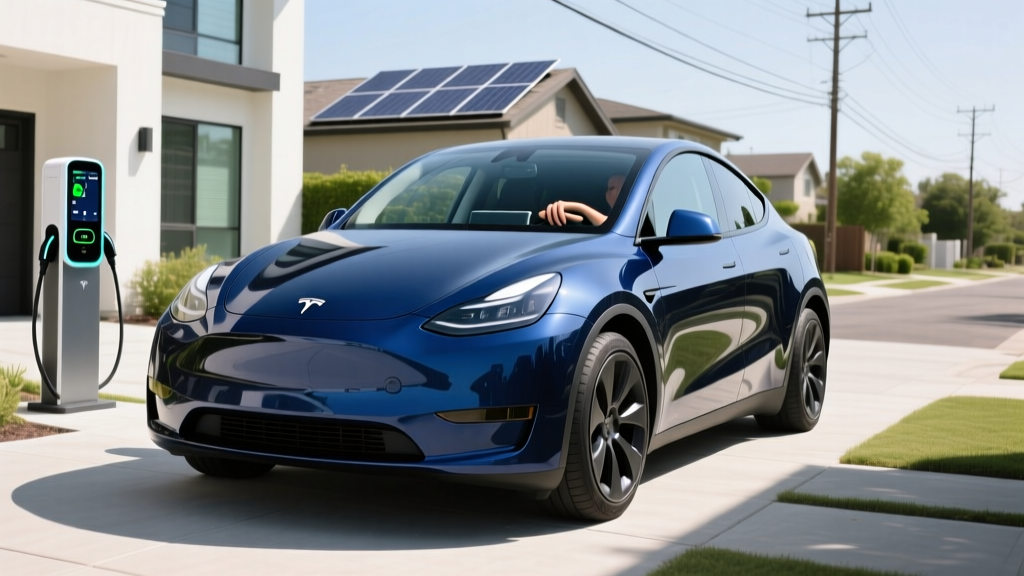
At home, the onboard 11.5 kW charger means a full charge from near-empty takes about 7.5 hours on a 48-amp Level 2 circuit (requiring a 60-amp breaker). Most owners install a Tesla Wall Connector ($420 for the unit) and budget $800–$2,000 for electrician labor depending on panel proximity and whether a 200-amp service upgrade is needed. According to data from fueleconomy.gov, the Model Y Long Range consumes about 30 kWh per 100 miles; at the US average electricity rate of $0.17/kWh, that's roughly $0.051 per mile — about one-third the per-mile cost of a 25 MPG gas SUV at $3.50/gallon.
Performance, Ride Quality, and Daily Driving
The Long Range AWD's 384 horsepower and 4.8-second 0-60 time make it genuinely quick for a family crossover. Instant torque delivery means highway merging and passing require zero planning. The dual-motor setup provides confident all-weather traction, and Tesla's traction control system reacts faster than any mechanical AWD system.
The 2026 Juniper update addressed the most common complaint about the pre-refresh Model Y: ride harshness. Tesla added frequency-selective dampers and additional sound deadening. The result is a noticeably quieter cabin at highway speeds and less impact harshness over expansion joints. It's still firmer than a Toyota RAV4 or Hyundai Tucson, but the gap has closed meaningfully.
One-pedal driving via regenerative braking is well-calibrated. Tesla removed the low-regen option in recent years, so expect meaningful deceleration when you lift off the accelerator. Most owners adapt within a week and rarely touch the brake pedal in normal driving. The physical brake discs, however, may need occasional conditioning (a firm stop from highway speed) to prevent surface rust from lack of use.
Interior, Tech, and Cargo Practicality
The 2026 Model Y interior is a study in minimalism. A 15.4-inch center touchscreen handles nearly all vehicle functions — climate, mirrors, glovebox, and wiper settings. The Juniper refresh adds a 8-inch rear touchscreen for back-seat passengers to control climate and media, ventilated front seats, power-folding second row, and a full-length ambient light strip.
Cargo volume: 30.2 cubic feet behind the second row, expanding to 72.1 cubic feet with the 60/40 split rear seats folded. The front trunk (frunk) adds 4.1 cubic feet — useful for charging cables, a small bag, or groceries. Rear legroom measures 40.5 inches, adequate for adults on longer trips. Headroom is generous at 41.0 inches front and 39.4 inches rear.
Tech highlights:
- Over-the-air software updates that add features monthly
- Tesla app with remote climate control, Sentry Mode cameras, and vehicle location
- Sentry Mode dashcam recording (requires USB drive)
- Dog Mode and Camp Mode for climate control while parked
- Built-in navigation with real-time Supercharger routing and battery preconditioning
Notable drawbacks: The lack of physical buttons for climate and wipers frustrates some drivers. There is no Apple CarPlay or Android Auto — Tesla's native infotainment is the only option. The panoramic glass roof, while beautiful, can let in significant heat in southern climates; Tesla includes a removable shade panel for 2026, but many owners still apply aftermarket tint film.
Pricing, Trims, and Federal Tax Credit Eligibility
| Trim | Base MSRP | As-Tested (typical) | Est. §30D Credit | Effective Price |
|---|---|---|---|---|
| Long Range AWD | $44,990 | $46,490 (w/ FSD transfer) | Up to $7,500* | ~$38,990* |
| Performance AWD | $49,990 | $51,490 (w/ FSD transfer) | Up to $7,500* | ~$43,990* |
*Federal tax credit eligibility depends on buyer income, battery sourcing, and MSRP caps under IRS §30D. See eligibility details below.
The 2026 Model Y Long Range AWD starts at $44,990 including destination, which is below the $80,000 MSRP cap for SUVs under the IRS §30D clean vehicle credit. Tesla has worked to qualify battery components and critical minerals under the credit's sourcing requirements, and as of early 2026, the Model Y Long Range and Performance remain eligible for up to $7,500 — but this is not guaranteed for every buyer or every delivery quarter.
Key §30D eligibility requirements:
- Buyer income caps: Modified AGI must not exceed $300,000 (married filing jointly), $225,000 (head of household), or $150,000 (single).
- MSRP cap: Vehicle base MSRP must be ≤ $80,000 for SUVs/trucks/vans.
- Battery sourcing: Minimum percentages of battery components manufactured in North America and critical minerals sourced from the US or FTA partners (percentages increase annually).
- Point-of-sale transfer: Eligible buyers can transfer the credit to Tesla at purchase, reducing the down payment directly rather than waiting for a tax refund.
We recommend verifying current credit eligibility on IRS.gov and consulting a tax professional before relying on the credit in your budget. Sourcing requirements tighten annually, and a vehicle eligible in January may lose partial or full credit by mid-year if supply chains shift.
Warranty, Battery Longevity, and Ownership Costs
Tesla provides a 4-year/50,000-mile basic vehicle warranty and an 8-year/120,000-mile battery and drive unit warranty for the Model Y Long Range and Performance (the RWD trim with LFP chemistry carries an 8-year/100,000-mile battery warranty). The battery warranty guarantees retention of at least 70% of original capacity during the coverage period.
Real-world degradation data from large owner surveys shows the Model Y's NMC battery typically retains about 90-93% capacity after 50,000 miles and roughly 85-88% after 100,000 miles. Best practices for longevity include:
- Set daily charge limit to 80% (Tesla's software recommends this for NMC batteries)
- Avoid frequent DC fast charging when Level 2 is available
- Don't let the battery sit at 0% or 100% for extended periods
- Precondition in extreme cold before driving or charging
Insurance costs tend to run 15-25% higher than comparable gas-powered crossovers due to repair costs and parts pricing. Average annual premiums for the Model Y range from $1,800 to $2,800 depending on state, driving record, and coverage level. Tesla Insurance is available in many states and can be competitive — get quotes from both Tesla and traditional carriers.
Maintenance is minimal: no oil changes, no spark plugs, no transmission fluid. Budget for cabin air filter replacement (~$50-100 every 2 years), tire rotation every 6,250 miles, brake fluid checks, and windshield washer fluid. Tires wear faster than on gas cars due to the Model Y's weight (~4,400 lbs) and instant torque; expect to replace tires every 25,000–35,000 miles at $200–$350 per tire for OEM-spec rubber.
How the Model Y Compares to Key Rivals
Getting a Tesla means choosing the Supercharger network and software ecosystem over some competitors' advantages. Here's how the Model Y stacks up:
vs. Hyundai Ioniq 5 (Long Range AWD): The Ioniq 5 charges faster on 350 kW chargers (10-80% in ~18 min vs 24 min) and offers physical buttons and CarPlay. But its EPA range tops out at 290 miles, and it now uses NACS, giving it Supercharger access. The Ioniq 5 is a compelling alternative if charge speed matters more than range.
vs. Ford Mustang Mach-E (Premium AWD): The Mach-E offers a more traditional interior with physical controls and a slightly lower starting price. Range peaks at 320 miles on the Extended Range battery, matching the Model Y. However, Ford's BlueCruise hands-free system is limited to pre-mapped highways, while Tesla's Autopilot works on virtually any divided road.
vs. BMW iX xDrive50: The iX delivers a more luxurious interior, adaptive air suspension, and 324 miles of range. But it starts at $75,900 — nearly $31,000 more than the Model Y Long Range — and doesn't qualify for the federal tax credit due to its MSRP. It's a different tier of vehicle.
Who Should Get a Tesla Model Y — and Who Should Look Elsewhere
Pros
- 320-mile EPA range covers most road trips with one stop
- Native Supercharger network access — still the most reliable DC charging ecosystem
- Strong performance (4.8s 0-60) with practical cargo space
- Over-the-air updates continuously improve the vehicle
- Qualifies for up to $7,500 federal tax credit (with caveats)
- Low running costs (~$0.05/mile on average electricity)
Cons
- No Apple CarPlay or Android Auto
- Minimalist controls require touchscreen reliance for basic functions
- 250 kW peak charge rate is no longer best-in-class
- Insurance premiums run higher than gas crossover averages
- Autopilot/FSD requires constant driver supervision (SAE Level 2)
- Glass roof heat in hot climates despite included shade
Best for: Daily commuters with home charging access, small families needing cargo versatility, road trippers who value Supercharger reliability, and tech-forward buyers who appreciate OTA updates. The Model Y is the most well-rounded electric SUV for someone getting a Tesla for the first time.
Look elsewhere if: You need three rows of seating (consider the Kia EV9 or Tesla Model X), you demand physical buttons and CarPlay (Hyundai Ioniq 5), or you want the fastest possible DC charging (Ioniq 5 or Porsche Macan EV).
Frequently Asked Questions
What is the real-world range of the 2026 Tesla Model Y?
The EPA rates the Long Range AWD at 320 miles combined. In real-world highway driving at 70-75 mph, expect 270-290 miles in moderate temperatures and 220-250 miles in freezing conditions. City driving with regenerative braking can match or slightly exceed the EPA figure.
How fast does the Model Y charge at home and on the road?
On a 48-amp Level 2 home charger (240V), the Model Y adds about 44 miles of range per hour, fully charging in roughly 7.5 hours. On a V3 or V4 Supercharger, it peaks at 250 kW and charges from 10-80% in about 24 minutes. The charge rate tapers significantly above 55% SoC.
Does the 2026 Tesla Model Y qualify for the federal EV tax credit?
As of early 2026, the Model Y Long Range and Performance are eligible for up to $7,500 under IRS §30D, provided the buyer meets income caps ($150K single / $300K joint), the vehicle MSRP is under $80,000 (it is), and battery sourcing requirements are met at the time of delivery. Eligibility can change — verify on IRS.gov before purchasing. The credit can be transferred at point of sale to reduce your down payment.
Is Autopilot or FSD actually self-driving?
No. Both Autopilot and Full Self-Driving (Supervised) are SAE Level 2 driver-assistance systems. You must keep your hands on the wheel (or demonstrate attention via the cabin camera) and remain fully engaged at all times. FSD can navigate city streets, stop lights, and highway interchanges, but it makes errors and requires constant supervision. True self-driving (Level 4) is currently only available in limited robotaxi services like Waymo, not in consumer vehicles.
Is the Tesla Model Y worth buying over competitors in 2026?
The Model Y's combination of range, Supercharger access, software, and pricing (especially after the tax credit) remains hard to beat as a complete package. If you prioritize the fastest DC charging, the Hyundai Ioniq 5 is a strong alternative. If you want a more traditional interior with physical buttons, look at the Ford Mach-E or Ioniq 5. But for a first-time EV buyer getting a Tesla, the Model Y Long Range AWD offers the lowest-friction entry into electric ownership.
What does it cost to charge a Model Y at home vs. Superchargers?
At the US average residential electricity rate of ~$0.17/kWh, a full charge (78 kWh) costs about $13.26, yielding roughly $0.05 per mile. Supercharger pricing varies by location and time of day but typically ranges from $0.25–$0.45/kWh, or $0.07–$0.13 per mile. Both are significantly cheaper than gasoline at $3.50/gallon for a 25 MPG vehicle (~$0.14 per mile).