The Short Answer: Should You Buy a German Electric Car?
If you're shopping for a German electric car in 2026, the realistic starting price is roughly $52,000 (VW ID.4) to $92,000+ (Porsche Macan EV, Mercedes EQS). Expect EPA range between 240 and 350 miles depending on model, DC fast charging from 135 kW to 270 kW peak, and 10–80% charge times of 18 to 32 minutes. German EVs prioritize build quality, highway stability, and refined ride over maximum range-per-dollar. They generally cost 15–30% more than comparable Korean or American EVs, but deliver superior interior materials, adaptive suspension tuning, and strong dealer networks. If you value driving dynamics and premium fitment over bargain pricing, a German EV earns its premium — but total cost of ownership demands honest math, which follows below.
German Electric Car Lineup: 2026 Specs at a Glance
The major German automakers now field a broad EV portfolio spanning compact crossovers to full-size luxury sedans. Here's how the current lineup stacks up on the metrics that matter most to buyers.
| Model | Battery (kWh, usable) | Chemistry | EPA Range | Peak DC kW | 10–80% Min | 0–60 mph | Base MSRP |
|---|---|---|---|---|---|---|---|
| VW ID.4 (RWD) | 82 kWh | NMC | 291 mi | 175 kW | ~28 min | 7.7 sec | $52,495 |
| VW ID.4 (AWD Pro S) | 82 kWh | NMC | 263 mi | 175 kW | ~28 min | 5.7 sec | $58,995 |
| BMW i4 eDrive40 | 83.9 kWh | NMC | 307 mi | 205 kW | ~26 min | 5.5 sec | $57,900 |
| BMW iX xDrive50 | 111.5 kWh | NMC | 324 mi | 195 kW | ~31 min | 4.4 sec | $87,250 |
| Porsche Macan 4 EV | 95 kWh (net) | NMC | 308 mi | 270 kW | ~21 min | 4.9 sec | $84,600 |
| Mercedes EQS 450+ | 118 kWh | NMC | 352 mi | 200 kW | ~31 min | 5.9 sec | $105,550 |
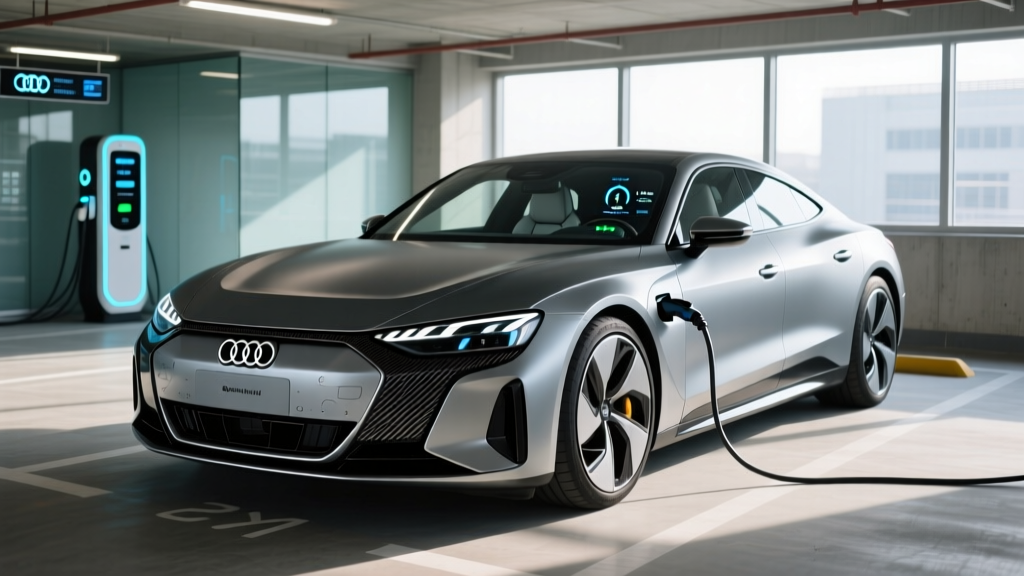
| Audi Q6 e-tron quattro | 94.4 kWh | NMC | 310 mi | 270 kW | ~21 min | 5.0 sec | $63,800 |
Chemistry note: Every current German EV uses NMC (nickel manganese cobalt) battery chemistry. You won't find LFP (lithium iron phosphate) in this segment yet — German OEMs have favored NMC for its higher energy density, which supports the longer ranges and performance figures buyers expect at these price points. The trade-off: NMC degrades slightly faster over time and carries higher raw-material costs than LFP. Expect roughly 10–12% capacity loss over 8 years/100,000 miles under normal use, versus 5–8% for LFP packs in competitors like the Tesla Model 3 RWD or base Ford Mustang Mach-E.
Real-World Range: What the EPA Sticker Doesn't Tell You
EPA range estimates for German EVs assume a mixed driving cycle at moderate temperatures. In practice:
- Highway driving (70+ mph): Subtract 10–15%. A 307-mile BMW i4 delivers roughly 260–275 miles at sustained interstate speed.
- Cold weather (below 32°F): Subtract 20–30% without preconditioning. The VW ID.4's 291-mile EPA figure can drop to ~200–220 miles in a 20°F winter commute. German EVs with heat pumps (standard on the Audi Q6 e-tron, Porsche Macan EV, and most BMW models) recover roughly 5–8% of that loss.
- Charging-curve taper: Peak DC charge rates (e.g., 270 kW on the Porsche/Audi PPE platform) hold only from roughly 10–40% SoC. Above 60%, the rate tapers significantly — expect 80–100 kW in the 60–80% window. That's why the 10–80% time is a far more useful metric than peak kW alone.
German EV vs. Gas Car: The Honest Cost Comparison
The sticker price of a German electric car is higher than its gasoline counterpart. But purchase price is only the start. Let's run a 5-year total cost of ownership (TCO) comparison between the BMW i4 eDrive40 and the BMW 430i Gran Coupe (gas) — two vehicles sharing a platform, similar dimensions, and comparable performance.
| Cost Factor (5 Years / 75,000 mi) | BMW i4 eDrive40 (EV) | BMW 430i Gran Coupe (Gas) |
|---|---|---|
| Purchase Price (MSRP) | $57,900 | $49,900 |
| Federal Tax Credit (§30D) | $0 (MSRP cap + sourcing)* | $0 |
| Estimated State Rebate | $0–$2,000 (varies) | $0 |
| Fuel/Energy (75k mi) | $3,900 (home L2 @ $0.14/kWh) | $9,375 (28 MPG avg @ $3.50/gal) |
| Maintenance | $1,200 (cabin filter, wipers, brake fluid) | $3,800 (oil, filters, spark plugs, brakes) |
| Insurance (avg annual) | $2,400/yr ($12,000 total) | $1,900/yr ($9,500 total) |
| Estimated Depreciation | $26,000 (45% over 5 yrs) | $22,000 (44% over 5 yrs) |
| Total 5-Year Cost | ~$69,000 | ~$72,575 |
*The BMW i4 is assembled in Munich, Germany, and its battery cells source critical minerals that may not meet §30D requirements. Always verify current eligibility at IRS.gov. Income caps ($150k single / $300k joint) and MSRP caps ($55k sedans / $80k SUVs) also apply.
The verdict: Over five years, the i4 EV breaks roughly even with the gas 430i despite an $8,000 higher starting price — driven by $5,475 in fuel savings and $2,600 in maintenance savings. However, the EV carries $2,500 more in insurance costs and slightly steeper depreciation. The financial case strengthens dramatically if you have access to cheap home electricity (under $0.12/kWh) or solar panels, and weakens if you rely solely on public DC fast charging at $0.35–$0.50/kWh.
Real-World Ownership: What First-Time German EV Buyers Must Know
Home Charging Is Non-Negotiable for Cost Savings
The TCO math above assumes 85%+ of your charging happens at home on a Level 2 (240V) circuit. A Level 2 home charger delivering 7.7–11.5 kW will fully replenish any German EV overnight (8–14 hours for a depleted pack). Installation typically costs $800–$2,200 for a straightforward 50-amp circuit with a NEMA 14-50 outlet near your panel, or $2,500–$5,000+ if your electrical panel needs a 200-amp upgrade.
If you live in an apartment or condo without dedicated parking and charging access, a German EV's higher purchase price becomes much harder to justify. Public DC fast charging at Electrify America or EVgo stations costs $0.35–$0.55/kWh — which erases most of the fuel-cost advantage over gasoline. Before committing, confirm your home or workplace can support Level 2 charging.
German EVs Use CCS1 (with NACS Transition Underway)
As of the 2026 model year, most German EVs still ship with the CCS1 charge port. BMW, VW, Audi, Porsche, and Mercedes have all committed to adopting the NACS (Tesla-style) connector for North American models, but the timeline varies:
- VW/Audi/Porsche: 2025+ models on the PPE platform (Q6 e-tron, Macan EV) include NACS adapters in-box; native NACS ports expected for 2027 model year.
- BMW: NACS adapter available; native port transition expected 2026–2027.
- Mercedes: CCS1 remains standard; NACS adapter available for purchase.
This matters because Tesla's Supercharger network — the most reliable DC fast-charging network in the U.S., with over 28,000 stalls — now accepts non-Tesla vehicles via NACS. If your German EV has CCS1, you'll need the OEM adapter to access Superchargers. Confirm adapter availability and cost (typically $0–$250) before purchase.
Battery Warranty Coverage
All major German OEMs provide an 8-year/100,000-mile high-voltage battery warranty with a capacity retention threshold of 70%. This is the industry standard and matches Tesla, Hyundai, and Ford. If your battery degrades below 70% of original capacity within the warranty period, the manufacturer must repair or replace it at no cost. In practice, NMC degradation curves flatten after the first 2–3 years, and most owners report 88–92% State of Health (SoH) at the 5-year mark based on fleet data.
German EV vs. Non-German Competitors: Where the Premium Goes
| Attribute | German EV (e.g., BMW iX) | Non-German EV (e.g., Hyundai Ioniq 5) |
|---|---|---|
| Starting MSRP | $87,250 | $46,650 |
| EPA Range | 324 mi | 318 mi |
| Peak DC Charge Rate | 195 kW | 240 kW |
| 10–80% Charge Time | ~31 min | ~18 min |
| Interior Materials | Merino leather, open-pore wood, aluminum | Eco-processed leather, recycled plastics |
| Ride Quality | Adaptive air suspension, excellent NVH | Conventional springs, good but firmer |
| ADAS | BMW Highway Assistant (Level 2) | Highway Driving Assist 2 (Level 2) |
| Build Quality / Panel Gaps | Excellent | Good, some variance |
| Dealer Network (U.S.) | Extensive, established | Growing, fewer dedicated EV service bays |
The German premium buys you superior ride isolation, higher-grade materials, stronger resale support from established dealer networks, and — in the case of the Porsche Macan EV and Audi Q6 e-tron — access to the 800-volt PPE architecture enabling 270 kW peak charging. But you sacrifice charging speed in some models (the BMW iX charges slower than the Ioniq 5 despite costing twice as much) and pay a significant MSRP premium that depreciation may not fully return.
A Note on "Self-Driving" Claims
German EVs offer sophisticated Level 2 driver-assistance systems: BMW Highway Assistant, Mercedes Drive Pilot (in limited markets), and Audi/VW Travel Assist. None of these are self-driving. Under SAE definitions, Level 2 requires the driver to remain fully engaged — hands on or near the wheel, eyes on the road. Mercedes' Drive Pilot is conditionally Level 3 in Germany (restricted to specific highways under 40 mph) but is not yet approved at Level 3 in the United States. You are always the driver.
Common Misconceptions About German Electric Cars
| Myth | Fact |
|---|---|
| "German EVs qualify for the $7,500 federal tax credit." | Most don't. §30D requires final assembly in North America AND battery-sourcing/critical-mineral thresholds. Vehicles built in Munich, Stuttgart, or Zwickau generally fail the assembly requirement. The VW ID.4 qualifies only when built at VW's Chattanooga, TN plant — verify the VIN. Check current rules at IRS.gov. |
| "A bigger battery means faster charging." | Not necessarily. The Mercedes EQS has a massive 118 kWh pack but peaks at 200 kW — its 10–80% time (~31 min) is slower than the Porsche Macan EV's 95 kWh pack at 270 kW (~21 min). Charge rate (kW) and the battery's C-rate tolerance matter more than capacity (kWh). |
| "German EVs are unreliable because of early VW ID.3 software issues." | Early ID.3/ID.4 software (2020–2022) was genuinely problematic. VW's Software 4.0+ updates and the newer PPE platform (Audi Q6, Porsche Macan EV) have resolved most issues. BMW's iDrive 8.5 and Mercedes MBUX have been more stable from launch. |
| "You'll save money immediately." | Not always. Higher insurance premiums ($300–$600/year more than gas equivalents), lack of federal tax credits on imported models, and potential home electrical upgrades ($1,000–$5,000) can delay breakeven to 4–6 years depending on mileage and electricity costs. |
Your Decision Framework: Which German EV (If Any) Should You Buy?
Choose a German Electric Car If:
- You have confirmed Level 2 home charging access (garage, driveway, or workplace charger).
- You drive 12,000–20,000 miles/year — high enough to capture fuel savings, but within the battery warranty horizon.
- You value ride refinement, highway stability at 80+ mph, and premium interior materials over lowest cost per mile of range.
- You're willing to accept a CCS1 port with a NACS adapter for Supercharger access, or your route network is well-served by Electrify America (which VW partially funds and which supports CCS1 natively).
- Your household income and the vehicle's MSRP/battery sourcing align with §30D eligibility — or you're comfortable paying full MSRP for the driving experience.
Look Elsewhere (Hyundai, Tesla, Ford) If:
- You want to maximize the $7,500 federal tax credit — most North American–built and Korean EVs qualify more easily.
- Fastest possible DC charging is your top priority (Hyundai/Kia E-GMP at 240 kW or Lucid at 300+ kW outpace most German offerings).
- You lack reliable home charging and depend on public infrastructure — a lower-cost EV minimizes the penalty of expensive public kWh rates.
- Your budget tops out below $50,000 — no German EV currently starts below $52,000 MSRP.
Frequently Asked Questions
Are German electric cars reliable long-term?
Current data suggests yes, with caveats. BMW's i4 and iX have shown strong initial quality in J.D. Power and Consumer Reports surveys. The VW ID.4's Chattanooga-built models have improved markedly since the 2023 software refresh. The main risk area remains software stability rather than powertrain durability — EV motors and batteries have few wear components. The 8-year/100,000-mile battery warranty provides a solid backstop.
Do any German EVs qualify for the federal tax credit?
The VW ID.4, built in Chattanooga, Tennessee, can qualify for partial or full §30D credit depending on the battery's critical-mineral and component sourcing for that specific model year. Most BMW, Mercedes, Audi, and Porsche models are assembled in Europe and do not meet the North American final-assembly requirement. Rules change frequently — verify at fueleconomy.gov and consult a tax professional before relying on credit eligibility.
What's the cheapest German electric car available in 2026?
The VW ID.4 starts at $52,495 for the RWD Pro model with 291 miles of EPA range. The next most affordable entry is the Audi Q4 e-tron at approximately $54,300. Both are compact crossovers — if you need a sedan, the BMW i4 at $57,900 is the lowest entry point.
How do German EVs handle in cold weather?
Expect 20–30% range reduction below freezing, consistent with all NMC battery EVs. German models with standard heat pumps (Porsche Macan EV, Audi Q6 e-tron, most BMW models) recover some efficiency by scavenging waste heat from the powertrain. Preconditioning the battery while plugged in — available via each brand's app — significantly reduces cold-weather range loss and improves DC fast-charge speeds in winter.
Can I use Tesla Superchargers with a German EV?
Yes, with an adapter. Tesla has opened much of its Supercharger network to non-Tesla vehicles equipped with a NACS connector or approved adapter. Check your OEM's adapter availability (typically $0–$250) and confirm your specific vehicle is listed as compatible on Tesla's "Charge Your Non-Tesla" support page. Native NACS ports on German EVs are expected starting with the 2027 model year.