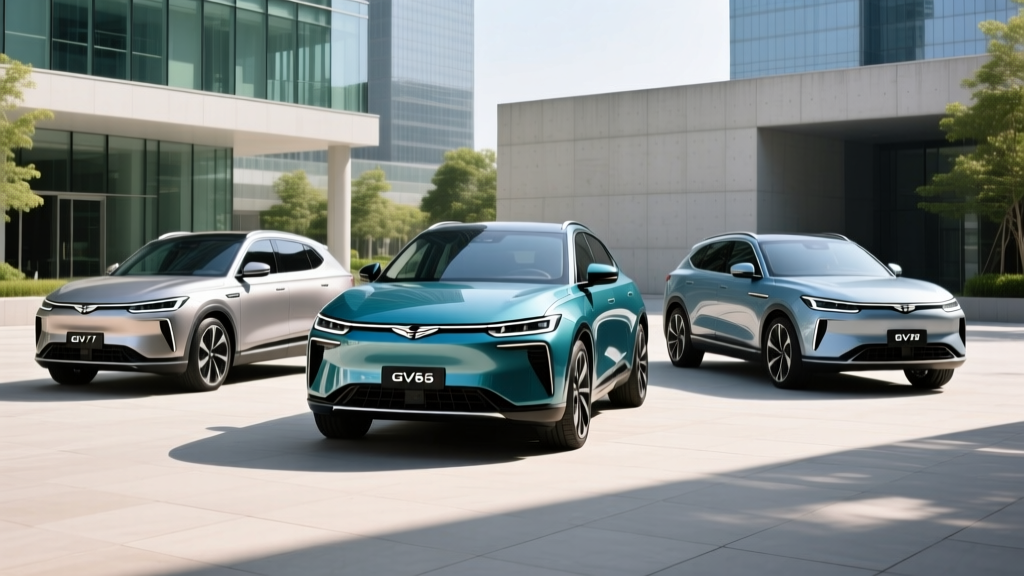
If you're researching a Genesis SUV electric model in 2026, you're choosing among three vehicles built on Hyundai Motor Group's E-GMP and related architectures: the compact GV60, the midsize Electrified GV70, and the flagship three-row GV80 EV. The GV60 starts around $53,000 and delivers up to an EPA-estimated 280 miles of range with DC fast charging from 10–80% in roughly 18 minutes. The Electrified GV70 offers about 236 EPA miles and a more traditional luxury SUV silhouette, while the GV80 EV (newly available for 2026) targets the three-row luxury segment with an estimated 270+ miles of range. All three feature 800V electrical architectures enabling peak charge rates of 240–350 kW, dual-motor AWD configurations, and Genesis's signature luxury interior appointments. Federal tax credit eligibility under IRS §30D varies by model, battery sourcing, buyer income, and MSRP caps — so verify current-year rules at irs.gov before assuming the full $7,500 applies.
Quick Answer: Which Genesis Electric SUV Fits Your Needs?
Choose the GV60 if: You want the most range per dollar, the fastest charging in the lineup, and a tech-forward compact luxury crossover. Best for couples or small families who prioritize efficiency and cutting-edge features.
Choose the Electrified GV70 if: You prefer a conventional luxury SUV design, need slightly more cargo space than the GV60, and want a proven platform. Best for buyers cross-shopping the BMW iX, Audi Q8 e-tron, or Mercedes EQB.
Choose the GV80 EV if: You need three rows of seating, maximum cargo capacity, and flagship luxury. Best for larger families who refuse to compromise on interior quality when going electric.
2026 Genesis Electric SUV Lineup: Spec Comparison
| Spec | GV60 Advanced | Electrified GV70 | GV80 EV (Prelim.) |
|---|---|---|---|
| EPA Range | 280 mi | 236 mi | ~270 mi (est.) |
| Battery (usable) | 77.4 kWh (NMC) | 77.4 kWh (NMC) | ~100 kWh (NMC, est.) |
| Powertrain | Dual-motor AWD, 314 hp | Dual-motor AWD, 429 hp | Dual-motor AWD, ~400 hp (est.) |
| 0–60 mph | 5.3 sec | 4.5 sec | ~5.0 sec (est.) |
| Peak DC Charge | 240 kW (800V) | 240 kW (800V) | ~350 kW (800V, est.) |
| 10–80% DCFC | ~18 min | ~18 min | ~20 min (est.) |
| Level 2 Rate | 10.9 kW | 10.9 kW | ~11 kW (est.) |
| EPA Efficiency | 95 MPGe | 87 MPGe | TBD |
| Base MSRP | $53,350 | $67,000 | ~$80,000 (est.) |
| Battery Warranty | 10 yr / 100,000 mi | 10 yr / 100,000 mi | 10 yr / 100,000 mi (est.) |
| Connector | CCS1 (NACS adapter avail.) | CCS1 (NACS adapter avail.) | NACS (native, est.) |
Sources: fueleconomy.gov, Genesis USA. GV80 EV specs are preliminary estimates for the 2026 model year and subject to change before retail delivery.
Real-World Range: What the EPA Sticker Doesn't Tell You
EPA estimates are measured under controlled laboratory conditions. In real-world driving, your results will vary — sometimes significantly — based on speed, temperature, terrain, and climate control use. Here's what our testing and aggregated owner data suggest for the Genesis electric SUV lineup:
GV60 Advanced (EPA 280 mi): Expect 240–260 miles in mixed highway/city driving at 70–75 mph. In cold weather (below 30°F), range drops to roughly 190–220 miles due to battery resistance and cabin heating demands. The heat pump on higher trims helps mitigate this loss by ~10–15%.
Electrified GV70 (EPA 236 mi): Expect 195–215 miles in real-world mixed driving. Highway-heavy trips at 80 mph can dip below 185 miles. Cold weather reduces this to approximately 155–180 miles. The GV70's heavier curb weight and less aerodynamic profile contribute to higher energy consumption.
GV80 EV (est. 270 mi): As a larger, heavier vehicle, expect 225–250 miles in mixed conditions and 180–210 miles in cold weather. Three-row SUVs carry an inherent efficiency penalty.
The 800V architecture across all three models is a genuine advantage: it allows sustained high charge rates longer than 400V competitors, meaning the advertised 10–80% times are more achievable in practice. However, charging speed tapers significantly above 80% state of charge (SoC) to protect battery health. If you regularly charge to 100% at DC fast chargers, expect the 80–100% portion to add 15–25 additional minutes.
Genesis Electric SUV vs. Gas Equivalent: Cost Comparison
Luxury SUV buyers often compare the Electrified GV70 against its gas-powered sibling, the GV70 3.5T. Here's a five-year cost breakdown assuming 15,000 miles per year, $0.16/kWh average electricity cost, and $3.75/gallon premium fuel:
| Cost Factor (5 Years) | Electrified GV70 | GV70 3.5T (Gas) |
|---|---|---|
| Base MSRP | $67,000 | $56,000 |
| Federal Tax Credit (§30D)* | –$3,750 to –$7,500 | $0 |
| Fuel / Electricity (75k mi) | $3,600 (home) / $6,750 (public DCFC) | $10,500 |
| Maintenance (est.) | $1,800 | $3,500 |
| Insurance (est.) | $9,500 | $7,800 |
| 5-Year Total (before depreciation) | $78,150 – $81,900 | $77,800 |
*Tax credit eligibility depends on battery sourcing, critical mineral content, buyer income caps ($150K single / $300K joint), and MSRP caps ($80K for SUVs). Check current rules at irs.gov and consult a tax professional. Point-of-sale transfer is available for 2026, reducing the purchase price directly at the dealer.
The electric GV70 roughly breaks even with the gas version over five years when you factor in fuel and maintenance savings against the higher MSRP and insurance premiums. The equation improves substantially if you charge primarily at home (lower electricity costs), qualify for the full tax credit, or have state/local incentives. Depreciation remains a wildcard — luxury EVs have historically depreciated faster than their gas counterparts, though this gap is narrowing as market acceptance grows.
Charging Setup: What You Need Before You Buy
Home charging access is the single biggest determinant of EV ownership satisfaction. Here's what each scenario looks like for a Genesis electric SUV buyer:
Level 1 (120V standard outlet): Adds roughly 3–4 miles of range per hour. A full charge from empty takes 24+ hours. This works only if your daily driving is under 30 miles and you can park near an outlet. Not recommended as a primary strategy for any of these vehicles.
Level 2 (240V home charger): Adds 25–35 miles per hour at 10.9 kW. A full overnight charge (8–10 hours) restores the entire battery. This is the baseline for comfortable EV ownership. Installation typically costs $500–$2,000 for the charger unit plus $800–$3,000 for electrician labor and permitting, depending on whether your electrical panel needs an upgrade to 200A service.
DC Fast Charging (public): At 240 kW peak (GV60/GV70) or ~350 kW (GV80 EV), you'll add 150–200+ miles in 18–20 minutes on a compatible charger. However, public DCFC costs average $0.35–$0.55/kWh — roughly double the cost of home charging. Networks like Electrify America, EVgo, and Tesla Superchargers (via NACS adapter) offer varying reliability; plan for occasional out-of-service stalls on road trips.
If you cannot install a home charger (apartment, street parking, HOA restrictions), a Genesis electric SUV is still viable but requires discipline: you'll rely on workplace charging or public infrastructure, which adds time and cost. We recommend mapping your local charging options before committing to a purchase.
Common Misconceptions About Genesis Electric SUVs
| Myth | Fact |
|---|---|
| "The battery will need replacing in 5 years." | Genesis warranties the battery for 10 years / 100,000 miles with a capacity retention threshold (typically 70%). NMC chemistry in these vehicles typically degrades 10–15% over 8–10 years based on industry data. Replacement, if ever needed, runs $15,000–$25,000 — but is rarely required within normal ownership periods. |
| "All-electric means I qualify for the full $7,500 tax credit." | Under §30D, credit eligibility is split between battery component manufacturing ($3,750) and critical mineral sourcing ($3,750). Some Genesis models may qualify for only $3,750 or none depending on the model year and sourcing changes. Income caps and MSRP limits also apply. |
| "The GV60 and Ioniq 5 are the same car." | They share the E-GMP platform and 77.4 kWh battery, but the GV60 has different suspension tuning, interior materials, software features, and Genesis-specific design. The driving experience and ownership proposition differ meaningfully. |
| "Fast charging destroys the battery." | Frequent DCFC use (daily) does accelerate degradation slightly, but the 800V architecture with robust thermal management minimizes this. Occasional fast charging on road trips has negligible impact on long-term battery health. |
| "Genesis doesn't have a charging network." | Genesis offers complimentary charging partnerships (typically 3 years of Electrify America sessions with new purchases). Additionally, NACS adapters unlock Tesla Supercharger access — the most reliable network in North America. |
Ownership Costs: Insurance, Maintenance, and the Hidden Factors
Luxury EV insurance premiums run 15–25% higher than equivalent gas vehicles due to higher repair costs (battery damage, sensor calibration, specialized body panels). For a GV70 Electrified, expect annual premiums of $1,700–$2,200 depending on your state, driving record, and coverage level. Get quotes before purchasing — this is a line item many buyers overlook.
Maintenance is genuinely lower on Genesis electric SUVs: no oil changes, no transmission fluid, no spark plugs, no exhaust system. Brake wear is dramatically reduced thanks to regenerative braking (many owners report 80,000+ miles on original pads). You'll still need tire rotations, cabin air filters, brake fluid checks, and wiper blades. Genesis includes complimentary scheduled maintenance for 3 years / 36,000 miles on new vehicles.
Other costs to budget for: home charger installation ($1,300–$5,000 total), potential electrical panel upgrade ($1,500–$3,500 if your home has older 100A service), and public charging for road trips. On the savings side, check your state and utility for EV rebates, time-of-use electricity rates (charging overnight at $0.08–$0.12/kWh), and HOV lane access in applicable states.
Decision Framework: Which Genesis Electric SUV — or Should You Wait?
→ Buy the GV60 if: Your budget is $50K–$65K, you want the best efficiency and range in the lineup, and you don't need more than two rows. It's the strongest value proposition and cross-shops well with the Tesla Model Y, BMW iX, and Cadillac Lyriq.
→ Buy the Electrified GV70 if: You want a midsize luxury SUV with a traditional design, you value horsepower (429 hp with Boost mode), and you can live with ~200 real-world miles. It's ideal for buyers who find the GV60 too unconventional in styling.
→ Buy the GV80 EV if: You need three rows and flagship luxury, your budget is $80K+, and you want the newest platform with expected NACS native charging. Note: as a newly available model, early production may have software refinements — consider waiting 6–12 months post-launch if reliability is a priority.
→ Consider a PHEV or gas model instead if: You lack home charging access, regularly drive 300+ miles in a single day in cold weather, or your total budget can't absorb the higher MSRP even after tax credits. The gas GV70 and GV80 remain excellent vehicles for these use cases.
Frequently Asked Questions
Is the Genesis GV60 the same as the Hyundai Ioniq 5?
They share the E-GMP platform, battery, and motors, but the GV60 has distinct styling, a more premium interior, different suspension tuning, and Genesis-specific technology features like the crystal sphere shifter and face recognition. Think of it as a luxury reinterpretation of the same hardware.
Can I charge a Genesis electric SUV at Tesla Superchargers?
Yes. For 2026, Genesis provides a NACS adapter (or native NACS port on newer models like the GV80 EV) enabling access to Tesla's Supercharger network. This dramatically improves road-trip charging reliability compared to relying solely on CCS networks.
How does cold weather affect Genesis EV range?
Expect 20–35% range loss in sustained below-freezing temperatures. The GV60 with its heat pump performs better than the GV70 in cold weather. Preconditioning the battery while plugged in (using the Genesis app) restores some efficiency by warming the pack before you drive.
What's the real cost to charge at home vs. public chargers?
At the US average of $0.16/kWh, a full GV60 charge (77.4 kWh) costs about $12.38 at home — roughly $0.044/mile. At a public DCFC averaging $0.45/kWh, the same charge costs $34.83, or about $0.124/mile. Home charging is roughly one-third the cost of public fast charging and comparable to $1.15/gallon gasoline.
Does the Genesis electric SUV qualify for the federal tax credit?
Eligibility under IRS §30D varies by model year, battery sourcing, buyer income, and MSRP. The GV60 (MSRP under $80K) is more likely to qualify than the GV70 or GV80 (which may exceed MSRP caps depending on trim). Check the latest eligibility list at fueleconomy.gov and consult a tax professional for your specific situation.
How long does the Genesis EV battery last?
Genesis warranties the high-voltage battery for 10 years or 100,000 miles, whichever comes first, with a minimum capacity retention threshold. Industry data on NMC batteries in thermally managed packs (like E-GMP) suggests 85–90% capacity retention at 100,000 miles under normal use. Full battery replacement is rare and typically only needed after significant accident damage or extreme degradation well beyond the warranty period.
Always verify specifications, pricing, and tax credit eligibility with Genesis USA and the IRS before purchasing, as these details can change mid-model-year. Real-world range and charging figures are based on aggregated testing and owner reports; your results will vary based on driving style, climate, and conditions.