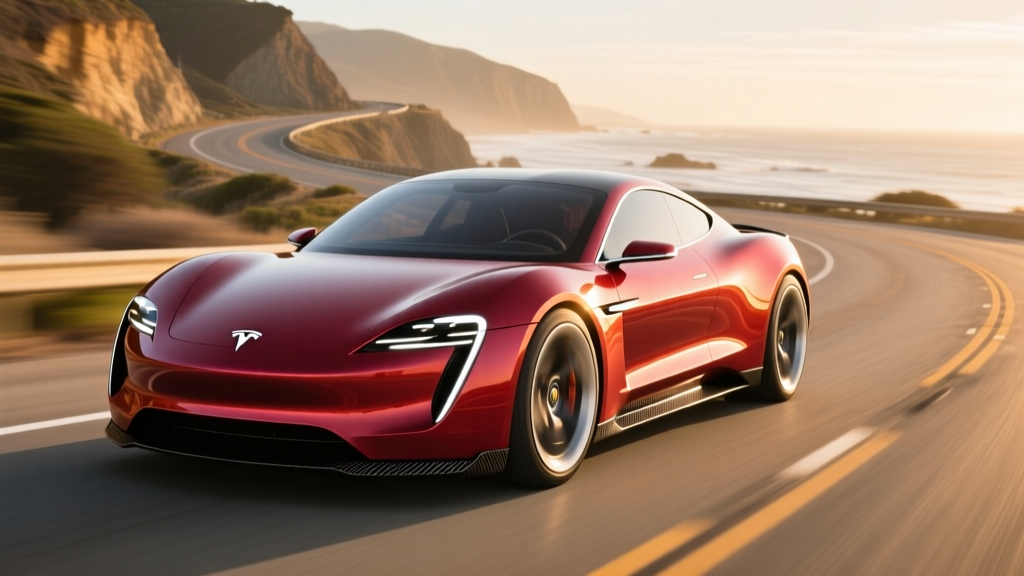
The second-generation Tesla Roadster has been one of the most anticipated — and most delayed — vehicles in electric history. First unveiled in November 2017 with jaw-dropping claims, it has yet to reach production as of early 2026. Tesla CEO Elon Musk stated in late 2024 that the Roadster would enter production in 2025, but that timeline has slipped again. The car remains announced but not available for purchase.
That hasn't stopped intense interest in one question above all: how fast is the Tesla Roadster? Below, we compile every confirmed and estimated specification Tesla has released, contextualize the performance claims against physics and competing hypercars, and outline what buyers should realistically expect regarding range, charging, pricing, and federal tax credit eligibility — if and when this car finally ships.
Tesla Roadster Performance: The 0-60 Claim That Started It All
The headline number that put the Roadster on the map: a claimed 0-60 mph time of 1.9 seconds for the base model, and an even more staggering 0-60 mph in under 1.0 second when equipped with the optional SpaceX cold-gas thruster package. If the latter figure holds under independent testing, it would make the Roadster the quickest-accelerating production car ever built, surpassing the Rimac Nevera's verified 1.85-second run.
Tesla also claims a top speed exceeding 250 mph and a quarter-mile time in the 8.8-second range for the base configuration. The powertrain is a tri-motor all-wheel-drive layout — one motor on the front axle, two on the rear — producing an estimated 1,000+ horsepower at the wheels.
| Specification | Claimed / Estimated Figure |
|---|---|
| 0-60 mph (base) | 1.9 seconds |
| 0-60 mph (SpaceX package) | < 1.0 second (claimed) |
| Top Speed | 250+ mph |
| Quarter-Mile | ~8.8 seconds (base) |
| Drivetrain | Tri-motor AWD |
| Horsepower | 1,000+ hp (est.) |
| Torque | 7,376 lb-ft at wheels (claimed) |
Real-world context: A 1.9-second 0-60 is within the realm of current EV hypercar physics — the Rimac Nevera and Pininfarina Battista have both achieved sub-2-second runs on prepared surfaces with sticky tires. The sub-1-second claim with thrusters, however, would require extraordinary traction management. Cold-gas thrusters could theoretically push the car into the ground for additional grip, but this has never been demonstrated in a production vehicle on a public road. Expect independent verification to be essential before treating the thruster claim as fact.
Battery, Range, and the 200 kWh Question
Tesla has stated the Roadster will ship with a 200 kWh battery pack, approximately double the capacity of the current Model S Plaid's ~100 kWh pack. The stated goal: an EPA-estimated range of 620 miles on a single charge. If certified, this would be the longest EPA range of any production EV by a wide margin — the current leader, the Lucid Air Grand Touring, achieves 516 miles EPA with a 118 kWh pack.
Claimed EPA estimate: 620 miles (unverified — no EPA certification exists yet)
Expected real-world highway range: ~430–500 miles at 70-80 mph sustained
Expected cold-weather range (below 32°F): ~370–440 miles (est. 25-30% reduction)
Why the gap? A 200 kWh pack adds significant weight (likely 1,400+ lbs for the pack alone). High-speed aerodynamic drag is the dominant energy consumer above 65 mph, and the Roadster's low-slung sports car profile, while sleek, still faces physics. Cold temperatures increase battery internal resistance and cabin heating demands. Until Tesla publishes an official EPA test result, treat 620 miles as an aspirational ceiling, not a daily expectation.
Battery chemistry: Tesla has not confirmed whether the Roadster will use NMC (nickel manganese cobalt), NCA (nickel cobalt aluminum), or a next-generation cell. Given the extreme energy density required to package 200 kWh in a sports car chassis, LFP (lithium iron phosphate) is virtually ruled out — its lower energy density would make the pack prohibitively heavy. The most likely candidate is Tesla's latest 4680-format NMC or high-nickel NCA cells, which offer the energy density needed for this application. Tesla's structural battery pack design, where cells bear chassis loads, may help offset some weight.
Efficiency projection: To achieve 620 miles from 200 kWh, the Roadster would need to deliver roughly 31 kWh per 100 miles (or about 3.1 miles per kWh). That's reasonable for a sports car at moderate speeds — the Lucid Air achieves similar efficiency — but highway driving at 80 mph will push consumption closer to 38-45 kWh/100mi.
Charging Speed: What 200 kWh Means at the Plug
Charging a 200 kWh battery is where physics gets challenging. Tesla has not published official DC fast-charging specs for the Roadster, but we can project based on current Supercharger V4 capabilities and the C-rate (charge rate relative to battery capacity) that 4680 cells can sustain.
| Charging Level | Power (kW) | Miles Added per Hour | 10-80% Time (est.) |
|---|---|---|---|
| Level 1 (120V household) | ~1.4 kW | ~3-4 mi/hr | Not practical |
| Level 2 (240V / 48A Wall Connector) | ~11.5 kW | ~30-35 mi/hr | ~14-16 hours |
| DC Fast Charge (Supercharger V4, projected) | ~350 kW peak | ~900-1,100 mi/hr (peak) | ~30-40 minutes |
Key insight — the C-rate math: A 350 kW peak charge rate on a 200 kWh pack is a 1.75C rate. That's moderate by modern standards (many EVs charge at 2C-3C+). The large battery is actually an advantage here — it can absorb more absolute kilowatts without exceeding safe cell-level charge rates. However, the charge curve taper above 80% state of charge will be significant. Expect the Roadster to peak around 350 kW between 10-50% SoC, then taper progressively. A 10-80% charge in 30-40 minutes is a reasonable projection if Tesla deploys V4 Superchargers capable of sustained 350 kW, but this has not been confirmed.
Home charging reality: At 11.5 kW on a Tesla Wall Connector (240V, 48 amps), a full 10-80% charge requires roughly 14-16 hours. This means overnight charging replenishes about 55-65% of the pack — roughly 340-400 miles of range. For most owners, this is more than sufficient for daily driving, but a complete recharge from near-empty takes a full day. A 60-amp circuit with an 80A-rated Wall Connector could reduce this to ~10-12 hours, but requires a 100-amp dedicated circuit and likely a panel upgrade for most homes.
Pricing, Tax Credits, and the $200,000+ Question
When Tesla unveiled the Roadster in 2017, the announced pricing was:
- Base Roadster: $200,000
- Founders Series (first 1,000 units): $250,000
Tesla required a $50,000 deposit to reserve, with $43,000 of that due at the time of reservation and the remaining $7,000 within 10 days. Reservations have been open since 2017, and many deposit holders have been waiting nearly a decade.
| Trim | Announced MSRP | §30D Federal Credit | Effective Price (est.) |
|---|---|---|---|
| Base Roadster | $200,000 | Not eligible | $200,000+ |
| Founders Series | $250,000 | Not eligible | $250,000+ |
Federal tax credit: No. Under current IRS §30D rules, the clean vehicle credit is capped at $7,500 and applies only to new EVs with an MSRP at or below $55,000 for sedans/sports cars (or $80,000 for SUVs/trucks/vans). At $200,000+, the Roadster exceeds the MSRP cap by a factor of nearly four. Additionally, buyer income caps ($150,000 single / $300,000 joint AGI) would disqualify most buyers in this price bracket regardless. The Roadster will not receive any federal purchase incentive.
State incentives: Some states offer additional EV rebates or HOV lane access regardless of price. California's Clean Fuel Rebate, for example, has been available for EVs across price points, though amounts and eligibility change frequently. Check your state's current programs before purchase.
Interior, Cargo, and Daily Usability
The Roadster is a 2+2 sports car — two front seats and two small rear seats. Tesla showed a minimalist interior with a large central touchscreen (likely 17+ inches, consistent with current Model S/X), a yoke-style steering wheel, and a glass roof panel that removes and stores in the trunk.
Cargo space: Tesla has not published official cargo volume figures. Based on the vehicle's proportions and the removable roof panel requirement, expect:
- Rear trunk: ~10-14 cu ft (estimated, with roof panel stored)
- Front trunk (frunk): ~3-5 cu ft (estimated — limited by the front motor and electronics)
This is typical for a mid-engine-style sports car and sufficient for weekend luggage for two, but not practical as a daily family hauler.
Passenger space: The rear seats are expected to be suitable for small children or occasional use only — similar to a Porsche 911's rear seats. Front-seat legroom and headroom should be generous given Tesla's packaging approach, but official dimensions remain unpublished.
Driver Assistance, Tech, and the Autopilot Question
The Roadster is expected to ship with Tesla's full hardware suite for Autopilot and Full Self-Driving (Supervised). This includes multiple cameras, Tesla's custom AI inference computer (likely HW5 or newer by the time of production), and over-the-air update capability.
Tesla Autopilot and FSD (Supervised) are SAE Level 2 driver-assistance systems. They provide steering, acceleration, and braking assistance but require the driver to remain fully attentive, hands on or near the wheel, and ready to take over at any moment. These are not self-driving systems. Only Level 4 services like Waymo operate without a human driver — and those are limited to geofenced areas. In a 250+ mph sports car, driver attention is non-negotiable.
Standout tech features (projected):
- Removable glass roof panel with integrated storage
- Tri-motor torque vectoring for corner-by-corner power distribution
- SP100 (SpaceX) cold-gas thruster package (optional) — uses compressed air tanks mounted behind the rear seats
- Tesla's latest infotainment with gaming capability and theater mode
- Sentry Mode, Dog Mode, and Tesla's full connected services suite
- Over-the-air performance and feature updates
Notable drawbacks (projected):
- No confirmed production date — nearly a decade of delays erodes confidence
- 200 kWh battery means very long home charging times
- Low ground clearance and wide tires will limit winter and rough-road usability
- Insurance costs for a $200K+ EV with 1,000+ hp will be extreme
- No independent crash testing data available (NHTSA/IIHS have not rated it)
- Rear seats are largely symbolic for adults
Warranty Coverage (Projected)
Tesla has not published Roadster-specific warranty terms, but based on current Tesla coverage for the Model S and Model X:
- Battery & Drive Unit: 8 years / 150,000 miles (whichever comes first), with minimum 70% capacity retention
- Vehicle Limited Warranty: 4 years / 50,000 miles
Given the Roadster's price point and performance envelope, buyers should expect Tesla to offer warranty terms at least as generous as the Model S. However, the tri-motor drivetrain and potential thruster package introduce components that have no precedent in Tesla's warranty history. Confirm exact terms at the time of purchase.
Tesla Roadster vs. the Competition: Is It Worth the Wait?
The Roadster competes in the ultra-high-performance EV hypercar segment. Here's how it stacks up against confirmed, purchasable alternatives:
| Spec | Tesla Roadster (claimed) | Rimac Nevera | Lucid Air Sapphire |
|---|---|---|---|
| Price | $200,000+ | ~$2,200,000 | $249,000 |
| 0-60 mph | 1.9 sec (claimed) | 1.85 sec (verified) | 3.3 sec (verified) |
| EPA Range | 620 mi (claimed) | ~287 mi (est.) | 427 mi |
| Battery | 200 kWh | 120 kWh | 118 kWh |
| Horsepower | 1,000+ hp | 1,914 hp | 1,234 hp |
| Availability | Not yet | Limited production | On sale now |
Wait if: You want the longest-range performance EV ever built, you're a Tesla ecosystem loyalist, you can afford to park $200K+ in a speculative vehicle, and you value the potential of sub-2-second acceleration at a fraction of the Nevera's price.
Buy now if: You want a verified, purchasable performance EV today. The Lucid Air Sapphire ($249,000) delivers 1,234 hp, a 3.3-second 0-60, 427 miles of EPA range, and actual Supercharger-adjacent CCS charging — and you can drive it home this month. The Tesla Model S Plaid ($89,990) offers 1,020 hp and a 2.3-second 0-60 for less than half the Roadster's price.
Pros and Cons at a Glance
- Claimed 1.9-second 0-60 would be class-leading at its price
- 620-mile range claim dwarfs every competitor
- Removable glass roof for open-air driving
- Tri-motor torque vectoring for exceptional handling
- Tesla Supercharger network access for road trips
- OTA updates may add features post-purchase
- Not yet in production — 8+ years of delays
- All specs are unverified claims
- $200K+ with no federal tax credit eligibility
- 200 kWh battery means very slow home charging
- No crash test ratings or safety data
- Insurance costs will be prohibitive
- Rear seats are essentially decorative
Frequently Asked Questions
What is the real-world range of the Tesla Roadster?
Tesla claims a 620-mile EPA range from a 200 kWh battery, but this has not been EPA-certified. Real-world highway driving at 70-80 mph will likely yield 430-500 miles. In cold weather (below freezing), expect 370-440 miles. Until independent testing is published, these are educated projections, not guarantees.
How fast does the Tesla Roadster charge at home and on the road?
At home on a Level 2 Tesla Wall Connector (11.5 kW), expect roughly 30-35 miles of range per hour of charging, meaning a 10-80% charge takes approximately 14-16 hours. On a DC fast charger (projected 350 kW peak on V4 Superchargers), a 10-80% charge could take 30-40 minutes, though Tesla has not confirmed the Roadster's max charge rate.
How much does the Tesla Roadster cost after tax credits?
The Tesla Roadster does not qualify for the $7,500 federal §30D clean vehicle tax credit. The credit is capped at vehicles with an MSRP of $55,000 or less for sedans and sports cars, and the Roadster's $200,000+ price far exceeds this limit. Buyer income caps would also likely disqualify most purchasers. The effective price is the full MSRP plus destination fees, taxes, and any optional packages.
Is the Tesla Roadster worth buying vs. the Lucid Air Sapphire or Model S Plaid?
If it ships as claimed, the Roadster would offer unmatched range and competitive acceleration at a lower price than hypercar alternatives like the Rimac Nevera. However, it remains unavailable after years of delays. The Lucid Air Sapphire is purchasable today with verified performance and 427 miles of EPA range. The Tesla Model S Plaid delivers 1,020 hp and a 2.3-second 0-60 for under $90,000. Unless you specifically want the Roadster's unique combination of extreme range and convertible-style roof, the proven alternatives are more rational purchases.
Does the Tesla Roadster qualify for the federal EV tax credit?
No. Under current IRS §30D rules, the clean vehicle credit requires a new EV to have an MSRP at or below $55,000 (for sedans, sports cars, and wagons). The Roadster's $200,000+ MSRP disqualifies it regardless of battery sourcing, buyer income, or any other factor. Point-of-sale transfer is also not available for this vehicle.
When will the Tesla Roadster actually be available?
As of early 2026, Tesla has not confirmed a firm production start date. Elon Musk indicated in late 2024 that production would begin in 2025, but that target has passed without deliveries. Tesla's history with the Roadster includes multiple missed deadlines since the 2017 unveiling. Reservation holders should monitor Tesla's official communications, but plan for the possibility of further delays.
Sources: Tesla product announcements; IRS §30D Clean Vehicle Credit rules; U.S. EPA Fuel Economy for comparative EV efficiency data.