The Quick Answer: Is the Genesis GV80 EV Worth It?
The Genesis GV80 EV is a luxury electric SUV built on a dedicated E-GMP-derived platform, offering an EPA-estimated range of approximately 280 miles from its 84 kWh usable battery (NMC chemistry), DC fast charging at up to 210 kW (10–80% in roughly 22 minutes), and a starting MSRP around $75,000 for the 2026 model year. It delivers 365 horsepower, a 0–60 mph time near 5.0 seconds, and qualifies for a partial or full §30D federal tax credit depending on battery-sourcing compliance and buyer income. Compared to the gas GV80 2.5T AWD (starting ~$58,000), the EV variant costs roughly $17,000 more upfront but saves an estimated $1,200–$1,800 annually on fuel and maintenance for a typical driver covering 12,000 miles per year.
Range and Efficiency: EPA Sticker vs. Real-World Expectations
The Genesis GV80 EV carries an EPA-estimated range of approximately 280 miles (combined city/highway) with its standard all-wheel-drive dual-motor configuration. Efficiency lands around 85 MPGe combined, translating to roughly 39 kWh per 100 miles driven.
Those numbers tell only part of the story. In real-world driving, expect the following adjustments:
- Highway driving at 75 mph: Range drops to approximately 230–250 miles. Electric SUVs lose efficiency at sustained high speeds due to aerodynamic drag, and the GV80's boxy luxury profile doesn't help.
- Cold weather (below 30°F): Expect a 15–25% range reduction, bringing usable range to roughly 210–240 miles. The GV80 EV includes a heat pump for cabin heating, which mitigates some of the loss compared to resistive heaters, but battery chemistry still suffers in the cold.
- Mountain driving or heavy cargo loads: Add another 5–10% reduction for sustained climbs or a fully loaded cabin with roof cargo.
| Specification | Value |
|---|---|
| Battery (usable) | ~84 kWh, NMC chemistry |
| EPA Range | ~280 miles (AWD) |
| Efficiency | ~85 MPGe / 39 kWh/100 mi |
| DC Fast Charge (peak) | 210 kW (10–80% in ~22 min) |
| Level 2 Charge Rate | 10.9 kW (~8.5 hours 10–100%) |
| Powertrain | Dual-motor AWD, 365 hp, 516 lb-ft |
| 0–60 mph | ~5.0 seconds |
| Towing Capacity | ~5,000 lbs (est.) |
| Base MSRP | ~$75,000 |
| Battery/Powertrain Warranty | 10 years / 100,000 miles |
Charging Speeds and Infrastructure Reality
The GV80 EV uses an 800-volt electrical architecture, which enables faster DC charging and more efficient power delivery compared to 400-volt systems. Here is what charging looks like across the three levels:
| Level | Power | Miles Added per Hour | Typical Use Case |
|---|---|---|---|
| Level 1 (120V) | ~1.4 kW | ~3–4 mi/hr | Emergency / overnight trickle |
| Level 2 (240V, 48A) | 10.9 kW | ~28–30 mi/hr | Home daily charging |
| DC Fast Charge | Up to 210 kW | ~180+ mi in 15 min | Road trips, public stations |
Charging curve reality check: The 210 kW peak rate is not sustained across the entire session. Like all EVs, the GV80 charges fastest between 10–40% state of charge (SoC), then tapers progressively. Expect the 10–80% session to average roughly 150–170 kW on a capable 350 kW Electrify America or Ionity station. Above 80%, charging slows dramatically to protect the battery — a top-up from 80–100% can take as long as the 10–80% session itself. For road trips, plan stops around the 10–80% window to minimize total charging time.
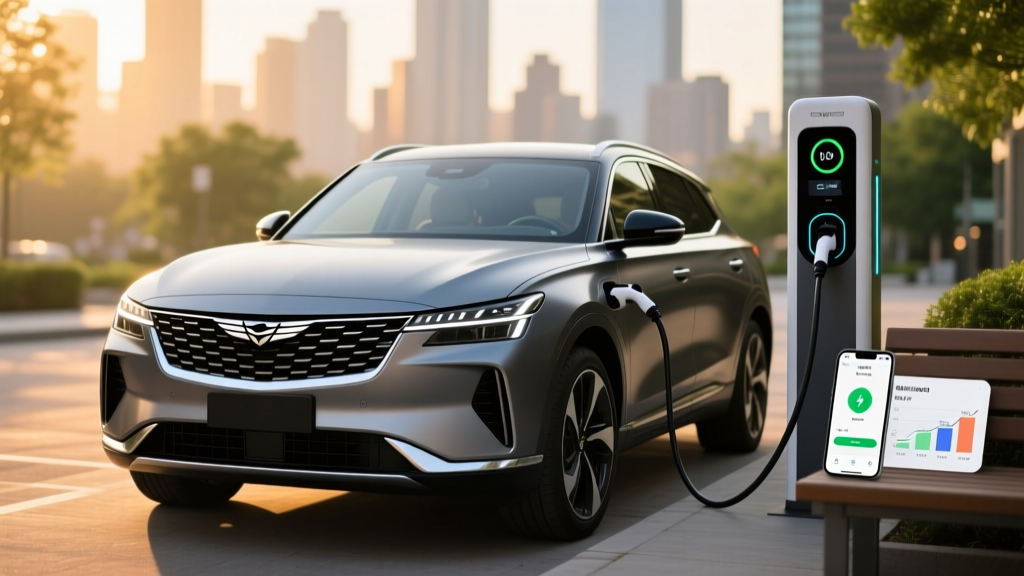
Connector note: The 2026 GV80 EV ships with a NACS (North American Charging Standard) port, giving it native access to Tesla Supercharger stations via the expanding open network. A CCS adapter may be included for legacy Electrify America and ChargePoint stations, but verify with your dealer at purchase.
GV80 EV vs. Gas GV80: Cost and Ownership Comparison
The most common cross-shopping question is whether the EV variant justifies its premium over the gasoline GV80. Here is a data-driven comparison based on 12,000 miles driven annually, $3.50/gallon regular fuel, and $0.14/kWh home electricity (national average):
| Category | GV80 EV (AWD) | GV80 Gas 2.5T AWD |
|---|---|---|
| Starting MSRP | ~$75,000 | ~$58,000 |
| Fuel/Energy Cost (annual) | ~$650 (home charging) | ~$2,100 (23 MPG combined) |
| Oil Changes | $0 | ~$200–$300/year |
| Brake Wear | Minimal (regen braking) | ~$400–$600 every 40k mi |
| Insurance (annual est.) | ~$2,800–$3,400 | ~$2,400–$2,900 |
| Federal Tax Credit (§30D) | Up to $7,500* | $0 |
| 5-Year Total Fuel/Maint. | ~$4,500 | ~$14,000 |
*The §30D federal EV tax credit is subject to battery-sourcing and critical-mineral requirements, buyer income caps ($150K single / $300K joint AGI), and MSRP limits ($80,000 for SUVs). The GV80 EV's MSRP is under the SUV cap, but credit eligibility depends on current-year sourcing rules. Check the latest requirements at IRS.gov and confirm with a tax professional. As of 2026, the credit can be transferred to the dealer at point of sale, reducing your purchase price directly.
Break-even analysis: The EV variant's ~$17,000 MSRP premium narrows to roughly $9,500 after the maximum $7,500 tax credit. With annual fuel and maintenance savings of approximately $1,500–$1,800, the break-even point falls around 5–6 years of ownership. If you keep the vehicle longer than that, the EV becomes the more economical choice — and you gain the daily convenience of home charging.
Real Costs of Ownership: The Full Picture
| Cost Category | Estimated Amount |
|---|---|
| Purchase Price (base) | $75,000 |
| Federal Tax Credit (§30D, max) | –$7,500 |
| Net Purchase Cost | $67,500 |
| Home Level 2 Charger Install | $800–$2,500 |
| Energy (5 years, 60k mi) | $3,250 (home) / $5,500 (mix of public) |
| Insurance (5 years) | $14,000–$17,000 |
| Maintenance (5 years) | $1,200–$1,800 |
| Estimated Depreciation (5 years) | $25,000–$32,000 |
| Estimated 5-Year Total Cost | $55,000–$65,000 (net of resale) |
Home charging installation: Most GV80 EV buyers will want a Level 2 home charger (240V, 48-amp circuit) for overnight replenishment. Budget $800–$1,500 for the charger unit itself (Genesis may include a branded unit) and $500–$1,500 for licensed electrician installation, depending on whether your electrical panel needs an upgrade. Homes with older 100-amp panels may face a $2,000–$4,000 panel upgrade — factor this into your purchase decision. Always hire a licensed electrician and pull the required permits.
Insurance: Luxury EVs carry higher premiums than their gas counterparts, typically 15–25% more, due to higher repair costs and battery replacement exposure. Expect $2,800–$3,400 annually depending on your location, driving record, and coverage level. Get quotes before committing to the purchase.
Depreciation: EV depreciation has been volatile. Luxury EVs in the $70K+ segment have historically lost 40–55% of value over five years, though the expanding charging network and improving consumer confidence are stabilizing residuals. The GV80's strong 10-year/100,000-mile battery warranty provides a floor of confidence for second owners.
Common Misconceptions About the GV80 EV
| Myth | Fact |
|---|---|
| "The battery will need expensive replacement within a few years." | Genesis covers the battery for 10 years / 100,000 miles with a capacity-retention guarantee (typically 70% minimum SoH). Modern NMC packs are engineered for 1,000+ full charge cycles with manageable degradation. Expect 85–90% capacity retention at 100,000 miles under normal use. |
| "I can't take road trips — charging takes too long." | At 210 kW peak, a 10–80% session takes roughly 22 minutes — comparable to a rest-stop break. With ~240 miles of real-world highway range, you'll stop every 3–3.5 hours, which aligns with recommended driver-rest intervals. |
| "The GV80 EV is just a gas GV80 with a battery swapped in." | The GV80 EV rides on a modified E-GMP platform with a dedicated skateboard battery architecture, lower center of gravity, and EV-specific suspension tuning. Interior packaging, weight distribution, and driving dynamics are purpose-engineered for electric propulsion. |
| "I'll never qualify for the tax credit." | The §30D credit has income caps ($300K joint / $150K single) and MSRP caps ($80K for SUVs), but many luxury-EV buyers fall within these thresholds. The point-of-sale transfer option (available since 2024) lets you apply the credit as an instant rebate at the dealer. Verify current-year battery-sourcing compliance on the IRS website. |
| "Public charging is unreliable everywhere." | Network reliability varies. Tesla Superchargers (now NACS-accessible) consistently report 95%+ uptime. Electrify America and ChargePoint have improved but still lag. Use apps like PlugShare and A Better Routeplanner to check station status before trips. |
First-Time EV Buyer: What You Need to Know Before Signing
If the GV80 EV is your first electric vehicle, these practical considerations will shape your ownership experience more than any spec sheet:
- Confirm your home charging situation first. Can you install a 240V outlet or hardwired Level 2 charger in your garage or driveway? If you live in a condo or apartment without charging access, daily EV ownership becomes significantly harder. Public charging alone is viable but more expensive ($0.30–$0.50/kWh at DC stations vs. $0.14/kWh at home) and less convenient.
- Understand preconditioning. The GV80 EV can warm its battery before a DC fast-charge session (triggered when you navigate to a charger in the infotainment system). This is critical in cold weather — a cold battery charges much slower. Always precondition before fast charging in temperatures below 50°F.
- Learn the charge curve. Don't plan road-trip stops around the "peak 210 kW" number. The sustained average matters more. Plan 10–80% sessions of 20–25 minutes and avoid charging past 80% unless necessary — the taper from 80–100% is painfully slow and rarely worth the wait on a road trip.
- Factor in the weight. The GV80 EV weighs over 5,800 pounds. That mass gives it a planted highway feel but increases tire wear. Budget for premium tire replacements every 30,000–40,000 miles at $300–$450 per tire for the OEM-spec rubber.
- Test the driver-assist, not the marketing. Genesis equips the GV80 EV with its Highway Driving Assist II system, which is a SAE Level 2 driver-assistance feature. It handles lane centering and adaptive cruise on divided highways, but you must keep your hands on the wheel and eyes on the road. It is not self-driving.
Decision Framework: Should You Buy the Genesis GV80 EV?
Choose the GV80 EV if:
- You have reliable home Level 2 charging access (garage or driveway with 240V).
- Your typical weekly driving is under 250 miles, making overnight home charging sufficient for daily needs.
- You value a quiet, torque-rich driving experience and want to eliminate gas-station visits.
- You plan to keep the vehicle 5+ years, allowing the fuel/maintenance savings to offset the higher MSRP.
- You qualify for the §30D tax credit (check income and sourcing rules at IRS.gov).
- You want luxury-crossover comfort with a dedicated EV platform and 10-year battery warranty peace of mind.
Stick with the gas GV80 (or consider a PHEV alternative) if:
- You lack home charging access and would rely entirely on public infrastructure.
- You regularly tow heavy loads over long distances (towing dramatically reduces EV range — expect a 40–50% reduction at max trailer weight).
- You live in an area with extreme cold (sustained sub-zero temperatures) and limited DC fast-charging infrastructure.
- You plan to sell or trade the vehicle within 3 years, before the EV's operating-cost advantage can offset the purchase premium.
- Your budget is strictly under $60,000 and you cannot absorb the EV premium even after tax credits.
Frequently Asked Questions
What is the real-world range of the Genesis GV80 EV?
The EPA estimates approximately 280 miles combined. In real-world highway driving at 70–75 mph, expect 230–250 miles. In freezing weather, plan for 210–240 miles. Mixed suburban driving with moderate climate use typically yields 250–270 miles.
How long does it take to charge the GV80 EV at home?
On a Level 2 home charger (240V, 48 amps, 10.9 kW), a full charge from 10% to 100% takes approximately 8.5 hours. Most owners plug in overnight and wake up to a full battery every morning. A standard 120V outlet (Level 1) adds only 3–4 miles per hour — useful for emergencies but impractical as a daily solution.
Does the Genesis GV80 EV qualify for the $7,500 federal tax credit?
Eligibility depends on current-year §30D rules, including battery-sourcing and critical-mineral requirements, buyer income limits ($300K joint / $150K single), and the $80,000 MSRP cap for SUVs. The GV80 EV's MSRP falls under the cap, but sourcing compliance changes periodically. Verify at IRS.gov and ask your dealer for the latest eligibility confirmation before purchase.
How does the GV80 EV compare to the BMW iX or Mercedes EQE SUV?
The BMW iX xDrive50 offers more range (~324 miles EPA) and faster charging but starts at a higher MSRP (~$87,000). The Mercedes EQE SUV 350+ provides similar luxury but with rear-wheel drive and roughly 305 miles EPA. The GV80 EV undercuts both on price while delivering competitive luxury, though its range is shorter. If maximum range is your priority, the iX wins. If value-for-luxury matters most, the GV80 EV has a strong case.
What is the battery warranty on the GV80 EV?
Genesis covers the high-voltage battery and electric powertrain for 10 years or 100,000 miles, whichever comes first. The warranty guarantees a minimum capacity retention (typically 70% state of health). This is one of the strongest battery warranties in the luxury EV segment and provides meaningful protection against premature degradation.
Can I tow with the Genesis GV80 EV?
Yes, with an estimated towing capacity of approximately 5,000 pounds when properly equipped. However, towing significantly reduces range — expect a 40–50% reduction when pulling a heavy trailer at highway speeds. If you tow frequently over long distances, plan your charging stops accordingly and consider whether a gas or hybrid alternative better suits your use case.
What connector does the GV80 EV use?
The 2026 model ships with a NACS (North American Charging Standard) port, providing native access to Tesla Superchargers and the growing NACS-equipped public network. Confirm CCS adapter availability with your dealer for compatibility with legacy Electrify America and ChargePoint stations.