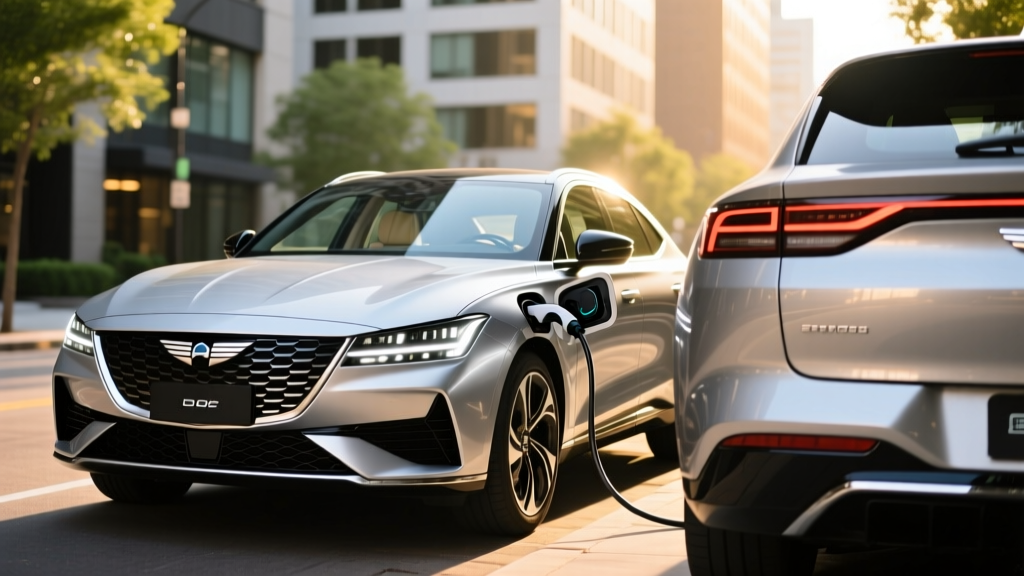
The Genesis GV60 occupies a rare space in the luxury electric SUV segment: it shares its E-GMP platform and powertrain DNA with the Hyundai Ioniq 5 and Kia EV6, yet wraps that proven hardware in a cabin and ownership experience that punches well above its price point. For 2026, the GV60 continues to offer three trims — Standard Range, Advanced AWD, and Performance — with a revised starting price of $53,350 and the same 77.4 kWh NMC battery pack that has defined the model since launch. This review breaks down the exact numbers that matter for buyers: real-world range, charging behavior at DC fast chargers, the federal tax credit picture under current IRS §30D rules, and whether the GV60's premium positioning justifies its cost against its platform siblings.
Spec Snapshot: 2026 Genesis GV60 at a Glance
| Spec | Standard Range RWD | Advanced AWD | Performance AWD |
|---|---|---|---|
| EPA Range | 294 mi | 248 mi | 235 mi |
| Battery (usable) | 77.4 kWh, NMC lithium-ion | ||
| Horsepower | 225 hp | 314 hp | 429 hp (490 hp Boost) |
| Torque | 258 lb-ft | 446 lb-ft | 446 lb-ft (516 lb-ft Boost) |
| 0-60 mph | 7.3 sec | 5.3 sec | 3.8 sec (Boost mode) |
| Drivetrain | RWD | Dual-motor AWD | Dual-motor AWD |
| Max DC Fast Charge | 233 kW (peak) | ||
| 10-80% DCFC Time | ~18 minutes (optimal conditions) | ||
| Level 2 Charge Rate | 10.9 kW (48A) | ||
| MPGe (combined) | 125 MPGe | 98 MPGe | 92 MPGe |
| kWh/100 mi | 27 | 34 | 36 |
| Base MSRP | $53,350 | $61,800 | $68,300 |
Sources: EPA fueleconomy.gov, Genesis USA specifications.
Range and Efficiency: EPA Numbers vs. Reality
- Standard Range RWD (EPA 294 mi): Expect ~240–260 mi on sustained highway driving at 70–75 mph. In cold weather (below 32°F), plan for 195–220 mi.
- Advanced AWD (EPA 248 mi): Highway real-world: ~200–220 mi. Cold weather: ~165–185 mi.
- Performance AWD (EPA 235 mi): Highway real-world: ~190–210 mi. Cold weather: ~155–175 mi.
The GV60's heat pump (standard on all trims) mitigates some cold-weather loss compared to EVs without active thermal management, but AWD Performance models with 21-inch wheels and stickier tires sacrifice meaningful efficiency.
The 77.4 kWh NMC (nickel-manganese-cobalt) battery pack is shared across all trims. NMC chemistry offers higher energy density than LFP alternatives — which is why Genesis can package this much capacity in a compact crossover footprint — but it comes with a slightly more conservative recommended charging routine. Genesis suggests daily charging to 80% for NMC longevity, reserving 100% fills for road-trip days. The battery management system maintains a top and bottom buffer (roughly 3–4 kWh combined), so the usable 77.4 kWh figure already accounts for this protection.
Efficiency drops predictably with the dual-motor AWD configurations. The Standard Range RWD model at 27 kWh/100 mi is competitive with luxury rivals like the BMW iX xDrive50 (roughly 31 kWh/100 mi) and significantly better than the Audi Q8 e-tron (38–40 kWh/100 mi). However, the Performance trim's 36 kWh/100 mi puts it closer to sport-oriented competitors and means you'll feel the range hit on longer trips.
Charging Speed: DC Fast Charging and Home Setup
The GV60 uses the E-GMP platform's 800-volt electrical architecture, which is the key enabler of its impressive peak charge rate. Here's what that translates to at the plug:
| Charging Method | Max Power (kW) | Charging Speed | Notes |
|---|---|---|---|
| DC Fast Charge (350 kW station) | 233 kW (peak) | 10–80% in ~18 min | Requires CCS connector or NACS adapter; station must deliver ≥150 kW for best results |
| DC Fast Charge (150 kW station) | ~130 kW (sustained) | 10–80% in ~28 min | Common at Electrify America, EVgo 150 kW stalls |
| Level 2 Home (240V, 48A) | 10.9 kW | ~33 mi/hr, 0–100% in ~7.5 hr | Requires NEMA 14-50 or hardwired; 60A circuit recommended |
| Level 2 Home (240V, 32A) | 7.7 kW | ~23 mi/hr, 0–100% in ~10.5 hr | Typical portable cord-set or lower-amp wallbox |
| Level 1 (120V, 12A) | 1.4 kW | ~4 mi/hr | Emergency/trickle only; full charge takes 55+ hours |
Charging curve reality check: The 233 kW peak is achieved between roughly 10–35% state of charge on a 350 kW-capable charger with battery preconditioning active. The curve tapers progressively — by 60% SoC you're likely seeing 120–140 kW, and above 80% it drops below 50 kW. This is normal NMC behavior and why the 10–80% metric is the most useful planning number. If you arrive at a DC fast charger at 5% SoC with preconditioning enabled (the car warms the battery when a charging station is set as your navigation destination), you'll see the fastest times. Skip preconditioning and your peak rate may be capped around 150–170 kW even at a 350 kW station, adding 4–6 minutes to the session.
Connector note: The 2026 GV60 ships with a CCS1 charge port in the US market. Genesis provides a NACS adapter for access to Tesla Supercharger stations equipped with the Magic Dock or through the adapter. Verify adapter compatibility with your model year at purchase, as the industry-wide transition to NACS is ongoing and adapter availability can vary.
Performance and Drivetrain Dynamics
The Performance trim's 3.8-second 0–60 mph time (with Boost mode engaged via the steering wheel button) places the GV60 in genuine sports-sedan territory — comparable to a BMW M340i xDrive and quicker than the Audi Q8 e-tron S. The dual-motor AWD system provides torque vectoring via brake-based intervention rather than a mechanical limited-slip, which works effectively in dry and wet conditions. The Standard Range RWD model at 7.3 seconds is leisurely by EV standards but adequate for highway merging and daily commuting.
Ride quality is where the GV60 differentiates from its Hyundai/Kia platform-mates. Genesis tunes the suspension with a clear comfort bias — the Advanced and Performance trims get adaptive dampers that absorb sharp impacts better than the Ioniq 5's firmer setup. Road noise insulation is also noticeably improved, with acoustic laminated glass on the front windows. However, the GV60 is not a corner-carver: body roll is present when pushed, and the steering lacks the communicative feel of a Porsche Macan Electric or BMW iX.
Pricing, Trims, and Federal Tax Credit Eligibility
| Trim | Base MSRP | Typical As-Tested | Federal §30D Credit Eligibility |
|---|---|---|---|
| Standard Range RWD | $53,350 | $54,500–$56,000 | Subject to battery-sourcing and critical-mineral requirements; verify on IRS eligible vehicle list |
| Advanced AWD | $61,800 | $63,500–$66,000 | Same sourcing rules apply; MSRP under $80,000 SUV cap |
| Performance AWD | $68,300 | $70,000–$73,500 | Under $80,000 SUV cap; sourcing rules apply |
- MSRP cap: Vehicle must have MSRP ≤ $80,000 for SUVs (all GV60 trims qualify on MSRP).
- Buyer income cap: Modified AGI must not exceed $150,000 (single), $225,000 (head of household), or $300,000 (joint filers).
- Battery sourcing: Increasingly strict critical-mineral and battery-component requirements must be met for the full $7,500 — partial credit ($3,750) may apply if only one threshold is met.
- Point-of-sale transfer: Eligible buyers can transfer the credit to the dealer at purchase for an immediate price reduction rather than waiting to claim it on their tax return.
- Assembly: Vehicle must undergo final assembly in North America (GV60 is assembled in South Korea — this may disqualify it from §30D; confirm current status with your dealer and the IRS qualified vehicle list).
Important: The GV60 is manufactured in Ulsan, South Korea. Under §30D's North American final-assembly requirement, it may not qualify for the new-vehicle federal tax credit. However, a leased GV60 may qualify for the commercial clean vehicle credit (§45W), which dealers can pass through as a lease discount — typically $7,500. Consult a tax professional and verify with Genesis at time of purchase.
Interior, Technology, and Cargo
The GV60's cabin is where the Genesis premium over its platform siblings becomes obvious. Standard features include a dual 12.3-inch curved display cluster, genuine aluminum trim, quilted Nappa leather on upper trims, and the distinctive crystal shifter sphere that rotates when the vehicle is powered on — a piece of theater that still impresses passengers.
Cargo and passenger dimensions:
- Rear cargo volume (behind second row): 24.0 cu ft
- Cargo volume (rear seats folded): 54.7 cu ft
- Front trunk (frunk): 0.7 cu ft (small — fits a charging cable bag, not a suitcase)
- Rear legroom: 37.6 inches
- Front headroom: 40.0 inches
The cargo area is competitive with the Audi Q8 e-tron (27.4 cu ft) but trails the larger BMW iX (35.5 cu ft). For a compact luxury crossover, 24.0 cu ft handles weekly groceries and a couple of carry-on bags comfortably; road trips for a family of four will require strategic packing or a roof box.
Driver assistance (SAE Level 2): The GV60 comes with Genesis Active Safety Control, which includes adaptive cruise control with stop-and-go, lane-centering assist, highway driving assist, blind-spot monitoring, and rear cross-traffic avoidance. This is a Level 2 system — the driver must keep hands on the wheel and remain fully engaged. It is not self-driving. The system is competent for highway cruising but less confident on unmarked roads and construction zones compared to GM's Super Cruise or Ford's BlueCruise on mapped highways.
Warranty and Long-Term Ownership
Genesis backs the GV60 with one of the strongest warranty packages in the luxury EV space:
- Battery warranty: 10 years / 100,000 miles (capacity retention guaranteed above 70% of original)
- Powertrain warranty: 10 years / 100,000 miles
- New vehicle limited warranty: 5 years / 60,000 miles
- Complimentary maintenance: 3 years / 36,000 miles (includes scheduled service, tire rotation, fluid top-offs)
- Roadside assistance: 5 years / unlimited miles
The 10-year battery warranty exceeds the industry standard (most competitors offer 8 years/100,000 miles) and provides meaningful peace of mind. Genesis's 70% capacity retention threshold is in line with industry norms — if your battery drops below 70% of its original 77.4 kWh capacity within the warranty period, Genesis will repair or replace it. Real-world NMC degradation data from E-GMP platform vehicles (Ioniq 5, EV6) suggests typical loss of 5–8% over the first 60,000 miles under normal use, well within the warranty buffer.
GV60 vs. Key Competitors: Is It Worth It?
- You want luxury-cabin materials and a quiet ride without paying BMW iX or Porsche Macan Electric prices ($70K–$90K+).
- You value the 10-year powertrain/battery warranty and 3-year complimentary maintenance.
- Your daily driving is under 200 miles and you have reliable home Level 2 charging.
- You prefer a distinctive, non-ubiquitous design over the Tesla or Hyundai mainstream look.
- Maximum range is your top priority — the Ioniq 5 (303 mi EPA, Long Range RWD) or Tesla Model Y (320 mi) offer more.
- You need a third row or over 30 cu ft of cargo behind the rear seats.
- You want access to hands-free driving on mapped highways — GM Super Cruise (Cadillac Lyriq) or Ford BlueCruise (Mustang Mach-E) lead here.
- Federal tax credit eligibility for a purchase (not lease) is essential to your budget — the Korean assembly may disqualify the GV60 from §30D.
- 800V architecture enables 233 kW peak DC fast charging — among the fastest in the segment
- Premium cabin materials, quiet ride, and distinctive design at a competitive price
- 10-year/100,000-mile battery and powertrain warranty
- Performance trim's 3.8-second 0–60 mph with Boost mode
- Standard heat pump for improved cold-weather efficiency
- EPA range peaks at 294 mi (RWD); AWD trims drop to 235–248 mi
- Cargo area (24.0 cu ft) trails key competitors; frunk is nearly negligible
- South Korean assembly may disqualify from §30D purchase credit (lease workaround available)
- CCS port requires adapter for Tesla Supercharger access
- Driver-assist system is competent but not class-leading on unmapped roads
Frequently Asked Questions
What is the real-world range of the 2026 Genesis GV60?
The EPA rates the Standard Range RWD at 294 miles, but sustained highway driving at 70+ mph typically yields 240–260 miles. The AWD Performance trim is rated at 235 miles EPA and delivers roughly 190–210 miles in real-world highway use. In freezing temperatures, expect 20–30% range reduction across all trims despite the standard heat pump.
How fast does the GV60 charge at home and on the road?
At a 350 kW DC fast charger with battery preconditioning, the GV60 peaks at 233 kW and charges from 10–80% in approximately 18 minutes. On a typical 150 kW public charger, plan for 25–30 minutes. At home on a 48-amp Level 2 wallbox (10.9 kW), a full charge takes about 7.5 hours — easily completed overnight.
Does the 2026 GV60 qualify for the $7,500 federal EV tax credit?
It depends. The GV60 is assembled in South Korea, which likely disqualifies it from the §30D new-vehicle credit for purchases due to the North American final-assembly requirement. However, leasing a GV60 may make it eligible for the §45W commercial clean vehicle credit, which Genesis and its dealers typically pass through as a $7,500 lease reduction. Always verify current eligibility on the IRS qualified vehicle list and consult a tax professional before committing.
Is the Genesis GV60 better than the Hyundai Ioniq 5 or Kia EV6?
They share the same E-GMP platform and battery, so range and charging speed are nearly identical. The GV60 wins on cabin materials, noise isolation, and warranty length (10 years vs. Hyundai/Kia's 10-year/100,000-mile powertrain but 8-year/100,000-mile battery in some configurations). The Ioniq 5 and EV6 offer slightly more cargo space, a longer-range RWD option (303–310 mi), and generally lower starting prices. If luxury ambiance matters, the GV60 justifies its premium; if value and maximum range are priorities, the Ioniq 5 is the stronger pick.
What is the biggest drawback of owning the GV60?
Range and cargo are the primary compromises. The AWD trims — which most buyers choose for all-weather capability — top out at 248 miles EPA, and real-world highway range is closer to 200–220 miles. Combined with a 24.0 cu ft cargo area and a near-useless frunk, the GV60 works best as a daily commuter and weekend cruiser for couples or small families, not as a primary road-trip hauler for four.