The Genesis GV60 occupies a rare space in the electric SUV market: it's a luxury EV that doesn't ask you to sacrifice build quality for efficiency, or efficiency for style. Built on Hyundai Motor Group's E-GMP platform—the same architecture underpinning the Hyundai Ioniq 5 and Kia EV6—the GV60 wraps cutting-edge 800-volt charging hardware in a cabin that rivals European competitors costing $20,000 more. For 2026, the GV60 continues with its dual-motor AWD lineup, adding refinements to its already impressive technology suite.
This review covers every number that matters to a prospective buyer: real-world range expectations, charging speeds across all levels, interior dimensions, and the often-confusing federal tax credit picture. If you've been searching for GV60 interior details alongside hard ownership data, this is your comprehensive resource.
Genesis GV60 Quick Specs at a Glance
| Specification | 2026 Genesis GV60 Advanced | 2026 Genesis GV60 Performance |
|---|---|---|
| EPA Range | 248 miles | 235 miles |
| Battery (usable) | 77.4 kWh, NMC lithium-ion | 77.4 kWh, NMC lithium-ion |
| Drivetrain | Dual-motor AWD | Dual-motor AWD |
| Horsepower | 314 hp | 429 hp (Boost mode) |
| 0–60 mph | 5.3 seconds | 3.9 seconds |
| Max DC Fast Charge | 233 kW (peak) | 233 kW (peak) |
| 10–80% DC Charge Time | ~18 minutes | ~18 minutes |
| Level 2 Charge Rate | 10.9 kW (~37 mi/hr) | 10.9 kW (~37 mi/hr) |
| MPGe (combined) | 95 MPGe | 85 MPGe |
| Efficiency | 35 kWh/100 mi | 39 kWh/100 mi |
| Base MSRP | $53,350 | $62,350 |
| Battery Warranty | 10 yr / 100,000 mi | 10 yr / 100,000 mi |
Real-World Range: What to Expect Beyond the EPA Sticker
The GV60's 77.4 kWh usable battery pack uses NMC (nickel-manganese-cobalt) chemistry, which delivers higher energy density than LFP alternatives but is more sensitive to sustained 100% state-of-charge storage. For daily driving, setting the charge limit to 80% preserves long-term battery health and still yields roughly 190–200 real-world miles—enough for most commutes with margin to spare.
According to fueleconomy.gov, the Advanced trim achieves 95 MPGe combined, translating to 35 kWh per 100 miles. That efficiency figure places the GV60 mid-pack among luxury electric crossovers—less efficient than a Tesla Model Y but competitive with the BMW iX and Audi Q4 e-tron.
Charging Speeds: 800-Volt Architecture Pays Off
The GV60's E-GMP platform supports 800-volt DC fast charging, enabling peak rates up to 233 kW at compatible stations. Here's what that means in practice across charging levels:
| Charging Level | Power | Speed (miles of range per hour) | Typical Use Case |
|---|---|---|---|
| Level 1 (120V household) | ~1.4 kW | ~4–5 mi/hr | Emergency top-up, overnight trickle |
| Level 2 (240V home) | 10.9 kW | ~37 mi/hr | Daily home charging, full charge in ~7.5 hours |
| DC Fast Charge (peak) | 233 kW | ~650+ mi/hr (at peak) | Road trips, 10–80% in ~18 minutes |
Charging curve reality: The 233 kW figure is a peak, not a sustained rate. The GV60 hits maximum charge speed between roughly 10–35% state of charge, then gradually tapers. From 10–80%, expect approximately 18 minutes at a 350 kW-capable station. Above 80%, charging slows significantly to protect the battery—plan to unplug at 80% on road trips rather than waiting for a full charge.
For home Level 2 charging, you'll need a 48-amp circuit (60-amp breaker) to achieve the full 10.9 kW rate. Most overnight sessions (8–10 hours) will replenish the entire battery from near-empty. Home charger installation typically costs $500–$2,000 depending on panel proximity and local permitting, according to industry estimates.
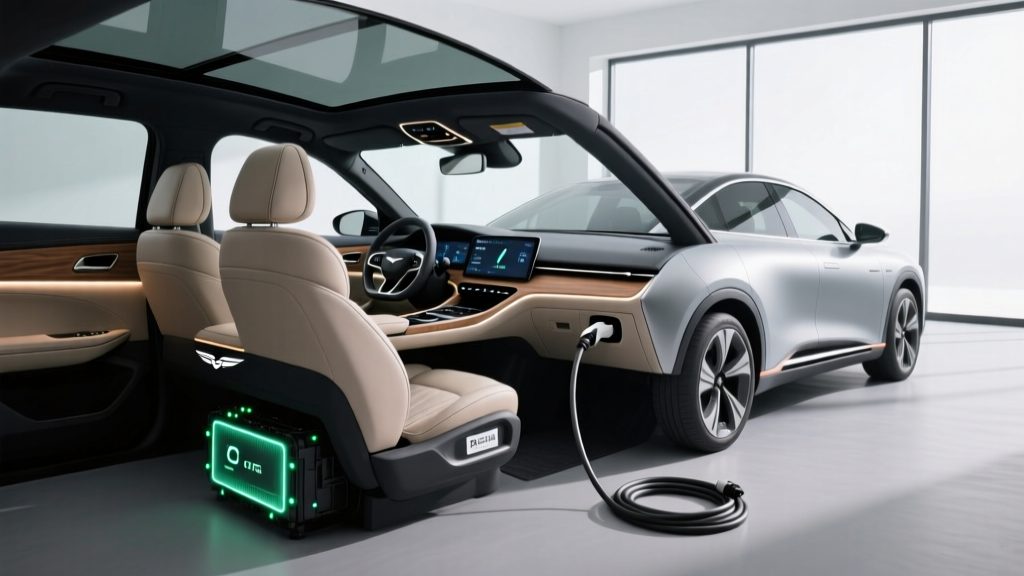
The GV60 Interior: Luxury Meets Function
This is where the Genesis GV60 differentiates itself from its Hyundai and Kia platform-mates. The cabin materials, fit-and-finish, and design language target buyers cross-shopping the Audi Q4 e-tron, BMW iX, and Volvo XC40 Recharge.
Interior Dimensions and Space
| Measurement | Genesis GV60 |
|---|---|
| Front Headroom | 39.6 inches |
| Front Legroom | 41.5 inches |
| Rear Headroom | 37.8 inches |
| Rear Legroom | 37.2 inches |
| Cargo Volume (behind rear seats) | 24.0 cu ft |
| Cargo Volume (rear seats folded) | 54.7 cu ft |
| Front Trunk (frunk) | 0.7 cu ft (cable storage only) |
The GV60's 24 cubic feet of rear cargo space trails the Hyundai Ioniq 5 (27.2 cu ft) and Tesla Model Y (30.2 cu ft), a trade-off for the sloping roofline and luxury insulation. Rear legroom at 37.2 inches is generous for the segment, comfortably fitting two adults on longer trips.
Standout Interior Features
- Crystal Sphere shifter: A decorative orb on the center console rotates to reveal a rotary gear selector when the vehicle starts—a signature Genesis design element.
- Dual 12.3-inch displays: A curved panoramic screen houses both the digital instrument cluster and infotainment system with wireless Apple CarPlay and Android Auto.
- Facial recognition (Face Connect): A camera on the B-pillar recognizes driver profiles and adjusts seat, mirror, and climate presets automatically.
- Fingerprint authentication: Stored on the center console, enabling personalized settings and digital key functions.
- Heat pump (standard): Improves cold-weather efficiency by scavenging waste heat from the drivetrain, reducing range loss in winter conditions.
- Vehicle-to-Load (V2L): An interior 120V outlet and exterior adapter allow the GV60 to power devices up to 3.6 kW—useful for camping or emergency backup.
Notable Interior Drawbacks
- Capacitive touch controls for climate and media lack tactile feedback, requiring eyes-off-road glances.
- The frunk is essentially a shallow cable-storage compartment—not a usable cargo area.
- Rear visibility is compromised by the thick C-pillars and small rear window; the digital rearview mirror (available on Performance trim) helps mitigate this.
Performance and Driving Dynamics
Both GV60 trims use dual electric motors providing standard all-wheel drive. The Advanced model delivers 314 horsepower and a 5.3-second 0–60 mph time—quick enough for confident highway merging without being ostentatious.
The Performance trim adds a Boost mode that temporarily elevates output to 429 horsepower, dropping the 0–60 time to 3.9 seconds. This mode also activates a simulated e-shift function that mimics gear changes for drivers who miss the engagement of a traditional transmission—an optional feature that can be toggled off for seamless EV acceleration.
Ride quality benefits from Genesis's adaptive suspension tuning (standard on Performance, available on Advanced). The GV60 isolates occupants from road imperfections effectively, though the 4,600+ lb curb weight is noticeable during aggressive cornering. This is a grand-touring electric SUV, not a sports car.
Pricing, Trims, and Federal Tax Credit Eligibility
The 2026 Genesis GV60 is offered in two primary trims:
| Trim | Base MSRP | As-Tested (with options) | §30D Federal Credit Eligibility |
|---|---|---|---|
| Advanced | $53,350 | $55,000–$58,000 | Eligible up to $7,500 (see caveats below) |
| Performance | $62,350 | $65,000–$69,000 | Eligible up to $7,500 (see caveats below) |
Federal Tax Credit Rules (§30D) — What You Must Know
The GV60 can qualify for the full $7,500 federal EV tax credit, but eligibility depends on multiple factors per current IRS guidelines:
- MSRP cap: SUVs must have a base MSRP at or below $80,000. Both GV60 trims clear this threshold.
- Buyer income limits: Modified adjusted gross income (MAGI) must not exceed $300,000 (joint filers), $225,000 (head of household), or $150,000 (single filers).
- Battery sourcing requirements: The credit splits into two halves—$3,750 for critical minerals and $3,750 for battery component manufacturing. Sourcing rules tighten annually; verify current-year compliance on the IRS website or with your tax professional before purchase.
- Point-of-sale transfer: As of 2024, eligible buyers can transfer the credit to the dealer at purchase, reducing the out-of-pocket price immediately rather than waiting for a tax refund.
Effective price after credit (Advanced trim): $53,350 – $7,500 = $45,850 (before state incentives, destination charges, or dealer fees). Always confirm eligibility with a tax professional, as rules can shift with legislation.
Warranty and Ownership Costs
Genesis backs the GV60 with one of the strongest warranty packages in the luxury segment:
- Battery/Powertrain: 10 years / 100,000 miles (whichever comes first), covering capacity loss below 70% of original.
- New Vehicle Limited: 5 years / 60,000 miles bumper-to-bumper.
- Complimentary Maintenance: 3 years / 36,000 miles of scheduled service (brake fluid, cabin filter, tire rotation).
- Roadside Assistance: 5 years, unlimited miles.
The 10-year battery warranty provides meaningful long-term peace of mind. NMC chemistry in the E-GMP platform has shown modest degradation in early Ioniq 5/EV6 data—typically 5–8% capacity loss over the first 100,000 miles when owners avoid frequent 100% charges and DC fast-charging abuse.
Pros, Cons, and the Verdict
- Premium interior materials rivaling Audi and BMW at a lower price point
- 800V architecture enables 10–80% DC charging in ~18 minutes
- Standard dual-motor AWD across all trims
- Generous 10-year/100,000-mile battery warranty
- V2L capability for off-grid power needs
- Unique design features (Crystal Sphere, facial recognition)
- Cargo space (24 cu ft) trails key competitors like the Ioniq 5 and Model Y
- No single-motor RWD option for maximum range seekers
- Frunk is nearly useless for cargo
- Capacitive touch controls can be distracting while driving
- Real-world highway and cold-weather range drops significantly below EPA estimates
- Public charging reliability varies by network (Electrify America, EVgo)
Who Should Buy the Genesis GV60?
The GV60 is ideal for luxury-oriented buyers who prioritize interior refinement and charging speed over maximum cargo capacity or class-leading range. It suits:
- Daily commuters with home Level 2 charging who value a quiet, well-appointed cabin.
- Couples and small families who don't need third-row seating or massive cargo volume.
- Road trippers willing to plan 18-minute DC fast-charge stops every 2–2.5 hours.
It's less suited for buyers who need 300+ miles of range, maximum cargo flexibility, or a single-motor efficiency play. Those shoppers should consider the Hyundai Ioniq 5 (Long Range RWD), Tesla Model Y, or Rivian R1S (three-row option).
Frequently Asked Questions
What is the real-world range of the Genesis GV60?
The EPA rates the GV60 Advanced at 248 miles and the Performance at 235 miles. In mixed real-world driving, expect 220–240 miles (Advanced) and 210–225 miles (Performance). Highway driving at 75+ mph and cold weather below 30°F will reduce range by 15–30% depending on conditions.
How fast does the GV60 charge at home and on the road?
At a DC fast charger capable of 350 kW, the GV60 peaks at 233 kW and charges from 10–80% in approximately 18 minutes. On a home Level 2 charger (240V, 48A), it charges at 10.9 kW, adding roughly 37 miles of range per hour—a full charge takes about 7.5 hours from empty.
How much does the GV60 cost after the federal tax credit?
The Advanced trim starts at $53,350. If you qualify for the full $7,500 §30D federal credit (income and battery sourcing rules apply), the effective price drops to approximately $45,850 before state incentives, destination fees, or dealer add-ons. Always verify eligibility with a tax professional.
Is the GV60 worth buying versus competitors like the Ioniq 5 or BMW iX?
Compared to the Hyundai Ioniq 5, the GV60 offers a more luxurious interior and longer warranty but less cargo space and no RWD option. Against the BMW iX, the GV60 is significantly less expensive but offers slightly less range and a smaller footprint. If cabin luxury and value are your priorities, the GV60 punches above its price class. If maximum range or cargo volume matters more, consider alternatives.
Does the Genesis GV60 qualify for the federal EV tax credit?
Yes, both trims fall under the $80,000 SUV MSRP cap. However, buyer income limits ($150K single / $300K joint), battery critical-mineral sourcing rules, and annual rule changes affect eligibility. The credit can be transferred at point-of-sale to reduce your purchase price directly. Check current IRS §30D rules before committing.
What's the battery warranty and expected longevity?
Genesis provides a 10-year/100,000-mile battery warranty covering capacity loss below 70%. Based on E-GMP platform data from sibling vehicles, expect 5–8% degradation over the first 100,000 miles with reasonable charging habits (avoiding frequent 100% charges and excessive DC fast charging).