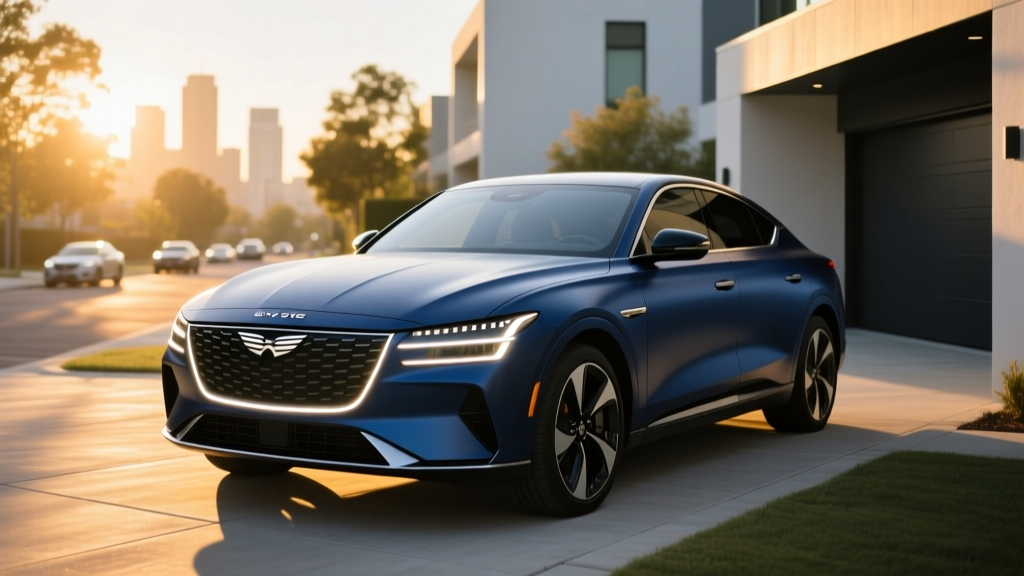
The 2025 Genesis GV60 occupies a rare space in the luxury electric crossover segment: it pairs genuine 800-volt fast-charging architecture with an interior that punches above its price class. Built on Hyundai Motor Group's Electric-Global Modular Platform (E-GMP) — the same underpinnings as the Ioniq 5 and Kia EV6 — the GV60 trades some of that platform's maximum range potential for a more refined, materials-forward cabin and Genesis-specific tuning. But luxury comes with trade-offs in efficiency and federal incentive eligibility. Here's the full data-driven breakdown.
Spec Snapshot: 2025 Genesis GV60 at a Glance
| Attribute | Standard Range AWD | Advanced AWD | Performance |
|---|---|---|---|
| EPA Range | 248 mi | 294 mi | 248 mi |
| Battery (usable) | 77.4 kWh (NMC) | 77.4 kWh (NMC) | 77.4 kWh (NMC) |
| Horsepower | 314 hp | 314 hp | 429 hp (483 boost) |
| 0–60 mph | 5.3 sec | 5.3 sec | 3.8 sec (Boost) |
| Drivetrain | Dual-motor AWD | Dual-motor AWD | Dual-motor AWD |
| Max DC Charge Rate | ~240 kW (peak) | ~240 kW (peak) | ~240 kW (peak) |
| 10–80% DCFC Time | ~18 min (ideal) | ~18 min (ideal) | ~18 min (ideal) |
| Level 2 Rate | 10.9 kW | 10.9 kW | 10.9 kW |
| MPGe (combined) | 90 MPGe | 95 MPGe | 85 MPGe |
| Base MSRP | $53,350 | $61,800 | $69,800 |
Note: The Standard Range trim was discontinued for 2025 in some configurations. Verify current availability with your dealer. Pricing excludes destination.
Range and Efficiency: EPA Sticker vs. Reality
EPA Range: 248 mi (Standard Range / Performance) | 294 mi (Advanced AWD)
Real-World Expectation: Plan for approximately 210–230 highway miles in the 248-mi trims and 250–270 miles in the Advanced AWD under mixed driving. In cold weather (below 32°F), expect a 15–25% reduction — bringing the Advanced trim down to roughly 220–230 miles and the Performance trim to 190–210 miles without preconditioning.
The GV60 Advanced's 294-mile EPA rating is respectable, but it trails the mechanically similar Hyundai Ioniq 5 Long Range AWD (307 mi EPA) due to the GV60's heavier curb weight (~4,800 lbs), more sound insulation, and slightly less aerodynamic profile. Efficiency sits at roughly 35–37 kWh/100 mi in mixed driving — adequate for a luxury crossover, but not class-leading.
For daily commuting under 60 miles round-trip, any GV60 trim handles a full work week on a single charge. For road trips, the 248-mile trims require charging stops every 2.5–3 hours at highway speeds; the Advanced trim stretches that to roughly 3.5 hours.
Charging: 800V Architecture Done Right
The GV60's 800-volt electrical architecture is its strongest technical asset. On a 350 kW DC fast charger (such as Electrify America's latest stations), the GV60 can accept a peak of approximately 240 kW, enabling a 10–80% charge in roughly 18 minutes under ideal battery temperature conditions.
| Charging Level | Power | Speed (Approx.) | Typical Use Case |
|---|---|---|---|
| Level 1 (120V) | ~1.4 kW | ~4 mi/hr | Emergency / overnight trickle |
| Level 2 (240V, 48A) | 10.9 kW | ~32 mi/hr | Home / workplace daily |
| DC Fast (350 kW station) | Peak ~240 kW | 10–80% in ~18 min | Road trips |
| DC Fast (150 kW station) | ~120–130 kW sustained | 10–80% in ~30 min | Common public chargers |
Charging curve reality check: Peak 240 kW is only sustained briefly between roughly 10–40% State of Charge. Above 60%, the curve tapers significantly, and above 80% it drops to under 50 kW. This is normal for NMC chemistry, but it means that charging from 80–100% on a road trip is painfully slow — plan your stops to stay in the 10–80% sweet spot.
For home Level 2 charging, the GV60's 10.9 kW onboard charger replenishes the 77.4 kWh battery from empty in roughly 7.5 hours. A full overnight charge is easily achievable on a properly installed 48-amp Level 2 home station. Expect home installation costs of $800–$2,000 for the charger and electrical work (assuming your panel has capacity — a 200-amp service panel is typically required).
The GV60 uses a CCS1 connector for DC fast charging. It does not natively support Tesla's NACS plug, though adapters are becoming available through Hyundai Motor Group's partnership with Tesla Supercharger access.
Performance and Driving Dynamics
The dual-motor AWD powertrain delivers confident acceleration across all trims. The standard 314-hp output produces a 5.3-second 0–60 mph time — quick enough for any merging situation. The Performance trim's 429 hp (483 hp in 20-second Boost mode, activated via a button on the steering wheel) drops that to 3.8 seconds, which is genuine sports-sedan territory in a 4,800-pound crossover.
Ride quality is where the GV60 distinguishes itself from its E-GMP siblings. The Advanced and Performance trims feature Genesis-tuned adaptive dampers that filter road imperfections noticeably better than the Ioniq 5's setup. Steering is precise but light — this is a grand tourer, not a track car. The Performance trim's electronic limited-slip differential and sport-tuned suspension add composure in spirited cornering, though the vehicle's weight is always apparent.
Regenerative braking offers four levels (0–3) adjustable via steering wheel paddles, with Level 3 approaching one-pedal driving in city traffic. The i-Pedal mode (full one-pedal) is available but requires a separate activation.
Interior, Cargo, and Technology
The GV60's cabin is its primary selling point over the Ioniq 5 and EV6. Quilted Nappa leather, open-pore wood trim, and a crystal shifter that rotates into position on startup create a genuine luxury atmosphere. The 12.3-inch dual curved displays run Genesis's latest infotainment software with native navigation, Apple CarPlay, and Android Auto (wired for CarPlay on 2025 models).
Cargo space: 24.0 cubic feet behind the rear seats, expanding to approximately 54.7 cu ft with the 60/40 rear seats folded. The front trunk (frunk) adds a modest 0.7 cu ft — enough for charging cables but little else. This is a notable shortfall versus the Ioniq 5 (27.2 cu ft rear) and rivals like the BMW iX (35.5 cu ft).
Passenger space: Front legroom is generous at 41.9 inches; rear legroom measures 37.8 inches — adequate for adults but tighter than the Ioniq 5's flat-floor advantage. The GV60's transmission tunnel intrusion (minimal but present) slightly compromises the middle rear seat.
Standout technology includes:
- Face Connect: Facial recognition camera on the B-pillar for keyless entry and driver-profile loading
- Digital Key 2: Uses your smartphone via UWB for lock/unlock/start
- Highway Driving Assist 2 (HDA2): SAE Level 2 driver assistance with lane-centering and adaptive cruise, including lane-change assist
- Remote Smart Parking Assist: Moves the vehicle in/out of tight spaces via key fob
- Boost Mode: 20-second maximum power burst (Performance trim)
Notable drawback: The GV60 lacks a rear wiper, which is a genuine annoyance in rain and snow for a vehicle with a steep rear hatch angle.
Pricing, Trims, and Federal Tax Credit Eligibility
The 2025 GV60 is offered in three configurations:
- Standard Range AWD: ~$53,350 MSRP (limited availability)
- Advanced AWD: ~$61,800 MSRP — the volume trim and best value
- Performance AWD: ~$69,800 MSRP
Destination charges add approximately $1,300. The Advanced trim with Prestige package (ventilated rear seats, head-up display, surround-view monitor) pushes the as-tested price to roughly $66,000–$68,000.
Does the 2025 GV60 Qualify for the Federal EV Tax Credit?
Likely answer: No — for most buyers. Under current IRS §30D rules, the GV60 faces two significant hurdles:
- MSRP cap: SUVs/crossovers must have an MSRP at or below $80,000 to qualify. The Performance trim at $69,800 clears this, but options can push it close.
- Battery sourcing requirements: The GV60's NMC battery cells are manufactured by SK Innovation, and critical-mineral and battery-component sourcing requirements under §30D have tightened significantly for 2025. As of early 2025, the GV60 does not appear on the IRS's qualifying vehicle list for the full $7,500 credit.
- Buyer income caps: AGI must not exceed $150,000 (single) / $300,000 (joint) to claim any credit.
Always verify current eligibility at fueleconomy.gov and consult a tax professional. State and local incentives may still apply — check your state's energy office for details.
The absence of the federal credit is a meaningful $7,500 disadvantage versus qualifying competitors like certain configurations of the Tesla Model Y, Ford Mustang Mach-E, and Chevrolet Equinox EV. Factor this into your total cost of ownership calculations.
Warranty and Ownership Costs
Genesis provides one of the strongest warranty packages in the luxury segment:
- New vehicle limited warranty: 5 years / 60,000 miles
- Powertrain warranty: 10 years / 100,000 miles
- Battery warranty: 10 years / 100,000 miles (retains ≥70% capacity)
- Complimentary maintenance: 3 years / 36,000 miles (oil changes don't apply, but covers cabin air filter, tire rotation, multi-point inspection)
- Complimentary valet service: 3 years — Genesis picks up and returns your vehicle for service
- Roadside assistance: 5 years / unlimited miles
The 10-year/100,000-mile battery warranty with a 70% capacity retention threshold is competitive and provides long-term peace of mind. NMC chemistry in the E-GMP platform has demonstrated approximately 8–12% degradation over 100,000 miles in real-world fleet data from Ioniq 5 and EV6 owners, suggesting the GV60 should comfortably stay within warranty limits.
Insurance costs run 10–20% higher than the Ioniq 5 due to the luxury badge and higher repair costs. Expect annual premiums of $2,200–$3,000 depending on your profile and state.
Pros, Cons, and the Verdict
Pros
- 800V architecture enables best-in-class 18-min 10–80% DC fast charging
- Interior materials and build quality exceed the price class
- Comprehensive 10-year powertrain and battery warranty
- Face Connect and Digital Key are genuinely useful differentiators
- Refined ride quality with adaptive dampers (Advanced/Performance)
- Strong performance (3.8 sec 0–60 in Performance trim)
Cons
- Does not qualify for $7,500 federal tax credit under current §30D rules
- Cargo space (24.0 cu ft) trails key competitors
- Real-world range in cold weather drops significantly below EPA
- No native NACS (Tesla) charging connector — CCS1 only
- Rear wiper absent — poor rear visibility in rain
- Wired-only Apple CarPlay on a 2025 luxury vehicle
Who Should Buy the 2025 Genesis GV60?
Choose the GV60 if:
- You prioritize interior luxury and materials over maximum range or cargo volume
- You have reliable home Level 2 charging and drive under 250 miles per day
- You value the 10-year warranty and Genesis's complimentary valet service
- You want 800V fast-charging speed for occasional road trips
- You don't qualify for or don't need the federal tax credit (e.g., income above caps, or leasing where the lessor captures it)
Look elsewhere if:
- Maximizing federal incentives is critical to your purchase math — consider the Tesla Model Y or Ford Mustang Mach-E
- You need maximum cargo space — the BMW iX or Rivian R1S offer significantly more
- You rely on Tesla Supercharger access without adapters — the GV60 is CCS1-native
- You regularly drive 300+ miles in cold weather between charging stops
How Does the GV60 Compare to Key Competitors?
| Spec | 2025 Genesis GV60 Advanced | 2025 Hyundai Ioniq 5 Limited AWD | 2025 BMW iX xDrive50 | 2025 Tesla Model Y LR AWD |
|---|---|---|---|---|
| EPA Range | 294 mi | 307 mi | 324 mi | 308 mi |
| Battery | 77.4 kWh (NMC) | 77.4 kWh (NMC) | 111.5 kWh (NMC) | ~78 kWh (NMC) |
| DCFC 10–80% | ~18 min | ~18 min | ~34 min | ~25 min |
| 0–60 mph | 5.3 sec | 5.1 sec | 4.4 sec | 4.8 sec |
| Cargo (rear) | 24.0 cu ft | 27.2 cu ft | 35.5 cu ft | 30.2 cu ft |
| Base MSRP | $61,800 | $57,400 | $87,250 | $48,590 |
| Federal Credit | Likely $0 | Up to $7,500 | $0 (over MSRP cap) | Up to $7,500 |
The GV60's closest rival is the Ioniq 5 — they share the E-GMP platform and battery, but the GV60 trades 13 miles of range and 3.2 cu ft of cargo for a meaningfully more premium interior and longer warranty. The BMW iX offers more range and space but costs $25,000+ more. The Tesla Model Y is the value benchmark but cannot match the GV60's cabin quality or charging speed.
Frequently Asked Questions
What is the real-world range of the 2025 Genesis GV60?
Expect 250–270 miles in mixed driving for the Advanced AWD trim (EPA 294 mi) and 210–230 miles for the 248-mi trims. Highway-only driving at 75+ mph reduces range by roughly 10–15%. In cold weather below freezing, subtract another 15–25% unless you precondition the battery while plugged in.
How fast does the GV60 charge at home and on the road?
On a 48-amp Level 2 home charger (10.9 kW), the GV60 adds approximately 32 miles of range per hour, fully charging in about 7.5 hours. On a 350 kW DC fast charger, it peaks at roughly 240 kW and charges from 10–80% in about 18 minutes under ideal conditions. On more common 150 kW public chargers, expect 10–80% in roughly 30 minutes.
Does the 2025 Genesis GV60 qualify for the $7,500 federal EV tax credit?
As of early 2025, the GV60 does not appear to qualify for the full §30D federal tax credit due to battery component and critical-mineral sourcing rules. The MSRP is under the $80,000 SUV cap for most trims, but the battery sourcing requirement is the disqualifying factor. Always verify at fueleconomy.gov and consult a tax professional before purchasing.
Is the GV60 worth buying over the Hyundai Ioniq 5?
If interior quality, ride refinement, and the 10-year warranty matter more to you than 13 extra miles of range, 3 additional cubic feet of cargo space, and $4,000–$7,500 in savings, then yes. The GV60 is the luxury execution of the E-GMP platform. If value and maximum practicality are your priorities, the Ioniq 5 is the more rational choice.
Does the GV60 have a frunk (front trunk)?
Yes, but it's very small — approximately 0.7 cubic feet. It's suitable for storing charging cables and a small emergency kit, but not much more. This is a compromise of the E-GMP platform's HVAC and electronics packaging.
What SAE automation level is the GV60's Highway Driving Assist 2?
HDA2 is an SAE Level 2 driver-assistance system. It provides lane-centering steering and adaptive cruise control simultaneously, but the driver must remain fully engaged, keep hands on or near the wheel, and monitor the road at all times. It is not autonomous or "self-driving."
What is the GV60's towing capacity?
The 2025 GV60 is rated to tow up to 2,000 pounds when properly equipped — enough for a small utility trailer or a pair of jet skis, but not a boat or camper. Towing will reduce range by approximately 30–40%.
Sources: EPA Fuel Economy (fueleconomy.gov), Genesis USA Official Specifications, IRS §30D Clean Vehicle Credit Guidelines.