Is the Genesis G80 EV Worth It in 2026?
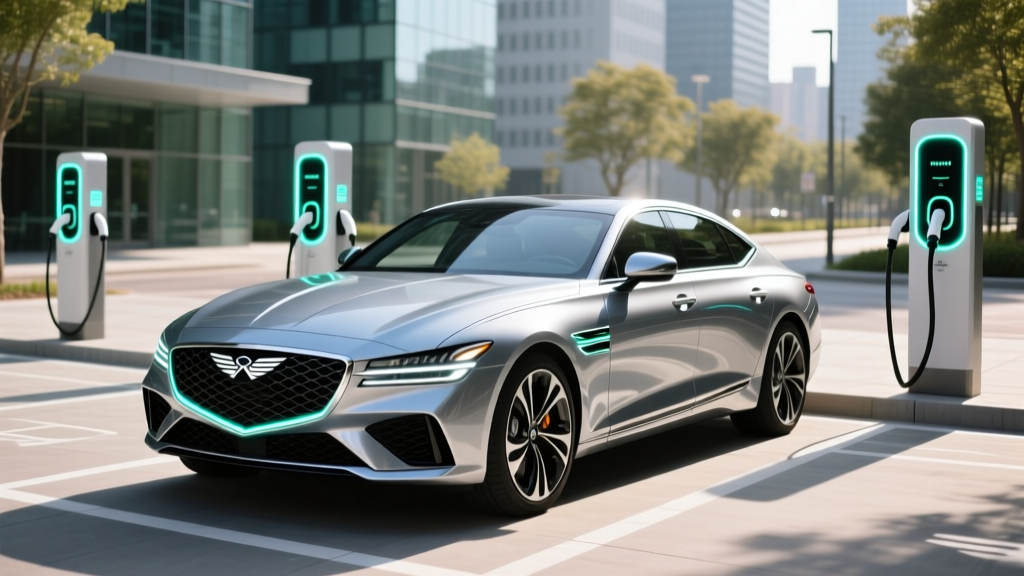
The Genesis G80 Electrified is a luxury midsize sedan that trades outright performance for refinement, delivering an EPA-estimated 282 miles of range from its 87.2 kWh battery, peak DC fast charging at roughly 240 kW (10–80% in ~22 minutes), and a starting MSRP near $79,825. It qualifies for a portion of the federal §30D tax credit depending on battery-sourcing compliance and your income — but it is not a universal $7,500 credit vehicle. Compared to the gas G80 2.5T AWD (~$55,000), the Electrified costs roughly $25,000 more upfront but saves $1,200–$1,800 annually in fuel and maintenance for a typical driver. It's best suited to luxury buyers with reliable Level 2 home charging who prioritize cabin quietness and ride quality over sporty dynamics.
Genesis G80 EV Specs at a Glance
| Spec | 2026 G80 Electrified |
|---|---|
| EPA Range | 282 miles |
| Battery (usable) | 87.2 kWh, NMC lithium-ion |
| Drivetrain | Dual-motor AWD, 365 hp / 516 lb-ft |
| 0–60 mph | 4.9 seconds |
| Peak DC Fast Charge | ~240 kW (E-GMP 800V architecture) |
| 10–80% DC Charge | ~22 minutes (ideal conditions) |
| Level 2 (AC) Charge Rate | 10.9 kW ( onboard charger) |
| Level 2 10–100% Time | ~8.5 hours |
| EPA Efficiency | 98 MPGe combined (29 kWh/100 mi) |
| Connector | CCS1 (NACS adapter available via Genesis) |
| Battery/Powertrain Warranty | 10 yr / 100,000 mi |
| Base MSRP (Advanced trim) | $79,825 (incl. destination) |
| Federal Tax Credit (§30D) | Up to $7,500 — sourcing/income dependent |
Real-World Range Expectations
The 282-mile EPA figure is a combined cycle. In real-world testing, plan for:
- Highway cruising (70–75 mph, mild weather): ~240–255 miles
- City/suburban mixed driving: ~265–280 miles
- Cold weather (below 32°F, cabin heat on): ~200–225 miles (20–28% reduction)
- Towing or heavy cargo: Not rated for towing; heavy loads reduce range ~10%
The G80 Electrified's heat pump (standard) mitigates cold-weather loss compared to resistive-heater EVs, but the sedan's large frontal area and luxury weight (~5,000 lbs) work against highway efficiency. Always precondition the battery via the Genesis Connected Services app before DC fast charging in cold weather — skipping this can push 10–80% times past 35 minutes.
Charging the G80 EV: Home and Public
The G80 Electrified rides on Hyundai Motor Group's E-GMP 800V platform, giving it access to some of the fastest DC charging in the luxury sedan segment. But peak kW is not sustained kW — the charge curve tapers significantly after 80% state of charge (SoC) to protect the NMC battery cells.
| Level | Power | Miles Added/Hour | Use Case |
|---|---|---|---|
| Level 1 (120V outlet) | ~1.4 kW | ~4 mi/hr | Emergency top-off only |
| Level 2 (240V, 48A) | 10.9 kW | ~35 mi/hr | Overnight home charging |
| DC Fast (50 kW) | 50 kW | ~150 mi/hr | Older public stations |
| DC Fast (150 kW) | 150 kW | ~430 mi/hr | Common Electrify America stalls |
| DC Fast (350 kW capable) | ~240 kW peak | ~700 mi/hr (peak) | Ionic Pulse, EA 350 kW stalls |
Home Charging Setup Costs
Most G80 Electrified owners will need a Level 2 home charger to replenish the 87.2 kWh battery overnight. Here's what installation typically costs:
| Component | Cost Range | Notes |
|---|---|---|
| Level 2 charger (hardwired, 48A) | $400–$750 | ChargePoint Home Flex, Wallbox Pulsar Plus, or Genesis-approved unit |
| Electrician labor (240V/60A circuit) | $500–$1,500 | Varies by panel proximity; 50-ft run typical |
| Permit & inspection | $50–$200 | Municipality dependent |
| Electrical panel upgrade (if needed) | $1,500–$3,500 | Required if existing panel is 100A or maxed out |
| Total (no panel upgrade) | $950–$2,450 | Most homes with 200A service |
| Total (with panel upgrade) | $2,450–$5,950 | Older homes with 100A service |
Genesis includes complimentary Electrify America charging for a limited period (typically 3 years with an 800 kWh cap) on new Electrified models — check your specific model-year terms. This offsets public-charging costs during the highest-depreciation ownership years.
G80 EV vs. Gas G80: 5-Year Cost Comparison
The core ownership question is whether the Electrified's premium pays for itself. Here's a 5-year / 75,000-mile comparison against the gas G80 2.5T AWD, assuming $3.50/gal regular and $0.14/kWh home electricity (national averages):
| Cost Category | G80 Electrified | G80 2.5T AWD (Gas) |
|---|---|---|
| Base MSRP | $79,825 | $55,175 |
| Est. Federal Tax Credit (§30D) | $3,750–$7,500* | $0 |
| Effective Purchase Price | $72,325–$76,075 | $55,175 |
| Fuel/Energy (75,000 mi) | $3,045 (home charging) | $8,530 (25 MPG combined) |
| Maintenance (75,000 mi) | ~$800 | ~$2,800 |
| Insurance (5-yr est.) | ~$14,500 | ~$12,000 |
| 5-Year Depreciation (est.) | ~$38,000 | ~$26,000 |
| Total 5-Year Cost of Ownership | ~$128,670–$132,420 | ~$104,505 |
*§30D credit amount depends on battery critical-mineral and component sourcing compliance, which has tightened annually through 2026. Confirm current eligibility at IRS.gov. Income caps apply: $150K single / $300K joint MAGI.
The Electrified's fuel and maintenance savings (~$7,500 over 5 years) do not close the purchase-price gap. This is a refinement and values-alignment purchase, not a pure economics play. Buyers chasing total-cost-of-ownership parity should look at the EPA fuel economy data for more efficient EVs in lower price brackets.
Common G80 EV Misconceptions
| Myth | Fact |
|---|---|
| "It qualifies for the full $7,500 federal tax credit automatically." | Credit eligibility depends on battery-sourcing rules that tighten yearly. The G80 Electrified's battery sourcing has been in flux — always verify the current year's qualified vehicle list on fueleconomy.gov before purchasing. |
| "282 miles of range means 282 miles on the highway." | The EPA combined figure includes city regenerative driving. Sustained 70+ mph highway driving yields ~240–255 miles, less in heat or cold. |
| "DC fast charging always takes 22 minutes." | The 10–80% time assumes a preconditioned battery on a 350 kW-capable charger. Cold batteries, low-SoC starts, and 150 kW stations can push times to 30–40 minutes. |
| "The battery will need replacing in 5 years." | Genesis warrants the battery for 10 years/100,000 miles against capacity loss below 70%. NMC degradation typically plateaus at ~10–12% loss over the first 100K miles based on industry data. |
| "I can use any Tesla Supercharger." | The G80 Electrified has a native CCS1 port. Tesla Supercharger access requires the manufacturer-approved NACS adapter — confirm compatibility with Genesis before using third-party adapters. |
Real-World Ownership: Who Should Buy the G80 Electrified
Home Charging Access
This sedan's 87.2 kWh battery makes Level 1 (120V) charging impractical as a daily strategy — you'd add only ~4 miles of range per hour, requiring 20+ hours for a full charge. If you cannot install a Level 2 charger at home or rely exclusively on apartment/condo living without workplace charging, the G80 Electrified becomes a logistics burden rather than a convenience.
Climate Considerations
The G80 Electrified's standard heat pump is a genuine advantage in cold climates (Northeast, Midwest, Mountain West), limiting range loss to ~20–28% below freezing versus ~35–40% for EVs with resistive heaters. In hot climates (Arizona, Texas), the battery's liquid thermal management keeps degradation in check, but expect ~5–8% range loss when running A/C heavily at highway speeds.
Driving Patterns
For commuters driving 30–60 miles daily with home charging, the G80 Electrified requires a plug-in roughly every 3–4 days. Road-trippers covering 300+ miles in a single stretch will need one DC fast-charge stop — plan 25–30 minutes at a high-power station and use the Genesis navigation's built-in route planner, which factors in charging and preconditioning.
Decision Framework: Should You Buy the G80 Electrified?
Choose the G80 Electrified if:
- You have Level 2 home charging and drive under 250 miles daily
- Cabin quietness and ride comfort rank above sporty handling
- You want a luxury sedan with zero tailpipe emissions and don't need the 330-mile range of a Tesla Model S
- You value Genesis's 10-year/100,000-mile battery warranty and complimentary maintenance program
- Your household income falls within §30D caps and you can verify current credit eligibility
Consider alternatives if:
- You lack reliable home or workplace Level 2 charging — look at the gas G80 or a PHEV like the BMW 550e xDrive
- You prioritize maximum range — the Lucid Air Pure (419 mi EPA) or Tesla Model S Long Range (402 mi) offer substantially more
- You want the lowest total cost of ownership — the Hyundai Ioniq 6 or Tesla Model 3 deliver similar tech at $35K–$50K less
- You need sport-sedan dynamics — the BMW i5 M60 or Porsche Taycan are sharper to drive, though pricier
Federal Tax Credit: What G80 EV Buyers Must Know
The §30D clean vehicle credit is not a guaranteed $7,500 for every G80 Electrified buyer. Eligibility hinges on three factors that change annually:
- Buyer income cap: Modified AGI must not exceed $150,000 (single), $225,000 (head of household), or $300,000 (joint filing)
- MSRP cap: Sedans must be at or below $55,000 — the G80 Electrified at $79,825 exceeds this cap, meaning it does not qualify for the new-vehicle §30D credit as of the current rules. (SUVs/vans have an $80,000 cap; Genesis classifies the G80 as a sedan.)
- Battery sourcing: Critical minerals and battery components must meet escalating domestic/free-trade-partner thresholds
- Point-of-sale transfer: If eligible, you can transfer the credit to the dealer at purchase for an immediate price reduction
Critical clarification: Because the G80 Electrified's MSRP exceeds the $55,000 sedan cap, it is ineligible for the new-vehicle §30D credit regardless of battery sourcing. Some buyers have confused this with the used EV credit (§25E, up to $4,000 on vehicles under $25,000) or with the G80's SUV sibling, the Electrified GV70 (which falls under the $80,000 SUV cap). Always confirm the latest qualified-vehicle list at fueleconomy.gov and consult a tax professional for your specific situation.
Frequently Asked Questions
How long does the G80 EV battery last?
Genesis warranties the high-voltage battery for 10 years or 100,000 miles against capacity loss below 70%. Industry data on similar NMC packs (Hyundai/Kia E-GMP platform) suggests 85–90% state of health at 100,000 miles under normal use. Full battery replacement, if ever needed out of warranty, is estimated at $15,000–$22,000 based on current E-GMP pricing — though this figure should decrease as the supply chain matures.
Can I charge the G80 Electrified at Tesla Superchargers?
Not natively. The G80 Electrified uses a CCS1 connector. Tesla has opened select Superchargers to non-Tesla EVs via the Magic Dock (built-in CCS adapter) or through manufacturer-approved NACS adapters. Check the Tesla app's "Charge Your Non-Teslа" feature for compatible stations in your area, and confirm adapter availability with your Genesis dealer.
What's the real cost to charge the G80 EV at home?
A full 0–100% charge on the 87.2 kWh battery at $0.14/kWh costs approximately $12.21 — enough for ~282 miles of range (EPA). That's roughly $0.043 per mile, compared to $0.114/mile in the gas G80 2.5T at $3.50/gal and 25 MPG combined. Commercial DC fast charging at $0.40–$0.55/kWh raises the per-mile cost to $0.12–$0.17, which can exceed gasoline costs on a per-mile basis.
Is the G80 Electrified classified as an SUV for the tax credit?
No. The IRS follows the EPA vehicle-class definition, and the G80 is classified as a midsize sedan — subject to the $55,000 MSRP cap. The Electrified GV70, despite sharing a platform name, is classified as an SUV and falls under the $80,000 cap. This distinction is the single most common point of confusion for Genesis EV buyers.
How does the G80 Electrified compare to the Mercedes EQE?
The Mercedes-Benz EQE 350 4MATIC offers 298 miles of EPA range (vs. 282), a similar luxury footprint, and starts around $74,900. The EQE is slightly more efficient (99 MPGe vs. 98 MPGe) and has a more advanced MBUX infotainment system. The G80 Electrified counters with a longer battery warranty (10/100K vs. 6/62K), a more traditional luxury interior aesthetic, and Genesis's complimentary maintenance and valet service. Both exceed the $55K sedan MSRP cap for §30D.