Quick Answer: Should You Buy a Genesis EV in 2026?
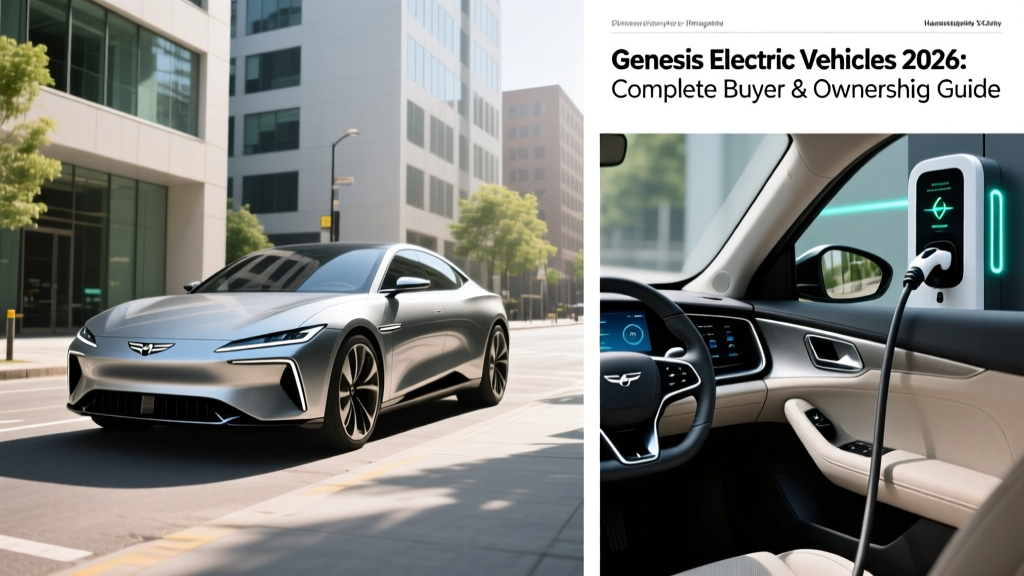
Genesis currently sells three fully electric models in the U.S.: the GV60 (compact luxury crossover, EPA 235–294 miles, from ~$53,350), the Electrified G80 (midsize luxury sedan, EPA 282 miles, from ~$79,850), and the Electrified GV70 (compact luxury SUV, EPA 236 miles, from ~$67,550). All three ride on Hyundai Motor Group's E-GMP platform with 800V architecture, enabling 10–80% DC fast charging in approximately 18 minutes at a 250+ kW charger. The GV60 is the most accessible and most efficient; the Electrified G80 offers the longest range and most traditional luxury sedan experience; the Electrified GV70 provides SUV utility but trades range for it. None currently qualify for the full $7,500 federal §30D tax credit due to battery-sourcing and assembly requirements — always verify current eligibility at IRS.gov before purchasing.
The 2026 Genesis EV Lineup at a Glance
Genesis has committed to an all-electric lineup by 2030, but as of the 2026 model year, the brand's three production EVs share core E-GMP underpinnings while targeting distinct buyer profiles. Here is how they stack up on the numbers that matter most.
| Specification | GV60 (Advanced) | GV60 (Performance) | Electrified G80 | Electrified GV70 |
|---|---|---|---|---|
| EPA Range | 294 mi | 235 mi | 282 mi | 236 mi |
| Battery (usable) | 77.4 kWh (NMC) | 77.4 kWh (NMC) | 87.2 kWh (NMC) | 77.4 kWh (NMC) |
| Horsepower | 314 hp (AWD) | 429 hp (AWD) | 365 hp (AWD) | 429 hp (AWD) |
| 0–60 mph | 5.3 sec | 3.9 sec | 4.9 sec | 4.2 sec |
| Max DC Charge Rate | ~240 kW | ~240 kW | ~240 kW | ~240 kW |
| 10–80% DC Fast Charge | ~18 min | ~18 min | ~22 min | ~18 min |
| Level 2 Rate (kW) | 10.9 kW | 10.9 kW | 10.9 kW | 10.9 kW |
| MPGe (combined) | 95 MPGe | 85 MPGe | 89 MPGe | 86 MPGe |
| Starting MSRP | $53,350 | $60,550 | $79,850 | $67,550 |
| Battery Warranty | 10 yr / 100,000 mi | 10 yr / 100,000 mi | 10 yr / 100,000 mi | 10 yr / 100,000 mi |
Sources: EPA / fueleconomy.gov, Genesis USA press specifications. Real-world highway range typically runs 10–15% below EPA combined figures; cold-weather (below 25°F) can reduce range an additional 20–30%.
Real-World Range Reality Check
GV60 Advanced (EPA 294 mi): Expect ~240–260 mi on a flat highway at 70 mph in mild weather. In sub-freezing temperatures, plan for ~190–210 mi. The 77.4 kWh battery paired with the Advanced trim's lower-output motors delivers the best efficiency in the lineup.
Electrified G80 (EPA 282 mi): Its larger 87.2 kWh battery provides a buffer for highway driving — expect ~235–250 mi real-world in moderate conditions, ~195–215 mi in cold weather. The sedan's lower drag coefficient helps at highway speeds.
Electrified GV70 (EPA 236 mi): The heaviest and least aerodynamic of the three. Real-world highway range lands around ~195–210 mi; cold weather drops this to ~155–175 mi. This is the model where range compromises are most tangible.
Genesis EV vs. Gas Equivalent: The Cost Comparison
The most common question from luxury-car shoppers: does a Genesis EV actually save money compared to its gas-powered siblings? Let's run the numbers for a realistic five-year, 60,000-mile ownership scenario, comparing the Electrified GV70 to the gas GV70 3.5T.
| Cost Category (5 yr / 60k mi) | Electrified GV70 | Gas GV70 3.5T |
|---|---|---|
| Purchase Price (base MSRP) | $67,550 | $60,050 |
| Estimated Federal Tax Credit | $0–$3,750* | $0 |
| Fuel / Electricity | $3,200 (home L2 avg) | $9,600 (premium 91 octane, 19 MPG combined) |
| Maintenance | ~$1,800 | ~$4,200 |
| Insurance (est. avg) | $11,500 | $9,800 |
| Estimated Depreciation | $28,000 | $24,000 |
| Total 5-Year Cost | ~$84,050 – $87,800 | ~$97,850 |
*Tax credit eligibility for Genesis EVs is limited by §30D battery-component and critical-mineral sourcing rules. The Electrified GV70 is assembled in South Korea, which disqualifies it from the full credit under current rules. Some partial credit ($3,750) may apply depending on mineral sourcing — verify at IRS.gov. Electricity costs based on $0.14/kWh national average; gas costs based on $4.10/gal premium.
The Electrified GV70 saves roughly $10,000–$14,000 over five years despite a higher sticker price, primarily through fuel and maintenance savings. The break-even point versus the gas GV70 arrives around year three for most drivers covering 12,000+ miles annually. However, if you lack home charging access and must rely entirely on DC fast charging at $0.35–$0.48/kWh, the fuel-cost advantage narrows significantly — potentially to $2,000–$3,000 over five years.
Charging the Genesis EV Lineup: What You Need to Know
All three Genesis EVs use the E-GMP 800V platform, which is among the fastest-charging architectures available in the luxury segment. Here is what that means in practice across charging levels.
| Charging Level | Power (kW) | Miles Added Per Hour | Typical Use Case |
|---|---|---|---|
| Level 1 (120V household) | ~1.4 kW | ~4–5 mi/hr | Emergency / overnight trickle |
| Level 2 (240V home) | 10.9 kW | ~33–38 mi/hr | Daily home charging |
| DC Fast Charge | Peak ~240 kW | ~800+ mi/hr (peak) | Road trips (10–80% in ~18 min) |
Home charging setup: A Level 2 home charger on a 48-amp circuit (60-amp breaker) will fully recharge any Genesis EV overnight — approximately 7–8 hours for the GV60 and Electrified GV70, 8–9 hours for the Electrified G80's larger battery. Installation costs typically range from $800–$2,500 depending on panel capacity and conduit run length. If your home's electrical panel is at or near capacity (common with 100-amp panels), a panel upgrade to 200 amps can add $1,500–$3,500.
DC fast charging reality: Genesis EVs peak at approximately 240 kW but sustain that rate only between roughly 10–40% state of charge (SoC). Above 60%, the charge curve tapers significantly — expect 80–100 kW from 60–80%, and below 40 kW above 80%. This is standard lithium-ion behavior to protect battery health. For road-trip efficiency, charge to 80% and go; pushing to 100% at a DC charger adds 20–25 minutes for minimal extra range.
Connector note: Current Genesis EVs use the CCS1 connector. Genesis has announced that future models will adopt the NACS (Tesla) connector, and adapters for Supercharger access are expected — but confirm current adapter availability and network compatibility with your dealer before relying on Tesla Superchargers.
Federal Tax Credits and Incentives: The Honest Picture
This is where Genesis EV buyers face the most complexity. Under the Inflation Reduction Act's §30D rules, a new clean vehicle must meet all of the following to qualify for the maximum $7,500 credit:
- Final assembly in North America — All three current Genesis EVs are assembled in South Korea. This alone disqualifies them from the new-vehicle §30D credit.
- MSRP caps: $80,000 for SUVs/pickups/vans; $55,000 for sedans. The Electrified G80 (sedan, ~$79,850) exceeds the sedan cap.
- Buyer income limits: AGI ≤ $150,000 (single), $225,000 (head of household), $300,000 (joint).
- Battery component sourcing: Phasing requirements for North American manufacture and critical-mineral sourcing.
Bottom line: As of 2026, no Genesis EV qualifies for the full $7,500 federal credit on new purchases. Some buyers may qualify for partial credits ($3,750) depending on the critical-minerals component, but the North America assembly requirement remains the primary barrier. Genesis has indicated plans for U.S. production (at the Hyundai Motor Group Metaplant America in Georgia), which could change eligibility for future models. Always confirm current status at IRS.gov.
Lease loophole: Vehicles leased (not purchased) may qualify for the commercial clean vehicle credit (§45W), which the leasing company can pass through as a lease reduction. Many Genesis dealerships offer lease incentives reflecting this — ask specifically about pass-through credit amounts.
Real-World Ownership: What First-Time Genesis EV Buyers Must Know
| Common Misconception | The Facts |
|---|---|
| "The battery will need replacing in a few years." | Genesis covers the battery for 10 years / 100,000 miles with a capacity-retention threshold of 70%. Real-world E-GMP degradation data from sibling Hyundai/Kia models shows ~8–12% loss over 100,000 miles — well above the warranty floor. |
| "I can charge at any public station." | Genesis EVs use CCS1. Electrify America, EVgo, and ChargePoint stations with CCS connectors are widely available, but Tesla Superchargers require a NACS adapter (confirm availability). Always check PlugShare or your vehicle's nav for connector type. |
| "EVs cost more to insure, always." | Genesis EV insurance runs ~15–20% higher than gas equivalents due to repair costs and parts pricing. However, Genesis's complimentary maintenance program (3 years / 36,000 miles) offsets some ownership costs. Get quotes from multiple insurers before committing. |
| "Range is exactly what the EPA sticker says." | EPA range is a combined city/highway estimate. Sustained 75+ mph highway driving reduces range 10–15%. Sub-25°F temperatures add 20–30% reduction. The GV60 Advanced's 294-mile EPA figure can realistically mean ~190 miles on a cold winter highway. |
| "Regenerative braking replaces brake service." | Partially true. Regen significantly reduces brake-pad wear — many EV owners report original pads at 80,000+ miles. But brake fluid still requires periodic flushing (every 2–3 years), and calipers can corrode from disuse in salt-belt states. |
Genesis Complimentary Ownership Perks
Genesis includes several ownership benefits that improve the value equation: 3 years / 36,000 miles of complimentary scheduled maintenance, 3 years / 36,000 miles of Genesis Connected Services (remote features, navigation updates), and valet service for maintenance pickups. For EVs, the maintenance schedule is light — primarily cabin-air-filter replacement, tire rotation, and brake-fluid checks — but having it covered eliminates a cost category entirely during the initial ownership period.
Decision Framework: Which Genesis EV Is Right for You?
Choose the GV60 Advanced if:
- You want the best range (294 mi EPA) and efficiency (95 MPGe) in the lineup
- Your budget starts around $53,000–$58,000
- You prioritize a compact crossover footprint for urban driving
- You want 800V fast-charging capability at the lowest entry price
Choose the GV60 Performance if:
- Acceleration matters — 429 hp and a 3.9-second 0–60 time
- You accept a range trade-off (235 mi EPA) for sportier dynamics
- You want the Boost Mode feature and adaptive suspension
Choose the Electrified G80 if:
- You want a traditional luxury sedan with the longest range in the lineup (282 mi EPA)
- Rear-seat comfort and trunk space are priorities
- Your budget supports ~$80,000+ and you value understated luxury over crossover styling
- You do mostly highway commuting where the sedan's aero advantage matters
Choose the Electrified GV70 if:
- You need SUV cargo capacity (28.7 cu ft behind rear seats, 56.9 cu ft folded)
- You want 429 hp in an SUV package with a conventional luxury design
- You accept the lowest range in the lineup (236 mi EPA) for utility and ride height
- Your daily commute is under 50 miles round-trip with home charging
Choose a non-Genesis alternative if:
- Federal tax-credit eligibility is a dealbreaker — consider the Tesla Model Y, Ford Mustang Mach-E, or Chevrolet Blazer EV (all U.S.-assembled and potentially credit-eligible)
- You need 320+ miles of range — the BMW iX xDrive50 (EPA 324 mi) or Tesla Model X (EPA 348 mi) offer more
- You rely exclusively on the Tesla Supercharger network without wanting an adapter
Frequently Asked Questions
Are Genesis EVs reliable?
Genesis as a brand consistently ranks near the top of J.D. Power dependability studies, and the E-GMP platform shared with the Hyundai Ioniq 5 and Kia EV6 has proven robust in real-world use. The main reliability variables are software (infotainment and connected-services glitches, which OTA updates address) and 12V auxiliary battery issues, which are common across many EV brands. The high-voltage traction battery carries a 10-year/100,000-mile warranty.
Can I charge a Genesis EV at a Tesla Supercharger?
Current Genesis models use the CCS1 connector. Tesla has opened some Superchargers to non-Tesla EVs via the built-in adapter at select stations, and a CCS-to-NACS adapter may be available — but availability and compatibility vary. Check with your Genesis dealer for the latest adapter status and confirm station compatibility on the Tesla app before relying on Superchargers for road trips.
How long does a Genesis EV battery last?
The battery is warranted for 10 years or 100,000 miles against capacity loss below 70%. Based on E-GMP platform data from Hyundai/Kia models in taxi and high-mileage fleet use, these NMC batteries typically retain 85–92% capacity at 100,000 miles. Replacement cost, if needed out of warranty, is estimated at $12,000–$18,000 depending on the model — though full replacements are rare within the first decade.
Is the Electrified GV70 worth it over the gas GV70?
If you have home charging and drive 12,000+ miles per year, the Electrified GV70 saves an estimated $10,000–$14,000 over five years through fuel and maintenance reductions. The trade-off is ~60 miles less EPA range than you might want for road trips, a higher sticker price, and limited federal tax-credit eligibility. For lower-mileage drivers or those without home charging, the gas GV70 remains competitive on total cost.
What happens if Genesis stops making EVs or goes out of business?
Genesis is a luxury division of Hyundai Motor Group, the world's third-largest automaker by volume. The brand is not at risk of dissolution. Hyundai Motor Group has committed over $55 billion to electrification through 2030, and the E-GMP platform underpins dozens of models across Hyundai, Kia, and Genesis. Parts availability and service infrastructure are backed by one of the largest automotive corporations globally.
Do Genesis EVs qualify for any state incentives?
State incentives vary widely and change frequently. Some states (e.g., California, Colorado, New York, Massachusetts) offer rebates of $1,000–$5,000 for new EV purchases, and many of these do not carry the North America assembly requirement that the federal credit does. Check your state's energy or environmental agency website, or use the Alternative Fuels Data Center incentive lookup tool for current state-level programs.