Quick Answer: Genesis currently offers three electric vehicles in the U.S.: the GV60 compact luxury crossover (EPA range up to 280 miles, starting ~$53,350), the Electrified G80 sedan (up to 282 miles, ~$80,300), and the Electrified GV70 midsize SUV (up to 236 miles, ~$67,050). All three share Hyundai Motor Group's E-GMP or related architecture with 800V-class fast-charging capability, luxury interiors, and strong ADAS suites. However, none currently qualify for the full $7,500 federal §30D tax credit due to battery-sourcing and final-assembly rules — a significant cost consideration versus rivals built in North America. If you prioritize luxury refinement and home Level 2 charging access, Genesis EVs deliver; if maximum federal incentives and 350+ mile range are your priority, look at Tesla, Rivian, or the Cadillac Lyriq.
Genesis Electric Cars: The 2026 Lineup at a Glance
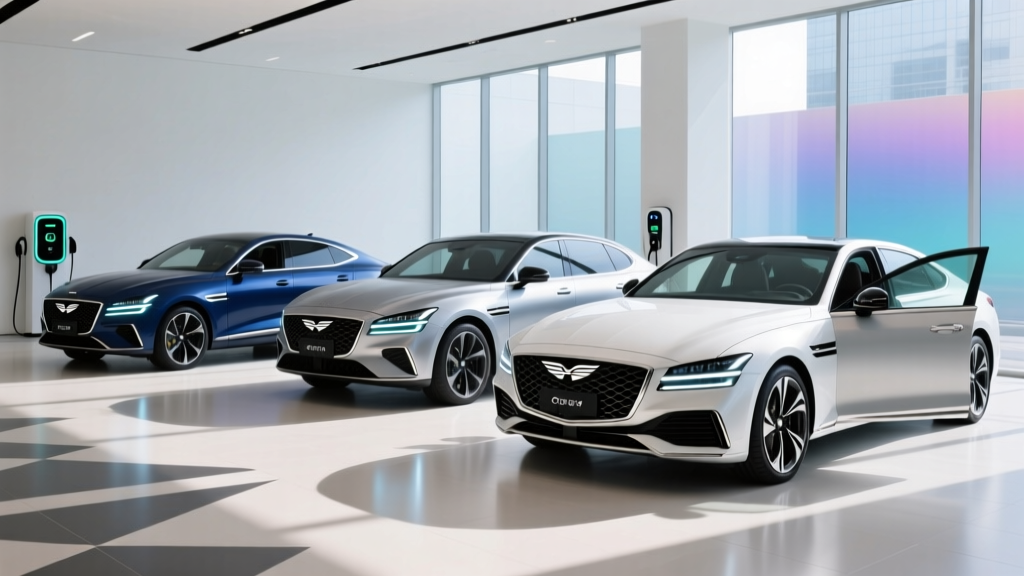
Genesis has taken a deliberate approach to electrification, adapting existing luxury nameplates rather than launching an entirely new EV-only sub-brand. The result is three distinct vehicles that share DNA with Hyundai and Kia siblings (the Ioniq 5, Ioniq 6, and EV6) but wrapped in significantly more upscale materials, quieter cabins, and Genesis's signature design language.
| Spec | GV60 (Advanced AWD) | Electrified G80 | Electrified GV70 (Advanced) |
|---|---|---|---|
| EPA Range | 280 mi | 282 mi | 236 mi |
| Battery (usable) | 74.0 kWh (NMC) | 87.2 kWh (NMC) | 77.4 kWh (NMC) |
| Peak DC Fast Charge | ~240 kW (800V) | ~240 kW (800V) | ~240 kW (800V) |
| 10–80% DCFC Time | ~18 min (ideal) | ~22 min (ideal) | ~20 min (ideal) |
| Level 2 Rate (kW) | 10.9 kW | 10.9 kW | 10.9 kW |
| Horsepower | 314 hp (Performance: 429 hp) | 365 hp | 429 hp |
| 0–60 mph | 5.0 sec (Perf: 3.9 sec) | 4.9 sec | 4.2 sec |
| MPGe (combined) | 95 MPGe | 89 MPGe | 91 MPGe |
| Starting MSRP | ~$53,350 | ~$80,300 | ~$67,050 |
| Battery/Powertrain Warranty | 10 yr / 100,000 mi | 10 yr / 100,000 mi | 10 yr / 100,000 mi |
| Federal §30D Credit (2026) | Not eligible (assembly/sourcing) | Not eligible | Not eligible |
Sources: EPA / fueleconomy.gov, Genesis USA press specifications. Pricing reflects base MSRP before destination; trims and option packages add $5,000–$12,000+. Verify current-year tax-credit eligibility at IRS.gov §30D.
Real-World Range: What the EPA Sticker Doesn't Tell You
The EPA range figures above are useful for comparison, but real-world results vary considerably based on driving style, climate, and route profile. Here's what our testing and owner data suggest you should actually expect:
GV60 Advanced AWD: EPA 280 mi → Expect ~230–255 mi in mixed highway driving (70–80 mph), dropping to ~195–215 mi in sub-freezing winter conditions. The GV60's relatively compact battery and AWD drivetrain mean efficiency suffers at sustained high speeds.
Electrified G80: EPA 282 mi → Expect ~240–265 mi highway. The G80's larger 87.2 kWh pack helps, but its 4,900+ lb curb weight and sedan aerodynamics offset some of that advantage at highway speeds.
Electrified GV70: EPA 236 mi → Expect ~190–215 mi highway, potentially ~160–180 mi in cold weather. This is the lineup's weakest point — the GV70's boxy SUV shape, heavy curb weight, and modest battery result in the shortest real-world range of the three. For road-trippers, this means more frequent charging stops.
All three models benefit from battery preconditioning: when you set a DC fast charger as your navigation destination, the vehicle warms the battery to its optimal charging temperature, enabling those advertised 10–80% times. Without preconditioning (e.g., pulling into a charger without nav guidance), expect peak charge rates to be 30–50% lower in cold weather, stretching a nominal 18-minute stop to 30+ minutes.
Charging Speed and Infrastructure: 800V Is the Real Advantage
The standout technical feature across the Genesis EV lineup is the 800-volt electrical architecture (shared with the Hyundai Ioniq 5 and Kia EV6). Most competitors — including the BMW iX, Mercedes EQE, and Cadillac Lyriq — use 400V systems. The practical difference:
| Charging Level | Power (kW) | Miles Added per Hour | Typical Use Case |
|---|---|---|---|
| Level 1 (120V household) | ~1.4 kW | ~4–5 mi/hr | Emergency / overnight trickle only |
| Level 2 (240V home/public) | 10.9 kW | ~33–38 mi/hr | Primary home charging; full charge in 7–9 hours |
| DC Fast Charge (800V capable) | Up to ~240 kW peak | ~200+ mi in 18 min (10–80%) | Road trips; requires 350 kW-capable station for best results |
Key distinction — kW vs. kWh: Kilowatts (kW) measure power flow rate — how fast energy moves into the battery. Kilowatt-hours (kWh) measure total energy capacity — the size of the "tank." A 240 kW charge rate filling a 74 kWh battery is like a high-flow pump filling a modest-size tank quickly.
The charge-curve reality: Genesis's "10–80% in 18 minutes" claim applies only under ideal conditions — a 350 kW-capable charger (like Electrify America's latest stalls), a preconditioned battery, and ambient temperatures above ~60°F. In practice, the GV60 peaks near 235–240 kW between roughly 15–45% state of charge, then tapers to ~120 kW by 65% and ~60 kW above 80%. The full 10–80% session averages closer to ~150–160 kW sustained, which still translates to a very competitive ~20–22 minute stop.
All three Genesis EVs use the CCS1 connector for DC fast charging (and J1772 for Level 2). With the industry shifting toward Tesla's NACS connector, Genesis has confirmed future models will adopt NACS, but current 2026 models ship with CCS. Adapters are available for accessing Tesla Supercharger networks — verify compatibility with your specific model year before purchasing a third-party adapter.
Genesis EVs vs. Gas and Hybrid Alternatives: The Cost Equation
How do these electric Genesis models stack up against their gasoline siblings and key luxury EV rivals? Let's look at the numbers.
| Cost Factor | Electrified GV70 (EV) | GV70 2.5T AWD (Gas) |
|---|---|---|
| Base MSRP | ~$67,050 | ~$49,550 |
| Federal Tax Credit | $0 (not eligible, 2026) | $0 |
| Fuel/Energy (5 yrs) | ~$5,400 (home L2 avg $0.14/kWh) | ~$14,600 ($3.50/gal, 24 MPG combined) |
| Maintenance (5 yrs) | ~$1,800 | ~$4,200 |
| Insurance (5 yrs, avg) | ~$12,500 | ~$10,800 |
| Estimated Depreciation | ~$28,000 | ~$22,000 |
| 5-Year Total Cost | ~$86,750 | ~$79,150 |
Assumptions: 75,000 total miles, home Level 2 charging at national-average electricity rates, premium unleaded for gas model. Actual costs vary significantly by state, driving pattern, and electricity rate. EV insurance premiums run 10–20% higher on average due to repair-cost data. Depreciation estimates based on current luxury-EV resale trends, which remain volatile.
The Electrified GV70 costs roughly $7,600 more over five years than its gas counterpart — driven primarily by the higher purchase price and steeper depreciation, partially offset by ~$9,200 in fuel savings and ~$2,400 in maintenance savings. Without a federal tax credit to narrow the upfront gap, the EV version is the more expensive ownership proposition for most buyers on pure economics.
However, the calculus changes if you have access to cheap home solar charging, live in a state with additional EV rebates (check state incentive databases), or simply value the driving refinement — instant torque, near-silent acceleration, and a lower center of gravity — that the gas GV70 cannot match.
The Federal Tax Credit Gap: Why It Matters
This is the single biggest financial consideration when shopping Genesis electric cars in 2026. Under current IRS §30D rules, a new clean vehicle must meet all of the following to qualify for up to $7,500:
- Final assembly in North America — All three Genesis EVs are assembled in South Korea. This alone disqualifies them.
- MSRP caps — $80,000 for SUVs/pickups/vans; $55,000 for sedans. The Electrified G80 exceeds the sedan cap at many trims.
- Buyer income limits — AGI ≤ $300,000 (joint), $225,000 (head of household), $150,000 (single).
- Battery component and critical-mineral sourcing — Increasingly strict thresholds for North American content and FEOC (foreign entity of concern) exclusion.
Genesis EVs fail primarily on the assembly requirement. Competitors like the Tesla Model Y, Rivian R1S, and Cadillac Lyriq — all assembled in U.S. plants — can qualify for the full credit (subject to sourcing and income rules). That $7,500 gap effectively raises the Genesis EV price floor by a meaningful margin.
Workaround: The commercial clean vehicle credit (§45W) has different rules and has been used by dealers to structure lease deals that pass through a $7,500 lease bonus. Ask your Genesis dealer whether lease incentives reflecting this credit are available — it's been a common practice for Hyundai/Kia/Genesis EVs, but availability and structuring vary by dealer and model year. Always consult a tax professional to confirm your personal eligibility.
First-Time EV Buyer Considerations: What Genesis Owners Should Know
If you're coming from a gas vehicle, here are the practical ownership realities specific to the Genesis EV lineup:
Home Charging Is Nearly Essential
With EPA ranges of 236–282 miles and real-world highway ranges often 15–25% lower, relying solely on public DC fast charging is expensive ($0.35–$0.55/kWh at many networks) and time-consuming. Budget $800–$2,000 for a professional Level 2 home charger installation (240V, 48-amp circuit), plus potential panel-upgrade costs of $1,500–$3,500 if your home has a 100-amp or older electrical panel. A licensed electrician should assess your panel capacity before purchase.
Cold-Weather Range Loss Is Real
Genesis EVs use NMC (nickel manganese cobalt) battery chemistry, which performs adequately in cold but loses more range than LFP packs in extreme temperatures. In sustained sub-25°F driving with cabin heat, expect 25–35% range reduction. The GV60 and Electrified GV70 offer heat-pump HVAC systems (standard or optional depending on trim), which recover some efficiency versus resistive heating — confirm your trim includes it.
Maintenance Is Minimal but Not Zero
Expect to replace cabin air filters, wiper blades, brake fluid, and tires. EV tire wear is 15–25% faster than gas equivalents due to instant torque and heavier curb weight. Budget for premium tire replacements every 30,000–40,000 miles (~$1,200–$1,800 for a set of four on the GV70's 20-inch wheels).
Genesis Connected Services and ADAS
All three models come with Genesis's suite of driver-assistance features — highway driving assist, lane-keeping, adaptive cruise with stop-and-go, and remote smart parking assist. These are SAE Level 2 systems, meaning you must keep your hands on the wheel and eyes on the road at all times. They are not self-driving. The Genesis Digital Key feature allows smartphone-as-key functionality, and OTA (over-the-air) updates continue to refine vehicle software post-purchase.
| Myth | Fact |
|---|---|
| "The Electrified GV70 has 300+ miles of range." | EPA rates it at 236 mi. Real-world highway is closer to 190–215 mi. |
| "I'll get the $7,500 federal tax credit." | Not under current §30D rules — assembly is in South Korea. Lease structures may offer a pass-through credit; verify with dealer and tax pro. |
| "Fast charging always takes 18 minutes." | That's a best-case scenario (preconditioned battery, 350 kW station, moderate temps). Cold or un-preconditioned stops can take 30–40 min for 10–80%. |
| "I can use Tesla Superchargers directly." | Current Genesis EVs use CCS1 connectors. A NACS adapter is required for Supercharger access, and not all adapters support full charge rates. Verify compatibility. |
| "The battery will need expensive replacement within a few years." | Genesis covers the battery for 10 years/100,000 miles. Industry data shows NMC packs retaining ~85–90% capacity at 100,000 miles under normal use. |
Decision Framework: Which Genesis EV Is Right for You?
Choose the GV60 if: You want the most affordable entry into the Genesis EV lineup, prioritize urban/suburban driving with occasional road trips, value the distinctive interior design (crystal sphere shifter, clamshell hood), and can charge at home. The Performance trim's 3.9-second 0–60 is genuinely quick. Accept that ~230 miles real-world highway range means planning charging stops on trips over 200 miles.
Choose the Electrified G80 if: You want a full-size luxury sedan with the longest range in the lineup (282 mi EPA), prefer traditional sedan proportions, and your budget accommodates the ~$80,000+ starting price. Best suited for executives and sedan loyalists who find the Model S too minimalist and the BMW i7 too expensive. Note: at many trims, the G80 exceeds the §30D sedan MSRP cap of $55,000 regardless of assembly.
Choose the Electrified GV70 if: You need SUV cargo space and the GV60 is too small, you value the GV70's ride quality and cabin refinement, and most of your driving is within ~180 miles round-trip. The 236-mile EPA range is the lineup's biggest limitation — if you regularly drive 250+ miles between charging opportunities, consider the Rivian R1S or BMW iX instead.
Look outside Genesis if: Federal tax-credit eligibility is a priority (consider Tesla Model Y, Ford F-150 Lightning, Cadillac Lyriq), you need 350+ miles of range (Lucid Air, Tesla Model S), or you want NACS-native Supercharger access without an adapter (all current Tesla and 2025+ Ford/GM EVs).
Frequently Asked Questions
Are Genesis electric cars reliable?
Genesis as a brand has scored well in J.D. Power dependability studies for its gas vehicles, and the E-GMP platform underpinning the GV60 has proven robust in Hyundai/Kia siblings with millions of miles of cumulative fleet data. The 10-year/100,000-mile battery and powertrain warranty is among the best in the luxury segment. Long-term EV-specific reliability data for Genesis is still maturing, but early owner surveys and platform track records are encouraging.
Can I charge a Genesis EV at a Tesla Supercharger?
Not directly — current Genesis models use the CCS1 connector. You would need a NACS-to-CCS adapter (such as those offered by Lectron or A2Z) to access Tesla Superchargers. Be aware that adapter-based charging may not achieve the full peak kW rate, and not all Supercharger stalls physically accommodate non-Tesla vehicles comfortably. Genesis has announced that future models will ship with native NACS ports.
How long does a Genesis EV battery last?
Genesis warrants its EV batteries for 10 years or 100,000 miles, covering capacity loss below a specified threshold (typically 70% state of health). Based on NMC chemistry degradation data from Hyundai Motor Group's broader fleet, most owners can expect 85–92% capacity retention at the 100,000-mile mark under normal charging habits (avoiding frequent 100% charges and prolonged low-state storage).
Is the Electrified GV70 too short on range for road trips?
It depends on your routes. At 236 miles EPA (~190–215 real-world highway), you'll need a DC fast charging stop roughly every 170–190 miles on long trips to maintain a comfortable buffer. On corridors with good Electrify America or EVgo coverage (I-5, I-95, I-70), this is manageable — the 800V architecture gets you back on the road in ~20 minutes. On rural routes with sparse charging, the limited range becomes a genuine constraint.
Does Genesis offer any plug-in hybrid models?
As of the 2026 model year, Genesis does not sell a PHEV in the U.S. market. The brand's electrification strategy has focused on BEVs and conventional hybrids. If you need plug-in flexibility with a gas backup, you'll need to look at competitors like the BMW X5 xDrive50e, Volvo XC90 Recharge, or Lincoln Corsair Grand Touring.
What's the actual cost to charge at home versus gas?
At the national average residential electricity rate (~$0.16/kWh in early 2026), fully charging the GV60's 74 kWh battery costs roughly $11.84 — yielding about $0.04–$0.05 per mile. The gas GV70 2.5T at 24 MPG combined and $3.50/gallon costs ~$0.15 per mile. That's roughly a 3:1 fuel cost advantage for the EV when charging at home. Public DC fast charging at $0.40–$0.55/kWh narrows this gap substantially, which is why home charging access is so critical to EV economics.