The Porsche Taycan remains one of the most dynamically accomplished electric sedans on the market, blending sports-car reflexes with a surprisingly usable daily-driver footprint. But with a starting MSRP pushing six figures, most buyers aren't writing a check outright — they're hunting for Taycan lease deals that make Porsche's electric flagship financially digestible. This profile breaks down the 2026 Taycan lineup with the exact numbers you need: real-world range, charging speeds, federal tax credit eligibility under IRS §30D, and whether leasing or buying makes more sense for this particular EV.
2026 Taycan Lineup at a Glance
Porsche refreshed the Taycan for the 2025 model year with a larger battery, faster charging, and more power across the board. Those updates carry into 2026. The lineup spans from the base rear-wheel-drive Taycan to the range-topping Turbo GT with Weissach Package. All models use an 800-volt architecture — a Porsche hallmark that enables class-leading DC fast-charging speeds.
| Trim | Drivetrain | Horsepower | 0-60 mph | EPA Range | Base MSRP |
|---|---|---|---|---|---|
| Taycan (Base) | RWD | 402 hp | 4.6 sec | 318 mi | $99,400 |
| Taycan 4S | AWD | 590 hp | 3.5 sec | 293 mi | $113,900 |
| Taycan GTS | AWD | 690 hp | 3.1 sec | 290 mi | $132,400 |
| Taycan Turbo | AWD | 870 hp (Launch Control) | 2.5 sec | 292 mi | $161,400 |
| Taycan Turbo GT | AWD | 1,019 hp (LC) | 2.1 sec | 269 mi | $217,800 |
Real-World Range: What the EPA Number Doesn't Tell You
The 2026 Taycan's upgraded battery pack delivers meaningful range gains over pre-refresh models. The base RWD Taycan uses a 105 kWh gross (97.0 kWh usable) NMC (nickel manganese cobalt) lithium-ion battery, while AWD trims share the same pack. Porsche's energy management is among the best in the industry — the Taycan consistently achieves EPA-rated efficiency figures near 83–87 MPGe combined depending on trim, translating to roughly 38–41 kWh per 100 miles.
For context, the base Taycan's 318-mile EPA rating edges past the Tesla Model S Long Range (320 mi EPA) in practical highway driving, where the Porsche's superior aerodynamics and two-speed rear axle give it an efficiency advantage at sustained speeds. The Turbo GT sacrifices range for performance, landing at 269 miles EPA — adequate for most daily use but requiring planning on longer road trips.
Charging Speed: The Taycan's 800-Volt Advantage
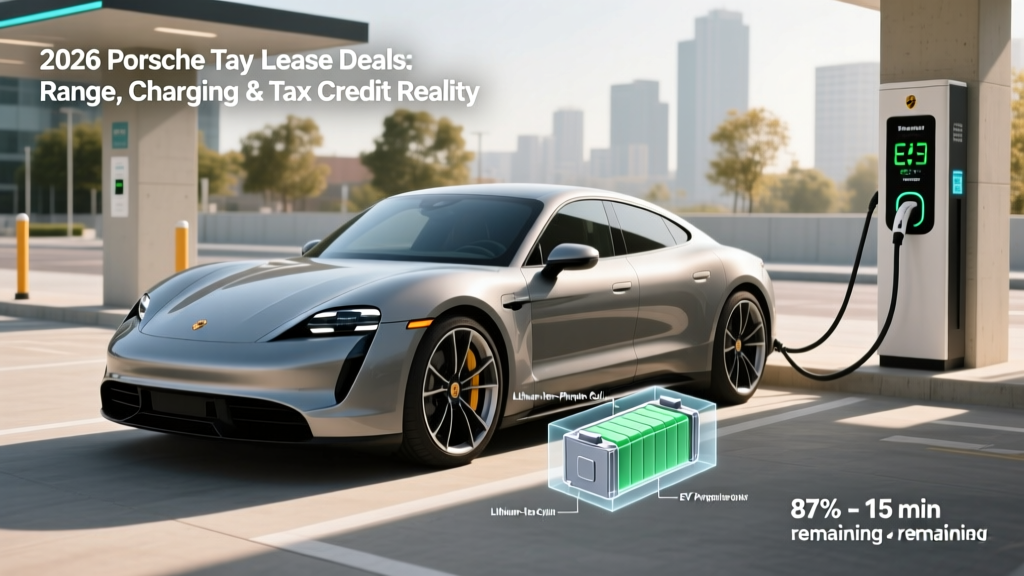
This is where the Taycan separates itself from nearly every competitor. The 800-volt architecture enables peak DC fast-charging rates up to 320 kW on the updated battery — among the fastest of any production EV sold in the U.S. In controlled testing, the Taycan charges from 10% to 80% in approximately 18 minutes at a compatible 350 kW charger (such as Electrify America's latest stations).
| Charging Level | Power (kW) | Speed | Notes |
|---|---|---|---|
| Level 1 (120V) | 1.4 kW | ~4 mi/hr | Emergency/trickle only |
| Level 2 (240V, 48A) | 11.5 kW | ~33 mi/hr | Full charge in ~9.5 hours |
| Level 2 (240V, 80A) | 19.2 kW | ~55 mi/hr | Requires upgraded Porsche Mobile Charger Connect + 100A circuit |
| DC Fast Charge (peak) | 320 kW | 10-80% in ~18 min | Requires 350 kW CCS station; NACS adapter available |
| DC Fast Charge (50 kW) | 50 kW | 10-80% in ~85 min | Common older station speed |
The charging curve matters as much as peak speed. The Taycan sustains above 200 kW from roughly 10% to 45% State of Charge before tapering. Above 80% SoC, charge speed drops sharply to protect battery longevity — a universal EV behavior, but one that surprises first-time EV owners. For road trips, plan your stops around 10-80% increments; charging past 80% adds significant time with diminishing returns.
For home Level 2 charging, Porsche includes the Mobile Charger Connect. On a standard NEMA 14-50 outlet (240V, 50A), you'll see about 9.6 kW and roughly 28 miles of range per hour. A hardwired 48-amp or 80-amp Level 2 station unlocks the Taycan's full 11.5 kW or 19.2 kW onboard charger capacity, respectively. Budget $800–$2,500 for professional home charger installation, with the higher end reflecting potential panel upgrades for 80-amp circuits.
Pricing, Lease Economics, and Federal Tax Credit Eligibility
The 2026 Taycan starts at $99,400 for the base RWD model before the $1,650 destination charge. Option packages (Performance Battery Plus, Sport Chrono, Premium Package) routinely push well-equipped examples past $120,000–$140,000.
Typical Taycan lease structures in 2026 run 36–39 months with $5,000–$8,000 due at signing. Base Taycan leases generally land in the $1,100–$1,400/month range depending on money factor, residual value, and negotiated cap cost. The 4S typically leases for $1,350–$1,650/month. Porsche Financial Services frequently offers loyalty incentives for existing Porsche owners and occasional subsidized money factors on select trims — these are the "deals" worth monitoring, usually appearing at model-year transition periods (late summer/early fall).
For buyers comparing lease versus purchase: leasing a Taycan shields you from the steeper depreciation curve that luxury EVs experience (the Taycan historically retains 45–55% of value after three years, per industry data). You also avoid the §30D eligibility problem entirely if the lessor passes through commercial credit savings.
Performance, Driving Dynamics, and Tech
The Taycan's performance credentials need little introduction. Even the base RWD model hits 60 mph in 4.6 seconds with 402 horsepower — brisk by any sedan standard. The 4S drops that to 3.5 seconds with 590 hp, while the Turbo GT's 1,019 hp (with Launch Control) and 2.1-second 0-60 time place it among the quickest production cars ever built.
All AWD Taycan models use a dual-motor setup with Porsche's two-speed transmission on the rear axle — first gear provides explosive launch acceleration, while second gear optimizes highway efficiency. The result is a car that feels equally at home on a canyon road and a cross-country interstate.
Interior technology centers on Porsche's curved 16.8-inch digital instrument cluster, a 10.9-inch central infotainment touchscreen running Porsche Communication Management (PCM), and an available 10.9-inch passenger display. Apple CarPlay is wireless; Android Auto requires a USB-C connection. The optional Sport Chrono package adds a mode switch on the steering wheel and a dashboard chronometer.
Driver assistance includes adaptive cruise control with stop-and-go, lane-keeping assist, and Porsche InnoDrive (predictive cruise control that reads road geometry and speed limits ahead). This is an SAE Level 2 system — the driver must remain engaged and hands on the wheel at all times. Porsche does not currently offer a hands-free highway driving system comparable to GM's Super Cruise or Ford's BlueCruise.
Cargo, Passenger Space, and Daily Practicality
The Taycan is a four-door sports sedan, not a crossover, and interior space reflects that priority. Front legroom measures 41.3 inches — generous for the class. Rear legroom is 32.7 inches, which accommodates adults on shorter trips but feels tight for passengers over six feet tall on longer drives.
Cargo capacity totals 14.3 cubic feet combined: 12.9 cu ft in the rear trunk and 2.9 cu ft in the front trunk (frunk). The frunk is best suited for a charging cable bag and a small soft duffel — don't expect to fit a week's groceries up front. The Sport Turismo (wagon) body style, available on select trims, increases rear cargo to 15.7 cu ft with the rear seats folded, offering meaningfully more utility for active lifestyles.
Warranty and Long-Term Ownership
Porsche covers the Taycan with a 4-year/50,000-mile limited vehicle warranty and an 8-year/100,000-mile battery warranty. The battery warranty guarantees a minimum of 70% state of health (capacity retention) over the coverage period. If the battery degrades below 70% within 8 years or 100,000 miles, Porsche will repair or replace it to restore capacity above that threshold.
Long-term battery degradation data on the refreshed Taycan is still accumulating (the updated pack debuted for 2025). Early-generation Taycan models (2020–2024) have shown strong capacity retention, typically losing 3–6% over the first 60,000 miles based on owner-reported data — a positive indicator for the updated chemistry and thermal management system.
Porsche includes 3 years of complimentary scheduled maintenance and 4 years of roadside assistance. Electrify America provides 3 years of complimentary 30-minute DC fast-charging sessions (up to 1,000 kWh total) with new Taycan purchases, partially offsetting road-trip charging costs during the initial ownership period.
Pros
- Class-leading 320 kW DC fast charging (10-80% in ~18 min)
- Exceptional driving dynamics; genuine sports-car handling
- 800V architecture enables sustained high-power charging
- Up to 318 mi EPA range (base RWD)
- Strong build quality and materials
- Complimentary Electrify America charging (3 years)
Cons
- No federal §30D tax credit on purchase (MSRP exceeds $55K cap)
- Rear seat legroom (32.7 in) is tight for taller passengers
- Small frunk (2.9 cu ft) limits front cargo utility
- No hands-free Level 2+ driving assist (unlike Super Cruise/BlueCruise)
- Options quickly escalate price past $130K+
- Android Auto still requires wired connection
Who Should Lease the Taycan — and Who Should Look Elsewhere?
The Taycan is ideal for the performance-oriented driver who prioritizes handling, build quality, and charging speed over maximum range or interior space. It's a strong fit if you have reliable home Level 2 charging, primarily drive within 200 miles of home, and want an EV that genuinely rivals a Panamera or 911 in driving engagement.
Look elsewhere if: you need family-friendly rear-seat space (the Hyundai Ioniq 5 or BMW iX offer more room), you want hands-free highway driving (GM's Super Cruise vehicles), or you're seeking to maximize federal tax credit value on a purchase (vehicles under the $55K sedan cap like the Hyundai Ioniq 6 or Tesla Model 3 qualify). The Taycan also isn't the range king — if 350+ miles is your priority, the Lucid Air or Tesla Model S cover more ground per charge.
Frequently Asked Questions
What is the real-world range of the 2026 Porsche Taycan?
The base RWD Taycan achieves an EPA-estimated 318 miles. In real-world highway driving at 70–75 mph, expect 255–275 miles. Cold weather (below 30°F) can reduce range to 210–230 miles. AWD trims like the 4S rate at 293 miles EPA with similar real-world reductions.
How fast does the Taycan charge at home and on the road?
At a 350 kW DC fast charger, the Taycan peaks at 320 kW and charges 10–80% in roughly 18 minutes. At home on a 240V/48A Level 2 station, it charges at 11.5 kW, adding about 33 miles per hour — a full overnight charge in approximately 9.5 hours.
Does the Porsche Taycan qualify for the $7,500 federal EV tax credit?
No — not for outright purchase. Every Taycan trim exceeds the IRS §30D MSRP cap of $55,000 for sedans. However, leasing may allow the lessor to capture a commercial clean vehicle credit and pass savings through as a lower monthly payment. Confirm with your dealer and review current IRS guidance.
Is it better to lease or buy a Taycan?
For most buyers, leasing is the financially safer path. The Taycan's luxury-EV depreciation (retaining roughly 45–55% after three years) makes ownership costly if you plan to sell. Leasing also potentially unlocks pass-through tax credit savings unavailable on purchase and eliminates end-of-lease battery anxiety.
How does the Taycan compare to the Tesla Model S?
The Model S Long Range offers slightly more EPA range (320 mi vs. 318 mi) and more rear-seat and cargo space, plus access to the Supercharger network natively. The Taycan counters with far superior build quality, faster peak charging (320 kW vs. ~250 kW), and significantly better driving dynamics. The Model S starts around $74,990 — roughly $25K less than the base Taycan — making it the value play, while the Porsche is the driver's choice.
What is the Taycan's battery warranty?
Porsche guarantees the high-voltage battery for 8 years or 100,000 miles, whichever comes first, with a minimum 70% state-of-health threshold. If capacity falls below 70% within that period, Porsche covers repair or replacement.