Quick Answer: Does a Garage Heater Electric 120V Help Your EV?
A standard 120V electric garage heater (typically 1,500W / 12.5A) can raise a single-car garage temperature by 10–20°F above outdoor temps in insulated spaces. For EV owners in cold climates, this modestly reduces cold-soak battery losses (which can cut range 20–35% at 20°F or below). However, the energy cost of running a 120V heater 8 hours nightly is roughly $1.50–$2.50/day depending on local electricity rates — and a heated garage is far less impactful on your EV's range than preconditioning the battery while plugged in. If you already have a 120V garage heater for personal comfort, using it to benefit your EV is a bonus. If you're buying one solely for EV range preservation, a Level 2 (240V) home charger with battery preconditioning is a far better investment.
Why Cold Weather Hits EV Range Harder Than Gas Cars
Every EV owner in a northern climate learns this lesson by their second winter: cold temperatures reduce usable range. The physics is straightforward. Lithium-ion batteries experience increased internal resistance at low temperatures, which limits both energy extraction and regenerative braking efficiency. Simultaneously, the cabin heater, seat warmers, and battery thermal management system all draw from the same traction battery.
According to testing by the U.S. Department of Energy, an EV driven at 20°F can lose 20–35% of its EPA-rated range compared to 70°F operation. A vehicle rated at 300 miles EPA might realistically deliver 195–240 miles in deep cold.
By comparison, a gasoline car loses roughly 12–15% fuel economy in the same conditions (per EPA data), primarily due to cold-engine enrichment and increased aerodynamic drag from denser air. The gas car's waste heat warms the cabin essentially for free — an EV must generate cabin heat electrically, consuming precious kWh.
| Metric | EV (300-mi EPA) | Gas Car (30 MPG EPA) |
|---|---|---|
| Range/Fuel Economy Loss | 20–35% (~195–240 real miles) | 12–15% (~25.5–26.5 MPG) |
| Cabin Heat Source | Traction battery (or heat pump) | Engine waste heat (free) |
| Cold-Start Energy Penalty | Battery preconditioning draw | Rich fuel mixture, alternator load |
| Warmup Time to Comfortable Cabin | 2–5 min (heat pump/resistance) | 5–10 min (engine must warm) |
| Overnight Energy Draw (plugged in) | Battery thermal mgmt: 0.5–2 kWh | None (engine off) |
What a Garage Heater Electric 120V Actually Does for Your EV
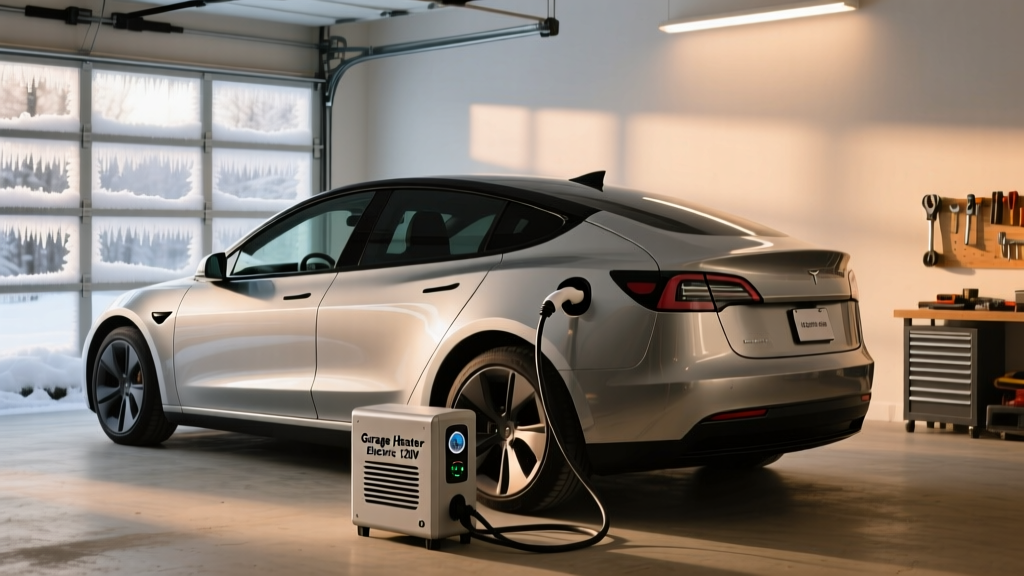
A typical plug-in 120V garage heater rated at 1,500 watts draws about 12.5 amps on a standard 15A household circuit. In a well-insulated single-car garage (~400 sq ft), this can maintain temperatures roughly 10–20°F above outdoor ambient over several hours of runtime.
Here's what that means in practice for your EV:
- At 10°F outdoors: Your garage might sit at 20–30°F with the heater running overnight. This is still cold enough to cause meaningful battery range loss, just less severe than a full cold soak.
- At 30°F outdoors: Your garage might reach 40–50°F. Battery performance improves noticeably above 40°F, with reduced thermal management energy draw and slightly better regen capability.
- Battery preconditioning: If your EV is plugged into a charger (even Level 1 at 120V), its thermal management system will draw grid power — not battery power — to warm the pack. A warm garage reduces the energy required for this process.
Realistic Energy Cost of a 120V Garage Heater
Running a 1,500W heater for 8 hours per night consumes 12 kWh. At the U.S. average residential electricity rate of roughly $0.16/kWh (EIA 2025 data), that's approximately $1.92 per night, or $57/month during heavy-use months. Over a 5-month heating season in a northern state, expect $250–$350 in added electricity costs just for the garage heater.
The Real Cost Comparison: Garage Heater vs. Home Charging Setup
Many first-time EV buyers consider a garage heater as part of their winter strategy. Here's how the costs stack up against investing in proper EV home charging infrastructure.
| Item | Upfront Cost | Season Operating Cost | Primary Benefit |
|---|---|---|---|
| 120V Garage Heater (1,500W) | $40–$150 | $250–$350 (electricity) | Garage ambient warmth, modest EV benefit |
| Level 2 Home Charger (240V, 48A) | $500–$750 (unit) + $800–$2,000 (install) | $0 (uses same electricity for charging) | Faster charging, battery preconditioning from grid |
| EV Battery Preconditioning (plugged in) | $0 (built-in feature) | $30–$60 (grid energy for thermal mgmt) | Optimal battery temp at departure, full regen |
| Garage Insulation Upgrade (R-19 walls, R-30 ceiling) | $1,500–$4,000 | $0 | Reduces heater runtime, benefits EV and home |
The data is clear: if you have $2,000–$3,000 to invest in winter EV optimization, a Level 2 home charger installation delivers far more range benefit than a garage heater. Here's why: when your EV is plugged into a Level 2 charger and scheduled to depart at 7 AM, the vehicle's thermal management system uses grid electricity (not battery energy) to warm the battery pack to its optimal operating temperature (~70–80°F internally). You leave with a warm battery, full regenerative braking from the first mile, and maximum usable capacity. A garage heater cannot replicate this — it warms the air around the car, not the battery cells themselves.
Real-World EV Winter Ownership: What First-Time Buyers Need to Know
If you're buying your first EV and live in a climate with sustained sub-40°F winters, here's the practical ownership picture.
Range Planning in Cold Weather
Take your vehicle's EPA range and multiply by 0.70 for a conservative winter planning number. A 2026 Hyundai IONIQ 5 Long Range (318 miles EPA) should be planned around ~220 miles in sustained 20°F highway driving. A 2026 Tesla Model Y Long Range (320 miles EPA) plans around ~225 miles in the same conditions. Vehicles equipped with heat pumps (standard on most 2025–2026 models from Hyundai, Kia, Tesla, BMW, and others) lose less range to cabin heating than older resistance-heater EVs.
Home Charging Access Is Non-Negotiable in Winter
Cold-weather EV ownership without home charging is significantly harder. Public DC fast charging in winter means arriving at a charger with a cold battery (slow charge speeds until the pack warms), sitting in a cold vehicle, and potentially paying $0.35–$0.50/kWh for electricity. Home charging on a Level 2 unit lets you precondition the battery from grid power while you sleep. If you cannot install home charging, a PHEV (plug-in hybrid) may be a more practical electrified option for your situation.
What About the Garage Heater If You Already Have One?
If you already own a 120V electric garage heater for workshop comfort or pipe-freeze prevention, running it overnight to slightly warm your garage will provide a marginal benefit to your EV. The battery won't cold-soak as deeply, and your morning preconditioning cycle will be shorter and draw less energy. Just don't expect it to eliminate cold-weather range loss — plan for 70–80% of EPA range regardless.
Common Misconceptions About EVs and Cold Garages
| Myth | Fact |
|---|---|
| "A warm garage means no range loss." | Even a 50°F garage is below optimal battery temperature. The vehicle still needs to precondition the pack internally. A warm garage helps modestly but doesn't eliminate cold effects once you drive into 20°F air. |
| "EVs are useless in winter." | Modern EVs with heat pumps and active thermal management handle winter well — you just need to plan around 70–80% range. EVs also start instantly in cold (no cranking a cold engine), and seat/steering wheel heaters use far less energy than cabin air heating. |
| "I need a 240V garage heater for my EV." | A 240V garage heater (3,000–5,000W) will warm a garage faster but costs $0.48–$0.80/hour to run and provides diminishing returns for EV benefit. That same 240V circuit is far better allocated to a Level 2 EV charger. |
| "Plugging in my EV wastes electricity overnight." | A plugged-in EV draws minimal energy for battery thermal management (typically 0.5–2 kWh overnight in cold weather, or $0.08–$0.32). This is far cheaper than the range you'd lose from a cold-soaked battery. |
| "LFP batteries handle cold worse than NMC." | Both chemistries lose performance in cold. LFP (lithium iron phosphate) batteries may show slightly more range reduction in extreme cold due to lower energy density, but the difference is modest. The bigger factor is whether the vehicle has active thermal management. |
Decision Framework: Should You Buy a Garage Heater for Your EV?
If X, Then Y
- If you don't have home charging yet: Invest in a Level 2 (240V) home charger installation first. Budget $1,300–$2,750 total (unit + electrician + permit). This delivers 10x the winter EV benefit of a garage heater. A 48A Level 2 unit adds roughly 30–40 miles of range per hour of charging.
- If you already have Level 2 charging and a cold garage: A 120V garage heater ($40–$150) provides a small supplementary benefit. Run it 1–2 hours before departure rather than all night to limit electricity cost to ~$0.24–$0.48/day.
- If your garage is uninsulated: A 120V heater will struggle to maintain meaningful temperature rise. Invest in garage insulation ($1,500–$4,000) before spending on heating. Insulation also benefits your home's overall energy efficiency.
- If you live in a mild-winter climate (rarely below 35°F): A garage heater for EV purposes is unnecessary. Your battery's thermal management handles these temperatures with minimal range impact.
- If you're considering a 240V garage heater: Dedicate that 240V circuit to a Level 2 EV charger instead. A hardwired 48A charger requires a 60A circuit; a 240V garage heater typically needs a 30A circuit. You likely don't have spare 240V capacity for both without a panel upgrade ($1,500–$3,000).
- If you can't install home charging at all (apartment, street parking): A garage heater is irrelevant to your situation. Focus on finding reliable public charging near your commute, or consider a PHEV as a bridge vehicle.
Federal Tax Credits and Winter EV Purchases (2026)
If you're buying an EV in 2026 partly to address winter commuting concerns, the IRS §30D Clean Vehicle Credit remains available with important caveats:
- Maximum credit: Up to $7,500, split between critical minerals ($3,750) and battery component ($3,750) requirements.
- MSRP caps: Vans/SUVs/pickups must be under $80,000; sedans under $55,000.
- Buyer income caps: $150,000 single / $225,000 head of household / $300,000 married filing jointly (modified AGI).
- Point-of-sale transfer: Eligible buyers can transfer the credit to the dealer at purchase for an immediate price reduction rather than waiting for tax filing.
- Battery sourcing: Sourcing requirements tighten annually. Check the EPA/DOE eligible vehicle list for current qualifying models.
Always confirm eligibility with a tax professional before relying on the credit for your purchase budget. Rules are subject to legislative change.
Frequently Asked Questions
Can I run a 120V garage heater and charge my EV on the same circuit?
No. A Level 1 EV charger draws 12A continuously on a 120V/15A circuit. A 1,500W garage heater draws 12.5A. Together they total 24.5A — well beyond the circuit's 15A capacity (and NEC rules limit continuous loads to 80% of breaker rating, or 12A). You must use separate circuits. This is why a dedicated 240V circuit for a Level 2 EV charger is the recommended solution.
Does a heat pump eliminate the need for a warm garage?
A heat pump significantly reduces cabin-heating energy consumption (using roughly 1/3 the electricity of a resistance heater) but does not warm the traction battery itself. Battery thermal management is a separate system. A warm garage helps both cabin and battery, but preconditioning while plugged in addresses the battery specifically.
Will a garage heater extend my EV battery's lifespan?
There is no strong evidence that keeping an EV in a mildly heated garage (40–50°F) meaningfully extends long-term battery health compared to cold-soaking. Lithium-ion degradation is primarily driven by high temperatures, high state-of-charge storage, and deep cycling — not by cold storage. In fact, cold storage at moderate SoC (~50%) is among the least degrading conditions for a lithium-ion pack.
What's the most cost-effective way to maximize winter EV range?
In priority order: (1) Install a Level 2 home charger and precondition before departure. (2) Use seat/steering wheel heaters instead of cabin air heat when possible (they use ~50W vs. 2,000–5,000W for cabin heating). (3) Keep tire pressure at the recommended PSI (cold air drops tire pressure, increasing rolling resistance). (4) Plan routes around 70–80% of EPA range. A garage heater is a distant fifth priority.
Is a PHEV better than a BEV for cold climates?
It depends on your driving pattern. If you drive under 30 miles daily and can charge at home, a BEV handles winter fine with range planning. If you regularly drive 200+ miles in winter conditions or lack reliable home charging, a PHEV gives you electric commuting with gas-engine range security for long cold-weather trips where DC fast charging infrastructure may be sparse or unreliable.