Quick Answer
If you're adding a Level 2 (240V) EV charger to a garage that also powers an electric motor for garage door openers, your electrical panel must support both loads simultaneously. A typical garage door opener draws 7–15 amps on a 120V circuit, while a Level 2 EV charger pulls 32–48 amps on a dedicated 240V circuit. Most modern 200-amp home panels can handle both, but older 100-amp panels often require an upgrade ($1,500–$3,000) before safe installation. Plan for $800–$2,500 total for a standard Level 2 home charger install, including the dedicated circuit and any panel work.
Why Your Garage Door Motor Matters When Installing an EV Charger
Most EV buyers assume home charging is a simple plug-and-play affair. In reality, your garage's existing electrical loads — especially the electric motor for garage door openers — play a direct role in whether a Level 2 charger can be safely installed without upgrading your service panel.
Garage door openers with AC motors typically draw 7–10 amps at 120V (about 840–1,200 watts). Newer DC-motor openers are more efficient at 3–5 amps (360–600 watts). While neither load is enormous, the opener shares circuit space and panel capacity with everything else in your garage: lighting, outlets, HVAC equipment, and now a 7.7–11.5 kW EV charger.
The National Electrical Code (NEC) requires that continuous loads — which includes EV charging sessions lasting 3+ hours — not exceed 80% of a circuit's rated capacity. That means a 50-amp circuit delivers a maximum sustained 40 amps (9.6 kW) to your vehicle. Your electrician will calculate the total connected load on your panel to ensure the garage door motor, charger, and all other circuits stay within safe limits.
Panel Capacity: Can Your Home Handle Both?
Here's where real numbers matter. A 200-amp residential panel provides roughly 48 kW of total capacity (200A × 240V). The average American home uses 30–40 amps of that at peak. Adding a 40-amp EV charger circuit and a 15-amp garage door opener circuit usually fits comfortably.
But if your home has a 100-amp panel — common in houses built before 1990 — you're working with just 24 kW total. An electric range (40A), electric dryer (30A), central AC (30A), and a 40A EV charger already exceed that panel's safe continuous capacity. The garage door opener motor is a small load, but it's part of a cumulative calculation your electrician must perform.
| Component | Typical Cost Range | Notes |
|---|---|---|
| Level 2 charger hardware (32–48A) | $350–$750 | Emporia, ChargePoint, Wallbox, Tesla |
| Dedicated 240V circuit (50A, ~30ft run) | $400–$900 | Varies by wire length, conduit, wall type |
| Panel upgrade (100A → 200A) | $1,500–$3,000 | Required for many older homes |
| Permit and inspection | $50–$300 | Required in most jurisdictions |
| Smart load management device | $200–$500 | Alternative to panel upgrade in some cases |
| Total (no panel upgrade) | $800–$1,950 | Most modern 200A homes |
| Total (with panel upgrade) | $2,300–$4,950 | Older 100A homes |
A smart load management system — like the Emporia VUE with automatic EV load shedding — can sometimes avoid a panel upgrade by throttling charger amperage when other large loads (dryer, oven, HVAC) are active. This is a legitimate option if your panel is at 100A but you don't want the upgrade expense.
Level 2 EV Charging vs. Gas: Real Cost Comparison
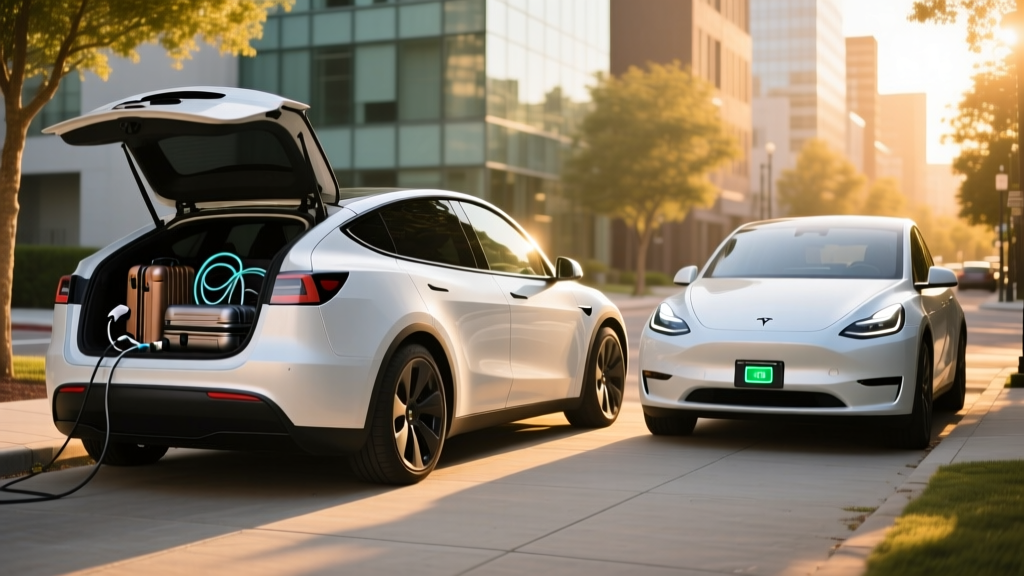
Once your garage is wired for both the electric motor for your garage door and a Level 2 charger, the ongoing economics strongly favor electric. Here's a concrete breakdown comparing a 2026 Tesla Model Y Long Range (320 miles EPA, 75 kWh usable battery, NMC chemistry) against a comparable 2026 Toyota RAV4 gas AWD (30 MPG combined).
| Metric | Tesla Model Y LR (BEV) | Toyota RAV4 AWD (Gas) |
|---|---|---|
| EPA range / fuel economy | 320 mi / 122 MPGe | 30 MPG combined |
| Annual miles driven | 12,000 | 12,000 |
| Energy consumed per year | ~3,530 kWh | ~400 gallons |
| Home charging cost ($0.16/kWh avg) | $565/year | — |
| Gas cost ($3.50/gal avg) | — | $1,400/year |
| Annual fuel savings (EV) | ~$835/year | |
| 5-year fuel savings | ~$4,175 | |
Source: Efficiency data from fueleconomy.gov. Electricity rates based on the 2025 EIA national average of $0.16/kWh. Actual costs vary by state — California averages $0.28/kWh while Louisiana averages $0.10/kWh.
Maintenance savings compound this advantage. BEVs eliminate oil changes ($40–$80 each, 2×/year), transmission fluid, spark plugs, and exhaust system repairs. Brake pad life extends 2–3× thanks to regenerative braking. The trade-off: EV insurance premiums run 15–25% higher on average, and tire replacement can come sooner due to higher vehicle weight and instant torque.
Real-World Home Charging Considerations for First-Time EV Buyers
Before committing to an EV purchase, honestly assess these factors:
Do You Have Reliable Garage or Driveway Access?
Level 2 charging at home is where 80–90% of EV charging happens for most owners. If you park on the street or in a shared lot without charging access, public DC fast charging (at $0.35–$0.55/kWh) will erode much of the cost advantage. A 75 kWh battery charged entirely at public DC stations costs ~$1,050–$1,650/year — nearly matching gas.
What's Your Climate?
Cold weather reduces EV range by 15–30% at 20°F due to battery chemistry limitations and cabin heating demand. A 320-mile EPA-rated Model Y may deliver 225–270 real-world miles in a Minnesota winter. Heat pumps (standard on Hyundai/Kia E-GMP vehicles, Tesla since 2021) mitigate this loss by 5–10 percentage points versus resistive heaters.
What Are Your Daily Driving Patterns?
The average American drives 37 miles/day. A Level 2 charger adding 25–35 miles of range per hour easily replenishes daily use overnight. But if you regularly drive 200+ miles one-way, you'll rely on DC fast charging — check your route for Tesla Supercharger or Electrify America coverage before buying.
Federal Tax Credit Eligibility (§30D)
For 2026, the federal EV tax credit under IRS §30D provides up to $7,500, but eligibility depends on multiple factors. The credit can now be transferred to the dealer at point of sale as an immediate price reduction. Key requirements:
| Myth | Fact (2026 Rules) |
|---|---|
| "Every EV qualifies for $7,500" | Only vehicles meeting battery-sourcing and critical-mineral requirements qualify; many models get $3,750 or $0 |
| "I can claim it regardless of income" | AGI caps apply: $150K single, $225K head of household, $300K joint filers |
| "Any price EV qualifies" | MSRP caps: $55,000 for sedans, $80,000 for SUVs/trucks/vans |
| "I need to wait until tax filing" | Point-of-sale transfer available since 2024 — dealer reduces price at purchase |
| "Used EVs don't qualify" | Used EVs can qualify for up to $4,000 (30% of sale price) under §25E with lower income caps |
Verify current eligibility at irs.gov. State incentives vary widely — consult your state energy office or a tax professional for local rebates.
Garage Electrical Layout: Integrating EV Charging with Existing Circuits
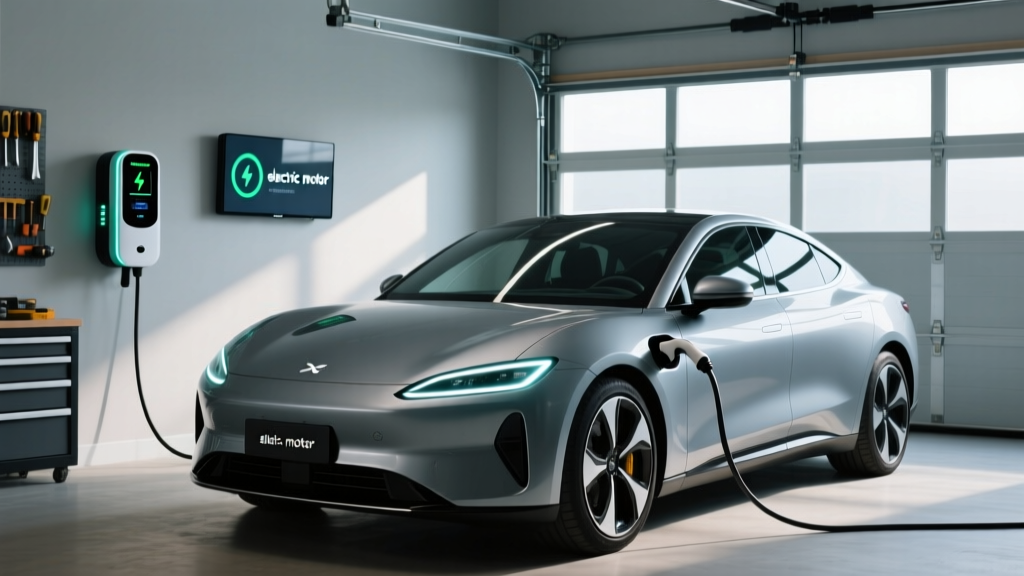
When your electrician surveys the garage, they'll map existing circuits. A typical garage electrical layout includes:
- Garage door opener circuit: 120V, 15–20A dedicated — powers the electric motor for garage door operation plus safety sensors and lighting
- General lighting: 120V, 15A — overhead LED or fluorescent fixtures
- Convenience outlets: 120V, 20A GFCI — workbench, tools, freezer
- NEW — EV charger circuit: 240V, 50A dedicated — hardwired or NEMA 14-50 receptacle
The critical point: the EV charger circuit must be dedicated — it cannot share with the garage door opener or any other load. This is a NEC requirement for continuous-duty equipment. Your electrician will run new 6 AWG copper wire (or 4 AWG aluminum) from the panel to the charger location, typically along the garage ceiling or wall.
If your garage door opener is on a circuit that also serves outlets you planned to use for Level 1 (120V) EV trickle charging, know that Level 1 delivers only 1.4–1.9 kW — adding roughly 3–5 miles of range per hour. That's adequate for PHEVs with 25–40 miles of electric range, but impractical for full BEVs with 70–100 kWh batteries needing 8–12 hours on Level 1.
Decision Framework: What's Right for Your Situation?
Choose Your Path
IF you have a 200A panel, garage parking, and under 100 miles/day driving → Install a 48A Level 2 charger (e.g., ChargePoint Home Flex, $550 hardware + $800–$1,200 install). This covers virtually all daily needs and pairs well with any current BEV.
IF you have a 100A panel → Get a load calculation first ($150–$300 from a licensed electrician). If the calculation shows insufficient headroom, either upgrade to 200A ($1,500–$3,000) or install a smart load management device that dynamically caps charger amperage when other appliances cycle on.
IF you're buying a PHEV (Toyota RAV4 Prime, 42 mi electric; Jeep Wrangler 4xe, 22 mi electric) → Level 2 is optional but recommended. A 32A charger ($400 hardware + $600–$900 install) will fully recharge most PHEV batteries in 2–3 hours. Level 1 works but takes 5–12 hours depending on battery size.
IF you lack home charging access → Consider a PHEV instead of a BEV, or verify that workplace and public DC charging within 1 mile of your parking spot can reliably meet your needs. Relying solely on public charging is feasible but costs 2–3× more than home Level 2.
IF you live in extreme cold (regularly below 10°F) → Choose an EV with a heat pump and preconditioning capability. Preconditioning the battery while plugged in preserves range and enables faster DC charging. LFP battery chemistry (Tesla Model 3 RWD, base Model Y) tolerates 100% daily charging better than NMC but charges slower in cold without preconditioning.
5-Year Total Cost of Ownership: EV vs. Gas vs. PHEV
| Category | BEV (Tesla Model Y LR) | PHEV (RAV4 Prime) | Gas (RAV4 AWD) |
|---|---|---|---|
| MSRP (base) | $44,990 | $43,690 | $32,350 |
| Federal tax credit applied | −$3,750* | $0† | $0 |
| Net purchase price | $41,240 | $43,690 | $32,350 |
| 5-year fuel cost | $2,825 (home L2) | $3,500 (mix electric+gas) | $7,000 |
| 5-year maintenance | $1,800 | $2,800 | $3,500 |
| 5-year insurance (est.) | $9,500 | $7,500 | $6,500 |
| Estimated 5-yr depreciation | $18,000 | $16,000 | $14,000 |
| 5-Year Total Cost | $73,365 | $73,490 | $63,350 |
*Model Y credit amount depends on battery sourcing compliance — verify at purchase. †RAV4 Prime is assembled in Japan and does not meet §30D North American assembly requirements.
The BEV and PHEV reach near-parity over 5 years despite higher purchase prices, driven by fuel and maintenance savings. Depreciation remains the wildcard — EV resale values have been volatile. The gas vehicle still wins on pure upfront cost, but the gap narrows each year as battery prices decline.
Frequently Asked Questions
Can I plug my EV charger into the same outlet as my garage door opener?
No. Level 2 EV chargers require a dedicated 240V circuit — they cannot share with any other appliance, including garage door opener motors. Level 1 (120V) chargers can technically share a 20A outlet circuit, but the garage door motor's startup surge (which can briefly draw 2–3× its running amperage) may trip the breaker during simultaneous use. A dedicated circuit is the safe, code-compliant choice.
Will charging my EV trip the breaker when I open the garage door?
If both are on properly sized, separate circuits — no. A 50A dedicated EV circuit and a 15A or 20A dedicated garage door opener circuit operate independently. Problems arise only if an electrician improperly wired multiple loads onto a single circuit or if your panel is overloaded overall. A professional load calculation eliminates this risk.
Do I need to upgrade my garage door opener motor for EV charging?
No. Your existing electric motor for garage door operation is unaffected by EV charger installation as long as each has its own dedicated circuit. However, if you're already running new electrical work in the garage, it's a good time to replace an aging chain-drive opener with a quieter belt-drive DC motor unit ($250–$400 installed) that draws less power and includes battery backup.
How much does it cost to charge an EV at home vs. gas per mile?
At the national average electricity rate of $0.16/kWh and an EV efficiency of 3.5 miles/kWh (typical for a midsize crossover), home Level 2 charging costs approximately $0.046 per mile. Gas at $3.50/gallon and 30 MPG costs $0.117 per mile. That's a per-mile savings of roughly 60% with home EV charging.
What size Level 2 charger should I install?
For most BEV owners, a 48-amp charger on a 60-amp circuit delivers 11.5 kW — enough to add 35–45 miles of range per hour and fully recharge a 75–100 kWh battery overnight. If your panel capacity is limited, a 32-amp charger on a 40-amp circuit (7.7 kW) still adds 25–30 miles per hour and suits daily driving needs. Always install the largest circuit your panel supports; you can set the charger to draw less via its app.
Is a hardwired EV charger better than a NEMA 14-50 plug?
Hardwired installations support higher amperage (up to 48A–80A depending on the unit), eliminate the $75–$150 cost of a quality 14-50 receptacle, and reduce one potential point of connection failure. A NEMA 14-50 plug offers portability — useful if you might move or want to take the charger with you. For a permanent garage installation where your electric motor for garage door is also hardwired, hardwiring the charger is the cleaner, more reliable approach.