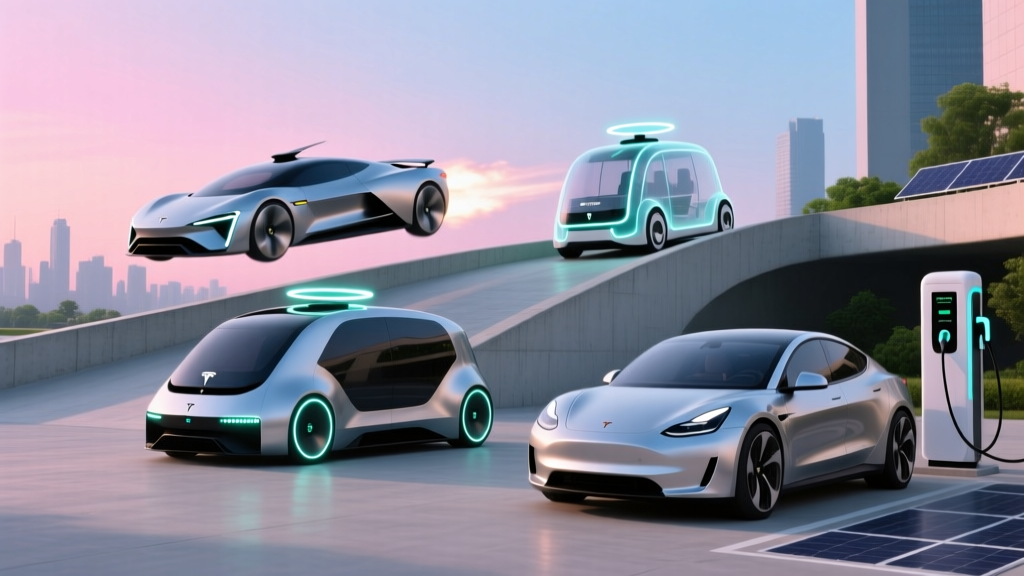
As of early 2026, Tesla's current lineup — Model 3, Model Y, Model S, Model X, and Cybertruck — remains the core of its consumer offerings. But the question dominating forums and investor calls alike is: what future Tesla models are actually coming, and when can buyers expect them? After years of shifting timelines, Elon Musk's keynote reveals, and earnings-call hints, a clearer picture is finally emerging. Below, we break down every announced or strongly signaled upcoming Tesla vehicle, pairing preliminary specifications with honest analysis of what's confirmed, what's estimated, and what remains speculative.
Tesla Roadster (Next-Gen): The Long-Promised Hypercar
First teased in 2017 and repeatedly delayed, the next-generation Tesla Roadster remains the most anticipated — and most elusive — of all future Tesla models. Musk confirmed in late 2025 that the Roadster is targeted for a late-2026 or early-2027 reveal, with production potentially beginning in 2027. While exact specifications remain under wraps, earlier announcements and engineering signals give us a working framework.
| Spec | Preliminary / Estimated |
|---|---|
| EPA Range (est.) | ~620 miles (with optional SpaceX cold-gas thruster package) |
| Base Range (est.) | ~400 miles (standard battery pack) |
| Battery Capacity | ~200 kWh (estimated, NMC chemistry likely) |
| 0-60 mph | 1.9 seconds (claimed with thruster package) |
| Horsepower | 1,000+ HP (tri-motor AWD) |
| Top Speed | 250+ mph (claimed) |
| Drivetrain | AWD, tri-motor (one front, two rear) |
| Max DC Fast Charge | Estimated 350+ kW (next-gen 4680 cells) |
| 10-80% Charge Time | Estimated ~20 minutes (preliminary) |
| Base MSRP (est.) | $200,000+ (Founders Series previously listed at $250,000) |
Real-World Range Expectations
A 200 kWh pack pushing a low-drag sports car could theoretically achieve 600+ EPA miles. However, real-world highway driving at 75+ mph typically reduces EV range by 15-25% compared to the EPA combined cycle. Cold-weather operation at 20°F can further reduce range by 20-30%. Expect real-world highway range closer to 450-500 miles in moderate conditions, dropping to 350-400 miles in winter — still exceptional, but not the headline number.
Does the Roadster Qualify for the Federal Tax Credit?
Almost certainly not. The IRS §30D credit caps eligible vehicles at $80,000 MSRP for SUVs/pickups/vans and $55,000 for sedans/sports cars. At an estimated $200,000+, the Roadster will far exceed this threshold. Buyers should also note the income caps: $150,000 single / $300,000 joint filer for new EVs. Consult a tax professional and the latest IRS guidance on clean vehicle credits.
Who the Roadster Suits
This is a halo car, not a daily driver. It targets collectors, performance enthusiasts, and early adopters willing to pay supercar money for electric hypercar performance. It is not a practical family vehicle, commuter, or road-tripper — cargo space will be minimal (likely under 5 cu ft combined), and the thruster package raises serious regulatory and insurance questions.
Tesla Robotaxi (Cybercab): The Purpose-Built Autonomous Platform
Unveiled at the "We, Robot" event in October 2024 and further detailed through 2025, Tesla's purpose-built Robotaxi — often called the Cybercab — represents perhaps the most consequential of all future Tesla models. Tesla has targeted a 2026 production start, though the vehicle is designed primarily for fleet/ride-hail operation rather than individual consumer ownership.
| Spec | Announced / Estimated |
|---|---|
| Seating | 2 passengers (no steering wheel or pedals) |
| EPA Range (est.) | ~250-300 miles |
| Battery Capacity | ~50-60 kWh (estimated, LFP likely for cost optimization) |
| Autonomy Level | SAE Level 4 (intended for geofenced driverless operation) |
| Charging | Wireless inductive charging (no plug port planned) |
| Max DC Fast Charge | Estimated 150-200 kW (if wired backup exists) |
| Estimated Production Cost | Under $30,000 per unit (Tesla target) |
| Consumer Availability | Not confirmed — fleet-first model |
Charging and Infrastructure Reality
Tesla's plan for wireless inductive charging pads at dedicated Cybercab depots is ambitious but unproven at scale. Inductive charging typically operates at 11-20 kW for passenger vehicles, meaning a full charge from 10-80% on a ~55 kWh battery could take 2-3 hours. For fleet economics, this requires high utilization and depot-based scheduling. If Tesla includes a wired CCS/NACS port as a backup, expect DC fast charging at 150-200 kW, yielding a 10-80% time of approximately 20-25 minutes.
Can Consumers Buy the Cybercab?
As of early 2026, Tesla has not confirmed a consumer purchase option for the Robotaxi. The business model mirrors Waymo's approach: Tesla owns and operates the fleet, earning revenue per ride. Musk has suggested individuals could add their own vehicles to a shared fleet, but regulatory frameworks for this in most U.S. states remain undeveloped. This is not a vehicle you can currently order or pre-order.
Next-Generation Compact Tesla ("Model 2" / "Redwood"): The $25,000 EV
The most commercially significant of all future Tesla models is the next-generation compact platform, internally codenamed "Redwood." Multiple earnings calls throughout 2024-2025 have pointed to a 2026-2027 launch, with production planned at Gigafactory Texas and potentially a next-gen platform that underpins multiple body styles. The stated goal: a starting price around $25,000 before incentives.
| Spec | Estimated / Projected |
|---|---|
| Body Styles | Compact crossover, possibly hatchback variant |
| EPA Range (est.) | 250-300 miles |
| Battery Capacity | ~50-65 kWh (LFP chemistry expected for base trim) |
| Drivetrain | RWD (base), AWD dual-motor (optional) |
| 0-60 mph | ~5.5-6.5 seconds (RWD, estimated) |
| Horsepower | ~200-280 HP (single/dual motor) |
| Max DC Fast Charge | Estimated 170-200 kW (next-gen 4680 LFP cells) |
| 10-80% Charge Time | Estimated 22-28 minutes |
| Level 2 Home Charging | ~11.5 kW (44 mi/hr estimated) |
| Base MSRP | ~$25,000 (target, before destination) |
| Cargo Volume | Estimated 20-25 cu ft (rear seats up) |
Real-World Range and Efficiency
A compact crossover with a ~60 kWh LFP pack and Tesla's efficiency leadership (likely 3.5-4.0 mi/kWh) could realistically achieve 250-280 EPA miles. In real-world highway driving at 70 mph, expect 210-240 miles before needing to charge. Winter conditions at 20°F with cabin heating could drop this to 170-200 miles. LFP batteries handle cold somewhat better than NMC in terms of longevity, but range loss in winter remains a physics constraint for all lithium-ion chemistries.
Federal Tax Credit Eligibility
At a $25,000 MSRP, this compact Tesla would clear the §30D price cap ($55,000 for cars, $80,000 for SUVs/trucks). However, the full $7,500 credit depends on battery component and critical mineral sourcing requirements that tighten annually. As of 2026, vehicles must meet increasingly strict domestic-content thresholds. Tesla's LFP cells have historically sourced from CATL (China), which may trigger the Foreign Entity of Concern (FEOC) exclusion. Tesla is actively building domestic LFP capacity, but eligibility will depend on the specific production batch and timing. Always verify current eligibility at fueleconomy.gov before purchasing.
| Scenario | Estimated Price |
|---|---|
| Base MSRP (RWD) | $25,000 |
| With full $7,500 §30D credit | $17,500 |
| With $3,750 partial credit (minerals only) | $21,250 |
| No credit (FEOC sourcing exclusion) | $25,000 |
Who This Compact Suits
This is Tesla's play for the mass market: first-time EV buyers, urban commuters, budget-conscious families needing a second car, and rideshare drivers. At $25,000 with potential incentives, it directly competes with the Chevrolet Bolt's successor, base Hyundai Kona Electric, and Nissan's next-gen Leaf. It's not a road-trip champion (250 miles requires planning on 400-mile days), but for daily commuting under 80 miles round-trip, it's ideal.
Tesla Model Y "Juniper" Refresh: Already Here, Still Evolving
While not a "future" model per se, the refreshed Model Y (codename Juniper) launched in early 2025 and continues to receive updates through 2026. It's worth addressing because many shoppers searching for future Tesla models are actually weighing whether to wait for something new or buy the updated Model Y now.
| Spec | 2026 Model Y Long Range AWD |
|---|---|
| EPA Range | 320 miles |
| Battery | ~78 kWh usable (NMC) |
| 0-60 mph | 4.8 seconds |
| Horsepower | 384 HP |
| Max DC Fast Charge | 250 kW |
| 10-80% Charge Time | ~25 minutes |
| Level 2 Rate | 11.5 kW (44 mi/hr) |
| MPGe (combined) | 122 MPGe |
| Cargo Volume | 30.2 cu ft (rear up), 72.1 cu ft (rear folded) |
| Base MSRP | $48,990 (Long Range AWD) |
| Battery Warranty | 8 years / 120,000 miles |
Real-World Range Check
The Juniper refresh brought improved aerodynamics and a heat pump as standard, boosting cold-weather efficiency. Expect 270-290 miles of real-world highway range in mild weather, and 220-250 miles in sub-freezing conditions. The 250 kW peak charge rate tapers significantly above 60% SoC — plan for ~25 minutes 10-80% at a V3 Supercharger, but a full 10-100% session takes closer to 50 minutes.
Should You Wait for Future Tesla Models Instead?
If you need a vehicle in 2026, the Model Y Juniper is a known quantity with established Supercharger access, proven reliability data, and current §30D eligibility (verify sourcing rules). The compact "Model 2" won't arrive until late 2026 at the earliest and may face initial production constraints. The Roadster is a niche hypercar. The Robotaxi isn't a consumer purchase. For most buyers, the updated Model Y remains the pragmatic choice.
Charging Infrastructure: What Future Tesla Models Mean for Owners
Every future Tesla model will use the NACS (North American Charging Standard) connector, which Tesla opened to other manufacturers in 2023. By 2026, the Supercharger network has expanded to over 6,500 stalls in North America, with V4 cabinets delivering up to 350 kW to capable vehicles. Here's what charging looks like across the upcoming lineup:
| Model | Max DC kW | 10-80% Time | Level 2 Home Rate | Miles/Hour (L2) |
|---|---|---|---|---|
| Roadster (est.) | 350 kW | ~20 min | 19.2 kW | ~55 mi/hr |
| Robotaxi (est.) | ~200 kW | ~25 min | Wireless (est. 11 kW) | ~35 mi/hr |
| Compact/"Model 2" (est.) | ~175 kW | ~25 min | 11.5 kW | ~44 mi/hr |
| Model Y Juniper (current) | 250 kW | ~25 min | 11.5 kW | ~44 mi/hr |
Home charging remains the backbone of Tesla ownership. A Level 2 wall connector installation typically costs $500-$2,000 depending on panel capacity and run length. Most future Tesla models will support 11.5 kW (48A) home charging, requiring a 60A dedicated circuit. Homes with 100A electrical panels may need a $1,500-$3,000 panel upgrade to support simultaneous EV charging and heavy appliance use.
Pros, Cons, and the Decision Framework
Pros of Waiting for Future Tesla Models
- Potentially lower entry price ($25K compact)
- Next-gen 4680 cells with improved energy density
- LFP chemistry in affordable trims (100% daily charging OK)
- Full NACS ecosystem access with expanding Supercharger network
- Purpose-built robotaxi could reshape ride-hail costs
Cons and Risks of Waiting
- Timeline uncertainty — Tesla has a history of delays
- Early production quality issues common in new platforms
- Tax credit eligibility uncertain for new models (sourcing rules)
- No consumer availability confirmed for Robotaxi
- Roadster pricing excludes most buyers ($200K+)
Wait for the compact "Model 2" if: your budget is under $30,000, you don't need a vehicle urgently, your commute is under 80 miles daily, and you want the lowest-cost entry into the Tesla/Supercharger ecosystem.
The Roadster and Robotaxi are not practical purchase decisions — the former is a low-volume halo car, and the latter is a fleet platform unlikely to be sold to individual consumers.
Frequently Asked Questions
What is the cheapest future Tesla model expected?
The next-generation compact ("Model 2" / Redwood platform) is targeted at approximately $25,000 MSRP before incentives. If it qualifies for the full §30D federal credit, the effective price could drop to $17,500. However, battery sourcing rules may limit credit eligibility, and production timing remains uncertain beyond a 2026-2027 window.
When will the Tesla Roadster actually ship?
Tesla has targeted late 2026 for a reveal with production beginning in 2027. Given Tesla's history of timeline slippage (the Roadster was originally announced for 2020), treat 2027-2028 as a more realistic delivery window. The previously listed $200,000 reservation deposit and Founders Series pricing suggest a vehicle well over $200,000 at delivery.
Can I buy the Tesla Robotaxi (Cybercab) for personal use?
Tesla has not confirmed a consumer purchase option for the Cybercab. The announced model is designed for autonomous fleet operation without a steering wheel or pedals, making it unsuitable (and likely illegal) for personal ownership under current U.S. vehicle regulations. Some states may develop frameworks for personal autonomous vehicles, but none exist as of early 2026.
Will future Tesla models use LFP or NMC batteries?
Both. Tesla is expected to use LFP (lithium iron phosphate) chemistry in base/affordable trims for its lower cost and longer cycle life, while reserving NMC (nickel manganese cobalt) for Long Range and Performance variants where energy density matters more. The Roadster will almost certainly use NMC or a next-gen high-nickel variant for maximum range. LFP owners can charge to 100% daily; NMC owners should set daily limits to 80%.
Do future Tesla models qualify for the $7,500 federal tax credit?
Eligibility depends on MSRP caps ($55,000 for cars, $80,000 for SUVs), buyer income limits ($150K single / $300K joint), and increasingly strict battery sourcing requirements under §30D. The $25,000 compact would clear the price cap but may face FEOC (Foreign Entity of Concern) restrictions depending on LFP cell sourcing. The Roadster exceeds the price cap entirely. Always check current eligibility at fueleconomy.gov and consult a tax professional.
Should I wait for future Tesla models or buy now?
If your current vehicle is functional and your budget is under $30,000, waiting 12-18 months for the compact platform could yield significant savings. If you need a vehicle now and can afford $40,000+, the refreshed Model 3 and Model Y are proven, efficient, and have established charging infrastructure. The Roadster and Robotaxi are not relevant to typical purchase decisions.
Sources: Tesla Q4 2025 earnings call transcripts, IRS §30D Clean Vehicle Credit guidance, fueleconomy.gov for current Model Y specifications. All future-model specs are preliminary and subject to change.