Freightliner Electric Trucks: The Quick Answer for Fleet Buyers
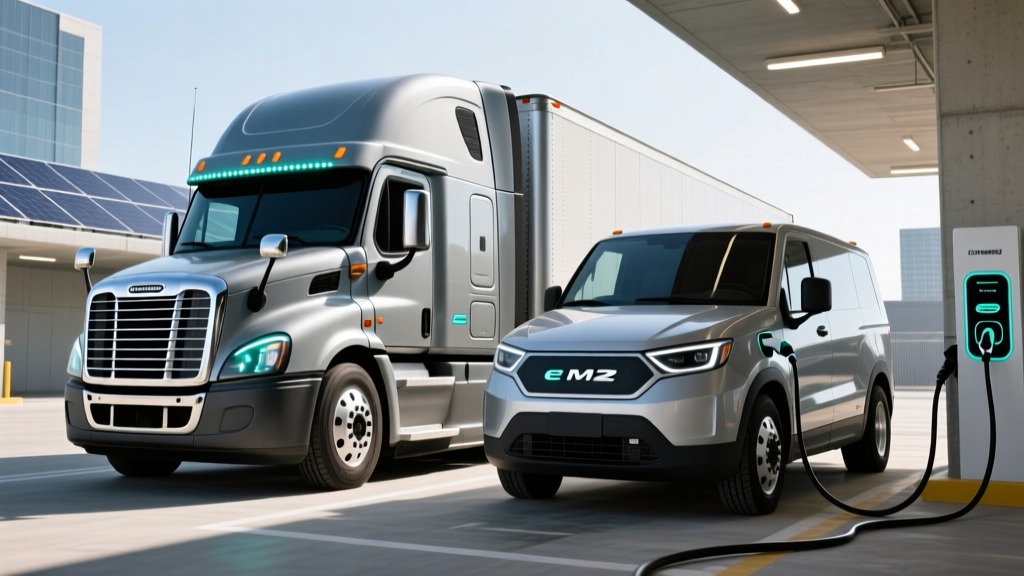
Bottom line: Freightliner currently offers two production battery-electric commercial trucks in the US: the Class 8 eCascadia (regional haul/drayage) and the Class 6/7 eM2 (local delivery, box truck, vocational). The eCascadia delivers an EPA-estimated ~230 miles of range from a 438 kWh battery pack, peaks at ~250 kW DC fast charging (10–80% in roughly 90 minutes), and carries a base price in the $350,000–$420,000 range before incentives. The eM2 offers ~230 miles from a 315 kWh pack at a lower entry price. Both qualify for the Commercial Clean Vehicle Credit (IRS §45W) — up to $40,000 for vehicles over 14,000 lbs GVWR — plus state-level HVIP and IRA bonus credits that can stack to cut effective cost by 40–60%.
If you're evaluating a Freightliner electric truck for a fleet or owner-operator operation, this guide breaks down the real-world numbers: range under load, depot charging infrastructure costs, diesel-vs-electric fuel savings, and the decision framework for whether battery-electric makes sense on your routes today.
Freightliner eCascadia vs eM2: Side-by-Side Specs
Freightliner (a Daimler Truck brand) has been producing electric trucks at scale since 2022, with cumulative production surpassing thousands of units by 2026. Here's how the two current models compare on paper and in practice.
| Specification | eCascadia (Class 8) | eM2 (Class 6/7) |
|---|---|---|
| GVWR | 82,000 lbs (tractor + trailer) | 26,000–33,000 lbs |
| Battery Capacity | 438 kWh (usable ~375 kWh) | 315 kWh (usable ~270 kWh) |
| Battery Chemistry | NMC (nickel manganese cobalt) | NMC |
| EPA-Estimated Range | ~230 miles | ~230 miles |
| Real-World Range (loaded, highway) | ~150–190 miles | ~170–210 miles |
| Peak DC Fast Charge Rate | ~250 kW (CCS1) | ~150 kW (CCS1) |
| 10–80% Charge Time | ~90 minutes | ~60 minutes |
| Motor Output | ~470 hp (peak) / 428 hp (continuous) | ~250 hp (peak) |
| Peak Torque | ~1,640 lb-ft | ~750 lb-ft |
| Base MSRP (approx.) | $350,000–$420,000 | $250,000–$310,000 |
| Battery Warranty | 10 years / 1,000,000 miles (to 70% SoH) | 10 years / 500,000 miles (to 70% SoH) |
Real-world range note: EPA range figures for Class 8 trucks are measured under controlled conditions. In actual fleet operations — hauling 40,000+ lbs at 65 mph on highways in moderate climate — expect the eCascadia to deliver 150–190 miles before needing a charge. In cold weather (below 32°F), battery heating and cabin HVAC can reduce that by an additional 15–25%. The eM2, used for stop-and-go delivery routes at lower speeds, tends to achieve range closer to its EPA sticker because regenerative braking recaptures more energy in urban duty cycles.
Diesel vs Electric: Operating Cost Comparison
The purchase price of a Freightliner electric truck is roughly 2.5–3x that of a comparable diesel Cascadia or M2. The economic case rests entirely on lower per-mile energy costs, reduced maintenance, and incentive stacking. Here's what the numbers look like for a typical regional-haul eCascadia vs a diesel Cascadia over a 5-year, 500,000-mile horizon.
| Cost Category (5 yr / 500k mi) | eCascadia (Electric) | Diesel Cascadia |
|---|---|---|
| Vehicle Purchase (after §45W credit) | $310,000–$380,000 | $150,000–$180,000 |
| Fuel / Energy | $45,000–$70,000 (depot charging) | $175,000–$220,000 (diesel @ ~$4.20/gal) |
| Maintenance (oil, filters, DPF, brakes) | $12,000–$18,000 | $40,000–$60,000 |
| Insurance | $35,000–$45,000 | $30,000–$40,000 |
| Depot Charger Install (amortized) | $30,000–$50,000 | $0 |
| Total Estimated 5-Year Cost | $432,000–$563,000 | $395,000–$500,000 |
Key takeaway: At current diesel prices and typical commercial electricity rates ($0.10–$0.18/kWh for depot charging), the eCascadia reaches cost parity with diesel around year 4–5 of operation — but only if the truck runs high-utilization routes (80,000+ miles/year) and charges primarily at depot rates. Public DC fast charging at $0.40–$0.70/kWh destroys the economic advantage quickly.
Fuel savings alone can reach $130,000–$150,000 over five years, and maintenance savings add another $25,000–$40,000. Electric motors have no oil changes, no diesel particulate filter replacements, no DEF fluid, and regenerative braking significantly extends brake pad life.
Depot Charging Infrastructure: What It Actually Costs
Unlike passenger EVs where home charging is straightforward, Freightliner electric trucks require depot-level DC or high-power AC charging infrastructure. This is often the most underestimated cost in fleet electrification.
Typical Depot Charging Setup
- Level 2 AC charging (19.2 kW per truck): ~$5,000–$12,000 per charger + $15,000–$40,000 electrical infrastructure per stall. Sufficient for overnight charging of eM2 trucks (full charge in ~14–16 hours).
- DC fast charging (60–150 kW per truck): ~$40,000–$80,000 per charger + $25,000–$60,000 infrastructure per stall. Required for eCascadia operations needing mid-day top-ups (10–80% in 60–90 min).
- Utility upgrades: Many depots need transformer upgrades, new switchgear, or even dedicated medium-voltage service. Budget $50,000–$200,000+ for a 5-truck depot depending on existing service capacity.
- Software & management: Fleet charging management platforms (Detroit Connect, ChargePoint, or third-party) add $500–$2,000/year per vehicle for scheduling, load management, and utility demand-charge optimization.
Critical reality: Utility demand charges — fees based on your peak power draw in a billing period — can add $0.05–$0.20/kWh to your effective charging cost if not managed. Smart charging software that staggers truck charging and avoids simultaneous peak draws is not optional; it's essential for economic viability. Freightliner's Detroit eFill charging platform and partnerships with utilities help manage this, but fleets must budget for it explicitly.
Tax Credits and Incentives: Stacking the Savings
Federal and state incentives dramatically alter the purchase equation for Freightliner electric trucks. Here's what's available as of 2026:
Federal Commercial Clean Vehicle Credit (§45W)
- Up to $40,000 for qualified commercial EVs with GVWR over 14,000 lbs (both eCascadia and eM2 qualify)
- No per-manufacturer cap, no buyer income cap (unlike the §30D consumer credit)
- Must be placed in service for business use; claimed on IRS Form 8936
- Vehicle must meet battery component and critical mineral sourcing requirements — verify current-year compliance with IRS guidance
Additional Incentive Layers
- California HVIP (Hybrid and Zero-Emission Truck and Bus Voucher): $60,000–$120,000+ per Class 8 truck depending on fleet size and drayage/short-haul eligibility
- IRA §179 deduction: Full expensing of qualifying commercial vehicles in the year placed in service
- Utility make-ready programs: Many utilities (PG&E, SCE, ConEdison) cover 50–100% of depot electrical infrastructure costs
- State/local air quality grants: Vary by jurisdiction — check your state's clean transportation authority
Stacked example (California fleet): A $400,000 eCascadia with $40,000 federal credit + $90,000 HVIP voucher + $30,000 utility make-ready contribution = effective cost of ~$240,000 — narrowing the gap with a $165,000 diesel significantly.
Real-World Ownership: What Fleet Operators Report
Based on fleet operator data and Freightliner's published case studies from 2024–2026 deployments, here's what ownership actually looks like:
Route Suitability
The eCascadia excels in regional haul and drayage — routes under 150 miles round-trip with depot return for overnight charging. Typical use cases include port drayage (LA/Long Beach, NY/NJ), food/beverage distribution, and LTL (less-than-truckload) regional routes. Long-haul OTR (over-the-road) operations exceeding 250 miles one-way are not yet viable without en-route DC fast charging infrastructure, which remains sparse for heavy-duty trucks.
Cold Weather Performance
Fleets operating in northern climates (Minnesota, Montana, New England) report 20–30% range reduction in sustained sub-freezing temperatures. Battery thermal preconditioning helps, but cabin heating at highway speeds is a significant energy draw. Fleets in these regions often spec shorter routes or add mid-day charging capability.
Driver Acceptance
Surprisingly strong. Drivers consistently report preferring the eCascadia's instant torque (1,640 lb-ft from zero RPM), smooth acceleration, dramatically lower noise and vibration, and one-pedal driving capability in stop-and-go traffic. The absence of a diesel engine means no DEF top-offs, no DPF regen cycles, and no engine braking noise in residential areas.
Maintenance Reality
Electric drivetrain maintenance is minimal — no oil, no filters, no emissions systems. The primary maintenance items are tire rotation (heavier axle loads accelerate wear), cabin air filters, coolant system checks, and brake inspections (brakes last 2–3x longer due to regen). Fleets report 60–70% lower scheduled maintenance costs vs diesel counterparts.
Decision Framework: Should Your Fleet Go Electric?
Choose a Freightliner electric truck if:
- Your routes are under 150 miles round-trip with depot return
- You operate in a state with strong HVIP/voucher programs (CA, NY, NJ, CO, WA, OR)
- Your trucks run 80,000+ miles/year (fuel savings justify the premium faster)
- You have depot or yard space where charging infrastructure can be installed
- You face regulatory pressure (California's Advanced Clean Fleets rule, CARB mandates, or port clean-truck requirements)
- Your operation includes drayage, local delivery, or urban distribution
Stick with diesel (or wait) if:
- Your routes regularly exceed 250 miles one-way without reliable en-route HD charging
- You operate in extreme cold climates with no flexibility for range reduction
- Your trucks run under 40,000 miles/year (payback period stretches beyond battery warranty)
- You lack depot ownership or utility cooperation for charging infrastructure
- Your operation requires heavy towing or extreme-grade mountain routes that drain batteries faster than diesel fuel
Common Misconceptions About Freightliner Electric Trucks
| Myth | Fact |
|---|---|
| "Electric trucks can't pull heavy loads" | The eCascadia is rated for 82,000 lbs GCW and delivers 1,640 lb-ft of torque from standstill. It pulls fully loaded 53-foot trailers in regular port and regional service across North America. |
| "The batteries will need replacing in 5 years" | Freightliner warranties the battery pack for 10 years / 1,000,000 miles to 70% state of health. NMC chemistry in heavy-duty packs with active thermal management shows degradation curves of ~2–3% per year in fleet data. |
| "Charging takes too long for commercial operations" | Overnight depot charging (Level 2, 10–12 hours) covers most regional routes. DC fast charging at 250 kW adds 150+ miles in 60 minutes for mid-day top-ups. Smart scheduling makes this operationally viable. |
| "The grid can't support fleet charging" | Most depot charging happens overnight during off-peak hours when grid capacity is abundant. Utility make-ready programs and managed charging software prevent demand spikes. |
| "Electric trucks are more expensive overall" | Higher purchase price is offset by $130,000–$190,000 in fuel and maintenance savings over 5 years, plus up to $160,000+ in stacked incentives. TCO parity is achievable by year 4 for high-utilization fleets. |
First-Time Electric Truck Buyer Checklist
If you're evaluating your fleet's first Freightliner electric truck, work through this sequence before placing an order:
- Audit your routes: Pull GPS/ELD data for the last 12 months. Identify trucks running under 150 miles/day with overnight depot parking. These are your electrification candidates.
- Engage your utility early: Contact your commercial utility representative 12–18 months before planned deployment. Request a service capacity assessment and inquire about make-ready programs and EV rate schedules.
- Model your energy costs: Calculate your effective cost per kWh including energy charges, demand charges, and any time-of-use differentials. Target under $0.20/kWh all-in for economic viability vs diesel.
- Apply for incentives before purchasing: HVIP vouchers and many state grants require pre-approval before vehicle delivery. Start applications 6–12 months out.
- Plan charging infrastructure: Budget for chargers, electrical infrastructure, utility upgrades, and software. Expect 9–18 months from order to operational depot charging.
- Train drivers and technicians: Freightliner offers eCascadia-specific training through its Detroit training network. High-voltage safety certification for shop technicians is mandatory.
Frequently Asked Questions
What is the real-world range of the Freightliner eCascadia?
The EPA-estimated range is approximately 230 miles. In real-world regional haul operations with a loaded trailer at highway speeds, expect 150–190 miles. In cold weather below 32°F, plan for 130–160 miles. Stop-and-go urban drayage can extend range closer to the EPA figure due to regenerative braking.
How long does it take to charge a Freightliner electric truck?
On a 250 kW DC fast charger, the eCascadia charges from 10% to 80% in approximately 90 minutes. On a 19.2 kW Level 2 depot charger, a full charge takes 18–22 hours — suitable for overnight top-offs between shifts. The eM2 charges faster due to its smaller 315 kWh battery: ~60 minutes to 80% on a 150 kW DC charger.
Does the Freightliner eCascadia qualify for the $7,500 consumer EV tax credit?
No. The §30D consumer credit applies to light-duty passenger vehicles. The eCascadia qualifies for the §45W Commercial Clean Vehicle Credit, which provides up to $40,000 for heavy-duty commercial EVs. This credit has no per-manufacturer cap and no buyer income limit. Consult a tax professional and review current IRS §45W guidance for eligibility.
What happens if the battery degrades below 70%?
Freightliner's battery warranty covers 10 years or 1,000,000 miles (whichever comes first) for the eCascadia, guaranteeing a minimum of 70% state of health. If degradation exceeds that threshold within the warranty period, Freightliner will repair or replace the pack. Out-of-warranty battery replacement costs are estimated at $80,000–$120,000 for the eCascadia pack, though prices are expected to decline as battery costs continue falling.
Can I charge a Freightliner electric truck at a public Tesla Supercharger or Electrify America station?
Currently, most public DC fast charging networks are designed for light-duty vehicles with lower power delivery and physical clearances unsuitable for Class 8 trucks. The eCascadia uses a CCS1 connector. Dedicated heavy-duty charging corridors (WattEV, Tesla Megacharger for Semi, Greenlane) are being deployed but remain limited as of 2026. Depot charging is the primary refueling strategy.
How does the Freightliner eCascadia compare to the Tesla Semi?
The Tesla Semi claims a 500-mile EPA range and 30-minute 10–80% charge on a Megacharger, but as of 2026 it remains in limited production with only PepsiCo and a handful of early fleet customers. The eCascadia is in full production with thousands of units delivered, established dealer service networks, and proven fleet integration. If you need trucks today with full support infrastructure, the eCascadia is the available option. The Semi may be viable for long-haul routes if and when production scales and Megacharger infrastructure deploys.