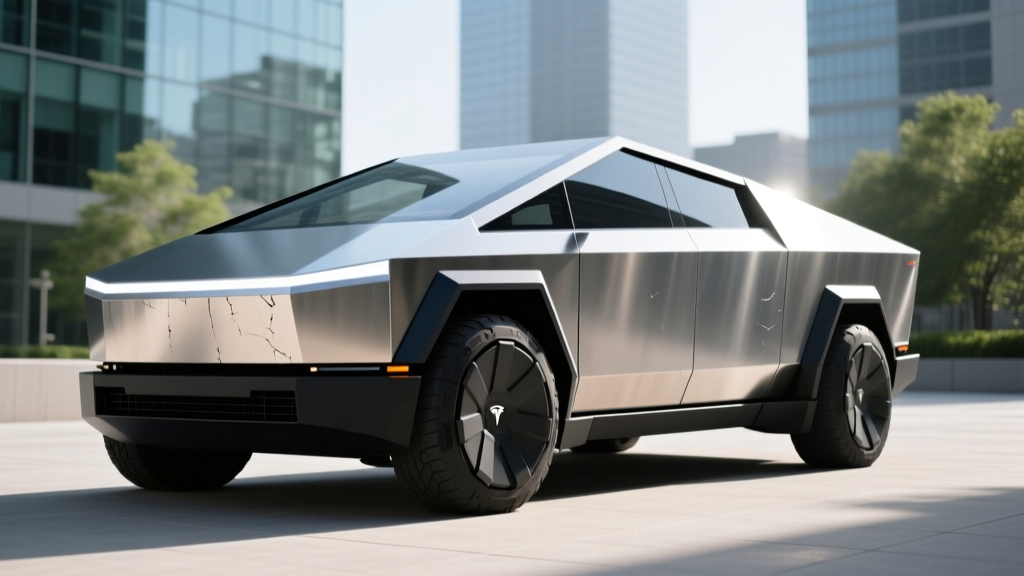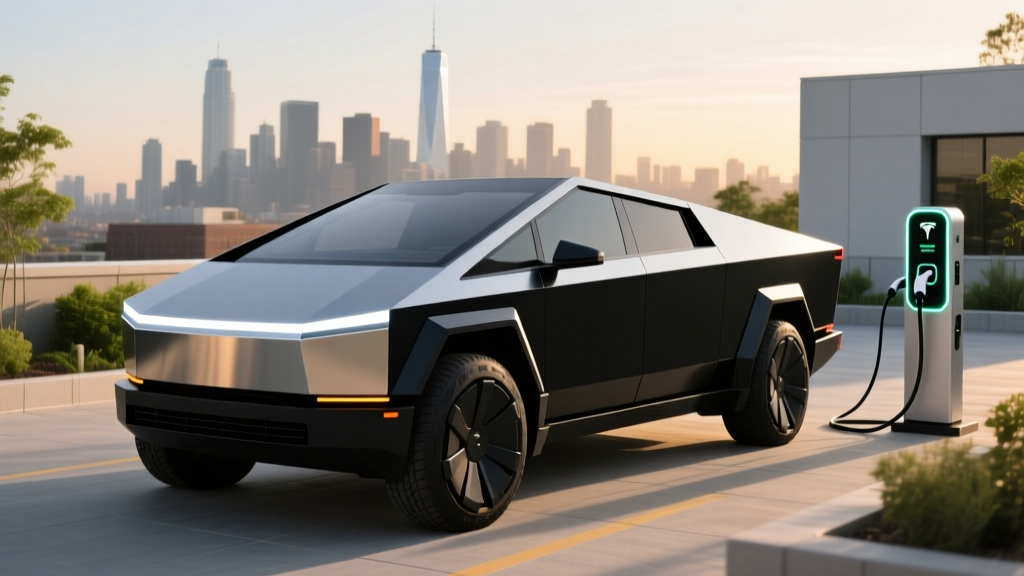
The Tesla Cybertruck Foundation Series arrived as the most expensive, fully loaded variant of Tesla's stainless-steel electric pickup — a first-year halo trim that bundles Full Self-Driving (Supervised), Powershare vehicle-to-home capability, and exclusive badging into a six-figure package. Now that initial deliveries have matured into a growing used market and Tesla has reshuffled its Cybertruck trim lineup for 2025–2026, the Foundation Series occupies a unique space: part collector's first-edition, part real-world testbed for the platform's most ambitious features.
This review breaks down the Foundation Series Cybertruck's EPA range versus what owners actually see on highways and in cold weather, its 800V-class DC fast-charging behavior, true ownership costs after federal tax credits, and how it stacks up against the Rivian R1T, Ford F-150 Lightning, and Chevrolet Silverado EV for buyers evaluating a premium electric truck today.
Foundation Series Cybertruck: Core Specifications at a Glance
| Attribute | Foundation Series (AWD Dual-Motor) |
|---|---|
| EPA Range | 320 miles (with range extender: up to ~470 mi est.) |
| Battery Capacity | ~123 kWh usable (NMC lithium-ion, structural pack) |
| Drivetrain | Dual-Motor AWD |
| Horsepower | 600 hp |
| 0–60 mph | 3.9 seconds |
| Peak DC Fast Charge | 350 kW (800V architecture) |
| 10–80% DC Charge Time | ~15–17 minutes (at V4 Supercharger) |
| Level 2 Home Charging | 11.5 kW (~37 miles/hr added) |
| MPGe (combined) | 59 MPGe (2.1 kWh/mi est.) |
| Towing Capacity | 11,000 lbs |
| Payload | 2,500 lbs |
| Bed Length | 6 ft (lockable vault) |
| Base MSRP (at launch) | $99,990 |
| Battery/Drive Unit Warranty | 8 years / 120,000 miles |
Real-World Range: What the EPA Sticker Doesn't Tell You
Real-World Highway (70–75 mph): ~240–270 miles
Real-World City/Mixed: ~280–300 miles
Cold Weather (below 32°F): ~200–240 miles (20–35% reduction)
The Foundation Series Cybertruck's 320-mile EPA rating applies to the dual-motor AWD configuration without the optional bed-mounted range extender battery. On paper, that's competitive with the Rivian R1T Dual-Motor Max Pack (352 mi EPA) and significantly ahead of the Ford F-150 Lightning Extended Range (320 mi EPA, though in a larger, heavier body).
In practice, the Cybertruck's angular stainless-steel exoskeleton creates substantial aerodynamic drag at highway speeds. Owners tracking efficiency via Tesla's onboard trip computer and third-party tools like Tessie report highway consumption between 2.3 and 2.6 kWh/mile at 70–75 mph — translating to roughly 240–270 miles of real-world highway range on a full charge. City driving, where regenerative braking recaptures energy, pushes efficiency closer to the EPA combined estimate of ~2.1 kWh/mile.
Cold weather compounds the range penalty. The Cybertruck's structural battery pack and heat pump system manage thermal conditions better than passive-cooled packs, but sub-freezing temperatures still reduce usable range by 20–35%, depending on cabin heating demand and whether the battery is preconditioned. For buyers in northern climates, planning road trips around a 200-mile effective range buffer in winter is prudent.
Charging Speed: 800V Architecture Meets Tesla's Supercharger Network
| Charging Level | Power | Rate / Time |
|---|---|---|
| Level 1 (120V household) | ~1.4 kW | ~4–5 mi/hr |
| Level 2 (240V / 48A Wall Connector) | 11.5 kW | ~37 mi/hr (full charge in ~11 hrs) |
| DC Fast Charge (V4 Supercharger) | Up to 350 kW peak | 10–80% in ~15–17 min |
| DC Fast Charge (CCS via adapter) | Up to 250 kW | 10–80% in ~22–25 min |
The Foundation Series Cybertruck uses an 800V electrical architecture — a first for a Tesla production vehicle — enabling it to accept up to 350 kW at compatible V4 Supercharger stalls. At peak, the charge curve sustains above 300 kW from roughly 10% to 35% State of Charge (SoC), then tapers progressively. The 10–80% charge takes approximately 15–17 minutes at a V4 stall, which is among the fastest of any production electric truck on the market.
On Tesla's widespread V3 Superchargers (250 kW peak), the Foundation Series still charges quickly but cannot leverage its full 800V advantage — expect 10–80% in roughly 20–23 minutes. For non-Tesla DC fast chargers using the CCS1 connector, Tesla provides a NACS-to-CCS adapter, though peak rates typically cap around 250 kW depending on the station.
Home charging at 11.5 kW via Tesla's Wall Connector (48A on a 60A circuit) adds approximately 37 miles of range per hour. A full overnight session from 20% to 100% takes roughly 9–10 hours. For daily driving under 100 miles, most Foundation Series owners report plugging in every other night and charging to 80–90% to preserve long-term battery health — standard practice for NMC chemistry.
Performance and Drivetrain: Dual-Motor AWD With Serious Acceleration
The Foundation Series uses Tesla's dual-motor all-wheel-drive powertrain, producing 600 horsepower and launching from 0–60 mph in 3.9 seconds (Tesla's published figure; independent tests by outlets like Motor Trend have recorded times in the 3.8–4.1 second range depending on surface and tire temperature).
That acceleration is remarkable for a vehicle with a curb weight exceeding 6,600 pounds. The structural battery pack contributes to a low center of gravity, and the adaptive air suspension (standard on Foundation Series) adjusts ride height from 9 to 16 inches of ground clearance. In "Extract" mode, the suspension raises fully for off-road use; at highway speeds, it lowers for improved aerodynamics.
Towing capacity is rated at 11,000 pounds — competitive with the F-150 Lightning (10,000 lbs) and ahead of the Rivian R1T (11,000 lbs). However, towing at or near maximum capacity reduces range by 40–60%, a reality consistent across all electric trucks. Expect roughly 130–170 miles of range when towing a 7,000–10,000 lb trailer at highway speeds.
The steer-by-wire system replaces the traditional mechanical steering column with electronic actuators. Feedback is artificially generated, and while some drivers adapt quickly, others find the lack of mechanical connection unnerving at highway speeds. The yoke-style steering wheel (standard on Foundation Series) pairs with the steer-by-wire system but remains polarizing for daily use, especially during low-speed parking maneuvers where a full turn requires hand-over-hand input that the yoke doesn't accommodate well.
Pricing, Tax Credits, and True Cost of Ownership
| Cost Factor | Amount |
|---|---|
| Foundation Series MSRP (at launch) | $99,990 |
| Federal §30D Tax Credit (if eligible) | Up to $7,500 |
| Effective Price After Max Credit | ~$92,490 |
| Est. Annual Insurance | $3,200–$4,500 |
| Est. Annual Electricity (12,000 mi/yr) | $600–$900 (home charging) |
| 5-Year Total Cost of Ownership (est.) | ~$120,000–$135,000 |
The Foundation Series launched at $99,990, placing it well above the IRS §30D MSRP cap for trucks, which is $80,000. This means the Foundation Series Cybertruck does not qualify for the federal $7,500 new EV tax credit based on its original MSRP. However, as these vehicles enter the used market, buyers may qualify for the used EV tax credit (up to $4,000 or 30% of the sale price, whichever is less) under §25E, provided the sale price is at or below $25,000 — a threshold Foundation Series trucks are unlikely to reach for several years.
For buyers considering a new Cybertruck and wanting §30D eligibility, the base Rear-Wheel-Drive Cybertruck (announced at $60,990 for 2025 delivery) falls under the $80,000 truck cap and may qualify, subject to IRS battery-sourcing and critical-mineral requirements that change annually. Always verify current eligibility at IRS.gov §30D guidelines and consult a tax professional before purchase.
Insurance is a significant ongoing cost. The Cybertruck's stainless-steel body panels, specialized repair requirements, and high replacement-part costs push premiums to $3,200–$4,500 annually for the Foundation Series, depending on driver profile and state. This is 30–50% higher than comparable F-150 Lightning premiums.
Cargo, Interior Space, and Daily Practicality
The Cybertruck's 6-foot bed (branded as "the vault") offers 67 cubic feet of lockable storage with a motorized tonneau cover that Tesla claims can withstand the weight of a person standing on it. The bed features built-in 120V and 240V outlets via Powershare, enabling the Foundation Series to function as a mobile generator — powering tools at a job site or supplying up to 11.5 kW to a home during an outage with the optional Powershare Pro wall-mounted transfer switch.
Interior passenger space accommodates five, though the rear bench is better suited for two adults on longer trips. Rear legroom measures approximately 38 inches — adequate but not generous compared to a full-size crew-cab truck like the F-150 Lightning (43.6 inches rear legroom). The minimalist interior centers on an 18.5-inch front touchscreen and a 9.4-inch rear screen, with no physical buttons or stalks. Turn signals are integrated into the yoke, and wiper/washer controls are touchscreen-only — a design choice that draws frequent criticism for adding friction to routine driving tasks.
The front trunk (frunk) provides an additional ~7 cubic feet of lockable storage, useful for charging cables and groceries. Overall, the Cybertruck sacrifices some traditional truck practicality (no rear under-seat storage, limited cabin cubbies) in favor of its structural design and vault-like bed security.
Technology, Driver Assists, and Notable Drawbacks
The Foundation Series includes Tesla's Full Self-Driving (Supervised) capability at no additional charge — a $8,000 value on other trims. FSD (Supervised) handles highway lane changes, on-ramp-to-off-ramp navigation, and some city-street driving with driver supervision. In practice, FSD requires frequent interventions in construction zones, complex intersections, and adverse weather. It is a convenience feature, not a replacement for an attentive driver.
The 18.5-inch primary display runs Tesla's latest UI, including navigation with real-time Supercharger routing and battery preconditioning (the truck warms its battery automatically when a Supercharger is set as the destination, improving charge speed on arrival). Over-the-air updates continue to add features post-delivery, though the pace of FSD improvements has slowed relative to Tesla's earlier projections.
Notable drawbacks reported by Foundation Series owners include:
- Panel gap inconsistencies and early-build quality issues (improving in later production runs)
- Steer-by-wire and yoke learning curve — not all drivers adapt comfortably
- Touchscreen-only controls for wipers, mirrors, and glovebox add distraction
- High insurance premiums relative to competing electric trucks
- Limited public charging options outside the Tesla Supercharger network (CCS adapter required, and not all third-party stations support the Cybertruck's size)
Pros and Cons: Foundation Series Cybertruck at a Glance
Pros
- Class-leading DC fast-charge speed (350 kW, 10–80% in ~15 min)
- Powershare V2H turns the truck into a home backup generator
- Stainless-steel exoskeleton and armored glass offer unique durability
- FSD (Supervised) included — $8,000 value
- 11,000-lb towing and 2,500-lb payload are truck-capable
- Lockable vault bed with built-in 120V/240V outlets
Cons
- $99,990 MSRP exceeds §30D federal tax credit cap
- Real-world highway range ~240–270 mi (well below 320 EPA)
- Steer-by-wire + yoke is polarizing; not ideal for all drivers
- Insurance costs 30–50% higher than F-150 Lightning
- Rear seat space trails full-size crew-cab competitors
- Touchscreen-only controls add friction to daily driving
How It Compares: Foundation Series vs. R1T, Lightning, and Silverado EV
Against the Rivian R1T Dual-Motor Max (~$87,000, 352 mi EPA), the Foundation Series trades range and interior refinement for faster charging, Powershare capability, and the Tesla Supercharger network advantage. The R1T's quad-motor variant offers more power but at a higher price and lower efficiency.
The Ford F-150 Lightning Platinum (~$96,000, 320 mi EPA) offers a more traditional truck experience with a larger cabin, physical controls, and Pro Power Onboard. However, its DC fast-charging peaks at 150 kW (10–80% in ~41 minutes), making road trips materially slower than in the Cybertruck.
The Chevrolet Silverado EV 4WT targets commercial and fleet buyers with a 400+ mile EPA option, but its interior and tech are more utilitarian. For personal premium-truck use, the Foundation Series offers more distinctive technology, though at the cost of mainstream serviceability.
Who Should Buy the Foundation Series Cybertruck?
- You need Powershare home backup or job-site power (11.5 kW V2H)
- Fast DC charging is a priority for frequent road trips
- You value the Tesla Supercharger network's reliability
- You want FSD (Supervised) included without the $8,000 add-on
- First-edition exclusivity and resale novelty matter to you
- You need maximum rear-seat space for family use (look at F-150 Lightning)
- Federal §30D tax credit eligibility is essential (consider base Cybertruck RWD or R1T)
- You prefer physical controls and a conventional steering wheel
- Insurance cost is a major budget factor
Frequently Asked Questions
What is the real-world range of the Foundation Series Cybertruck?
The EPA rates the dual-motor Foundation Series at 320 miles. Real-world highway driving at 70–75 mph yields approximately 240–270 miles. In cold weather below freezing, expect 200–240 miles. The optional range extender battery (mounted in the bed) can push total range to an estimated 470 miles, but reduces bed space.
How fast does the Foundation Series Cybertruck charge?
On a Tesla V4 Supercharger (350 kW capable), the Foundation Series charges from 10–80% in approximately 15–17 minutes, thanks to its 800V architecture. On V3 Superchargers (250 kW), expect 20–23 minutes. Home Level 2 charging at 11.5 kW adds about 37 miles of range per hour.
Does the Foundation Series Cybertruck qualify for the federal EV tax credit?
No. The Foundation Series MSRP of $99,990 exceeds the IRS §30D cap of $80,000 for trucks. It does not qualify for the $7,500 new clean vehicle credit. Used models may eventually qualify for the §25E used EV credit (up to $4,000) once sale prices drop below $25,000, though this is unlikely before 2028–2029. Always verify rules at IRS.gov.
Is the Foundation Series worth buying over a Rivian R1T or F-150 Lightning?
It depends on your priorities. The Foundation Series wins on DC fast-charging speed, Powershare V2H capability, and Supercharger network access. The R1T offers better range and a more refined interior. The F-150 Lightning offers more cabin space, physical controls, and a more traditional truck experience. If Powershare and charge speed are critical, the Foundation Series is the strongest option.
What is the battery warranty on the Foundation Series Cybertruck?
Tesla covers the battery and drive units for 8 years or 120,000 miles, whichever comes first, with a minimum 70% capacity retention threshold during the warranty period. This is slightly more generous in mileage than the F-150 Lightning's 8-year/100,000-mile battery warranty and on par with Rivian's 8-year/120,000-mile coverage.
How does the steer-by-wire system feel in daily driving?
Steer-by-wire eliminates the mechanical connection between the yoke and the wheels, using electronic actuators instead. The variable ratio means less hand movement is needed at low speeds, but the lack of physical road feedback takes adjustment. Most owners report adapting within 1–2 weeks, though some find it fatiguing on long highway drives where micro-corrections feel disconnected.
Sources: EPA fuel economy data via fueleconomy.gov; Tesla Cybertruck specifications via Tesla's official press and owner resources; IRS §30D and §25E credit rules via irs.gov. Real-world range and charging data aggregated from owner reports and independent testing. Prices and credit eligibility reflect 2025–2026 model-year information and are subject to change.