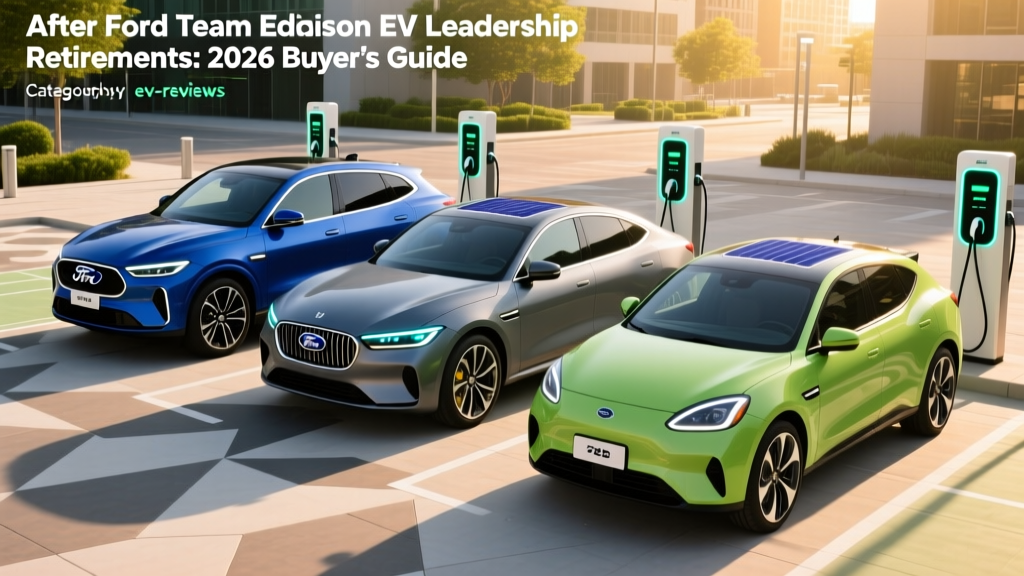
The Short Answer on Ford's EV Direction After Team Edison Retirements
The departure of key Ford Team Edison EV leadership retirements — including engineers and strategists who developed the Mustang Mach-E and F-150 Lightning — has not derailed Ford's current EV lineup or support infrastructure. For 2026 buyers, the vehicles remain in production with updated specs, the dealer network continues selling and servicing them, and federal §30D tax credit eligibility still applies where sourcing rules are met. The real impact is long-term: Ford has pivoted toward smaller, more affordable EVs and hybrid-heavy strategies under its reorganized "Ford Blue," "Ford Model e," and "Ford Pro" divisions. If you're buying now, current warranty terms, parts availability, and Supercharger access remain intact.
What Ford Team Edison Built — and What Retirements Mean for 2026 Buyers
Ford's Team Edison was the skunkworks-style group responsible for engineering the Mustang Mach-E from a clean-sheet EV platform and later adapting the F-150 Lightning from America's best-selling truck. Key figures from that team began retiring or transitioning out between 2023 and 2025, coinciding with Ford's broader restructuring that split operations into Ford Model e (EVs and software) and Ford Blue (ICE and hybrids).
For current buyers, the practical question isn't who's in the C-suite — it's whether the vehicles still deliver on range, charging, reliability, and long-term support. Let's examine the 2026 lineup with hard numbers.
2026 Ford EV Lineup: Range, Charging, and Pricing
| Model | Trim | Battery (kWh usable) | Chemistry | EPA Range | Peak DC Charge (kW) | 10–80% Time | 0–60 mph | HP | MSRP |
|---|---|---|---|---|---|---|---|---|---|
| Mustang Mach-E | Select RWD | 75.7 | NMC | 250 mi | 150 kW | ~38 min | 6.3 sec | 290 | $39,995 |
| Mustang Mach-E | Premium AWD ER | 98.8 | NMC | 312 mi | 150 kW | ~45 min | 4.8 sec | 365 | $49,875 |
| Mustang Mach-E | GT | 98.8 | NMC | 280 mi | 150 kW | ~45 min | 3.5 sec | 480 | $59,995 |
| F-150 Lightning | Pro SR | 98 | NMC | 240 mi | 120 kW | ~44 min | 4.4 sec | 580 | $52,090 |
| F-150 Lightning | XLT ER | 131 | NMC | 320 mi | 120 kW | ~41 min | 4.0 sec | 580 | $72,090 |
Real-World Range Reality Check: EPA figures assume mixed driving at moderate temperatures. Expect the Mach-E Premium AWD ER to deliver ~260–280 miles on highway trips at 70+ mph, and as low as ~200 miles in sub-30°F winter conditions. The F-150 Lightning ER loses roughly 25–35% range when towing a 5,000-lb trailer. Plan road trips around 200–220 usable miles between charges for comfort.
Ford's NMC (nickel manganese cobalt) battery chemistry delivers strong energy density but is more sensitive to sustained 100% charges and extreme heat than LFP alternatives. Ford's battery management system includes a buffer (typically 5–8 kWh unusable) to protect longevity.
Cost Breakdown: Ford EV vs. Gas Equivalent
Let's compare the 2026 Mustang Mach-E Premium AWD ER against a similarly equipped 2026 Ford Edge ST-Line AWD (2.0L turbo, 250 hp, 23 mpg combined per fueleconomy.gov).
| Cost Factor | Mach-E Premium AWD ER | Ford Edge ST-Line AWD |
|---|---|---|
| Base MSRP | $49,875 | $42,500 |
| Est. Federal §30D Credit | Up to $3,750* | $0 |
| Effective Purchase Price | ~$46,125 | $42,500 |
| Fuel/Energy Cost (15,000 mi/yr) | $660/yr (home L2, $0.14/kWh) | $2,283/yr (gas, $3.50/gal) |
| 5-Year Fuel/Energy Total | $3,300 | $11,415 |
| Maintenance (5-yr est.) | ~$1,800 | ~$3,500 |
| Insurance (5-yr avg.) | ~$10,500 | ~$8,200 |
| 5-Year Total Cost of Ownership | ~$61,725 | ~$65,615 |
*Federal §30D credit eligibility depends on MSRP caps (SUVs: $80,000), buyer income limits ($150K single / $300K joint), and battery critical-mineral and component sourcing requirements per IRS rules. The Mach-E currently qualifies for a partial credit; verify at point of sale. Credit can be transferred to the dealer for an immediate price reduction.
The Mach-E wins on operating costs, but the higher insurance premium (roughly 15–25% more for EVs, per industry data) and higher initial price narrow the gap. Break-even typically occurs around year 4–5 for home-charging owners.
EV vs. Hybrid: Where Does a Ford PHEV Fit?
Ford's strategic pivot post-Team Edison has emphasized hybrids. The 2026 Ford Escape PHEV (2.5L Atkinson + 14.4 kWh battery, 37 miles electric-only, 44 mpg combined after depletion) offers a bridge for buyers without reliable home charging.
| Factor | Mach-E (BEV) | Escape PHEV | Escape HEV |
|---|---|---|---|
| Electric-Only Range | 250–312 mi | 37 mi | 0 mi |
| MPGe / MPG Combined | 101 MPGe | 105 MPGe (EV mode) / 40 mpg | 39 mpg |
| Home Charging Needed? | Strongly recommended | Recommended for EV benefit | No |
| Annual Fuel Cost (15K mi) | $660 | $900–$1,400 | $1,350 |
| Upfront Price (base) | $39,995 | $35,500 | $30,500 |
| §30D Credit Eligible? | Partial (up to $3,750) | No (PHEV battery <7 kWh threshold varies) | No |
If you drive under 35 miles daily and can charge at home, the Escape PHEV covers most commutes on electricity while retaining a gas tank for road trips. The Mach-E is superior for drivers who want zero tailpipe emissions, lower per-mile costs, and a more engaging driving experience — but only if charging access is secure.
Real-World Ownership Considerations
Home Charging Access
Level 2 home charging (240V, 32–48A) adds roughly 20–30 miles of range per hour for the Mach-E and 15–20 for the Lightning. A full overnight charge covers most daily needs. Installation costs range from $500 (simple NEMA 14-50 outlet near the panel) to $2,500+ (panel upgrade to 200A, long wire runs, permit fees). If you cannot install home charging, a BEV becomes significantly less convenient — public DC fast charging costs 2–3× more per kWh and requires time.
Climate Impact
The Mach-E and Lightning use heat pumps (standard on most 2026 trims), which reduce winter range loss compared to resistive heaters. Still, expect 20–30% range reduction at 20°F versus 70°F. In northern states, a 312-mile EPA Mach-E may deliver ~220 miles in January. Preconditioning the battery while plugged in mitigates this and preserves battery health.
Charging Network Access
Ford EVs now use the NACS connector (adopted starting 2025 model year) and have full access to the Tesla Supercharger network — over 25,000 stalls nationwide. This is a significant advantage over CCS-only vehicles. On Superchargers, the Mach-E peaks around 150 kW; the Lightning around 120 kW. Neither matches Hyundai/Kia's 800V architecture (240+ kW), so Ford charge times are longer on road trips.
Common Misconceptions About Ford EVs Post-Restructuring
| Myth | Fact |
|---|---|
| "Ford is abandoning EVs after Team Edison left." | Ford continues producing the Mach-E and Lightning, invested $11B+ in EVs, and has announced next-gen affordable EVs for 2027+. The strategy shifted; the commitment didn't end. |
| "The Lightning was discontinued." | The 2026 F-150 Lightning is in production with updated trims. Ford adjusted volume targets based on demand but has not killed the model. |
| "I can't get parts or service without the original team." | Ford's dealer network stocks EV parts and has trained EV technicians. Warranty coverage (3 yr/36K basic, 5 yr/60K powertrain, 8 yr/100K battery) is fully honored. |
| "Ford EVs get the full $7,500 tax credit." | Credit amounts vary by trim and sourcing. The Mach-E currently qualifies for a partial credit (typically $3,750). Always verify at point of sale and with a tax professional. |
| "Battery replacement will cost $20,000+." | Out-of-warranty replacement for a Mach-E pack runs $12,000–$18,000 depending on kWh, but battery degradation data shows most packs retain 85–92% capacity after 100,000 miles. The 8-year/100K-mile warranty covers packs that drop below 70% capacity. |
Decision Framework: Should You Buy a Ford EV in 2026?
Buy the Mustang Mach-E if:
- You have Level 2 home charging (or can install it)
- Your daily driving is under 200 miles and you road-trip 4–6 times/year
- You want a sporty crossover with strong 0–60 performance and Supercharger access
- You value NACS compatibility and don't want to rely solely on Electrify America or EVgo
Buy the F-150 Lightning if:
- You need truck utility (towing up to 7,700 lbs, Pro Power Onboard for job-site power)
- You mostly drive within 150 miles of home and can charge overnight
- You understand towing cuts range by 25–40% and plan accordingly
Choose a Ford Hybrid or PHEV instead if:
- You live in an apartment or lack home charging access
- You frequently drive 400+ miles in rural areas with sparse DC fast chargers
- You live in extreme cold (below 0°F regularly) and can't garage the vehicle
- Upfront cost is a primary concern and the partial tax credit doesn't bridge the gap
Wait if:
- You want Ford's next-gen affordable EV platform (expected 2027+)
- You need 800V ultra-fast charging (look at Hyundai Ioniq 5 or Kia EV6 instead)
- You're in a state without EV incentives and the federal credit doesn't apply to your income level
Warranty, Depreciation, and Long-Term Support
Ford's EV warranty structure remains competitive:
- Battery: 8 years / 100,000 miles (covers degradation below 70% of original capacity)
- Electric Powertrain: 5 years / 60,000 miles
- Bumper-to-Bumper: 3 years / 36,000 miles
Depreciation has been a pain point. The Mach-E retains approximately 48–52% of its value after 3 years (vs. ~55% for the Tesla Model Y), partly due to aggressive price cuts Ford implemented in 2023–2024 and Tesla's brand pull. The Lightning holds value better (~55–58% at 3 years) due to truck demand and limited EV truck competition.
Long-term parts and service support does not depend on the original Team Edison engineers. Ford has institutionalized EV service protocols across its 3,000+ dealer network, and over-the-air (OTA) updates continue to add features and refine battery management.
Frequently Asked Questions
Does the Ford Team Edison retirement wave affect my warranty?
No. Your warranty is a contractual obligation from Ford Motor Company, not dependent on specific personnel. The 8-year/100,000-mile battery warranty and all other coverage terms remain fully in force regardless of leadership changes.
Can I still get the $7,500 federal tax credit on a Ford EV?
Most Ford EVs currently qualify for a partial credit — typically $3,750 — due to battery component and critical mineral sourcing rules under IRS §30D. The full $7,500 requires meeting both the battery component (100% North American) and critical mineral thresholds. Always confirm with your dealer at point of sale, as credit amounts can change with supply chain updates. The credit can be applied as an immediate price reduction if you elect point-of-sale transfer.
How does Ford's charging speed compare to competitors?
Ford's 400V architecture limits peak DC charging to ~150 kW (Mach-E) and ~120 kW (Lightning). The Hyundai Ioniq 5 and Kia EV6 use 800V systems that peak at 240+ kW, achieving 10–80% in ~18 minutes versus Ford's ~38–45 minutes. However, Ford's NACS connector grants access to Tesla's Supercharger network, which has far more stations and higher reliability than most CCS networks — a significant practical advantage on road trips.
What happens if Ford discontinues my EV model?
Federal law requires manufacturers to provide parts for at least 10 years after a model's final production year. Ford's dealer network and EV-trained technicians will continue servicing the Mach-E and Lightning regardless of future production decisions. Third-party EV service shops are also expanding nationally.
Is the Mach-E or Lightning a good first EV?
Yes, with caveats. Both are well-built, proven platforms with NACS/Supercharger access and strong dealer support. The Mach-E is an excellent first EV for suburban commuters with home charging. The Lightning works well as a first EV truck for drivers who don't regularly tow long distances. If you lack home charging or frequently drive 500+ mile routes, start with a PHEV like the Escape Plug-In Hybrid instead.