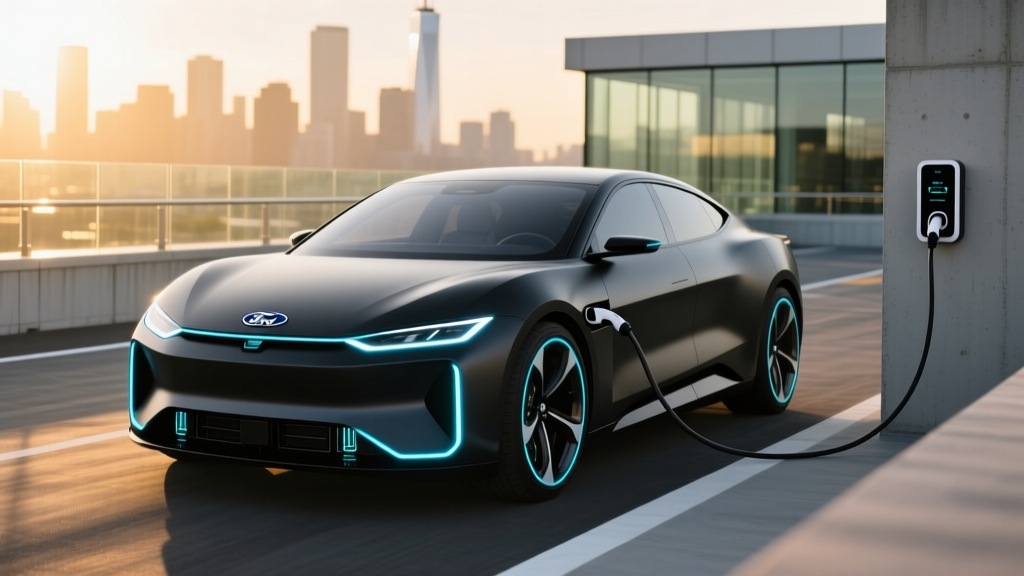
Ford's internal "Skunkworks" EV division — a dedicated team spun out to develop a next-generation, low-cost electric vehicle platform from the ground up — has been one of the most closely watched projects in the American auto industry. If you're searching for a Ford Skunkworks EV, here's the direct answer: as of early 2026, Ford has not yet released a production vehicle bearing the Skunkworks nameplate or built on its publicly detailed low-cost EV architecture. What Ford has confirmed is a new universal electric platform targeting a sub-$30,000 price point, developed by the team led by former Tesla and Apple executive Alan Clarke, with production expected to begin in late 2026 or 2027.
Quick Answer
Ford's Skunkworks EV project is an upcoming low-cost electric platform, not a currently purchasable vehicle. Expect a compact or midsize EV targeting ~250+ miles of EPA range, a base MSRP under $30,000, and potential §30D federal tax credit eligibility. Production is anticipated for late 2026 or the 2027 model year. If you need an EV today, Ford's current lineup includes the Mustang Mach-E and F-150 Lightning.
What Is Ford's Skunkworks EV Project?
The term "Skunkworks" refers to Ford's reorganized EV development unit, created to break away from legacy engineering processes and build an entirely new electric vehicle architecture optimized for cost reduction. The initiative gained public attention after Ford CEO Jim Farley repeatedly referenced the team's mission: to produce an EV that could compete on price with internal combustion vehicles without relying on incentives.
The project's significance lies in its engineering philosophy. Rather than adapting an existing platform — as Ford did with the Mach-E (which shares underpinnings with Ford's global rear-wheel-drive architecture) — the Skunkworks team is designing a dedicated EV skateboard from scratch. This approach mirrors what Tesla achieved with the Model 3/Y platform and what Hyundai executed with the E-GMP architecture underpinning the Ioniq 5 and 6.
Key announced goals for the platform include:
- A base MSRP below $30,000 before incentives
- Targeted EPA range of 250+ miles on a single charge
- LFP (lithium iron phosphate) battery chemistry to reduce cost and avoid critical-mineral sourcing constraints
- Simplified manufacturing with fewer parts and integrated structural battery pack design
- DC fast charging capability targeting 10-80% in approximately 25-30 minutes
How Would a Skunkworks EV Compare to Gas and Hybrid Alternatives?
Until final specs are published, we can model a comparison using Ford's stated targets against the most likely competitors: the Chevrolet Equinox EV, Nissan Leaf successor, and Toyota's upcoming affordable EV, as well as Ford's own hybrid options like the Maverick Hybrid.
| Attribute | Ford Skunkworks EV (Projected) | Ford Maverick Hybrid | Chevrolet Equinox EV 2LT | Toyota Prius (HEV) |
|---|---|---|---|---|
| Base MSRP | ~$28,000-$30,000 | $28,995 | $33,600 | $28,350 |
| EPA Range / MPG | ~250 mi (est.) | 42 MPG combined | 319 mi | 57 MPG combined |
| Energy/Fuel Cost per Mile | ~$0.04-$0.06 (home charging) | ~$0.09 (at $3.50/gal) | ~$0.04-$0.06 | ~$0.06 (at $3.50/gal) |
| Federal Tax Credit (§30D) | Up to $7,500 (if eligible) | $0 (not a BEV) | Up to $7,500 | $0 (not a BEV/PHEV) |
| Estimated 5-Year Fuel/Energy Cost | ~$2,500-$3,500 | ~$5,500-$6,500 | ~$2,500-$3,500 | ~$3,800-$4,500 |
| Maintenance (5-Year Est.) | ~$1,500-$2,000 | ~$3,000-$3,500 | ~$1,500-$2,000 | ~$2,800-$3,200 |
The cost advantage of a sub-$30,000 EV becomes dramatic when paired with the §30D federal tax credit. If the Skunkworks EV qualifies for the full $7,500 credit — which is plausible given Ford's stated intent to use LFP chemistry and North American assembly — the effective purchase price could drop to approximately $20,500-$22,500. That undercuts nearly every new vehicle on the market, electric or otherwise.
However, the Maverick Hybrid and Prius remain compelling for buyers who lack reliable home charging access or who regularly drive in extreme cold, where EV range can drop 20-35%.
Real Costs and Savings: What Ownership Would Look Like
Let's model the five-year total cost of ownership (TCO) for a hypothetical Ford Skunkworks EV at $29,000 MSRP, assuming full §30D eligibility, against a comparable gas vehicle at the same sticker price.
| Cost Category | Skunkworks EV (Est.) | Gas Compact SUV |
|---|---|---|
| Purchase Price (after credit) | $21,500 | $29,000 |
| Home Charger Install (Level 2) | $800-$2,000 | $0 |
| Energy/Fuel (60,000 mi) | $3,000 (home) / $5,400 (public) | $6,300 |
| Maintenance | $1,800 | $3,200 |
| Insurance (5-yr avg.) | $7,500-$9,000 | $6,000-$7,500 |
| Estimated Depreciation | $8,000-$10,000 | $9,000-$11,000 |
| Total 5-Year Cost | $42,600-$47,300 | $53,500-$57,000 |
Several real-world factors shape these numbers:
Home charging is the economic linchpin. At a national average residential rate of ~$0.16/kWh and an assumed efficiency of 3.5 mi/kWh, home charging costs roughly $0.046/mile. Public DC fast charging at $0.35-$0.50/kWh pushes that to $0.10-$0.14/mile — comparable to a 30 MPG gas car. Buyers without access to Level 1 or Level 2 home charging will see significantly reduced savings.
Insurance premiums run higher for EVs. Industry data from the Insurance Information Institute shows EV insurance costs 15-25% more than equivalent gas vehicles, driven by higher repair costs for battery packs and specialized body structures. Budget $1,500-$1,800/year rather than the $1,200-$1,500/year typical for a gas compact.
Maintenance savings are real and measurable. EVs eliminate oil changes, transmission fluid, spark plugs, and exhaust system repairs. Regenerative braking extends brake pad life to 80,000-100,000+ miles in typical driving. The primary maintenance items are cabin air filters, tire rotation/replacement (EVs wear tires 20-30% faster due to weight and instant torque), wiper fluid, and the cabin air filter.
What First-Time EV Buyers Should Know Before Waiting
If you're considering holding off on an EV purchase until the Skunkworks platform arrives, weigh these practical factors:
The timeline is uncertain. Ford has targeted late 2026 or 2027 for production, but new-platform launches frequently slip. The F-150 Lightning experienced multiple delays, and the Chevrolet Silverado EV took over two years from announcement to meaningful volume. If you need a vehicle in the next 6-12 months, waiting may not be practical.
Tax credit rules may change. The §30D credit currently offers up to $7,500 for new EVs meeting battery sourcing and critical mineral requirements, with buyer income caps ($150K single / $300K joint) and MSRP caps ($55K cars / $80K SUVs/trucks). These rules are subject to legislative change. A vehicle arriving in 2027 may face different incentive landscapes than what exists today. Always check the latest rules at IRS.gov.
LFP batteries have trade-offs. Lithium iron phosphate chemistry — likely for the Skunkworks platform — offers excellent cycle life (3,000+ full cycles before significant degradation), lower cost, and no cobalt or nickel sourcing concerns. The trade-off: LFP has lower energy density than NMC chemistry, meaning either a heavier pack or reduced range for a given pack size. LFP also performs less well in extreme cold, with range losses potentially reaching 35-40% below freezing compared to 20-30% for NMC. Ford can mitigate this with a heat pump and battery preconditioning, but physics sets a floor.
Charging speed matters more than peak range. A 250-mile EV that charges at 150 kW (10-80% in ~25 minutes) is more road-trip-friendly than a 300-mile EV limited to 50 kW. Watch for Ford's announced DC fast-charge rate when specs are finalized. The charge curve — how quickly the vehicle sustains peak kW before tapering above 80% SoC — is often more important than the peak number itself.
Common Misconceptions About Ford's Skunkworks EV
| Myth | Fact |
|---|---|
| "It's a Ford-badged Chinese EV." | Ford has stated the platform is being developed in-house, with production planned at US facilities. Battery cell sourcing may involve partnerships (Ford has a licensing deal with CATL for LFP cells in Michigan), but final assembly and integration are domestic. |
| "A $28K EV will have terrible range." | Current LFP-equipped EVs like the base Tesla Model 3 achieve 272 EPA miles. A compact crossover on a dedicated platform with a 60-65 kWh LFP pack can realistically target 240-270 miles EPA. |
| "It will definitely qualify for the full $7,500 tax credit." | Eligibility depends on final battery sourcing, critical mineral content, MSRP, and buyer income at time of purchase. Ford is designing to maximize eligibility, but final IRS determination happens at the point of sale. Consult IRS §30D guidelines and a tax professional. |
| "It will charge as fast as a Tesla." | Tesla's current 4680-cell vehicles peak at ~250 kW. A cost-optimized LFP platform is more likely to peak at 130-175 kW, which is still practical (10-80% in ~25-30 min) but not class-leading. |
| "I should wait instead of buying any EV now." | If your current vehicle is unreliable, unsafe, or costly to fuel, waiting 18+ months for an unconfirmed product may cost more in fuel, repairs, and missed incentives than buying a proven EV today. |
Decision Framework: Should You Wait for the Skunkworks EV?
If-Then Decision Guide
- If your current car is running fine and you can wait 12-18+ months → Waiting is reasonable. The sub-$30K EV segment will have more options by late 2027, and competition will push pricing and features in buyers' favor.
- If you need a vehicle within 6 months → Don't wait. Consider the Chevrolet Equinox EV ($33,600, 319 mi EPA), Hyundai Kona Electric ($32,975, 261 mi), or a used Tesla Model 3 (eligible for the $4,000 used-EV credit if priced under $25,000).
- If you lack home charging and can't install Level 2 → A hybrid like the Ford Maverick Hybrid (42 MPG, ~$29K) or Toyota Prius (57 MPG, ~$28K) may serve you better regardless of what Ford's Skunkworks team delivers. Public-only EV charging erases most fuel-cost savings.
- If you live in a cold climate (consistent sub-30°F winters) → Factor in 25-35% winter range loss. A 250-mile EV becomes a ~165-185-mile EV in January. If your daily commute plus errands exceed 80 miles, the margin gets thin. A PHEV or HEV may be more practical, or wait to see if Ford includes a heat pump in the Skunkworks platform.
- If you qualify for the full §30D credit and have home charging → The effective price of ~$21,500-$22,500 makes this potentially the best value in new vehicles, period. Worth monitoring closely for official specs and reservation openings.
- If you need more than 250 miles of range for frequent road trips → This platform likely won't be optimized for 350+ mile range. Look at the Hyundai Ioniq 5 (311 mi), Tesla Model 3 Long Range (363 mi), or Chevrolet Blazer EV (324 mi) instead.
What to Watch For Next
Ford is expected to reveal official specifications — including battery capacity (kWh), EPA range estimates, DC fast-charge rates (kW), and trim-level pricing — closer to the production launch. Key data points to monitor:
- Battery capacity and chemistry confirmation: A 60-65 kWh LFP pack is the most likely configuration. This would align with the ~250-mile target at compact-crossover efficiency of ~3.5-4.0 mi/kWh.
- NACS connector standard: Ford has committed to the North American Charging Standard (NACS) for all future EVs, granting access to Tesla's Supercharger network. Confirm whether the Skunkworks platform ships with a native NACS port or requires an adapter.
- §30D eligibility confirmation: Ford must certify battery sourcing compliance to the IRS. Watch for the vehicle's addition to the fueleconomy.gov qualified vehicles list before assuming credit eligibility.
- Production location and timeline: Ford's Marshall, Michigan LFP battery plant and potential assembly at an existing or retooled facility will determine whether the vehicle meets domestic-content requirements and when volume production begins.
- Real-world charging curve data: Peak kW alone doesn't tell the story. Independent testing of sustained charge rates from 10-80% and preconditioning behavior will determine road-trip practicality.
Frequently Asked Questions
Can I order or reserve the Ford Skunkworks EV now?
No. As of early 2026, Ford has not opened reservations or published final specifications for any vehicle built on the Skunkworks low-cost EV platform. The project remains in development. Monitor Ford's official newsroom and fueleconomy.gov for updates.
Will the Skunkworks EV have access to Tesla Superchargers?
Ford has confirmed that all its future EVs will adopt the NACS (North American Charging Standard) connector, which provides native access to Tesla's Supercharger network. It is highly likely — though not yet officially confirmed for this specific platform — that the Skunkworks EV will ship with a NACS port.
How does LFP battery chemistry affect longevity?
LFP batteries typically offer superior cycle life compared to NMC — often 3,000+ full charge cycles before degrading to 80% capacity, versus 1,500-2,000 cycles for NMC. For a 250-mile-range EV, that translates to 750,000+ miles of theoretical battery life. In practice, calendar aging (degradation over time regardless of use) becomes the limiting factor, but LFP owners can generally expect 85-90%+ capacity retention after 8-10 years. Ford's battery warranty will likely cover 8 years / 100,000 miles with a 70% capacity retention threshold, consistent with industry standards.
Is it better to buy an EV now or wait for cheaper models like this?
It depends on your situation. If your current vehicle is reliable, affordable to fuel, and safe, waiting 12-18 months for more affordable EV options is a sound strategy — the sub-$30K segment will be more competitive by 2027. If you're spending $200+/month on gas, your car needs expensive repairs, or you qualify for incentives that may change, buying a proven EV now (like the Equinox EV or Kona Electric) locks in savings and current credit eligibility.
What will insurance cost for a budget Ford EV?
Expect EV insurance premiums to run 15-25% higher than a comparable gas vehicle. For a ~$29,000 compact EV, budget approximately $1,500-$1,800/year depending on your state, driving record, and coverage levels. Get quotes from multiple insurers — some now offer EV-specific discounts that partially offset the premium difference.