Quick Verdict: An Off-Road EV With Real Trade-Offs
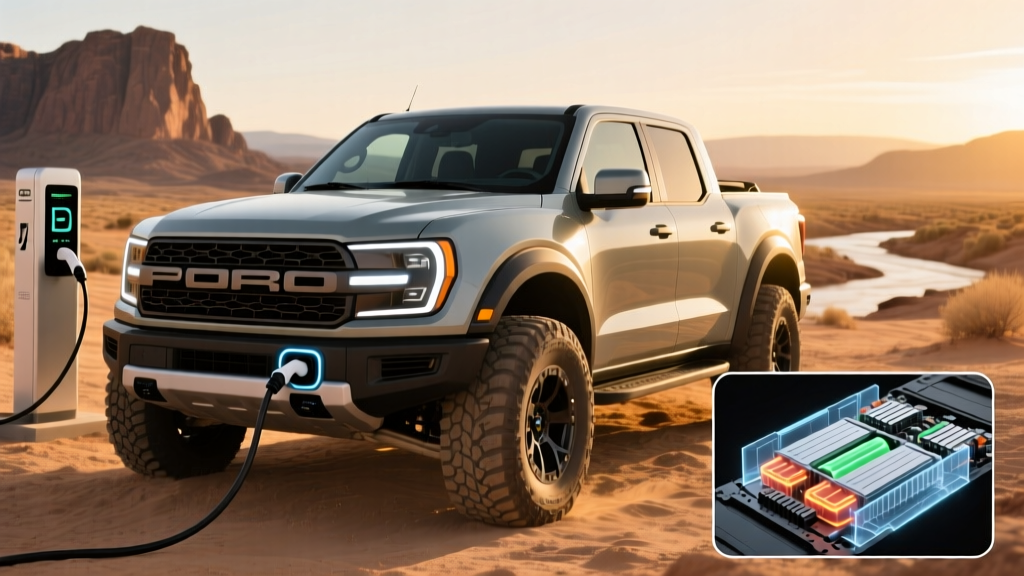
The Ford F-150 Lightning Raptor (commonly searched as the "Ford Raptor Lightning") occupies a unique niche: a high-performance electric truck built for off-road abuse that also happens to serve as a capable daily driver and tow rig. For the 2026 model year, Ford continues to refine the Lightning platform with incremental battery management and software updates, but the Raptor variant remains the range-topping, desert-runner of the lineup.
It delivers exhilarating acceleration, class-leading tech, and genuine off-road chops. But the laws of physics impose a tax: the Raptor's aggressive tires, lifted suspension, and heavy battery pack cut deeply into efficiency and range compared to standard Lightning trims. If you want the fastest, most capable electric truck Ford sells, this is it. If you prioritize maximum range and lowest cost per mile, the standard Extended Range Lightning is the smarter buy.
Range & Efficiency: The Physics Tax of an Off-Road Truck
Real-World Expectation: Plan for ~190–210 miles on highway road trips at 70+ mph; ~160–180 miles in freezing weather or when towing. City driving with regen braking can approach or slightly exceed the EPA sticker.
The F-150 Lightning Raptor uses Ford's Extended Range battery pack, which provides approximately 131 kWh of usable capacity (roughly 149 kWh gross). The battery employs NMC (nickel-manganese-cobalt) lithium-ion chemistry, chosen for its higher energy density compared to LFP — a necessary trade-off to fit sufficient range into a truck this heavy and aerodynamically challenged.
Efficiency is the Raptor's weakest metric on paper. The EPA rates it at roughly 70 MPGe combined, translating to about 48 kWh per 100 miles. For comparison, the standard F-150 Lightning Extended Range 4x4 achieves around 77 MPGe combined. The difference comes down to the Raptor's 37-inch all-terrain tires, wider track, increased ride height, and additional underbody armor — all of which increase rolling resistance and drag.
In our experience, highway efficiency at 75 mph settles around 2.1–2.3 kWh/mile in mild weather. That means a 250-mile highway road trip will leave you arriving with roughly 10–15% state of charge, which is uncomfortably tight for chargers that may be occupied or out of service. We strongly recommend planning road trips around 180–200 mile segments to maintain a safety buffer.
Charging: DC Fast Charging and Home Setup
Charging speed is where the Lightning platform shows its age relative to newer 800-volt architectures from Hyundai/Kia and Lucid. The Raptor operates on a 400-volt electrical architecture, which limits peak DC fast-charge rates.
| Charging Level | Power / Rate | Time or Miles Added |
|---|---|---|
| DC Fast Charge (Peak) | 150 kW | 10–80% in ~41 minutes |
| DC Fast Charge (Sustained avg.) | ~100–110 kW | Expect taper above 80% SoC |
| Level 2 Home (Ford Charge Station Pro) | 19.2 kW (80A) | ~14 miles per hour of charging |
| Level 2 Home (Standard 48A) | 11.5 kW | ~8–9 miles per hour of charging |
| Level 1 (120V household) | ~1.4 kW | ~2–3 miles per hour (emergency only) |
At a 150 kW DC fast charger, the Raptor's large 131 kWh pack means you're spending meaningful time plugged in. The charge curve is relatively flat between 10–60% SoC, sustaining near-peak rates, but tapers noticeably past 80% as the battery management system protects cell longevity. A 10–80% session takes approximately 41 minutes under ideal conditions (preconditioned battery, warm ambient temps). In cold weather, add 10–15 minutes unless you've used the truck's navigation-based battery preconditioning.
For home charging, Ford's 80A Charge Station Pro is the gold standard for Lightning owners — it adds roughly 14 miles of range per hour, meaning a full overnight charge is easily achievable even after draining the pack. However, the 80A station requires a 100-amp dedicated circuit, which may necessitate a panel upgrade in older homes. Budget $1,500–$3,000 for professional installation (equipment + electrician + permit), and consult a licensed electrician to assess your panel capacity. A standard 48A Level 2 charger on a 60-amp circuit is more practical for most homes and still fully replenishes the pack overnight.
Performance: Supercar Acceleration, Baja-Ready Suspension
The Lightning Raptor's dual-motor all-wheel-drive powertrain produces 580 horsepower and 775 lb-ft of instant torque. Ford claims a 0–60 mph time of approximately 4.0 seconds — remarkable for a truck with a curb weight exceeding 6,800 pounds.
| Specification | F-150 Lightning Raptor (2026) |
|---|---|
| Drivetrain | Dual-motor AWD |
| Horsepower | 580 hp |
| Torque | 775 lb-ft |
| 0–60 mph | ~4.0 seconds |
| Usable Battery | ~131 kWh (NMC) |
| EPA Range | 240 miles |
| Max Tow Rating | 8,500 lbs |
| Max Payload | ~1,800 lbs |
| Ground Clearance | ~13.1 inches |
Off-road, the Raptor distinguishes itself from every other Lightning trim with FOX Live Valve internal-bypass shocks, a specially tuned rear suspension, 37-inch BFGoodrich All-Terrain T/A KO2 tires, and dedicated drive modes including Baja mode. The truck's instant electric torque delivery is a genuine advantage in rock crawling and sand running — no turbo lag, no transmission hunting, just linear power on demand.
The trade-off is that the Raptor's off-road hardware adds weight and parasitic drag that standard Lightning trims simply don't carry. If your off-road excursions are limited to fire roads and snowy driveways, the standard Lariat or Platinum with the Max Tow package offers a better efficiency-to-capability ratio.
Interior, Tech & Driver Assistance
The Lightning Raptor's cabin centers on Ford's SYNC 4A infotainment system displayed on a 15.5-inch portrait touchscreen. The interface is responsive, supports wireless Apple CarPlay and Android Auto, and integrates over-the-air (OTA) update capability that has allowed Ford to push meaningful feature additions since launch.
The digital instrument cluster is a 12-inch configurable display, and available features include a head-up display, 18-speaker B&O Unleashed audio system, and the fold-out shifter that converts the center console into a flat work surface. The 6.5-foot bed includes the Pro Power Onboard system with up to 9.6 kW of exportable power — enough to run power tools at a job site or keep essential appliances running during an outage.
On the driver-assistance front, Ford Co-Pilot360 Active 2.0 is standard, bundling adaptive cruise control, lane centering, and evasive steering assist. BlueCruise hands-free driving is available on over 130,000 miles of pre-mapped divided highways. This is an SAE Level 2 system — it requires continuous driver supervision, with a camera monitoring your eyes. It is not autonomous driving, and you must remain prepared to take over at any moment.
Interior space remains generous: front legroom measures 43.9 inches, rear legroom is 43.6 inches, and the crew cab seats five adults comfortably. The front trunk (frunk) offers 14.1 cubic feet of lockable, weather-sealed storage — a practical advantage over every internal-combustion F-150. Behind the rear seats, the 5.5-foot bed provides 52.8 cubic feet of cargo volume.
Pricing, Trims & Federal Tax Credit Eligibility
The F-150 Lightning Raptor is the most expensive variant in the Lightning lineup. Pricing for the 2026 model year starts at approximately $96,875 MSRP (including destination). With popular options — such as the Towing Package, BlueCruise subscription, and upgraded interior trim — as-tested prices routinely reach $100,000–$105,000.
| Item | Approximate Cost |
|---|---|
| Base MSRP (Lightning Raptor) | $96,875 |
| As-Tested (with common options) | $100,000–$105,000 |
| Federal Tax Credit (§30D max) | Up to $7,500 (see eligibility below) |
| Effective Price After Max Credit | ~$89,375–$97,500 |
The IRS §30D federal tax credit offers up to $7,500 for qualifying new EVs, but eligibility is layered and subject to change. Here are the key rules for 2026:
- MSRP Cap: Trucks must have an MSRP at or below $80,000 to qualify. The Lightning Raptor's base MSRP of ~$96,875 exceeds this cap, meaning it does NOT qualify for the §30D new-vehicle credit in its standard configuration.
- Buyer Income Cap: Modified adjusted gross income must not exceed $300,000 (joint filers), $225,000 (head of household), or $150,000 (individual).
- Battery Sourcing: The $7,500 credit is split into two $3,750 halves — one for critical minerals sourcing and one for battery component manufacturing — both subject to annual tightening of foreign-entity-of-concern (FEOC) rules.
- Point-of-Sale Transfer: For qualifying vehicles, the credit can be transferred to the dealer at purchase, reducing your out-of-pocket cost immediately rather than waiting for a tax refund.
Bottom line on the credit: The Raptor trim's MSRP exceeds the $80,000 truck cap, disqualifying it from the new-vehicle §30D credit. Buyers seeking credit eligibility should consider the Lightning Lariat Extended Range (MSRP starting around $69,995) or the XLT, both of which fall under the cap. Always consult a tax professional and verify current-year rules at IRS.gov before making a purchase decision.
Ownership Costs & Warranty
Ford backs the Lightning's battery pack and electric drivetrain with an 8-year/100,000-mile warranty, which is the industry standard for EVs. The warranty guarantees the battery will retain at least 70% of its original capacity during that period. Based on data from early 2022–2024 Lightning owners, degradation has been modest — most report 3–6% loss over the first 30,000–50,000 miles, which is consistent with liquid-cooled NMC packs managed conservatively by Ford's thermal system.
The limited vehicle warranty covers 3 years/36,000 miles bumper-to-bumper. Insurance premiums for the Lightning Raptor tend to run 15–25% higher than the standard Lightning due to the higher MSRP, performance capability, and repair costs for specialized off-road components.
Operating costs are where the Lightning claw back value against the gas-powered Raptor. At a national average electricity rate of $0.16/kWh, charging the Raptor's 131 kWh pack from empty costs roughly $21. The gas Raptor, rated at 16 mpg combined, would burn about 15.6 gallons over the same 250-mile distance — approximately $55 at $3.50/gallon. Over 15,000 miles per year, the electric Raptor saves roughly $1,800–$2,200 in fuel costs, depending on your local electricity rate and whether you charge primarily at home or on expensive DC fast-charging networks.
Who Should Buy the Ford Raptor Lightning?
- You want the highest-performance electric truck Ford offers and use off-road capability regularly (desert running, rock crawling, overlanding)
- You can charge at home (Level 2) and your daily commute is under 150 miles round-trip
- You value Pro Power Onboard for job-site or emergency backup power
- You're not dependent on the federal tax credit (or will claim it on a different qualifying vehicle)
- Range and efficiency are your top priorities (the Lariat ER achieves ~320 miles EPA)
- You want to qualify for the §30D tax credit (MSRP under $80,000)
- Your off-road needs are limited to snow, gravel roads, and light trails
- You tow frequently and want to maximize practical range while loaded
The Lightning Raptor competes primarily with the Rivian R1T Tri-Motor (more range, more refined on-road, but higher starting price) and the GMC Hummer EV Pickup (more extreme off-road hardware, but far heavier and less efficient). Against the gas-powered Ford Raptor, the Lightning variant wins on acceleration, fuel cost, and frunk utility, but loses on range confidence during remote off-road excursions where charging infrastructure is sparse.
Pros, Cons & Final Assessment
- 4.0-second 0–60 mph with instant electric torque
- Genuine off-road hardware: FOX Live Valve shocks, 37-inch tires, skid plates
- Pro Power Onboard (9.6 kW) for job-site and backup power
- 14.1 cu-ft frunk adds secure, weatherproof storage
- BlueCruise hands-free highway driving (Level 2)
- Dramatically lower per-mile energy cost vs. gas Raptor
- 240-mile EPA range is the lowest in the Lightning lineup
- 150 kW peak DC charging is outpaced by 800V competitors
- MSRP exceeds $80K — does not qualify for §30D federal tax credit
- Heavy curb weight (~6,800 lbs) hurts efficiency and tire wear
- High insurance premiums relative to standard Lightning trims
- 10–80% DC charge takes ~41 minutes — long for road trips
The Ford Raptor Lightning is a compelling proof-of-concept: electric powertrains can deliver Baja-capable performance while eliminating tailpipe emissions and cutting fuel costs. But it is not the most practical Lightning to own. The range penalty, charging speed limitation, and tax-credit disqualification make it a passion purchase rather than a purely rational one. If you live for off-road weekends and can charge at home, it's a thrilling daily driver. If you need maximum versatility, the standard Extended Range Lightning serves most truck buyers better at a lower price.
Frequently Asked Questions
What is the real-world range of the Ford Raptor Lightning?
The EPA estimates 240 miles for the Lightning Raptor with the Extended Range battery. In real-world highway driving at 70–75 mph, expect 190–210 miles. In freezing temperatures or while towing, range can drop to 160–180 miles. City driving with regenerative braking can meet or slightly exceed the EPA figure.
How fast does the Lightning Raptor charge at home and on the road?
On a DC fast charger, it peaks at 150 kW and charges from 10–80% in approximately 41 minutes. At home on a 19.2 kW (80A) Level 2 Ford Charge Station Pro, it adds about 14 miles of range per hour — enough to fully recharge overnight. On a standard 48A Level 2 charger, expect 8–9 miles per hour.
Does the Ford Raptor Lightning qualify for the federal EV tax credit?
No. The §30D federal tax credit caps qualifying trucks at an MSRP of $80,000. The Lightning Raptor starts at approximately $96,875, exceeding this threshold. Lower Lightning trims (XLT, Lariat) with MSRP under $80,000 may qualify, subject to buyer income limits and battery-sourcing requirements. Always verify current rules at IRS.gov.
Is the Lightning Raptor worth it vs. the Rivian R1T or gas Raptor?
Against the Rivian R1T Tri-Motor, the Lightning Raptor offers a larger bed, Pro Power Onboard, and Ford's dealer network, but less range and slower charging. Against the gas Raptor, it wins on acceleration, fuel cost, and frunk storage, but loses on unlimited range for remote off-road trips. Your choice depends on whether off-road range confidence or daily-driver efficiency matters more.
How long will the Lightning Raptor's battery last?
Ford warranties the battery for 8 years or 100,000 miles, guaranteeing at least 70% capacity retention. Early Lightning owners (2022–2024 models) report 3–6% degradation over 30,000–50,000 miles. With proper care — avoiding frequent 100% charges, using preconditioning for DC fast charging, and minimizing prolonged exposure to extreme heat — the NMC pack should deliver 150,000–200,000+ miles before significant capacity loss.
Can I tow with the Lightning Raptor?
Yes. The Raptor is rated to tow up to 8,500 pounds. However, towing significantly impacts range — expect a 30–50% reduction depending on trailer weight, aerodynamics, and terrain. A 250-mile solo range may shrink to 130–170 miles while towing a 6,000-pound camper. Plan charging stops accordingly.