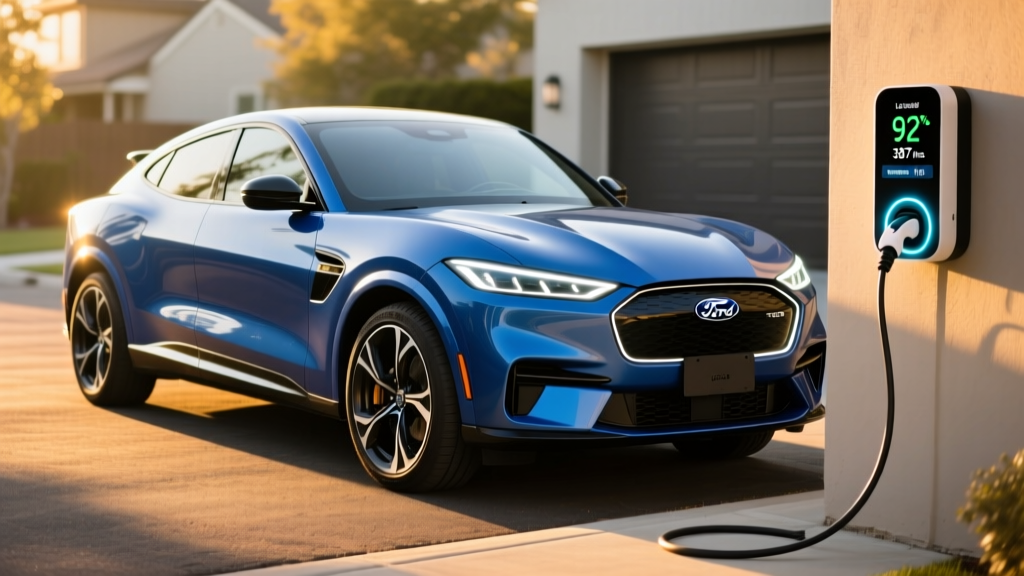
The Ford Mustang Mach-E enters its sixth model year in 2026 with a formula that has aged well: a sporty crossover silhouette, competitive range, and one of the most dependable public charging ecosystems among non-Tesla EVs. But for buyers researching Ford Mach-E reliability, the conversation goes deeper than EPA stickers. It spans battery chemistry shifts, long-term powertrain warranty coverage, software stability, and real-world ownership costs. This review breaks down every data point you need to evaluate whether the 2026 Mach-E is a sound long-term purchase.
2026 Mach-E at a Glance: Core Specifications
| Spec | Select (RWD) | Premium AWD (ER) | GT |
|---|---|---|---|
| EPA Range | 250 mi | 320 mi | 280 mi |
| Battery (usable) | 75.7 kWh (LFP) | 91.0 kWh (NMC) | 91.0 kWh (NMC) |
| Horsepower | 290 hp | 365 hp | 480 hp |
| 0–60 mph | 6.1 sec | 4.8 sec | 3.5 sec |
| Drivetrain | RWD (single motor) | AWD (dual motor) | AWD (dual motor, performance tuned) |
| Peak DC Fast Charge | 150 kW | 150 kW | 150 kW |
| 10–80% DC Time | ~33 min | ~36 min | ~36 min |
| Level 2 Home Rate | 10.5 kW (~30 mi/hr) | 10.5 kW (~30 mi/hr) | 10.5 kW (~30 mi/hr) |
| Efficiency (combined) | 101 MPGe (33 kWh/100mi) | 98 MPGe (34 kWh/100mi) | 86 MPGe (39 kWh/100mi) |
| Base MSRP | $39,995 | $52,495 | $59,995 |
Real-World Range: What the EPA Sticker Doesn't Tell You
According to fueleconomy.gov, the Mach-E Premium AWD ER returns 34 kWh per 100 miles combined. That efficiency is competitive with the Hyundai Ioniq 5 AWD but trails the Tesla Model Y Long Range, which manages around 28 kWh/100mi. The Mach-E's aerodynamic drag coefficient of 0.29 and its 4,800-pound curb weight (AWD ER) work against it at highway speeds, which is where most range loss occurs.
LFP chemistry in the Select trim carries a trade-off: slightly lower energy density means a smaller battery and shorter range, but LFP cells tolerate regular 100% charging without the degradation concerns of NMC packs. Ford recommends daily charging to 100% for LFP-equipped Mach-E models — a significant ownership convenience that NMC owners (Premium, GT) should avoid, keeping those packs between 20–80% for optimal longevity.
Charging Speed and Infrastructure: DC Fast, Level 2, and the NACS Transition
| Charging Level | Power | Speed (approx.) | Notes |
|---|---|---|---|
| Level 1 (120V household) | 1.4 kW | ~3–4 mi/hr | Emergency/trickle only |
| Level 2 (240V home/public) | 10.5 kW | ~30 mi/hr | Full charge in ~9–10 hrs (ER) |
| DC Fast Charge | Peak 150 kW | 10–80% in ~33–36 min | Tapers significantly above 80% |
The Mach-E's 150 kW peak DC charge rate is its most debated spec. Competitors like the Ioniq 5 and Kia EV6 accept up to 240–350 kW on 800V architectures, enabling 10–80% charges in 18 minutes or less. The Mach-E's 400V platform caps at 150 kW, and real-world testing shows the charge curve tapers from 150 kW to under 60 kW once the battery passes 80% state of charge. On a road trip, that means planning slightly longer stops than you would in an 800V vehicle.
For 2026, Ford has fully transitioned the Mach-E to the NACS (Tesla-style) charge port, eliminating the need for an adapter at Tesla Superchargers. This unlocks access to over 20,000 Supercharger stalls nationwide — a decisive infrastructure advantage that reshapes the reliability-of-charging conversation. Home Level 2 charging with a Ford Charge Station Pro or any quality 48-amp J1772/NACS wall unit delivers roughly 30 miles of range per hour, easily replenishing a full day's commute overnight.
Battery Longevity and Ford Mach-E Reliability Data
Ford's high-voltage battery warranty covers 8 years or 100,000 miles (whichever comes first) against defects and capacity loss below 70% of original capacity. This matches the industry standard and aligns with the NHTSA-mandated minimum for emissions-related components, though some competitors like Hyundai offer 10-year/100,000-mile coverage.
The shift to LFP (lithium iron phosphate) chemistry in the Select trim is one of the most reliability-positive moves Ford has made with the Mach-E. LFP cells offer several durability advantages:
- Cycle life: LFP cells typically sustain 3,000+ full charge cycles before reaching 80% capacity, compared to roughly 1,500–2,000 cycles for NMC. That translates to well over 300,000 miles of driving before meaningful degradation.
- Thermal stability: LFP chemistry is inherently more resistant to thermal runaway, reducing the risk of battery-related fire events.
- No cobalt: Eliminates supply-chain ethics concerns and reduces exposure to cobalt price volatility for replacement cells.
The NMC packs in Premium and GT trims remain proven technology. Ford's active liquid thermal management system keeps the battery in its optimal temperature window, and real-world data from 2021–2024 Mach-E owners suggests average annual degradation of approximately 1.5–2.0% — meaning a 320-mile ER model would retain roughly 290–300 miles of range after five years of typical use.
On the mechanical side, the Mach-E has avoided the widespread drivetrain failures that plagued some early EVs from other brands. The most commonly reported issues in owner forums and NHTSA complaint databases relate to 12V auxiliary battery drain (a software-related parasitic draw issue addressed via OTA updates) and occasional build-quality concerns like wind noise from door seals. The electric motors themselves — permanent-magnet synchronous units on both axles for AWD — have proven robust with no systemic failure patterns.
Pricing, Trims, and Federal Tax Credit Eligibility
| Trim | Base MSRP | As-Tested (typical options) | §30D Credit Eligibility | Effective Price (est.) |
|---|---|---|---|---|
| Select RWD | $39,995 | $42,500 | Likely eligible (up to $7,500) | ~$32,495–$35,000 |
| Premium AWD ER | $52,495 | $56,800 | Eligible (under $80K MSRP cap) | ~$44,995–$49,300 |
| GT | $59,995 | $64,000 | Eligible (under $80K MSRP cap) | ~$52,495–$56,500 |
Under current IRS §30D rules, the Mach-E qualifies for the federal clean vehicle credit — up to $7,500 — provided the buyer meets income thresholds ($150K single / $300K joint MAGI) and the vehicle satisfies battery-component and critical-mineral sourcing requirements. Ford has worked to shift battery sourcing to North American supply chains, but the exact credit amount ($3,750 for meeting one requirement, $7,500 for both) can shift based on Treasury guidance. The Mach-E's MSRP in all trims falls well under the $80,000 SUV cap. Buyers can elect to transfer the credit to the dealer at point of sale, reducing the purchase price directly rather than waiting for a tax refund.
Always verify current eligibility at fueleconomy.gov's tax credit database before purchasing, as battery-sourcing compliance is updated periodically by the Treasury Department.
Interior Space, Technology, and Daily Usability
The Mach-E's interior reflects Ford's tech-forward ambitions. A 15.5-inch vertical touchscreen running SYNC 4A dominates the dashboard, with wireless Apple CarPlay and Android Auto as standard. The digital instrument cluster is a 10.2-inch unit positioned high in the sightline. Over-the-air updates continue to refine the interface — Ford's Ford Power-Up platform has delivered meaningful improvements to navigation routing, charge-station recommendations, and BlueCruise capability since launch.
Cargo and passenger dimensions remain practical for a midsize crossover:
- Rear cargo (behind second row): 29.7 cu ft
- Cargo with rear seats folded: 59.7 cu ft
- Front trunk (frunk): 4.7 cu ft (drainable, useful for wet gear)
- Rear legroom: 38.9 inches
- Front headroom: 40.4 inches
The frunk is smaller than the Tesla Model Y's 4.1 cu ft front trunk (combined with its larger rear), and the Mach-E's rear cargo area trails the Model Y's 76 cu ft maximum. For families with strollers or road-trip gear, this is a real-world limitation worth measuring against your needs.
BlueCruise, Ford's Level 2 hands-free driving assist, operates on over 130,000 miles of pre-mapped divided highways. It uses a driver-facing camera to monitor eye attention, allowing hands-off operation while requiring the driver to remain alert. This is not autonomous driving — it is SAE Level 2 automation, and the driver is responsible for all vehicle operation. In practice, BlueCruise is smooth and confidence-inspiring on long highway stretches, reducing fatigue meaningfully. It's available as a subscription after the initial trial period expires (typically 90 days to 1 year depending on trim and promotion).
How the Mach-E Stacks Up Against Key Competitors
The Mach-E competes directly with the Tesla Model Y Long Range, Hyundai Ioniq 5 AWD, and Kia EV6 Wind AWD. Here's how they compare on the metrics that matter most:
- Range: Model Y LR (~330 mi EPA) leads, followed by Mach-E Premium ER (320 mi), Ioniq 5 AWD (~290 mi), EV6 AWD (~282 mi).
- Charging speed: Ioniq 5 and EV6 dominate at 240–350 kW peak. Model Y peaks around 250 kW. Mach-E trails at 150 kW.
- Charging network: Mach-E (NACS port) and Model Y share Supercharger access. Ioniq 5/EV6 rely on Electrify America and third-party networks.
- Cargo space: Model Y wins decisively. Mach-E is mid-pack. Ioniq 5 and EV6 offer similar volumes.
- Driving dynamics: Mach-E GT and EV6 GT are the enthusiast picks. Model Y prioritizes efficiency. Ioniq 5 is the comfort-oriented cruiser.
- Price after credit: All four compete in the $35K–$55K effective range depending on trim. Mach-E Select LFP at ~$32K after credit is one of the most affordable entries.
Pros, Cons, and Who Should Buy the Mach-E
Pros
- NACS port = native Supercharger access, no adapter needed
- LFP battery option (Select) offers exceptional cycle life and daily 100% charging
- Competitive handling and steering feel for a crossover EV
- BlueCruise is among the best Level 2 systems on divided highways
- Strong federal tax credit eligibility across all trims
- Ford dealer network for service is vast and accessible
Cons
- 150 kW DC fast-charge peak lags behind 800V competitors
- Highway real-world range drops noticeably from EPA sticker
- Rear cargo space trails Model Y by over 15 cu ft
- BlueCruise requires ongoing subscription after trial
- No heat pump standard on all trims (efficiency hit in cold weather)
- Some owners report 12V battery drain issues (mostly resolved via OTA)
Best for: Daily commuters and small families who want a sporty-driving EV with reliable Supercharger access on road trips. The Select RWD with LFP is ideal for buyers who charge at home nightly and want maximum battery longevity with minimal degradation anxiety. The Premium AWD ER suits those who need all-weather traction and 300+ mile road-trip capability.
Look elsewhere if: You regularly take 400+ mile road trips and want the shortest possible charge stops (Ioniq 5/EV6), you need maximum cargo volume (Model Y), or you want the most cutting-edge charging architecture available.
Frequently Asked Questions
What is the real-world range of the 2026 Ford Mustang Mach-E?
The Premium AWD Extended Range achieves 320 miles EPA. Real-world highway driving yields approximately 265–285 miles in mild weather and 220–250 miles in freezing conditions. The Select RWD (250 mi EPA) delivers roughly 210–225 miles on the highway.
How fast does the Mach-E charge at home and on the road?
At home on a Level 2 (240V, 48-amp) charger, the Mach-E adds about 30 miles of range per hour, fully replenishing the Extended Range battery in roughly 9–10 hours. On DC fast chargers, it peaks at 150 kW, reaching 10–80% in about 33–36 minutes before tapering significantly.
Does the 2026 Mach-E qualify for the $7,500 federal EV tax credit?
Yes, all trims fall under the $80,000 MSRP cap for SUVs. Buyers must meet income limits ($150K single / $300K joint) and the vehicle must satisfy battery-sourcing requirements. The credit can be transferred to the dealer at point of sale. Verify current eligibility on fueleconomy.gov before purchase.
Is the Ford Mach-E reliable long-term?
The Mach-E's electric drivetrain has shown no systemic failure patterns through five model years. The LFP battery in the Select trim offers superior cycle life (3,000+ cycles). Ford's 8-year/100,000-mile battery warranty covers capacity loss below 70%. The most common complaints involve 12V battery drain and minor build-quality issues, not high-voltage system failures.
Is the Mach-E worth buying over a Tesla Model Y or Hyundai Ioniq 5?
It depends on priorities. The Mach-E offers native NACS/Supercharger access, a sportier drive, and an LFP battery option for longevity-focused buyers. The Model Y wins on cargo space and efficiency. The Ioniq 5 wins on DC charging speed. If Supercharger access and driving feel matter most, the Mach-E is a strong choice.