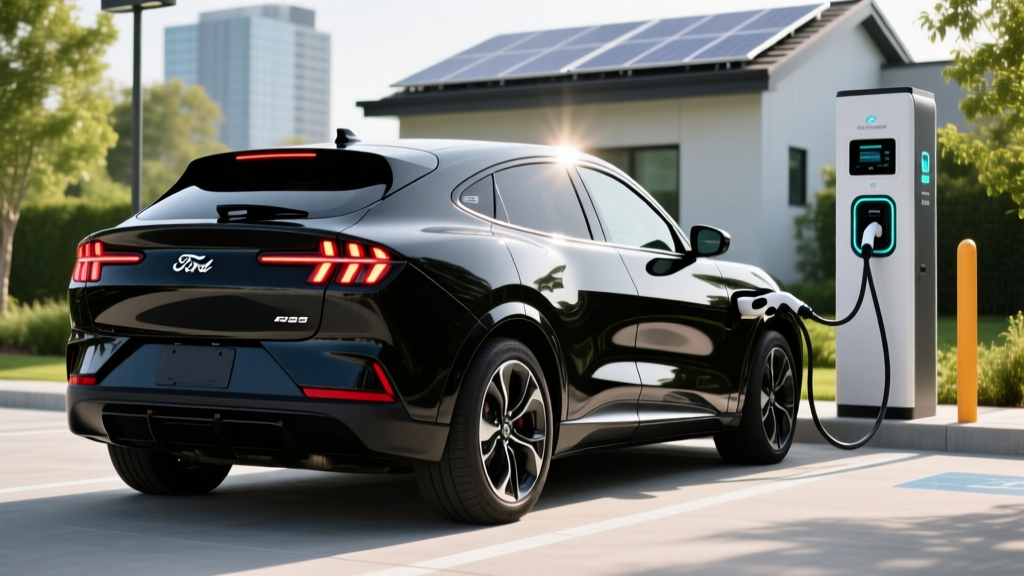
Quick Answer: The 2026 Ford Mustang Mach-E is a compelling electric crossover for buyers who want Mustang-inspired styling without the gas bill. The Select trim starts at $42,995 with an EPA-estimated 250 miles of range, while the Premium Extended Range RWD reaches 320 miles EPA. DC fast charging peaks at 150 kW, delivering a 10–80% charge in roughly 26 minutes. With the federal §30D tax credit (up to $7,500 for eligible buyers) applied at the point of sale, effective pricing drops meaningfully — but eligibility depends on income, MSRP caps, and battery-sourcing rules that shift year to year. Compared to a gas-powered Ford Edge or Toyota RAV4, the Mach-E saves an estimated $1,200–$1,800 annually in fuel and maintenance for a driver covering 12,000 miles per year, though insurance premiums and upfront cost remain higher.
Mustang Mach-E Range: EPA Stickers vs Real-World Miles
Range is the first question every EV shopper asks, and the Mach-E lineup spans a wide envelope depending on trim and drivetrain. Here's what Ford publishes and what fueleconomy.gov lists for the current generation:
| Trim | Battery (kWh usable) | Drivetrain | EPA Range | MPGe (combined) |
|---|---|---|---|---|
| Select SR RWD | 70 kWh (LFP) | RWD | 250 mi | 101 MPGe |
| Select ER AWD | 91 kWh (NMC) | AWD | 290 mi | 98 MPGe |
| Premium ER RWD | 91 kWh (NMC) | RWD | 320 mi | 104 MPGe |
| Premium ER AWD | 91 kWh (NMC) | AWD | 300 mi | 98 MPGe |
| GT | 91 kWh (NMC) | AWD | 280 mi | 86 MPGe |
Real-World Range Reality: EPA estimates assume a mix of city and highway driving at moderate temperatures. In our experience and consistent with third-party highway tests, expect 10–15% less range at sustained 75 mph highway speeds — putting the Premium ER RWD closer to 270–285 real highway miles. In freezing temperatures (below 30°F), plan for an additional 15–25% reduction due to cabin heating and battery chemistry limitations. The LFP battery in the Select SR is more tolerant of daily 100% charging but offers lower energy density, meaning less total range.
Charging the Mustang Mach-E: Home, Public, and the NACS Transition
Charging speed separates a road-trip-capable EV from a commuter-only appliance. The Mach-E uses the NACS (Tesla-style) charge port as of the 2025 model year, giving it native access to Tesla's Supercharger network — currently over 25,000 stalls in North America — without an adapter. This is a significant advantage over CCS-equipped competitors still reliant on adapters or sparser networks.
| Charging Level | Power (kW) | Miles Added per Hour | Typical Use Case |
|---|---|---|---|
| Level 1 (120V household) | ~1.4 kW | ~4–5 mi/hr | Overnight top-up, emergencies |
| Level 2 (240V home, 48A) | ~11.5 kW | ~33–36 mi/hr | Primary daily charging |
| DC Fast (peak) | 150 kW | ~180 mi in 20 min | Road trips, quick stops |
DC fast charging curve reality: The Mach-E peaks at 150 kW only between roughly 10–40% state of charge. Above 60%, the curve tapers significantly — by 80% you're pulling closer to 50–60 kW. A 10–80% session takes approximately 26 minutes at a properly rated stall, but charging from 80–100% can add another 25+ minutes. This is why road-trip strategy focuses on 10–80% sprints rather than full fills.
For home charging, a Level 2 wall connector on a 60-amp circuit (delivering 48 amps continuous) fully replenishes the Extended Range battery in roughly 8–9 hours — ideal for overnight charging. Installation costs vary widely: expect $500–$1,200 for the electrician and hardware if your panel is close to the garage, but $1,500–$3,000+ if a panel upgrade or long conduit run is needed. Always get a quote from a licensed electrician before committing to a vehicle.
Performance and Driving: 0–60, Horsepower, and the GT Question
The Mach-E isn't just an efficiency play — it's genuinely quick. Here's the performance breakdown by powertrain:
- Select RWD: 266 hp, 0–60 mph in ~6.1 seconds
- ER AWD: 312 hp, 0–60 mph in ~5.1 seconds
- GT: 480 hp, 0–60 mph in ~3.5 seconds
The GT's 3.5-second sprint puts it in sports-car territory, but it trades range (280 mi EPA) and efficiency (86 MPGe) for that performance. For most buyers, the Premium ER RWD at 320 miles and 104 MPGe hits the sweet spot between daily usability and passing power. The single-motor RWD layout also means lower tire wear and slightly reduced maintenance over the dual-motor AWD variants.
All trims include Ford's BlueCruise hands-free highway driving assist on compatible divided highways. To be clear per SAE automation levels defined by NHTSA, BlueCruise is a Level 2 system — the driver must remain attentive and is legally responsible for the vehicle at all times. It is not self-driving.
EV vs Gas: Mustang Mach-E Compared to the Ford Edge and RAV4
Buyers cross-shopping the Mach-E are often comparing it to a mid-size gas crossover. Let's put numbers to that decision with a 5-year ownership estimate based on 12,000 miles/year, $3.50/gallon gas, and $0.14/kWh electricity (national averages):
| Cost Category | Mach-E Premium ER RWD | Ford Edge AWD (Gas) | Toyota RAV4 AWD (Gas) |
|---|---|---|---|
| Base MSRP | $48,995 | $40,500 | $33,500 |
| Fed. Tax Credit (est.) | -$3,750 to -$7,500* | $0 | $0 |
| Fuel/Energy (5 yr) | ~$4,200 | ~$10,500 | ~$8,400 |
| Maintenance (5 yr) | ~$1,800 | ~$3,600 | ~$3,200 |
| Insurance (5 yr est.) | ~$11,500 | ~$9,000 | ~$8,200 |
| 5-Year Total (before depreciation) | ~$55,245–$58,995 | ~$63,600 | ~$53,300 |
*Tax credit amount depends on battery-sourcing compliance, buyer income caps ($150K single / $300K joint), and MSRP caps ($80K for SUVs). Verify current eligibility at IRS.gov §30D.
The Mach-E's higher insurance cost — typically 15–25% more than a comparable gas crossover — partially offsets fuel savings. However, the elimination of oil changes, transmission fluid, spark plugs, and exhaust system repairs delivers genuine long-term savings. For buyers who can charge at home and drive 10,000+ miles annually, the Mach-E breaks even against the Edge within roughly 3–4 years and pulls ahead after that.
Common Mustang Mach-E Misconceptions, Addressed with Data
| Myth | Fact |
|---|---|
| "The battery will need replacing in 5 years." | Ford warranties the battery for 8 years / 100,000 miles against degradation below 70% capacity. Industry data shows typical degradation of 8–12% over 8 years for NMC packs with normal use. |
| "I can't take road trips — charging takes too long." | A 10–80% DC fast charge takes ~26 minutes. On a 600-mile trip, you'd add roughly 50–60 minutes of charging across 2–3 stops — comparable to meal and restroom breaks. |
| "EVs are worse in winter." | Range drops 15–25% in sub-freezing temps, but preconditioning while plugged in mitigates this. The Mach-E's heat pump (standard on most trims) improves cold-weather efficiency over resistive heating. |
| "I need a Tesla to use Superchargers." | Since 2025, the Mach-E has a native NACS port and accesses Supercharger stalls directly — no adapter needed. |
| "The $7,500 tax credit applies to everyone." | Eligibility requires meeting income caps, MSRP caps, and critical-mineral/battery-component sourcing thresholds. Many buyers qualify for a partial credit ($3,750) or none at all. Always check IRS guidance. |
Ownership Decision Framework: Is the Mach-E Right for You?
Choose the Mustang Mach-E if:
- You have access to Level 2 home charging (garage or driveway with a 240V outlet)
- Your daily commute is under 80 miles round-trip (covers 95%+ of driving on a single charge)
- You take 1–3 road trips per year of 300–600 miles (manageable with Supercharger access)
- You want a crossover with genuine performance (sub-6-second 0–60) and modern tech
- You qualify for at least a partial §30D tax credit, bringing effective price closer to gas competitors
Look elsewhere (consider a PHEV or HEV) if:
- You live in an apartment or lack reliable home/workplace charging access
- You regularly drive 400+ miles in a single day through areas with sparse charging infrastructure
- You live in extreme cold climates (frequent sub-10°F weather) and cannot garage the vehicle
- Your budget is strictly under $35,000 and you need a new vehicle — consider a used Mach-E (eligible for the separate $4,000 used-EV credit) or a hybrid like the RAV4 Hybrid
- You need 3-row seating — the Mach-E is a 5-passenger, 2-row crossover
Pricing, Trims, and What to Budget in 2026
The 2026 Mach-E lineup breaks down as follows (destination charge included):
- Select SR RWD: $42,995 — 250 mi range, LFP battery, well-equipped base
- Select ER AWD: $48,495 — 290 mi range, NMC battery, dual motor
- Premium ER RWD: $48,995 — 320 mi range, panoramic roof, upgraded interior
- Premium ER AWD: $51,995 — 300 mi range, all-weather capability
- GT: $59,995 — 280 mi range, 480 hp, MagneRide dampers
Add $0–$1,200 for destination on top of any dealer-installed accessories. The federal tax credit, where applicable, can now be transferred at the point of sale, meaning the dealer applies it as a down-payment reduction rather than waiting for a tax refund. This makes the effective purchase price significantly lower for eligible buyers — but confirm your eligibility with a tax professional before relying on the full $7,500.
Frequently Asked Questions
What's the real-world highway range of the Mach-E Premium Extended Range?
The EPA rates it at 320 miles combined. At sustained 70–75 mph highway speeds in moderate temperatures, expect approximately 275–290 miles. In cold weather (below 30°F) at highway speeds, plan for 230–255 miles before needing to charge.
Can I charge the Mach-E at Tesla Superchargers?
Yes. The 2025+ Mach-E has a native NACS charge port and accesses the Supercharger network directly. No adapter is required. Use the FordPass app or the vehicle's built-in navigation to locate and initiate sessions.
How much does it cost to charge at home per month?
At the national average electricity rate of ~$0.14/kWh and driving 1,000 miles/month (consuming roughly 300 kWh), expect a home charging cost of approximately $42/month. Compare that to $175/month for a gas crossover averaging 25 MPG at $3.50/gallon.
Does the Mach-E qualify for the $7,500 federal tax credit?
It may qualify for the full $7,500, a partial $3,750, or no credit depending on current battery-sourcing compliance, your adjusted gross income, and the MSRP cap ($80,000 for SUVs). Rules change periodically — check fueleconomy.gov's credit lookup tool for the specific VIN you're considering.
How does insurance cost compare to a gas crossover?
EV insurance typically runs 15–25% higher than an equivalent gas vehicle due to higher repair costs and battery replacement risk. For the Mach-E, expect annual premiums of roughly $2,000–$2,600 depending on your state, driving record, and coverage level — compared to $1,600–$2,000 for a gas Edge or RAV4.
What's the battery warranty?
Ford covers the high-voltage battery for 8 years or 100,000 miles (whichever comes first) against defects and capacity loss below 70% of original capacity. The powertrain (motors, power electronics) is covered for the same period.