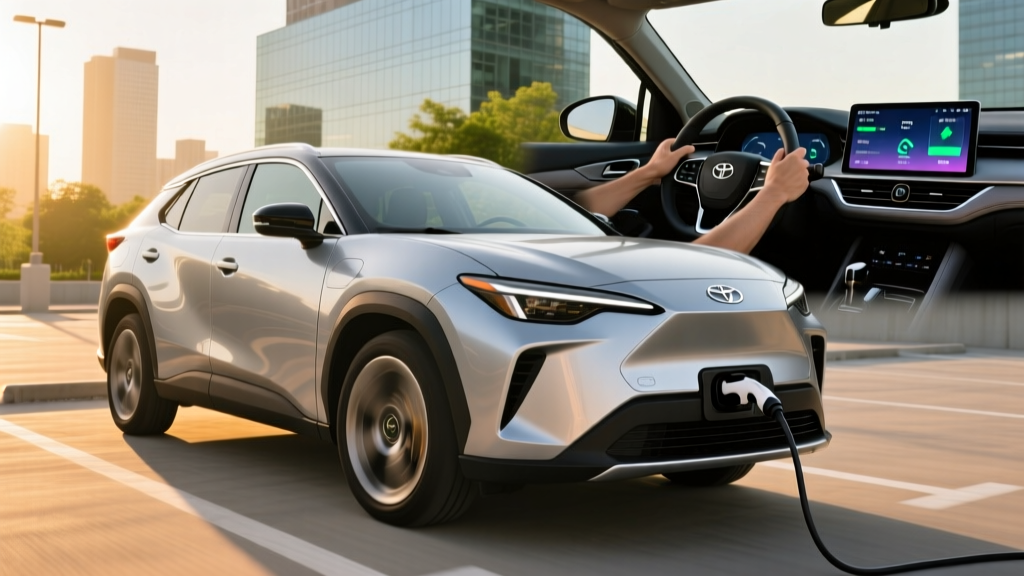
The Toyota bZ4X entered the U.S. market with more than its share of skepticism — early recall woes, modest range, and conservative charging speeds left enthusiasts underwhelmed. But for the 2025 model year, Toyota has quietly refined the formula. The result is a mainstream compact electric crossover that prioritizes comfort, reliability, and a familiar Toyota ownership experience over headline-grabbing specs. If you're cross-shopping the Toyota bZ4X 2025 against rivals like the Hyundai Ioniq 5, Ford Mustang Mach-E, or Volkswagen ID.4, here's the data-driven breakdown you need before visiting a dealer.
Quick Verdict: Who the 2025 bZ4X Is For
The 2025 bZ4X is best suited for Toyota-loyal commuters and small families who want a zero-tailpipe-emission daily driver with predictable ownership costs, strong dealer support, and a comfortable ride. It is not the segment leader in range, charging speed, or cargo space — but it doesn't pretend to be. Buyers who prioritize a refined cabin, standard all-wheel drive availability, and Toyota's reputation for long-term reliability will find the bZ4X a compelling, if conservative, choice.
Look elsewhere if: You need 300+ miles of range, the fastest DC charging in the segment, or maximum cargo volume.
Range and Efficiency: EPA Numbers vs. Real-World Reality
| Trim / Drivetrain | EPA Range | MPGe (City/Hwy/Combined) | kWh/100 mi |
|---|---|---|---|
| XLE FWD | 252 mi | 131 / 107 / 119 | 28 |
| XLE AWD | 228 mi | 114 / 94 / 104 | 32 |
| Limited FWD | 236 mi | 121 / 100 / 111 | 30 |
| Limited AWD | 222 mi | 110 / 92 / 102 | 33 |
The EPA-estimated 252 miles for the FWD XLE is achievable in mixed city/suburban driving in mild weather. However, expect approximately 200–220 miles on sustained highway trips at 70–75 mph, where aerodynamic drag and the bZ4X's relatively low efficiency (28–33 kWh/100 mi) take a toll. In cold weather (below 32°F), plan for a 20–30% range reduction, bringing the FWD model to roughly 175–200 miles and the AWD Limited to as low as 155–175 miles. The bZ4X uses a resistive cabin heater on most trims rather than a heat pump (a dealer-installed heat pump is available in some markets), which amplifies cold-weather energy consumption.
Compared to the Hyundai Ioniq 5 Long Range (EPA 303 mi) or the Volkswagen ID.4 Pro S (EPA 291 mi), the bZ4X's range sits near the bottom of the compact electric crossover segment. For daily commutes under 60 miles round-trip, this is a non-issue — you'll charge at home and rarely think about it. For road trips exceeding 200 miles, you'll need to plan at least one DC fast-charge stop.
Battery and Powertrain: Chemistry, Capacity, and Performance
| Specification | Detail |
|---|---|
| Battery Chemistry | NMC (Nickel Manganese Cobalt) lithium-ion |
| Total Battery Capacity | 71.4 kWh |
| Usable Capacity (estimated) | ~64–66 kWh |
| FWD Motor Output | 201 hp / 196 lb-ft torque |
| AWD Motor Output (combined) | 214 hp / 248 lb-ft torque |
| Drivetrain | FWD (single motor) or AWD (dual motor, X-Mode) |
| 0–60 mph (FWD) | ~7.1 seconds |
| 0–60 mph (AWD) | ~5.8 seconds |
| Thermal Management | Liquid-cooled battery pack |
The bZ4X's 71.4 kWh NMC battery is liquid-cooled, which helps manage degradation and supports consistent charging performance. Toyota has engineered a relatively large buffer (roughly 5–7 kWh reserved above and below the usable window) to protect long-term cell health — a hallmark of Toyota's conservative approach to battery management. The trade-off is that usable capacity is lower than the total figure might suggest.
The AWD model uses Toyota's X-Mode system with independent front and rear motors, offering modest off-road capability and improved traction in snow and rain. It's not a performance-oriented dual-motor setup like the Tesla Model Y or Ford Mustang Mach-E GT, but it delivers confident acceleration for merging and passing.
Charging Speeds: DC Fast Charging and Home Level 2
| Charging Level | Power / Rate | Time / Miles Added | Connector |
|---|---|---|---|
| Level 1 (120V household) | ~1.4 kW | ~3–4 miles per hour | J1772 |
| Level 2 (240V home/public) | Up to 7.6 kW | ~20–23 miles per hour; full charge in ~9.5 hrs | J1772 |
| DC Fast Charge (peak) | Up to 150 kW (FWD) / 100 kW (AWD)* | 10–80% in ~30 minutes | CCS1 |
*Note: Toyota lists the AWD model's peak DC charge rate lower than the FWD. Real-world DC fast charging sessions typically average 70–90 kW sustained across the 10–80% session, as the charge curve tapers significantly above 60% State of Charge. Plan for roughly 30 minutes for a 10–80% session at a 150 kW+ station.
The bZ4X uses the CCS1 connector standard. With the broader industry shifting toward NACS (the Tesla charging standard), Toyota has announced that future models will adopt NACS natively. For 2025, bZ4X owners can access Tesla Superchargers using a Toyota-approved CCS-to-NACS adapter, which significantly expands the available public fast-charging network.
One practical note: the bZ4X supports battery preconditioning for DC fast charging when a charging station is set as the navigation destination. This warms the battery to optimal temperature and can meaningfully improve charge speed in cold weather — always use the nav-routing feature when heading to a fast charger.
Pricing, Trims, and Federal Tax Credit Eligibility
| Trim | Drivetrain | Base MSRP* | Est. After §30D Credit** |
|---|---|---|---|
| XLE | FWD | $37,070 | ~$29,570 |
| XLE | AWD | $39,150 | ~$31,650 |
| Limited | FWD | $43,070 | ~$35,570 |
| Limited | AWD | $45,150 | ~$37,650 |
*MSRP includes destination charge. Prices subject to change; verify with dealer.
**Federal tax credit amount is up to $7,500 under IRS §30D. Eligibility depends on buyer income, battery sourcing, and MSRP caps. Credit may be applied at point of sale as a down-payment reduction starting 2024. See IRS Clean Vehicle Credit for current rules.
- MSRP Cap: SUVs/crossovers must have an MSRP at or below $80,000 — the bZ4X clears this easily.
- Buyer Income Cap: Modified AGI must not exceed $150,000 (single), $225,000 (head of household), or $300,000 (joint).
- Battery Sourcing: The credit is split into two halves — $3,750 for meeting critical-mineral requirements and $3,750 for battery-component sourcing. Vehicles with China-sourced battery components may qualify for a reduced credit or none at all. Toyota has been working to shift supply chains, but verify current eligibility for the specific VIN with your dealer before purchase.
- Point-of-Sale Transfer: Eligible buyers can transfer the credit to the dealer at purchase, reducing the upfront cost immediately rather than waiting to claim it on their tax return.
Interior, Cargo, and Technology
| Measurement | Specification |
|---|---|
| Seating Capacity | 5 passengers |
| Front Legroom | 42.1 inches |
| Rear Legroom | 35.3 inches |
| Cargo Volume (behind 2nd row) | 27.7 cu ft |
| Cargo Volume (2nd row folded) | 56.9 cu ft |
| Front Trunk (Frunk) | None |
The cabin is where the bZ4X makes its strongest case. Materials quality is a step above the Hyundai Ioniq 5 and competitive with the VW ID.4, with soft-touch surfaces on the dashboard and door panels. The 12.3-inch touchscreen (standard on all trims for 2025) runs Toyota's latest infotainment system with wireless Apple CarPlay and Android Auto, native navigation, and over-the-air update capability.
Toyota Safety Sense 3.0 comes standard, bundling adaptive cruise control, lane-keeping assist, automatic emergency braking with pedestrian detection, and blind-spot monitoring. This is a SAE Level 2 driver-assist system — it requires the driver to remain fully engaged and hands on the wheel at all times. It is not a self-driving system.
The most notable drawback is the absence of a front trunk (frunk), which costs you roughly 1–2 cu ft of enclosed storage that competitors like the Ioniq 5 and Mach-E provide. The 27.7 cu ft rear cargo area is adequate for a family grocery run but trails the ID.4's 30.3 cu ft and the Ioniq 5's 27.2 cu ft (though the Ioniq 5's frunk partially offsets this).
Warranty and Long-Term Ownership
| Coverage Area | Term |
|---|---|
| Basic (Bumper-to-Bumper) | 3 years / 36,000 miles |
| Powertrain | 5 years / 60,000 miles |
| Hybrid/EV Battery | 8 years / 100,000 miles |
| Corrosion Perforation | 5 years / unlimited miles |
| Roadside Assistance | 2 years / 25,000 miles |
Toyota guarantees the bZ4X's high-voltage battery will retain at least 70% of its original capacity during the 8-year/100,000-mile warranty period. Toyota's internal testing targets 90% capacity retention after 10 years — a claim supported by their conservative buffer strategy and decades of hybrid battery experience. A full battery replacement, if needed out of warranty, is estimated at $8,000–$12,000 based on current NMC pack pricing, though costs are expected to decline as the supply chain matures.
According to fueleconomy.gov, the bZ4X FWD XLE's annual fuel cost (electricity) is estimated at approximately $600–$750 based on national average electricity rates — roughly one-third the cost of fueling a comparable gasoline RAV4.
Pros, Cons, and How It Stacks Up
- Comfortable, well-insulated cabin with quality materials
- Standard Toyota Safety Sense 3.0 across all trims
- AWD available with X-Mode for snow/light off-road
- Competitive pricing; eligible for up to $7,500 federal credit
- Strong Toyota dealer network for service and support
- Conservative battery management favors long-term longevity
- EPA range (222–252 mi) trails most compact EV crossover rivals
- DC fast charging peaks at 150 kW and tapers early; 10–80% in ~30 min
- No front trunk (frunk)
- No heat pump standard (reduces cold-weather efficiency)
- Rear legroom (35.3 in) is tighter than some competitors
- AWD model has a lower peak DC charge rate than FWD
Frequently Asked Questions
What is the real-world range of the 2025 Toyota bZ4X?
In mild weather with mixed city and suburban driving, the FWD XLE achieves close to its EPA estimate of 252 miles. On highway road trips at 70+ mph, expect 200–220 miles. In freezing temperatures, plan for 175–200 miles (FWD) or 155–175 miles (AWD Limited) due to battery chemistry limitations and the lack of a standard heat pump.
How fast does the 2025 bZ4X charge at home and on DC fast chargers?
At home on a Level 2 (240V) charger, the bZ4X accepts up to 7.6 kW, adding roughly 20–23 miles of range per hour — a full charge from empty takes about 9.5 hours. On DC fast chargers, the FWD model peaks at 150 kW, while the AWD peaks lower at approximately 100 kW. Both models typically complete a 10–80% session in around 30 minutes, with the charge rate tapering noticeably above 60% State of Charge.
Does the 2025 Toyota bZ4X qualify for the federal EV tax credit?
The bZ4X's MSRP falls well under the $80,000 SUV cap, making it potentially eligible for up to $7,500 under IRS §30D. However, the actual credit amount depends on battery-component and critical-mineral sourcing requirements, which vary by production batch, as well as buyer income limits ($150K single / $300K joint). Verify eligibility for the specific VIN with your dealer and consult IRS.gov or a tax professional before purchase. The credit can be transferred at point of sale to reduce your down payment.
Is the 2025 bZ4X worth buying vs. the Hyundai Ioniq 5 or VW ID.4?
If range and fast-charging speed are your top priorities, the Ioniq 5 (303 mi EPA, 10–80% in ~18 min) and ID.4 (291 mi EPA) are stronger picks. The bZ4X wins on cabin refinement, standard safety tech, and Toyota's long-term reliability reputation. It's the pragmatic choice for buyers who charge at home nightly and want a comfortable, low-drama EV with strong dealer support — not the spec-sheet champion.
What are the biggest drawbacks of the 2025 bZ4X?
The main limitations are below-average range for the segment, relatively slow DC fast charging compared to Hyundai/Kia's 800V architecture, no frunk, and the absence of a standard heat pump (which hurts cold-weather efficiency). Rear legroom is also tighter than some rivals.
Can the bZ4X tow or handle road trips?
The 2025 bZ4X is not rated for towing in the U.S. market. For road trips, plan charging stops every 180–200 miles in warm weather (or every 140–160 miles in cold weather). With access to CCS and Tesla Supercharger networks (via adapter), route planning is manageable but requires more stops than longer-range competitors.
Sources: fueleconomy.gov, Toyota bZ4X official page, IRS Clean Vehicle Credit. Specifications reflect 2025 model year data as published by Toyota. Verify all pricing and credit eligibility at time of purchase.