Is the 2026 Mustang Mach-E the Right EV to Lease?
If you're researching a Ford Mustang Mach-E lease, you're likely weighing it against the Tesla Model Y, Hyundai IONIQ 5, and Chevrolet Blazer EV. The Mach-E has matured since its 2021 debut: Ford has added NACS charge ports, extended-range batteries, and refined its BlueCruise hands-free driving system. For 2026, the Mach-E lineup starts at $36,495 (Select trim) and tops out near $65,000 (GT Performance Edition), with EPA ranges spanning 250 to 320 miles depending on battery and drivetrain.
This profile gives you the exact numbers — range, charging curves, pricing, federal tax credit eligibility under IRS §30D — to decide whether leasing the Mach-E makes financial sense for your commute and road-trip habits.
| Spec | Select / Premium (Std Range) | Premium (Ext Range RWD) | GT (Ext Range AWD) |
|---|---|---|---|
| EPA Range | 250 mi | 320 mi | 280 mi |
| Battery (usable) | 70 kWh (LFP) | 91 kWh (NMC) | 91 kWh (NMC) |
| Peak DC Charge Rate | 135 kW | 150 kW | 150 kW |
| 10–80% DC Time | ~38 min | ~45 min | ~45 min |
| Level 2 Rate | 10.5 kW (~30 mi/hr) | 10.5 kW (~26 mi/hr) | 10.5 kW (~26 mi/hr) |
| 0–60 mph | 6.3 s | 5.8 s | 3.8 s (GT) / 3.5 s (Perf Ed) |
| Horsepower | 266 hp | 290 hp | 480 hp (GT) / 563 hp (Perf Ed) |
| Drivetrain | RWD (single motor) | RWD or eAWD | eAWD (dual motor) |
| MPGe (combined) | 105 MPGe | 101 MPGe | 84 MPGe |
| Base MSRP | $36,495 | $43,495 | $55,995 |
Source: EPA Fuel Economy, Ford Motor Company 2026 spec sheets.
Real-World Range vs. EPA Estimates
The EPA sticker is a useful baseline, but actual range depends heavily on driving style, climate, and terrain. Here's what to expect from the two most popular configurations:
EPA: 320 miles | Real-world highway (70 mph, 72°F): ~275–290 miles
Cold weather (30°F, mixed driving): ~225–250 miles
City/regenerative driving: ~300–315 miles
EPA: 280 miles | Real-world highway (70 mph, 72°F): ~240–255 miles
Cold weather (30°F, mixed driving): ~200–220 miles
Aggressive driving or mountain terrain: ~190–210 miles
The standard-range LFP battery (Select trim) is best suited for commuters with home charging. Expect roughly 215–230 real-world highway miles and 180–200 miles in freezing temps. LFP chemistry tolerates cold somewhat better than NMC at low states of charge, but you'll still see a 20–30% range reduction below freezing without preconditioning.
Key insight for lease shoppers: If you regularly drive more than 250 miles per day or live in a cold-weather state, the Extended Range NMC battery is worth the premium. For urban commuters covering under 60 miles daily, the Standard Range LFP pack keeps lease payments lower and offers excellent cycle life.
Charging Speed: DC Fast, Level 2, and Connector Details
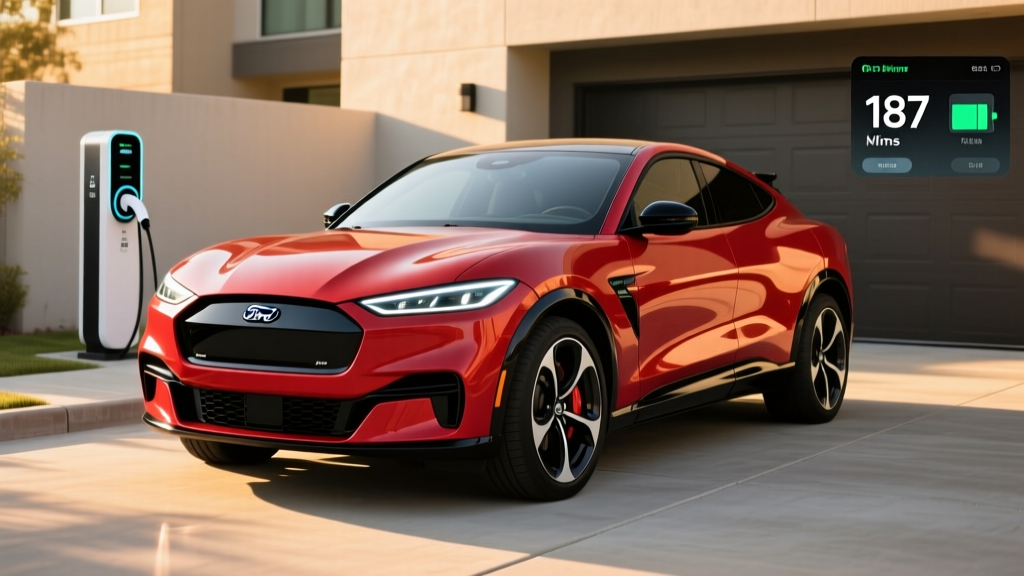
Ford switched the 2025+ Mach-E to the NACS (Tesla-style) charge port, giving native access to the Tesla Supercharger network — currently the most reliable DC fast-charging infrastructure in the U.S. This is a significant advantage for lessees planning road trips.
| Charge Level | Power / Rate | Miles Added | Notes |
|---|---|---|---|
| Level 1 (120V household) | ~1.4 kW | ~3–4 mi/hr | Emergency/top-up only |
| Level 2 (240V, 48A) | 10.5 kW | 26–30 mi/hr | Full charge overnight (~8–10 hrs) |
| DC Fast (peak, Std Range) | 135 kW | ~100 mi in 15 min | Tapers above 80% SoC |
| DC Fast (peak, Ext Range) | 150 kW | ~110 mi in 15 min | 10–80% in ~45 min |
Charging-curve reality: The 150 kW peak on Extended Range models is not sustained. The Mach-E typically holds 130–150 kW from 10% to roughly 50% SoC, then steps down to ~80 kW through 70%, and drops further to ~40 kW above 80%. Plan your road-trip stops around the 10–80% window for the best time efficiency. Preconditioning the battery (via the navigation system's "charge routing" feature) is essential in cold weather to hit peak rates.
For home charging, Ford includes the Ford Mobile Power Cord with every Mach-E. For regular Level 2 home charging, you'll want a hardwired 48-amp Wall Connector or equivalent — budget $500–$1,200 for equipment plus $800–$2,500 for electrician installation depending on your panel capacity and run length.
Pricing, Lease Costs, and Federal Tax Credit Eligibility
Leasing the Mach-E can be financially advantageous, particularly because the federal EV tax credit can sometimes be passed through as a lease incentive (the "lease loophole" under §30D's commercial clean vehicle credit interpretation). However, rules have tightened, and you must verify current-year eligibility with your dealer and tax professional.
| Trim | Base MSRP | As-Tested (Typical Options) | §30D Credit Eligibility | Est. Monthly Lease (36 mo, $3,500 down) |
|---|---|---|---|---|
| Select (Std Range RWD) | $36,495 | $37,990 | Eligible (MSRP under $55K cap; verify income & sourcing) | $329–$399 |
| Premium (Ext Range RWD) | $43,495 | $47,200 | Eligible (MSRP under $55K cap) | $429–$519 |
| GT (Ext Range eAWD) | $55,995 | $59,500 | Eligible (SUV MSRP cap: $80K) | $559–$679 |
| GT Performance Edition | $62,995 | $65,800 | Eligible (SUV MSRP cap: $80K) | $649–$779 |
- MSRP cap: Vans/SUVs/pickups ≤ $80,000; sedans/other ≤ $55,000 (Mach-E classifies as SUV)
- Buyer income cap: AGI ≤ $150,000 (single) / $225,000 (head of household) / $300,000 (joint)
- Battery sourcing: Critical minerals and battery components must meet phased-in domestic/free-trade-partner thresholds — verify VIN eligibility at fueleconomy.gov
- Point-of-sale transfer: You may transfer the credit to the dealer at purchase to reduce out-of-pocket cost; for leases, the lessor claims the commercial credit and may pass savings as a cap-cost reduction
- Final assembly: Vehicle must undergo final assembly in North America (all Mach-E units are built in Cuautitlán, Mexico — which qualifies under USMCA)
Source: IRS.gov §30D guidance. Rules are subject to legislative change; consult a tax professional before committing.
Interior, Cargo, and Technology
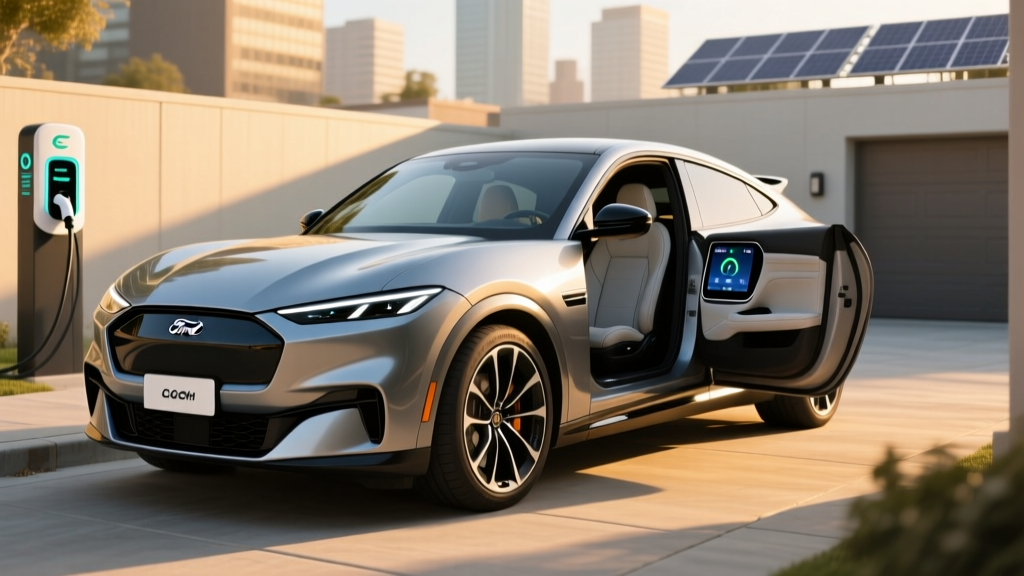
The Mach-E's cabin blends Mustang heritage styling cues with a modern EV layout. The 15.5-inch vertical touchscreen running SYNC 4A dominates the dash, with a minimalist center console and a rotary gear selector.
- Front legroom: 43.3 inches | Rear legroom: 38.1 inches
- Cargo (rear seats up): 29.7 cu ft | Cargo (rear seats folded): 59.7 cu ft
- Front trunk (frunk): 4.7 cu ft (weather-sealed, drainable — useful for wet gear or groceries)
- Towing capacity: Up to 2,300 lbs (with factory tow package, eAWD models only)
Standout tech:
- BlueCruise 1.5: Hands-free driving on 130,000+ miles of divided highways (SAE Level 2 — driver must remain attentive; eyes monitored by cabin camera). Included free for 90 days, then ~$75/month or $2,500 lifetime subscription.
- Phone-as-a-key: BLE-based entry and start; works reliably with iOS and Android.
- Over-the-air updates: Ford regularly pushes software improvements (battery management, infotainment features, BlueCruise maps).
- Wireless Apple CarPlay / Android Auto — standard on all trims.
Notable drawbacks:
- Rear visibility is compromised by thick C-pillars; the digital rearview camera mirror (optional on Premium, standard on GT) helps significantly.
- The glass roof (standard on Premium and above) has no shade — cabin heat load in summer is noticeable and can reduce range by 3–5% in extreme heat.
- SYNC 4A's interface, while improved, still has more menu layers than Tesla's or Hyundai's infotainment for common tasks like climate adjustment.
- Rear-seat cushion height is low — taller passengers may find thigh support lacking on long trips.
Warranty and Long-Term Battery Durability
Ford backs the Mach-E with competitive warranty coverage:
- Bumper-to-bumper: 3 years / 36,000 miles
- Powertrain: 5 years / 60,000 miles
- Battery (high-voltage): 8 years / 100,000 miles (retains ≥70% of original capacity)
- BlueCruise hardware: Covered under the 3-year bumper-to-bumper warranty; camera/sensor replacement out of warranty can cost $800–$1,500
LFP vs. NMC battery longevity: The Standard Range pack uses lithium iron phosphate (LFP) chemistry, which typically degrades more slowly than NMC and can tolerate regular charging to 100% without accelerated wear. The Extended Range NMC pack offers higher energy density (more range in a lighter package) but benefits from daily charging limits of 80–90% for long-term health. For a 36-month lease, degradation is unlikely to be a practical concern — expect 95–98% state of health at lease-end under normal use.
Pros, Cons, and Who Should Lease the Mach-E
- NACS port provides native Tesla Supercharger access — best public charging reliability in the U.S.
- Competitive real-world range (275–290 mi highway on Ext Range RWD)
- BlueCruise hands-free driving is well-calibrated and smooth on highways
- Car-like driving dynamics (low center of gravity, responsive steering)
- Strong lease incentives often available from Ford Credit
- Drainable frunk is genuinely practical
- 150 kW peak DC charging is slower than Hyundai IONIQ 5 (240 kW) and Tesla Model Y (250 kW)
- No shade on glass roof increases cabin heat
- Rear seat comfort is average for the class
- GT trims push pricing into luxury-EV territory
- BlueCruise subscription adds $75/month after trial
- Built in Mexico — some buyers prefer U.S.-built vehicles
- Commuters (30–80 mi/day): Select or Premium trims with home Level 2 charging. Low running costs (~$0.04–$0.06/mile on utility-rate electricity), comfortable ride, and BlueCruise reduce daily fatigue.
- Families needing 300+ mi road-trip range: Premium Extended Range RWD. Supercharger access makes cross-country travel viable with 30–40 minute stops every ~250 miles.
- Performance-oriented drivers: GT or GT Performance Edition. 3.5–3.8 second 0–60 with dual motors, MagneRide damping, and Brembo brakes — at the cost of range (240–255 real-world miles).
- Frequent fast-charging road trippers: The IONIQ 5 or Model Y charge 30–40% faster on DC, cutting stop times by 10–15 minutes per session.
- Three-row family haulers: The Mach-E has no third row; consider the Kia EV9 or Rivian R1S instead.
- Heavy towers: The 2,300-lb limit rules out most travel trailers; look at the F-150 Lightning or R1T.
Frequently Asked Questions
What is the real-world range of the 2026 Mustang Mach-E?
It depends on trim and conditions. The Extended Range RWD (Premium) delivers an EPA-estimated 320 miles, with real-world highway driving yielding roughly 275–290 miles at 72°F and 225–250 miles in freezing temperatures. The GT eAWD manages 240–255 real-world highway miles. The Standard Range RWD (Select) provides about 215–230 real-world highway miles.
How fast does the Mach-E charge at home and on the road?
On a 48-amp Level 2 home charger (10.5 kW), the Mach-E adds 26–30 miles of range per hour, fully recharging overnight in 8–10 hours. On DC fast chargers, the Extended Range models peak at 150 kW (10–80% in approximately 45 minutes), while the Standard Range peaks at 135 kW (10–80% in about 38 minutes). The NACS port gives native access to Tesla Superchargers.
How much does a 2026 Mach-E cost after tax credits?
Base MSRP starts at $36,495 (Select) and reaches $62,995 (GT Performance Edition). If you qualify for the full $7,500 federal §30D credit, the effective price drops to $28,995–$55,495 depending on trim. For leases, the credit may be applied as a cap-cost reduction by Ford Credit — confirm with your dealer. State incentives (e.g., California's CVRP, Colorado's $5,000 credit) can stack on top but vary by jurisdiction.
Does the 2026 Mach-E qualify for the federal EV tax credit?
Yes, the Mach-E is currently on the IRS eligible-vehicle list (verify your specific VIN at fueleconomy.gov). It qualifies because its MSRP is under the $80,000 SUV cap and final assembly occurs in North America. However, buyer eligibility also depends on your adjusted gross income (≤$150K single / ≤$300K joint) and the battery's critical-mineral and component sourcing meeting 2026 thresholds. Always confirm with a tax professional.
Is the Mach-E worth leasing vs. the Tesla Model Y or Hyundai IONIQ 5?
It depends on your priorities. The Mach-E offers the most car-like driving feel, a comfortable ride, and BlueCruise — but charges slower than the IONIQ 5 (240 kW peak) and has less cargo volume than the Model Y (76 cu ft max). If public charging speed and cargo space are paramount, the Model Y or IONIQ 5 may suit better. If you prefer a traditional automaker's dealership experience, hands-free driving polish, and a lower lease payment on the Select trim, the Mach-E is a strong pick.
What's the biggest risk of leasing vs. buying the Mach-E?
Lease mileage penalties (typically $0.20–$0.25/mile over the agreed limit) can add up if your driving habits change. Additionally, you won't benefit from potential long-term battery durability gains — but for a 36-month lease, battery degradation is negligible (typically 2–5% capacity loss). The main advantage of leasing is the lower monthly payment and the ability to upgrade to newer EV technology in three years.