2026 Ford Mustang Mach-E: The Lease-Value Breakdown
If you've been searching for ford mach e lease specials, you're likely weighing monthly payments against real-world usability. The 2026 Mustang Mach-E remains Ford's flagship electric crossover, and leasing can be the smartest path to ownership — especially when manufacturer incentives stack with the IRS §30D federal tax credit (which Ford typically passes through as a lease credit). This review dissects the range, charging speed, pricing, and total value proposition so you can decide whether a Mach-E lease fits your driving life.
| Spec | Select RWD | Premium AWD | GT |
|---|---|---|---|
| EPA Range | ~250 mi (Std Range) / ~320 mi (Ext Range) | ~290 mi (Ext Range) | ~280 mi (Ext Range) |
| Battery (usable) | 70 kWh (LFP) / 91 kWh (NMC) | 91 kWh (NMC) | 91 kWh (NMC) |
| DC Fast Charge (peak) | 150 kW | 150 kW | 150 kW |
| 10–80% DCFC Time | ~35 min (Std) / ~45 min (Ext) | ~45 min | ~45 min |
| Level 2 Home Charge | 10.5 kW (~32 mi/hr) | 10.5 kW (~32 mi/hr) | 10.5 kW (~32 mi/hr) |
| 0–60 mph | ~6.2 sec (RWD Ext) | ~5.2 sec | ~3.5 sec |
| Horsepower | 266 hp (Std) / 290 hp (Ext) | 346 hp | 480 hp |
| Base MSRP (est.) | $37,995 | $45,995 | $55,995 |
Real-World Range: What the EPA Sticker Doesn't Tell You
The EPA estimates for the 2026 Mach-E vary widely by configuration. The Extended Range RWD Select model tops the lineup at approximately 320 miles, while the Standard Range RWD comes in near 250 miles. AWD trims with the larger 91 kWh pack land between 280–290 miles.
EPA Range vs. Reality: The 320-mile EPA estimate for the Extended Range RWD assumes a mix of city and moderate-speed driving. In real-world highway testing at 70–75 mph, expect approximately 265–285 miles before reaching 10% SoC. In cold weather (below 30°F), range drops 20–30%, meaning a 320-mile sticker can shrink to roughly 225–255 miles. The Mach-E's heat pump (standard on 2025+ models) helps mitigate cabin-heating losses, but battery chemistry still suffers in deep cold. City and suburban driving with regenerative braking can actually exceed the EPA figure in mild weather.
The Standard Range models use a 70 kWh LFP (lithium iron phosphate) battery, which trades energy density for longevity and the ability to charge to 100% daily without accelerated degradation. The Extended Range and all GT models use a 91 kWh NMC (nickel manganese cobalt) pack, which delivers more range but benefits from an 80% daily charge limit to preserve long-term health.
Charging Speed: DC Fast Charge and Home Setup
Charging remains one of the Mach-E's weaker competitive attributes. The 2026 model peaks at 150 kW on DC fast chargers — adequate, but noticeably slower than rivals like the Hyundai Ioniq 5 (which can sustain 235+ kW) or the Tesla Model Y (up to 250 kW on V3 Superchargers).
| Charge Level | Power / Voltage | Miles Added per Hour | Typical Use Case |
|---|---|---|---|
| Level 1 (120V) | ~1.4 kW | ~3–4 mi/hr | Emergency / overnight trickle |
| Level 2 (240V, 48A) | 10.5 kW | ~32 mi/hr | Home daily charging |
| DC Fast Charge | 150 kW peak | ~190 mi in 30 min (10–60%) | Road trips |
The 10–80% charge time of roughly 35–45 minutes (depending on battery size) reflects a charge curve that ramps quickly to ~130–150 kW up to about 40% SoC, then tapers progressively. Above 80%, charging slows dramatically — a common trait for NMC chemistries. If your road trips regularly exceed 250 miles between stops, plan for 40-minute charging breaks rather than the 18–22 minutes some competitors manage.
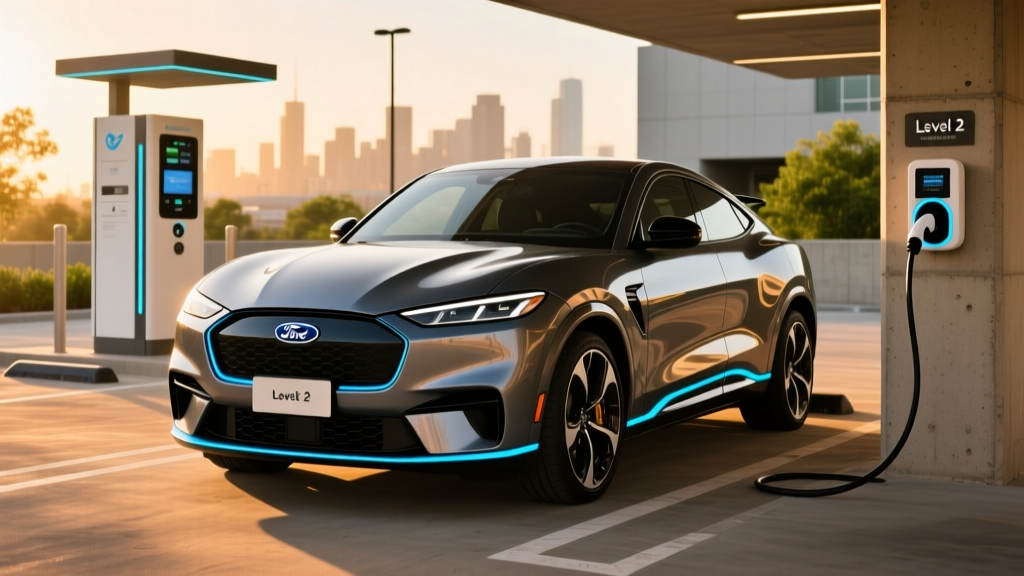
At home on a Level 2 charger (the Ford Mobile Power Cord or a hardwired wall unit at 48 amps), the Mach-E replenishes roughly 32 miles of range per hour. A full overnight charge from 20% to 80% takes about 6 hours — sufficient for virtually any daily commute. Home installation of a 240V/48A circuit typically costs $800–$2,000 depending on panel capacity and run length, per Ford's home charging guidelines.
Performance and Driving Dynamics
The Mach-E earns its "Mustang" badge more through handling character than straight-line speed, though the GT variant is genuinely quick. The RWD Extended Range model hits 0–60 mph in about 6.2 seconds with 290 hp — brisk for daily commuting. The dual-motor AWD Premium delivers 346 hp and a 5.2-second sprint, while the GT's 480 hp drops the 0–60 time to roughly 3.5 seconds.
Ride quality is firm but composed, with a low center of gravity that keeps body roll minimal through corners. The steering is precise and weighted appropriately across drive modes (Engage, Active, Whisper). One-pedal driving is available but not as aggressive as Nissan or Chevrolet's implementation — you'll still use the brake pedal for final stops.
The Mach-E carries an IIHS Top Safety Pick+ rating (when equipped with specific headlights), and the available BlueCruise hands-free driving system covers over 130,000 miles of divided highways. Note: BlueCruise is an SAE Level 2 system, meaning the driver must remain attentive and cannot sleep, read, or disengage from the road.
Pricing, Lease Specials, and Federal Tax Credit
For the 2026 model year, the Mach-E Select RWD Standard Range starts at an estimated $37,995 MSRP. The Premium AWD Extended Range lands around $45,995, and the GT tops out near $55,995 before options and destination charges.
| Trim | Base MSRP (est.) | Est. Lease Incentive* | Effective Price / Cap Cost Reduction |
|---|---|---|---|
| Select RWD Std Range | $37,995 | Up to $7,500 | ~$30,495 effective |
| Premium AWD Ext Range | $45,995 | Up to $7,500 | ~$38,495 effective |
| GT AWD Ext Range | $55,995 | Up to $7,500 | ~$48,495 effective |
*Lease incentive assumes the manufacturer passes through the full §30D credit as a cap-cost reduction. Eligibility depends on current IRS rules.
The IRS §30D federal tax credit offers up to $7,500, but eligibility is layered with requirements that trip up many buyers:
- MSRP Cap: SUVs/crossovers must not exceed $80,000 MSRP (all Mach-E trims qualify).
- Buyer Income Cap: Modified AGI must not exceed $150,000 (single), $225,000 (head of household), or $300,000 (joint) for purchases. Lease transactions may bypass income caps under the commercial clean vehicle credit (§45W) passthrough structure.
- Battery Sourcing: The credit splits into two halves — $3,750 for critical-minerals sourcing and $3,750 for battery-component assembly. Sourcing requirements tighten annually. Check the latest fueleconomy.gov listings for current Mach-E credit status.
- Point-of-Sale Transfer: As of 2024+, buyers can transfer the credit to the dealer at purchase for an immediate price reduction. For leases, the leasing company (Ford Credit) typically claims the credit and applies it as a cap-cost reduction, which lowers your monthly payment directly.
This is precisely why Ford Mach-E lease specials can be compelling: even buyers who wouldn't qualify for the purchase credit due to income limits may benefit when Ford Credit structures the lease to capture the commercial credit passthrough. Always confirm the exact incentive with your dealer, as Ford's promotional offers rotate monthly and vary by region.
Interior, Cargo, and Daily Usability
The Mach-E's cabin prioritizes tech-forward minimalism. A 15.5-inch vertical touchscreen (running SYNC 4A) dominates the dash, with a secondary 10.2-inch digital instrument cluster behind the wheel. Physical buttons are sparse — climate controls and most settings live in the touchscreen, which draws polarizing reactions.
Cargo volume is competitive: 29.7 cubic feet behind the rear seats and 59.7 cu ft with the rear seats folded. The front trunk (frunk) adds 4.7 cu ft of drainable storage — useful for charging cables, groceries, or wet gear. Rear legroom measures 38.9 inches, adequate for adults on longer trips, though the sloping roofline limits headroom for taller passengers.
The Mach-E is rated to tow up to 2,300 lbs with the Extended Range AWD configuration (with the factory tow package) — enough for a small utility trailer or a pair of dirt bikes, but not a camper. If towing is a priority, the Rivian R1S or Tesla Model X offer significantly more capacity at higher price points.
Warranty, Reliability, and Ownership Costs
Ford backs the Mach-E's high-voltage battery and electric powertrain components with an 8-year/100,000-mile warranty, covering defects and capacity loss below 70% of original capacity. The bumper-to-bumper warranty runs 3 years/36,000 miles. These terms are industry-standard, matching Hyundai, Kia, and Tesla.
Efficiency figures for the 2026 Extended Range RWD hover around 101 MPGe combined (33 kWh/100 miles), per fueleconomy.gov. At the national average electricity rate of ~$0.16/kWh, that translates to roughly $5.28 per 100 miles driven — compared to approximately $12–14 per 100 miles for a comparable gas-powered crossover at 28 MPG and $3.50/gallon.
Insurance costs for the Mach-E run 15–25% higher than comparable ICE crossovers, a pattern common across EVs due to higher repair costs and parts pricing. Expect annual premiums in the $1,800–$2,600 range depending on your profile and state.
Pros
- Competitive range (up to 320 mi EPA) with Extended Range pack
- Strong lease incentives when §30D passthrough is available
- Engaging driving dynamics; GT is genuinely fast
- BlueCruise hands-free driving on 130,000+ miles of highway
- Useful frunk with drainable design
- LFP option on Standard Range allows daily 100% charging
Cons
- DC fast charging (150 kW peak) lags behind Hyundai, Kia, Tesla
- 10–80% charge time of 35–45 min is slow for road trips
- Touchscreen-heavy interior frustrates some drivers
- Rear headroom limited by coupe-like roofline
- Higher insurance premiums than gas equivalents
- NMC battery requires 80% daily charge limit for longevity
Is the Mach-E Worth Leasing Over Key Competitors?
The Mach-E competes in the most crowded EV segment. Here's how it stacks up on the metrics that matter:
- vs. Tesla Model Y: Model Y charges faster (250 kW peak), has access to the full Supercharger network natively, and offers slightly more cargo space. Mach-E counters with a more traditional interior layout, BlueCruise, and often more aggressive lease incentives.
- vs. Hyundai Ioniq 5: Ioniq 5 charges dramatically faster (up to 235 kW on 800V architecture, 10–80% in ~18 min) and offers V2L capability. Mach-E offers more range in its top configuration and a more car-like driving feel.
- vs. Kia EV6: Shares the Ioniq 5's 800V fast-charging advantage. The EV6 GT-Line is similarly priced but offers less range (~310 mi max). Mach-E wins on cargo utility.
- vs. Chevrolet Equinox EV: Equinox EV undercuts on price (~$33,000 base) with 315+ mi of range, but feels less premium inside and offers less power.
Lease the Mach-E If:
- You want a sporty-driving EV crossover with competitive range
- Your daily commute is under 80 miles round-trip (home charging covers you)
- You value BlueCruise for frequent highway travel
- Ford's current lease incentives bring the effective price below $35,000
Look Elsewhere If:
- You take frequent road trips exceeding 200 miles (faster-charging rivals save hours)
- You need maximum cargo space (Model Y or Ioniq 5 offer more)
- You want the lowest possible monthly payment (Equinox EV or Nissan Ariana may undercut)
Frequently Asked Questions
What is the real-world range of the 2026 Ford Mustang Mach-E?
The EPA rates the Extended Range RWD at approximately 320 miles. Real-world highway driving at 70–75 mph yields about 265–285 miles. In cold weather below 30°F, expect 225–255 miles. City driving with regenerative braking in mild weather can approach or slightly exceed the EPA figure.
How fast does the Mach-E charge at home and on DC fast chargers?
On a Level 2 home charger (240V, 48A), the Mach-E charges at 10.5 kW, adding roughly 32 miles of range per hour. On DC fast chargers, it peaks at 150 kW, with a 10–80% charge taking approximately 35 minutes (Standard Range) or 45 minutes (Extended Range). This is slower than competitors like the Ioniq 5 (~18 min) or Tesla Model Y (~25 min).
Does the 2026 Mach-E qualify for the $7,500 federal EV tax credit?
All Mach-E trims fall under the $80,000 MSRP cap for SUVs/crossovers. However, full credit eligibility depends on battery-sourcing requirements (critical minerals and component assembly), which tighten annually. When leasing through Ford Credit, the credit is often passed through as a cap-cost reduction regardless of your personal income. Verify current eligibility at fueleconomy.gov and consult a tax professional for purchase scenarios.
How much does a Mach-E lease cost per month?
Lease payments vary by region, dealer incentives, credit tier, and money-down. As of early 2026, well-qualified lessees have reported deals in the $299–$449/month range for Select and Premium trims with $2,500–$3,999 due at signing, often reflecting Ford's application of the $7,500 lease incentive. Always negotiate the capitalized cost (sale price) before discussing monthly payments.
Is the Mach-E better than the Tesla Model Y for leasing?
It depends on priorities. The Model Y charges faster, has a more extensive native fast-charging network, and offers more cargo space. The Mach-E often has more aggressive lease incentives, a more conventional interior with physical door handles and a driver display, and BlueCruise for hands-free highway driving. If lease payment is the primary driver, compare both with current incentives applied.
What's the biggest drawback of the Mach-E?
The 150 kW peak DC fast-charging speed is the most consequential limitation. On road trips, you'll spend 35–45 minutes per charging stop where competitors manage 18–25 minutes. Over a 1,000-mile trip, that adds up to an extra hour or more of total charging time. If you rarely road-trip, this is a minor concern; if you drive cross-country regularly, it's a meaningful trade-off.