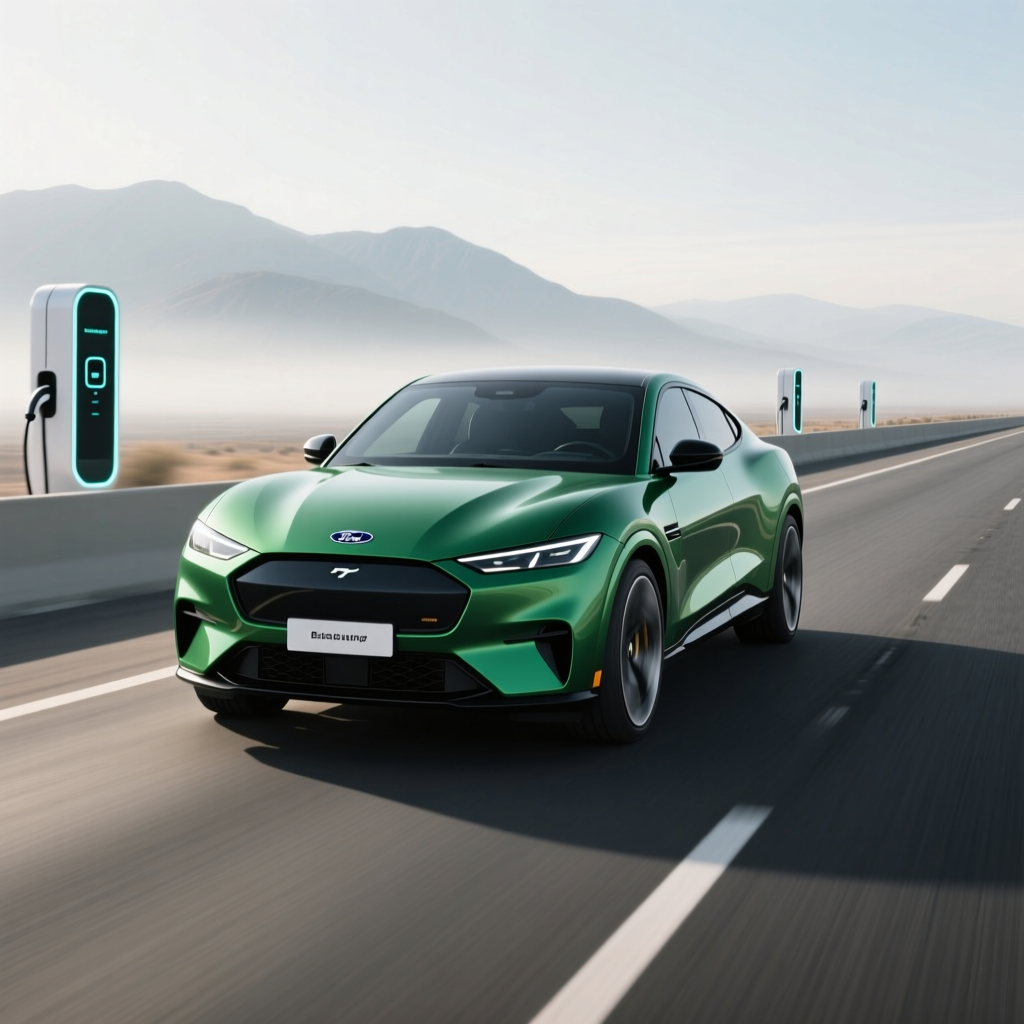
Ford Mustang Mach-E Extended Range Review: A Comprehensive Look at Range, Performance & Value
The Ford Mustang Mach-E Extended Range has carved out a unique position in the electric vehicle landscape. Borrowing the legendary Mustang nameplate and grafting it onto a fully electric crossover, Ford created something that divides traditionalists and intrigues EV adopters in equal measure. But beyond the badge controversy lies a genuinely compelling electric vehicle — one that offers impressive range, sharp styling, and a technology-forward cabin that rivals premium competitors.
In this comprehensive review, we put the Mustang Mach-E Extended Range through its paces, examining everything from real-world driving range and charging performance to interior quality, driving dynamics, and long-term ownership costs. Whether you are cross-shopping against the Tesla Model Y, the Hyundai Ioniq 5, or the Volkswagen ID.4, this review will help you determine if the Mach-E Extended Range deserves a spot on your shortlist. For a broader look at the segment, check out our roundup of the best electric SUVs available today.
Vehicle Overview: What Is the Mustang Mach-E Extended Range?
The Ford Mustang Mach-E is a battery-electric crossover SUV built on Ford's dedicated EV platform. The Extended Range variant is distinguished primarily by its larger battery pack — a 91 kWh usable capacity lithium-ion battery (compared to the Standard Range model's 70 kWh pack). This larger battery unlocks significantly more driving range and is available in both rear-wheel-drive (RWD) and all-wheel-drive (AWD) configurations, including the performance-oriented GT models.
The Extended Range RWD model produces 290 horsepower and 317 lb-ft of torque, while the AWD variant bumps output to 346 horsepower and 428 lb-ft of torque. For those seeking even more performance, the GT Extended Range delivers a staggering 480 horsepower (or 563 lb-ft of torque with the Performance Upgrade), making it one of the quickest electric crossovers on the market.
Ford has equipped the Mach-E with a suite of modern features including the SYNC 4A infotainment system, Ford Co-Pilot360 driver assistance technologies, and available BlueCruise hands-free driving capability. The vehicle supports DC fast charging at up to 150 kW and comes with a Ford Mobile Charger for Level 1 and Level 2 home charging.
| Specification | ER RWD | ER AWD | GT ER AWD |
|---|---|---|---|
| Battery Capacity (usable) | 91 kWh | 91 kWh | 91 kWh |
| Horsepower | 290 hp | 346 hp | 480 hp |
| Torque | 317 lb-ft | 428 lb-ft | 600 lb-ft (Perf. Upgrade) |
| EPA Estimated Range | 320 miles | 290–312 miles | 260–280 miles |
| 0–60 mph | ~5.8 seconds | ~5.1 seconds | ~3.5 seconds |
| DC Fast Charge Rate | Up to 150 kW | Up to 150 kW | Up to 150 kW |
| 10–80% Charge Time (DCFC) | ~45 minutes | ~45 minutes | ~45 minutes |
| Cargo Volume | 29.7 cu ft (rear seats up) / 59.7 cu ft (rear seats folded) | ||
| Front Trunk (Frunk) | 4.7 cu ft (drainable) | ||
| Towing Capacity | Up to 2,300 lbs (AWD) | ||
For a detailed head-to-head analysis, see our Mustang Mach-E vs. Tesla Model Y comparison.
Real-World Range: How Far Does the Mach-E Extended Range Actually Go?
The EPA-estimated range for the Mustang Mach-E Extended Range RWD sits at an impressive 320 miles — a figure that places it among the top tier of electric crossovers. The AWD California Route 1 edition pushes that number to approximately 312 miles, while the standard AWD Extended Range achieves around 290 miles. The GT variant, with its more aggressive tuning and standard AWD, sees its EPA rating drop to roughly 260–280 miles depending on wheel and equipment choices.
But EPA estimates tell only part of the story. Independent testing by organizations such as Edmunds and Consumer Reports has shown that the Mach-E Extended Range tends to perform close to its EPA ratings in mixed driving conditions — a trait that is not universal among EVs. Some competitors, notably certain Hyundai and Kia models, have been found to fall short of their EPA estimates by 10–15% in real-world testing.
In highway driving at sustained speeds of 70–75 mph, expect the Extended Range RWD to deliver approximately 260–280 miles before needing a charge. Cold weather — particularly temperatures below freezing — can reduce range by 20–30%, a reality that applies to virtually all lithium-ion battery electric vehicles. The Mach-E's battery thermal management system helps mitigate this effect, but owners in cold climates should plan accordingly.
City driving and stop-and-go traffic tend to be more favorable for EV range thanks to regenerative braking. In urban conditions, achieving or even slightly exceeding the EPA estimate is entirely realistic. The Mach-E offers multiple drive modes — Whisper, Engage, and Unbridled — each of which adjusts throttle response, regenerative braking intensity, and steering weight. Using the one-pedal driving mode in city conditions maximizes energy recapture and can extend range noticeably.
For more on maximizing your electric vehicle's range, read our guide to overcoming EV range anxiety.
Charging Speed & Infrastructure: How Quickly Can You Refuel?
The Mustang Mach-E Extended Range supports DC fast charging at peak rates of up to 150 kW via its CCS (Combined Charging System) port. At a compatible fast charger, Ford states the vehicle can add approximately 59 miles of range in just 10 minutes, and a 10–80% charge takes roughly 45 minutes under optimal conditions.
It is worth noting that the Mach-E's peak charging rate of 150 kW trails some competitors. The Hyundai Ioniq 5 and Kia EV6, built on 800-volt architectures, can accept up to 250–350 kW, enabling 10–80% charges in as little as 18 minutes. However, the real-world usefulness of ultra-fast charging depends heavily on the availability of 350 kW chargers along your typical routes. On the widespread Electrify America and ChargePoint networks, 150 kW chargers are far more common, meaning the Mach-E's charging speed is perfectly practical for most road trip scenarios.
For Level 2 home charging, the Mach-E comes equipped with a Ford Connected Charge Station (available as an option or included depending on trim and promotion) that delivers up to 48 amps, adding roughly 28 miles of range per hour of charging. A full charge from empty on a Level 2 home charger takes approximately 10–11 hours, making overnight charging convenient and effortless.
The included Ford Mobile Charger provides flexibility for Level 1 (120V) trickle charging — adding roughly 3 miles of range per hour — as well as Level 2 (240V) charging at a lower amperage when a dedicated wallbox is not available. Ford also provides complimentary access to the BlueOval Charge Network, which aggregates access to tens of thousands of public charging stations across North America through a single app interface.
One area where Ford has made significant strides is in navigation-integrated charging. The SYNC 4A system can plan routes that include charging stops, pre-condition the battery for optimal charging speed upon arrival, and display real-time charger availability. This integration significantly reduces the friction of long-distance EV travel. If you are curious about how different EVs stack up in charging convenience, explore our best EVs for road trips list.
Interior & Technology: A Modern, Driver-Focused Cabin
Step inside the Mustang Mach-E, and the first thing that commands attention is the massive 15.5-inch vertically oriented touchscreen that dominates the center stack. This portrait-oriented display runs Ford's SYNC 4A infotainment system, which features a clean, card-based interface that is intuitive to navigate. The screen handles everything from climate controls to navigation, media, and vehicle settings.
Unlike some competitors that have eliminated physical controls entirely, Ford retained a few thoughtful touches — including a rotary dial for volume embedded at the base of the touchscreen and steering wheel-mounted controls for common functions. Wireless Apple CarPlay and wireless Android Auto are standard, eliminating the need for cables. The system also supports over-the-air (OTA) software updates, meaning the vehicle's technology can improve and evolve long after purchase.
A 10.2-inch fully digital instrument cluster sits behind the steering wheel, displaying essential driving information including speed, range, navigation directions, and driver assistance status. The available head-up display projects key information onto the windshield, reducing the need to glance away from the road.
Interior materials are a mixed bag. The Mach-E uses sustainable, leather-free upholstery throughout, with ActiveX synthetic leather on higher trims. The seats are comfortable and supportive on long drives, and the cabin offers generous headroom and legroom for front and rear passengers. However, some hard plastics are present on the lower door panels and center console — areas where competitors like the Hyundai Ioniq 5 and Volkswagen ID.4 feel slightly more premium.
The panoramic fixed glass roof, standard on most trims, floods the cabin with natural light and contributes to an airy, spacious feeling. The glass is tinted and treated to reduce heat and UV intrusion, though some owners in hot climates report appreciating a sunshade accessory.
Ford's BlueCruise hands-free driving system is available on the Mach-E and represents one of the most capable Level 2 driver assistance systems on the market. On pre-qualified sections of divided highways — over 130,000 miles of roads across the United States and Canada — BlueCruise allows true hands-free operation while monitoring the driver through an infrared camera to ensure attentiveness. The system handles lane centering, adaptive cruise control, and lane changes with impressive smoothness. For a deeper dive into driver assistance technology, see our analysis of the best EVs with autonomous driving features.
Driving Dynamics: Does It Deserve the Mustang Badge?
The question of whether an electric crossover deserves the Mustang name is philosophical. From a driving dynamics perspective, however, the Mach-E Extended Range makes a surprisingly compelling case.
The RWD Extended Range model delivers smooth, linear acceleration that is characteristic of electric motors. There is no turbo lag, no transmission shift shock — just an immediate, seamless surge of torque from a standstill. The 0–60 mph time of approximately 5.8 seconds is brisk enough for confident highway merging and passing, even if it will not pin you to your seat.
The AWD Extended Range model adds a front motor and improves the 0–60 time to roughly 5.1 seconds. More importantly, the dual-motor setup provides excellent traction in adverse weather conditions. The system can vary torque distribution between the front and rear axles in milliseconds, providing a sure-footed feel in rain, snow, and on loose surfaces.
Where the Mach-E truly surprises is in its handling. Ford's engineering team tuned the suspension to deliver a sporty, connected feel that is rare among electric crossovers. The steering is well-weighted and communicative — particularly in Unbridled mode — and the low center of gravity afforded by the floor-mounted battery pack minimizes body roll through corners. The ride quality strikes a reasonable balance between firmness and comfort, though some may find it slightly stiff over rough pavement compared to the more comfort-oriented Volkswagen ID.4.
The GT Extended Range transforms the driving experience entirely. With 480 horsepower and available MagneRide adaptive dampers, the GT delivers supercar-rivaling acceleration (0–60 mph in approximately 3.5 seconds with the Performance Upgrade) while maintaining composure through corners. The GT's Unbridled Extend drive mode is designed for track use, managing battery and motor temperatures to sustain performance over extended sessions.
Regenerative braking in the Mach-E is well-calibrated. The one-pedal driving mode provides strong deceleration when you lift off the accelerator, allowing you to drive almost entirely without touching the brake pedal in city conditions. The friction brakes blend in smoothly when additional stopping power is needed, avoiding the abrupt transitions that plague some competing EVs.
Compare the Mach-E's driving experience to other sporty EVs in our best performance electric SUVs roundup.
Ownership Costs & Value: The Financial Picture
The Mustang Mach-E Extended Range represents a strong value proposition in the electric crossover segment. Pricing varies by trim and configuration, but the Extended Range models generally position themselves competitively against the Tesla Model Y Long Range, the Hyundai Ioniq 5 Long Range, and the Volkswagen ID.4 Pro S.
Federal and state incentives can significantly reduce the effective purchase price. The Mach-E has qualified for federal EV tax credits at various points, and many states offer additional rebates, HOV lane access, and reduced registration fees for electric vehicles. Be sure to check current incentive availability, as these programs evolve regularly. Our guide to EV tax credits and incentives breaks down what is available.
Operating costs are where the Mach-E truly shines compared to internal combustion vehicles. Electricity costs vary by region, but charging at home on a standard residential rate typically costs the equivalent of $1.00–$1.50 per gallon of gasoline. Public DC fast charging is more expensive — often comparable to gasoline on a per-mile basis — but most daily driving can be covered with inexpensive home charging.
Maintenance costs for the Mach-E are minimal compared to gasoline vehicles. There are no oil changes, no spark plugs, no transmission fluid to replace, and no exhaust system to maintain. Brake wear is significantly reduced thanks to regenerative braking — many EV owners report original brake pads lasting well beyond 100,000 miles. The primary maintenance items are tire rotations, cabin air filter replacements, and windshield washer fluid.
Ford provides a bumper-to-bumper warranty of 3 years or 36,000 miles, a powertrain warranty of 5 years or 60,000 miles, and an electric vehicle component warranty of 8 years or 100,000 miles. The battery is warranted to retain at least 70% of its original capacity over the 8-year/100,000-mile period, which is in line with industry standards.
Insurance costs for the Mach-E tend to be slightly higher than average for the compact SUV segment, reflecting the vehicle's performance capability and the generally higher repair costs associated with electric vehicles. Shopping around for quotes is strongly recommended, as rates vary significantly between insurers.
Depreciation is an important consideration for any vehicle purchase. Electric vehicles have historically experienced steeper depreciation than their gasoline counterparts, though this gap has been narrowing as consumer demand for used EVs grows. The Mustang badge and Ford's brand recognition may provide some support for residual values compared to lesser-known EV brands.
Pros & Cons: The Bottom Line
Pros
- Excellent EPA range: Up to 320 miles on the Extended Range RWD, among the best in the electric crossover segment.
- Engaging driving dynamics: Sporty handling and responsive steering that genuinely set the Mach-E apart from comfort-focused competitors.
- Impressive technology suite: The large SYNC 4A touchscreen, wireless smartphone integration, and available BlueCruise hands-free driving create a premium tech experience.
- Practical cargo space: Nearly 30 cubic feet behind the rear seats, plus a drainable front trunk for additional storage.
- Strong performance options: The GT variant delivers thrilling acceleration that rivals sports cars costing significantly more.
- OTA updates: Continuous software improvements keep the vehicle current long after purchase.
Cons
- Charging speed lags some competitors: At 150 kW peak, the Mach-E charges slower than 800-volt rivals like the Ioniq 5 and EV6.
- Some interior hard plastics: Certain touchpoints feel less premium than expected at this price point.
- Touchscreen-reliant climate controls: The lack of dedicated physical climate buttons requires interacting with the screen for temperature adjustments.
- Ride firmness: The sport-tuned suspension may feel too firm for buyers prioritizing plush comfort.
- GT range trade-off: The high-performance GT variant sacrifices significant range for its acceleration advantage.
If you are still weighing options, our best electric SUVs guide compares the top contenders side by side.
Frequently Asked Questions
What is the real-world range of the Ford Mustang Mach-E Extended Range?
In mixed driving conditions, the Mustang Mach-E Extended Range RWD typically achieves between 280 and 310 miles on a full charge, close to its EPA rating of 320 miles. Highway driving at higher speeds will reduce this to approximately 260–280 miles, while city driving with heavy regenerative braking can push range toward or slightly above the EPA estimate. Cold weather can reduce range by 20–30%, so plan accordingly in winter months. Independent testing by Edmunds has confirmed the Mach-E's real-world range performance is among the most accurate in the segment.
How long does it take to charge the Mustang Mach-E Extended Range at home?
Using a Ford Connected Charge Station or equivalent Level 2 charger (48 amps, 240 volts), a full charge from empty takes approximately 10–11 hours. This makes overnight charging ideal — plug in when you get home and wake up to a full battery every morning. On a standard 120-volt household outlet (Level 1), expect roughly 3 miles of range per hour of charging, which is suitable for topping off but not practical for a full charge from empty. Most owners find that Level 2 home charging completely eliminates the need to visit public chargers for daily driving.
Is the Mustang Mach-E Extended Range good in snow and winter conditions?
The AWD Extended Range model performs admirably in snow and winter conditions. The dual-motor all-wheel-drive system provides excellent traction, and the low center of gravity contributes to stable handling on slippery surfaces. Ford includes a Slippery drive mode that adjusts throttle response and traction control for low-grip conditions. The Mach-E also features a battery preconditioning system that warms the battery for optimal performance and charging speed in cold weather. Winter tires are strongly recommended for owners in regions with heavy snowfall, as the factory all-season tires may not provide adequate grip in severe winter conditions.
How does the Mustang Mach-E Extended Range compare to the Tesla Model Y?
The Mustang Mach-E Extended Range and Tesla Model Y Long Range are direct competitors with distinct strengths. The Mach-E offers a more traditional, driver-focused interior with higher-quality materials in some areas, more engaging handling dynamics, and the available BlueCruise hands-free system. The Model Y counters with access to Tesla's Supercharger network (though Ford has gained access to Superchargers via an adapter), a more minimalist interior with a single large screen, slightly more cargo space, and Tesla's continuously evolving software ecosystem. Range figures are competitive between the two, and pricing often overlaps. For a detailed comparison, read our Mach-E vs. Model Y head-to-head analysis.
Does the Ford Mustang Mach-E qualify for federal EV tax credits?
Eligibility for federal EV tax credits depends on several factors including the vehicle's battery component sourcing, the buyer's tax liability, and current legislation. The Mach-E has been eligible for partial or full federal tax credits at various points, and Ford has worked to adjust its supply chain to maximize credit eligibility. State and local incentives may also be available, including rebates, reduced registration fees, and HOV lane access. We recommend checking the latest information on fueleconomy.gov and consulting a tax professional to understand your specific eligibility. Our EV incentives guide is regularly updated with the latest information.