Quick Verdict: The 2026 Mustang Mach-E
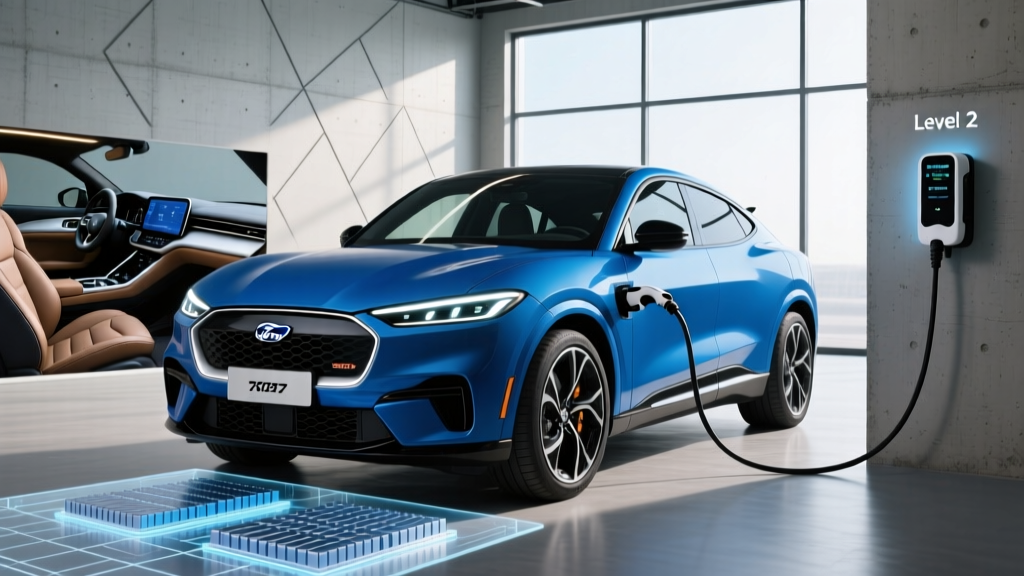
The 2026 Ford Mustang Mach-E is the electric Mustang SUV that bridges muscle-car heritage with practical EV ownership. Starting at $39,995 (Select trim) and reaching up to 320 miles EPA range (California Route 1), it competes directly with the Tesla Model Y and Hyundai IONIQ 5. Peak DC fast charging hits 150 kW (extended-range battery), delivering a 10–80% charge in approximately 33 minutes. It qualifies for partial or full federal tax credits under §30D depending on trim and battery sourcing — but real-world highway range drops to roughly 260–280 miles, and cold climates can shave another 15–20%. If you want a driver-focused electric crossover with Ford's dealer network behind it, the Mach-E is a strong pick. If maximum charging speed or cargo volume is your priority, rivals edge it out.
Range, Battery, and Real-World Efficiency
The 2026 Mustang Mach-E offers two battery packs across its trim lineup. Understanding which one fits your driving pattern is the single biggest decision you'll make.
| Spec | Standard Range (SR) | Extended Range (ER) |
|---|---|---|
| Battery Capacity (usable) | 72 kWh (LFP) | 91 kWh (NMC) |
| EPA Range (best config) | 250 mi | 320 mi (RWD Cal Route 1) |
| EPA Range (AWD) | 230 mi | 290 mi (GT) |
| MPGe (combined) | 101 MPGe | 94–105 MPGe |
| kWh/100 mi | 33–34 | 32–36 |
| 0–60 mph | 5.8 sec (RWD) | 3.5 sec (GT AWD) |
| Horsepower | 266 hp | 290–480 hp |
Real-World Range Reality Check
EPA Sticker: Up to 320 miles (ER, RWD, California Route 1)
Expect in practice:
- Highway cruising (75 mph, moderate temps): ~260–280 miles
- City/suburban mixed driving: ~290–310 miles
- Cold weather (below 32°F, highway): ~210–240 miles
- Towing (max 2,200 lbs rated): expect 40–50% range reduction
The Mach-E's heat pump (standard on ER trims) mitigates cold-weather loss better than many competitors, but physics still applies. Plan your road-trip charging stops around 200–220 miles of usable range to maintain a comfort buffer.
Charging Speed and Infrastructure
Charging is where the Mach-E shows its age relative to newer 800V platforms. It runs on a 400V architecture, which caps peak DC fast-charging rates below what rivals like the IONIQ 5 or Porsche Macan EV can achieve.
| Charging Level | Power (kW) | Miles Added per Hour | Time (10–80%) |
|---|---|---|---|
| Level 1 (120V household) | ~1.2 kW | ~3–4 mi/hr | N/A (days for full) |
| Level 2 (240V home/public) | 10.5 kW (max onboard) | ~30–35 mi/hr | ~8–9 hours (full) |
| DC Fast (SR battery) | 115 kW peak | ~200+ mi/hr (peak) | ~38 min |
| DC Fast (ER battery) | 150 kW peak | ~250+ mi/hr (peak) | ~33 min |
Charging curve reality: The 150 kW peak on the extended-range battery is sustained only between roughly 10–40% State of Charge (SoC). Above 60%, the rate tapers significantly — often dropping below 60 kW past 80%. This is normal for NMC lithium-ion chemistry, but it means a 10–90% stop takes considerably longer than 10–80%. On road trips, plan to charge to 80% and move on rather than waiting for the last 10–20%.
The Mach-E ships with Ford's Mobile Power Cord (Level 1/Level 2 capable with adapter). For home Level 2 charging, you'll want a 48-amp hardwired wall connector on a 60-amp circuit. Budget $800–$2,000 for professional installation depending on your panel capacity and run distance — more if your home needs a 200-amp service upgrade.
Connector note: 2026 Mach-E models use the NACS (Tesla-style) charge port, giving direct access to Tesla Supercharger stations via Ford's charging agreement. This is a major advantage over CCS-only vehicles, as Supercharger reliability consistently outperforms third-party networks in J.D. Power charging studies.
Pricing, Trims, and Tax Credit Eligibility
| Trim | Battery | Drivetrain | EPA Range | MSRP |
|---|---|---|---|---|
| Select | SR (72 kWh) | RWD | 250 mi | $39,995 |
| Select | SR (72 kWh) | AWD | 230 mi | $42,995 |
| Premium | ER (91 kWh) | RWD | 310 mi | $48,995 |
| Premium | ER (91 kWh) | AWD | 290 mi | $51,995 |
| California Route 1 | ER (91 kWh) | RWD | 320 mi | $46,775 |
| GT | ER (91 kWh) | AWD | 290 mi | $59,995 |
| Rally | ER (91 kWh) | AWD | 272 mi | $61,995 |
Federal §30D Tax Credit — 2026 Rules
The Mach-E's credit eligibility depends on battery-component and critical-mineral sourcing, which Ford has been actively reshoring. As of the 2026 model year:
- Up to $3,750–$7,500 depending on whether the vehicle meets the battery-components requirement ($3,750) and critical-minerals requirement ($3,750) independently.
- MSRP cap: SUVs must be under $80,000 — all Mach-E trims qualify.
- Buyer income cap: AGI ≤ $150K (single), $225K (head of household), $300K (joint).
- Point-of-sale transfer: Eligible buyers can apply the credit as a down-payment reduction at the dealer instead of waiting for a tax refund.
- Sourcing rules shift annually — verify current eligibility at fueleconomy.gov before purchasing.
The standard-range (LFP) battery may face different sourcing restrictions than the extended-range (NMC) pack. Confirm with your dealer and a tax professional before relying on a specific credit amount.
EV vs Gas: How Does the Mach-E Compare to a Gas SUV?
Buyers cross-shopping the Mach-E often compare it against the Ford Edge, Honda Passport, or even a loaded Ford Explorer. Here's how the numbers stack up against a typical midsize gas SUV.
| Factor | 2026 Mustang Mach-E (Premium ER RWD) | 2026 Gas Midsize SUV (AWD, ~24 MPG combined) |
|---|---|---|
| Sticker Price (MSRP) | $48,995 (before credit) | $40,000–$45,000 |
| After Federal Credit | ~$41,495–$45,245 | $40,000–$45,000 |
| Fuel/Energy Cost per Mile | ~$0.04–$0.06/mi (home L2) | ~$0.14–$0.17/mi ($3.50/gal) |
| Annual Fuel/Energy (12K mi) | ~$480–$720 | ~$1,680–$2,040 |
| Annual Maintenance | ~$200–$400 | ~$600–$1,000 |
| 5-Year Fuel + Maintenance | ~$3,400–$5,600 | ~$11,400–$15,200 |
| Estimated Insurance (annual) | ~$1,800–$2,400 | ~$1,400–$1,800 |
| Cargo Volume | 29.7 cu ft (rear up) / 59.7 cu ft (folded) | 36–41 cu ft (rear up) |
The math: If you qualify for a $3,750–$7,500 credit, the Mach-E reaches price parity with a comparably equipped gas SUV at purchase. From there, you save roughly $1,000–$1,400 per year on fuel and maintenance combined. Over five years, that's $5,000–$7,000 in operating savings — but you'll pay $2,000–$3,000 more in insurance premiums over the same period.
The Mach-E's frunk (front trunk) adds 4.7 cu ft of sealed, drainable storage — useful for groceries or wet gear. However, total cargo volume trails boxier gas SUVs, and there's no third-row option.
Real-World Ownership: What First-Time EV Buyers Need to Know
Owning a Mach-E day-to-day differs from a gas car in ways that brochures don't fully capture. Here's what matters after the paperwork is signed.
Home Charging Is Non-Negotiable for Most Owners
Public DC fast charging costs $0.30–$0.50/kWh at most networks, making it comparable to or more expensive than gasoline on a per-mile basis. The economics of EV ownership only work if you charge at home most of the time on a Level 2 circuit (240V, ~$0.10–$0.18/kWh depending on your utility). If you live in an apartment without charging access or street-park exclusively, the Mach-E — or any EV — will be a friction-heavy experience.
Cold Climate? Plan Around 20–30% Range Loss
The Mach-E's heat pump helps, but lithium-ion batteries inherently lose efficiency below freezing. If your winter commute is 150+ miles round-trip in sub-30°F temperatures, the ER AWD trim is essential. Preconditioning the battery while plugged in (via the FordPass app) recovers significant range and improves charging speed.
Insurance Costs More — Shop Early
EV insurance premiums run 15–25% higher than equivalent gas vehicles due to repair complexity and battery replacement costs. Get quotes before committing to a purchase. Some insurers (GEICO, Progressive, State Farm) have improved EV-specific pricing, but rates vary widely by ZIP code and driving record.
Battery Warranty and Longevity
Ford covers the Mach-E's high-voltage battery for 8 years / 100,000 miles with a capacity-retention threshold of 70%. Real-world degradation data from 2021–2024 Mach-E fleets shows an average of 4–7% capacity loss at 60,000 miles — well within warranty tolerance. The LFP standard-range battery is expected to degrade even more slowly due to its chemistry's superior cycle life, though long-term fleet data is still maturing.
Maintenance Is Minimal
No oil changes, no spark plugs, no transmission fluid. You'll rotate tires every 5,000–7,500 miles (EVs wear tires faster due to instant torque and heavier weight), replace cabin air filters annually, and top off washer fluid. Brake pads last 80,000–120,000+ miles thanks to regenerative braking doing most of the deceleration work.
Myths vs Facts: Clearing Up Common Misconceptions
| Myth | Fact |
|---|---|
| "The battery will need replacing in 5 years" | Ford warranties 70% capacity at 8yr/100K mi. Real-world data shows ~93–96% retention at 60K miles. Most EV batteries outlast the car. |
| "You can't take an EV on road trips" | With NACS access to 20,000+ Superchargers and ~33-min 10–80% charges, a 600-mile trip adds ~45–60 min of charging. Planning required? Yes. Impossible? No. |
| "EVs are worse for the environment" | Manufacturing an EV creates a higher initial carbon footprint, but lifecycle emissions are 50–70% lower over 150K miles on the average US grid (EPA analysis). The gap widens as grids add renewables. |
| "The Mach-E isn't a real Mustang" | It's a crossover wearing the badge, yes. But 480 hp in the GT, a 3.5-sec 0–60, and Ford Performance tuning give it legitimate performance credentials — just not V8 sound. |
| "Home charging installation is too expensive" | A standard 48A Level 2 install on an existing 200A panel with a short wire run costs $800–$1,500. A full panel upgrade can push it to $3,000–$5,000, but this is a one-time cost that adds home value. |
Decision Framework: Is the Mach-E the Right EV for You?
Choose the Mustang Mach-E If:
- You want a driver-focused electric crossover with genuine performance (especially the GT at 480 hp).
- You value Ford's nationwide dealer network for service and warranty work.
- You want direct Tesla Supercharger access via NACS without adapters.
- Your daily commute is under 200 miles round-trip and you can charge at home.
- You qualify for the §30D federal credit, bringing effective pricing below $42K.
Look Elsewhere If:
- Maximum cargo volume is essential — the Model Y offers 76 cu ft vs the Mach-E's 59.7.
- You need 350+ miles of EPA range — consider the Hyundai IONIQ 5 or a long-range Model Y.
- Ultra-fast charging (sub-20-min 10–80%) matters for your road-trip frequency — look at 800V platforms like the IONIQ 5 (350 kW peak) or Kia EV6.
- You need a third row — the Kia EV9 or Rivian RDS are your options.
- You can't install home charging and rely entirely on public infrastructure in an area with sparse DC coverage.
Pros and Cons at a Glance
Pros
- Engaging driving dynamics, especially GT and Rally trims
- NACS charge port — direct Supercharger access
- Strong BlueCruise hands-free highway driving (Level 2)
- Competitive pricing after federal tax credit
- LFP battery option (SR) for slower degradation and lower cost
- Useful 4.7 cu ft frunk with drain plug
- Heat pump standard on ER trims for cold-climate efficiency
Cons
- 150 kW peak DC charging trails 800V competitors
- Cargo volume (59.7 cu ft max) below Model Y and IONIQ 5
- No third-row option
- Real-world highway range falls ~40–60 mi below EPA on ER models
- Insurance premiums 15–25% higher than gas equivalents
- BlueCruise subscription required after trial period (~$75/year)
- Interior materials don't quite match the price on lower trims
Frequently Asked Questions
Is the Mustang Mach-E a good first EV?
Yes, if you have home charging access. The Mach-E offers familiar crossover ergonomics, Ford dealer support, and NACS Supercharger access — reducing the learning curve for new EV owners. Start with the Select SR trim at $39,995 to minimize upfront risk, or step to the Premium ER for road-trip flexibility.
How long does it take to charge a Mach-E at home?
On a 48-amp Level 2 home charger (10.5 kW), the extended-range 91 kWh battery charges from empty to full in roughly 8.5–9 hours. Most owners plug in overnight and wake up to a full battery every morning — equivalent to starting each day with a "full tank."
Does the Mach-E qualify for the $7,500 federal tax credit?
Eligibility depends on battery sourcing requirements that tighten each year under §30D. Some Mach-E configurations may qualify for the full $7,500, others $3,750, and some may not qualify at all depending on the model year's sourcing compliance. Check fueleconomy.gov for the current list and confirm with your dealer. Income and MSRP caps also apply.
How does the Mach-E compare to the Tesla Model Y?
The Model Y Long Range offers more range (~330 mi EPA), more cargo space (76 cu ft), and faster Supercharger-native charging. The Mach-E counters with a more traditional driving feel, physical controls alongside its touchscreen, BlueCruise hands-free capability, and access to Ford's service network. Both are strong — the choice often comes down to brand loyalty and interior preference.
What's the Mach-E's towing capacity?
The 2026 Mach-E is rated for up to 2,200 lbs with the extended-range battery and the factory tow package. That handles a small utility trailer or a pair of jet skis, but it's not suited for boat or camper towing. Expect significant range reduction when towing near max capacity.
Is BlueCruise self-driving?
No. BlueCruise is a SAE Level 2 driver-assistance system. It allows hands-free driving on pre-mapped divided highways (over 130,000 miles of compatible roads in the US), but the driver must remain attentive. A camera monitors your eyes, and the system will disengage if you look away. This is fundamentally different from Level 4 robotaxi services like Waymo. You are always responsible for the vehicle.