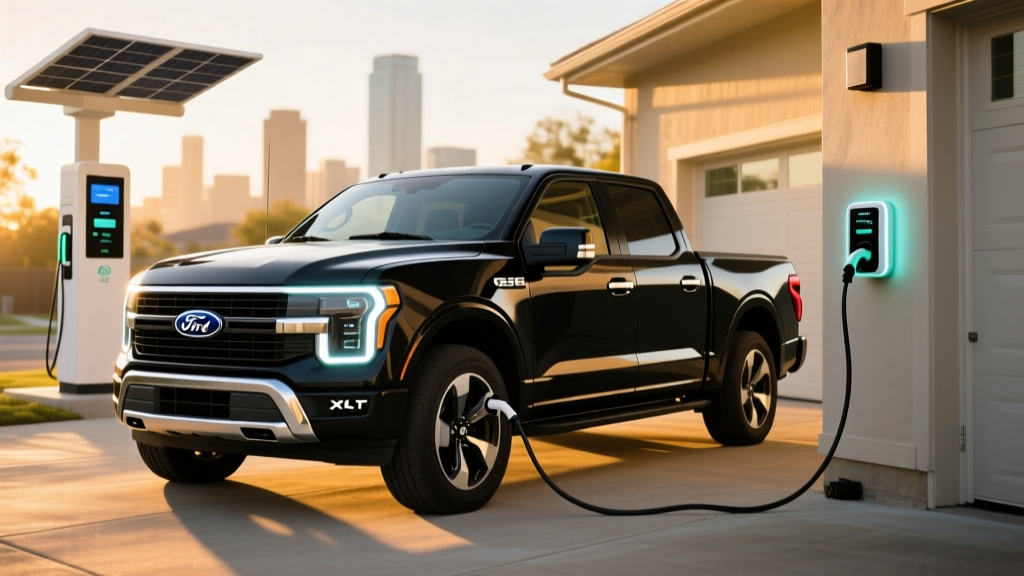
The Ford F-150 Lightning XLT occupies a rare position in the EV truck market: it's the volume trim that most buyers actually consider, sitting between the fleet-oriented Pro and the premium Lariat. For the 2025 model year, Ford has refined the formula with updated software, a revised heat pump standard on extended-range models, and continued eligibility for the full federal tax credit. But with competitors like the Rivian R1T, Chevrolet Silverado EV, and the refreshed Tesla Cybertruck reshaping the electric truck landscape, the Lightning XLT needs to justify its place on spec sheets and driveways alike.
This review covers the 2025 Ford F-150 Lightning XLT in both Standard Range and Extended Range configurations, with exact EPA figures, real-world range expectations, charging speeds, and total cost of ownership. If you're cross-shopping electric trucks, this is the data you need.
2025 Ford F-150 Lightning XLT: Core Specifications
| Specification | Standard Range | Extended Range |
|---|---|---|
| EPA Range | 230 miles | 320 miles |
| Battery Capacity (usable) | 98 kWh | 131 kWh |
| Battery Chemistry | NMC (Nickel Manganese Cobalt) | NMC (Nickel Manganese Cobalt) |
| Drivetrain | Dual-motor AWD | Dual-motor AWD |
| Horsepower | 452 hp | 580 hp |
| Torque | 775 lb-ft | 775 lb-ft |
| 0–60 mph | ~5.0 sec | ~3.8 sec |
| Max DC Fast Charge | 120 kW | 150 kW (up to 130 kW sustained) |
| 10–80% DC Charge Time | ~44 min | ~41 min |
| Level 2 Home Charge Rate | 11.3 kW (30 mi/hr) | 19.2 kW (52 mi/hr) with 80A charger |
| EPA Efficiency (MPGe) | 76 MPGe combined | 70 MPGe combined |
| Max Towing Capacity | 7,700 lbs | 10,000 lbs |
| Max Payload | 2,235 lbs | 1,800 lbs |
| Base MSRP | $54,995 | $69,995 |
Sources: EPA fueleconomy.gov, Ford.com 2025 Lightning specs
Real-World Range: What the EPA Sticker Doesn't Tell You
Standard Range (EPA 230 mi): Expect ~190–210 miles on highway trips at 70+ mph. In freezing temperatures (below 32°F), plan for 150–175 miles before needing a charge.
Extended Range (EPA 320 mi): Highway driving at 70–75 mph typically yields 260–285 miles. Cold weather (20–32°F) drops that to roughly 210–240 miles. Below 20°F with cabin heat, expect 190–215 miles.
Trucks are aerodynamic bricks. The Lightning's tall, flat front end and 6,500+ lb curb weight penalize highway efficiency more than city driving, where regenerative braking recovers energy.
The Extended Range battery's 131 kWh usable capacity is one of the largest in any production EV, and that physical energy reserve is what delivers its 320-mile EPA figure. But physics doesn't lie: pushing a 6,700-pound truck at interstate speeds consumes energy at a prodigious rate. On fueleconomy.gov, the Extended Range XLT is rated at 70 MPGe combined, which translates to roughly 48 kWh per 100 miles — significantly thirstier than a sedan-class EV.
For context, in mixed suburban/highway driving at moderate temperatures (55–75°F), owners consistently report achieving 90–95% of the EPA sticker. The gap widens primarily in two scenarios: sustained highway speeds above 75 mph, and cold-weather operation where battery preconditioning and cabin heating draw additional energy. The 2025 model's standard heat pump (on Extended Range trims) mitigates some cold-weather loss compared to earlier resistive-heating models, but a 25–35% range reduction in deep winter remains realistic.
Charging Speed and Infrastructure
| Charging Level | Standard Range | Extended Range |
|---|---|---|
| Level 1 (120V, 12A) | ~2 mi/hr (1.4 kW) | ~2 mi/hr (1.4 kW) |
| Level 2 (240V, 48A) | ~30 mi/hr (11.3 kW) | ~30 mi/hr (11.3 kW) |
| Level 2 (240V, 80A)* | N/A (onboard limit 48A) | ~52 mi/hr (19.2 kW) |
| DC Fast Charge (peak) | 120 kW | 150 kW (peak), ~130 kW sustained |
| DC 10–80% Time | ~44 minutes | ~41 minutes |
| CCS/NACS Connector | CCS (NACS adapter included) | CCS (NACS adapter included) |
*80A Level 2 charging requires Ford's optional 80-amp Charge Station Pro and a dedicated 100-amp circuit installed by a licensed electrician.
The Lightning XLT's DC fast-charging speed is its most debated specification. At a peak of 150 kW (Extended Range), it trails the 800-volt architecture rivals like the Hyundai Ioniq 5 (which peaks at 240 kW) and the Rivian R1T's updated charging profile. Ford uses a 400-volt battery architecture, which limits peak charge rate but offers proven reliability and lower manufacturing cost.
Here's what matters for road trips: the Extended Range battery's large 131 kWh capacity means that even at a "modest" 130 kW sustained rate, you're adding roughly 2.5 miles of range per minute of charging. A typical 20-minute stop at an Electrify America or Tesla Supercharger (via the included NACS adapter) adds approximately 50–65 miles of real-world highway range. The charge curve tapers noticeably above 80% state of charge, dropping below 50 kW — so plan your stops around 10–80% windows for maximum efficiency.
For home charging, the 80-amp Charge Station Pro is the standout feature for Extended Range owners. At 19.2 kW, it can replenish the full 131 kWh battery in roughly 7 hours — meaning you wake up to a full truck every morning even after a heavy-use day. Standard Range models max out at 48A (11.3 kW), which still delivers a full overnight charge for the smaller 98 kWh pack in about 8.5 hours. Either configuration requires a professional electrical installation; budget $500–$2,000 for the electrician depending on your panel capacity and run distance.
Performance and Drivetrain
Every 2025 Lightning XLT comes with dual-motor all-wheel drive as standard — there's no rear-wheel-drive option. The Standard Range produces 452 horsepower, while the Extended Range bumps that to 580 hp. Both deliver the same 775 lb-ft of instant torque, which is the number that matters when pulling away from stoplights or merging onto highways with a bed full of cargo.
The Extended Range XLT hits 60 mph in approximately 3.8 seconds, making it one of the quickest production pickups ever sold. The Standard Range is no slouch at roughly 5.0 seconds. Both figures outpace any gasoline F-150 this side of the Raptor R, and the electric powertrain's seamless torque delivery makes the acceleration feel even more immediate than the stopwatch suggests.
Towing capacity splits by battery: Standard Range is rated at 7,700 pounds, while Extended Range reaches 10,000 pounds with the Max Trailer Tow Package. Real-world towing range is where EV trucks face their sternest test — expect a 40–50% range reduction when towing a 5,000+ pound trailer at highway speeds. That means an Extended Range XLT towing a mid-size travel trailer should plan for 140–170 miles between charging stops. Ford's onboard scales and Pro Power Onboard (standard 2.4 kW, optional 9.6 kW) remain class-leading features for job-site and campsite utility.
Pricing, Trims, and Federal Tax Credit
| Configuration | Base MSRP | Typical As-Tested* | Federal Credit Eligible? |
|---|---|---|---|
| XLT Standard Range | $54,995 | $58,000–$63,000 | Yes — up to $7,500 |
| XLT Extended Range | $69,995 | $73,000–$80,000 | Yes — up to $7,500 |
*As-tested prices reflect common option packages (tow package, bed liner, upgraded wheels). Destination charge additional.
The 2025 F-150 Lightning XLT qualifies for the full IRS §30D federal tax credit of up to $7,500, provided the buyer meets all current eligibility requirements:
- MSRP cap: The truck must be under $80,000 MSRP for trucks/vans/SUVs. The XLT Standard Range clears this easily. The Extended Range XLT base ($69,995) qualifies, but fully loaded builds can cross the $80,000 threshold — verify your exact build's window sticker.
- Buyer income limits: Adjusted gross income must not exceed $300,000 (married filing jointly), $225,000 (head of household), or $150,000 (single).
- Battery sourcing: The Lightning's battery components and critical minerals must meet phased-in domestic-content and FEOC (Foreign Entity of Concern) requirements. Ford has confirmed the 2025 Lightning continues to meet these thresholds, but always verify the specific VIN with your dealer before purchase.
- Point-of-sale transfer: As of 2024, the credit can be transferred to the dealer at purchase, reducing your out-of-pocket cost by $7,500 at the time of sale — no need to wait for tax filing. The dealer must be IRS-registered.
After applying the $7,500 credit, the XLT Standard Range effectively starts at ~$47,495 — a price point that competes directly with mid-trim gasoline F-150s when you factor in fuel savings. The Extended Range, after credit, starts near $62,495.
Interior, Cargo, and Technology
The Lightning XLT interior mirrors the gasoline F-150 XLT's layout, which is both a compliment and a critique. You get the same spacious SuperCrew cab with 43.6 inches of rear legroom, a 6.5-foot bed with 52.8 cubic feet of cargo volume, and the class-exclusive front trunk ("frunk") offering 14.1 cubic feet of lockable, drainable storage — large enough for two full-size suitcases or a week's worth of groceries.
The XLT trim comes standard with a 12-inch touchscreen running Ford's SYNC 4 system, wireless Apple CarPlay and Android Auto, and a 12-inch digital instrument cluster. The available 15.5-inch portrait touchscreen (part of the Equipment Group 312A package) is a significant upgrade in usability and includes navigation with real-time charging station routing.
Driver-assistance technology includes Ford Co-Pilot360 2.0 as standard: automatic emergency braking with pedestrian detection, lane-keeping assist, blind-spot monitoring with trailer coverage, and rear cross-traffic alert. BlueCruise (Ford's Level 2 hands-free highway driving system) is available on the XLT with the Equipment Group 312A package and a subscription — it operates on pre-mapped divided highways and handles steering, acceleration, and braking, but the driver must remain attentive at all times.
BlueCruise is a Level 2 driver-assistance system under SAE J3016 classification. It requires continuous driver supervision — eyes on the road, hands available to take over. It is NOT autonomous or self-driving. Only Level 4 services (like Waymo in designated geofenced areas) operate without a human driver.
Notable drawbacks: the XLT's standard cloth seats and manual-adjust steering column feel dated at this price point. The 12-inch base screen, while adequate, looks small compared to the 15.5-inch upgrade. And while the Lightning's cabin is whisper-quiet at low speeds, wind noise around the large side mirrors becomes noticeable above 70 mph — a common trait among full-size trucks regardless of powertrain.
Warranty and Battery Longevity
Ford covers the 2025 Lightning's battery and electric powertrain with an 8-year / 100,000-mile warranty (whichever comes first), with a capacity retention threshold of 70%. If the battery's state of health degrades below 70% of its original capacity within the warranty period, Ford will repair or replace it at no cost.
The bumper-to-bumper limited warranty is 3 years / 36,000 miles, which is standard for the segment but shorter than Hyundai/Kia's 5-year / 60,000-mile coverage. Corrosion perforation coverage extends to 5 years with unlimited miles.
Based on data from 2022–2024 Lightning owners, NMC battery degradation has been minimal — most high-mileage owners report 3–5% capacity loss after 30,000–50,000 miles. The large battery buffer (Ford reserves a meaningful portion of gross capacity to protect longevity) and active liquid thermal management contribute to strong early-life degradation curves. Replacement cost for the Extended Range battery, out of warranty, is estimated at $15,000–$22,000 based on current parts pricing — a figure expected to decline as battery costs continue their downward trend.
Who Should Buy the 2025 F-150 Lightning XLT?
Choose the XLT Standard Range if:
- Your daily driving is under 150 miles round-trip
- You have reliable home Level 2 charging
- You want the lowest entry price with full tax credit benefit
- Towing needs are light (under 5,000 lbs)
- You regularly drive 200+ miles between charges
- You need 10,000-lb towing capacity
- You want the 580 hp / 3.8-second 0–60 performance
- You plan to use Pro Power Onboard heavily (job site, camping)
- You need 400+ mile range for frequent long road trips (consider Rivian R1T Dual-Motor Max or wait for Silverado EV 4WT)
- You want the fastest DC charging available (800V platforms charge 30–50% faster)
- Bed length matters — the Lightning only comes in a 5.5-foot bed configuration
Pros and Cons
- Full $7,500 federal tax credit eligibility
- Massive 14.1 cu-ft frunk with drain plug
- Pro Power Onboard (2.4 kW std / 9.6 kW opt) — true job-site utility
- 580 hp Extended Range delivers supercar-level acceleration in a truck
- 80A home charging capability (Extended Range) — fastest in class
- Familiar F-150 interior controls — minimal learning curve
- BlueCruise hands-free highway driving available
- DC fast charging at 150 kW peak is slower than 800V competitors
- Only available with 5.5-foot bed (no 6.5- or 8-foot option)
- Real-world highway range falls 10–15% below EPA sticker
- Cold-weather range loss of 25–35% is significant in northern states
- XLT base trim uses cloth seats and manual steering column
- Towing cuts range by 40–50% — plan charging stops accordingly
- Curb weight over 6,500 lbs increases tire wear and registration fees in some states
Frequently Asked Questions
What is the real-world range of the 2025 F-150 Lightning XLT?
The Standard Range XLT delivers approximately 190–210 highway miles and 210–225 mixed-driving miles in moderate temperatures. The Extended Range XLT achieves roughly 260–285 highway miles and 290–310 mixed miles. Cold weather (below 32°F) reduces these figures by 25–35%. City driving with regenerative braking often matches or slightly exceeds the EPA sticker.
How fast does the F-150 Lightning XLT charge?
On a DC fast charger, the Extended Range peaks at 150 kW and charges from 10–80% in approximately 41 minutes. The Standard Range peaks at 120 kW with a 10–80% time of about 44 minutes. At home on Level 2, the Extended Range can charge at up to 19.2 kW (52 miles of range per hour) with the optional 80-amp station, while the Standard Range charges at 11.3 kW (30 miles per hour).
Does the 2025 F-150 Lightning XLT qualify for the federal EV tax credit?
Yes, the 2025 Lightning XLT qualifies for the full IRS §30D credit of up to $7,500, provided the buyer's income is within limits ($150K single / $300K joint), the vehicle MSRP stays under $80,000, and battery sourcing requirements are met. The credit can be transferred to the dealer at point of sale for an immediate price reduction. Always confirm eligibility for your specific build and tax situation with a qualified tax professional.
Is the Lightning XLT worth buying vs. the Rivian R1T or Silverado EV?
The Lightning XLT wins on price, frunk space, Pro Power Onboard utility, and tax credit certainty. The Rivian R1T offers more range options (up to 420 miles with Max Pack), a more premium interior, and faster DC charging, but starts significantly higher in price and may not qualify for the full federal credit depending on sourcing. The Chevrolet Silverado EV 4WT targets fleet buyers with a 492-mile range option but is larger, heavier, and less refined in its current software. For most retail truck buyers who need a daily-driver pickup with home charging, the Lightning XLT remains the best-value electric truck in 2025.
How much does it cost to charge the Lightning at home vs. gasoline?
At the US average residential electricity rate of ~$0.16/kWh, fully charging the Extended Range 131 kWh battery costs approximately $21. For the Standard Range 98 kWh battery, it's about $16. A comparable gasoline F-150 (18 MPG combined) would cost $55–$70 to cover the same 320 miles at $3.50/gallon. Over 15,000 annual miles, Lightning owners typically save $1,500–$2,500 in fuel costs depending on local electricity and gas prices.
Can I use Tesla Superchargers with the F-150 Lightning?
Yes. Ford includes a NACS (North American Charging Standard) adapter with the 2025 Lightning, granting access to Tesla's Supercharger network — the largest and most reliable DC fast-charging network in North America. The Lightning's CCS port connects to the adapter seamlessly, and Ford's navigation system routes through Supercharger stations natively.